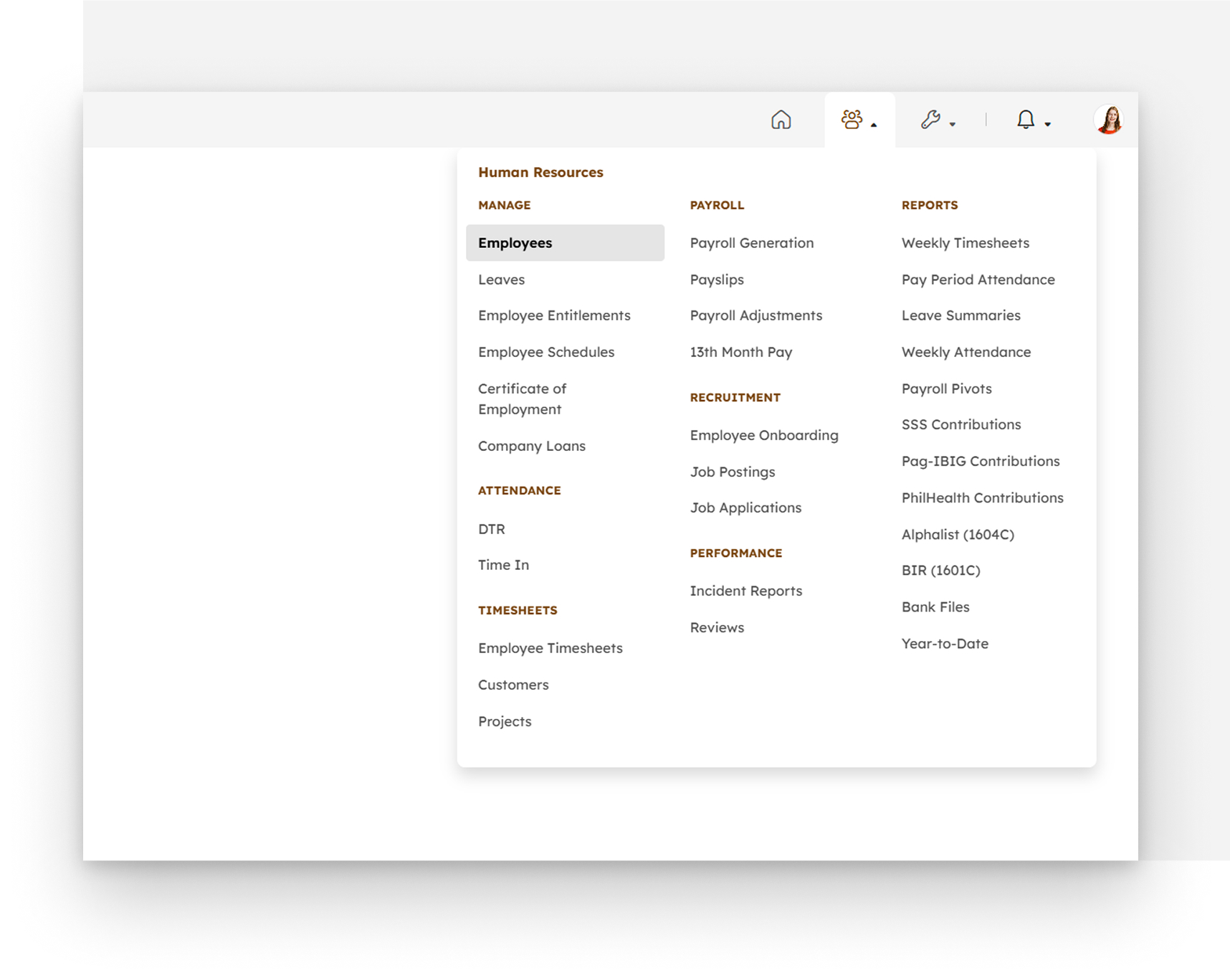
The Manage Submodule provides access to essential tools for managing employee information, schedules, and records within a single centralized platform. This submodule is designed to efficiently oversee key HR-related processes, including the maintenance of employee profiles, management of leave applications, tracking of entitlements, and organization of work schedules. It also enables the generation of certificates of employment and the monitoring of company loans, promoting a streamlined and organized HR workflow.
Definition of Terms
Defined in this section are the available pages under the Manage submodule as follows:
Employees Page. This page displays and manages all employee records, including personal details, employment information, and current status.
Leaves Page. This page allows users to view, request, and manage employee leave applications, balances, and approval statuses.
Entitlements Page. This page shows the entitlements assigned to each employee, such as leave credits and attendance types.
Employee Schedule Page. This page is used to set, view, and manage employee work schedules, including shift assignments and working hours.
Certificate of Employment. This page enables the generation of Certificates of Employment, confirming an employee’s job title, employment period, and work status.
Company Loan. This page tracks and manages loans provided by the company to employees, including loan amounts, payment schedules, and balances.
Employee Timesheets. Refers to tracking and recording the working hours and activities of individual employees within an organization. It allows employees to log and report time spent on different tasks, projects, or activities.
Roles and Permissions
Function
Administrator
HR Manager
Employee
Employees
Create Employee
check-circle
check-circle
times-circle
Edit Employee
check-circle
check-circle
times-circle
View Employee
check-circle
check-circle
times-circle
End Employment
check-circle
check-circle
times-circle
Import Employees
check-circle
check-circle
times-circle
Export Employee
check-circle
check-circle
times-circle
View Positions
check-circle
check-circle
times-circle
Create Position
check-circle
check-circle
times-circle
Edit Position
check-circle
check-circle
times-circle
View Job Position Ranks
check-circle
check-circle
times-circle
Create Job Position Rank
check-circle
check-circle
times-circle
Edit Job Position Rank
check-circle
check-circle
times-circle
Leaves
Apply Leave
check-circle
check-circle
check-circle
Apply on Behalf
check-circle
check-circle
check-circle
Edit Leave
check-circle
check-circle
check-circle
Cancel Leave
check-circle
check-circle
check-circle
Approve Leave
check-circle
check-circle
times-circle
Reject Leave
check-circle
check-circle
times-circle
View Holidays
check-circle
check-circle
times-circle
Create Holiday
check-circle
check-circle
times-circle
Edit Holiday
check-circle
check-circle
times-circle
Activate/Deactivate Holiday
check-circle
check-circle
times-circle
View Leave Types
check-circle
check-circle
times-circle
Create Leave Type
check-circle
check-circle
times-circle
Edit Leave Type
check-circle
check-circle
times-circle
Activate/Deactivate Leave Type
check-circle
check-circle
times-circle
Entitlements
Assign Attendance Entitlements
check-circle
check-circle
times-circle
Assign Leave Entitlements
check-circle
check-circle
times-circle
Activate/Deactivate Entitlements
check-circle
check-circle
times-circle
Employee Schedules
Create Schedule
check-circle
check-circle
times-circle
Edit Schedule
check-circle
check-circle
times-circle
Assign Schedule
check-circle
check-circle
times-circle
Delete Assigned Schedule
check-circle
check-circle
times-circle
Certificate of Employment
Request COE
check-circle
check-circle
check-circle
Issue COE
check-circle
check-circle
times-circle
Approve COE
check-circle
check-circle
check-circle
Send COE
check-circle
check-circle
check-circle
Preview COE PDF
check-circle
check-circle
check-circle
info-circle
Roles and Permissions
Flexibly enhance access control and refine user privileges by effortlessly adding and configuring additional roles and permissions. This aligns system functionality with the organizational structure and security requirements, ensuring that users have appropriate levels of access and responsibilities.
To do so, contact [email protected]
Employees
Introduction to Employees Page
This page manages the list of employees within the company. It serves as a centralized repository of employee information and provides an overview of the workforce.
The overall function of this page is to manage employee information such as personal details, employment status, job title, department, salary history, and reporting structure.
To access this page, navigate to the Human Resources Module by selecting 'Employees' under the Manage Submodule, as shown in the image below.
Employees Page Features
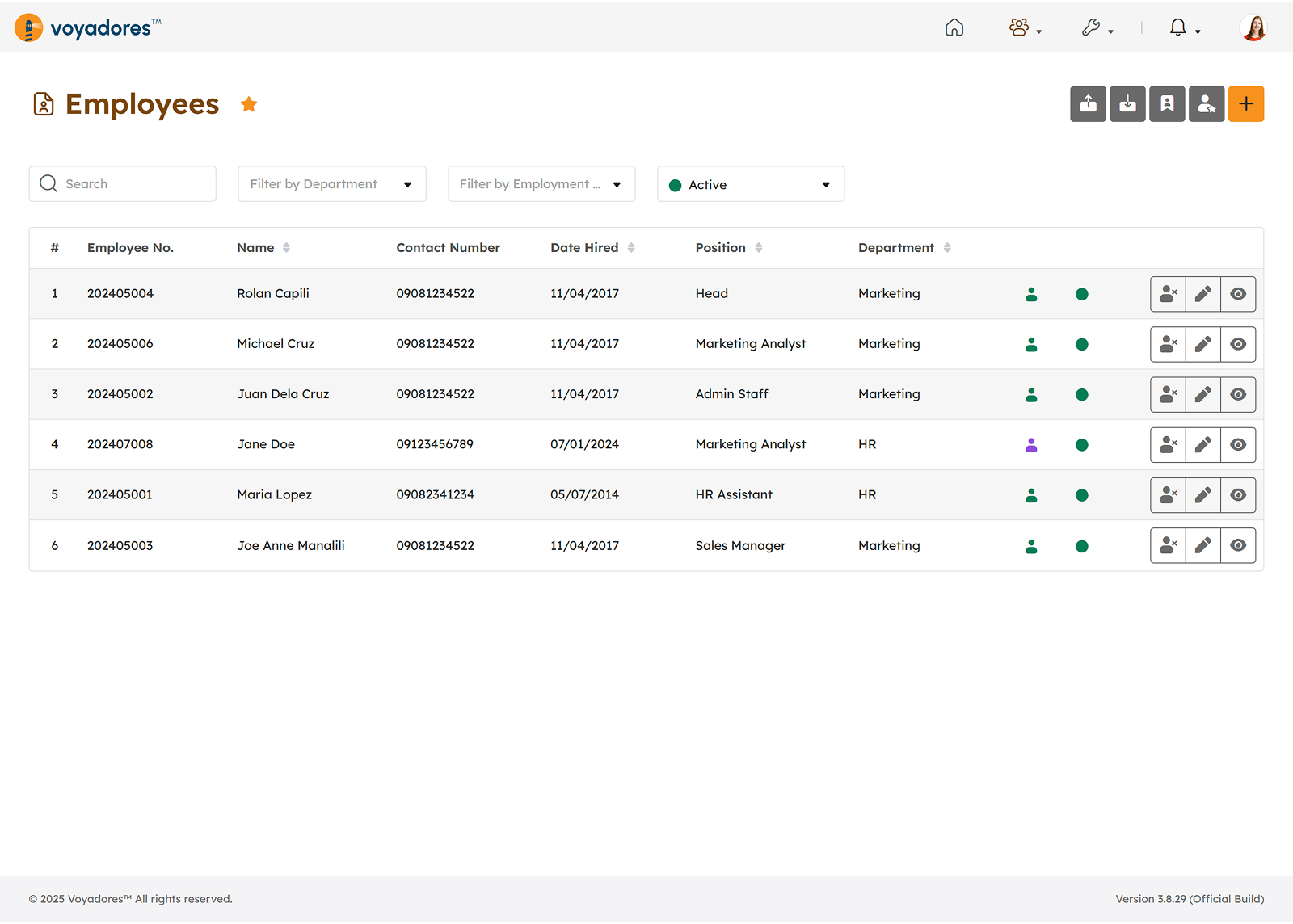
The snip below provides a high-level view of the Employees page along with its built-in features.
Employees Page Header Actions
home-dash
Set as Default Page
star
Add to Quick Links
plus
Create Employee
user-star
View Job Position Ranks
bookmark-user
View Positions
Preview Employees
upload
Import Employees
Employees Summary Table
The summary table displays the list of employees with the following columns:
Employee No.
Name
Contact Number
Date Hired
Position
Department
Employee Type
Status
Actions
user-times End Employment
pen Edit Employee
eye View Employee
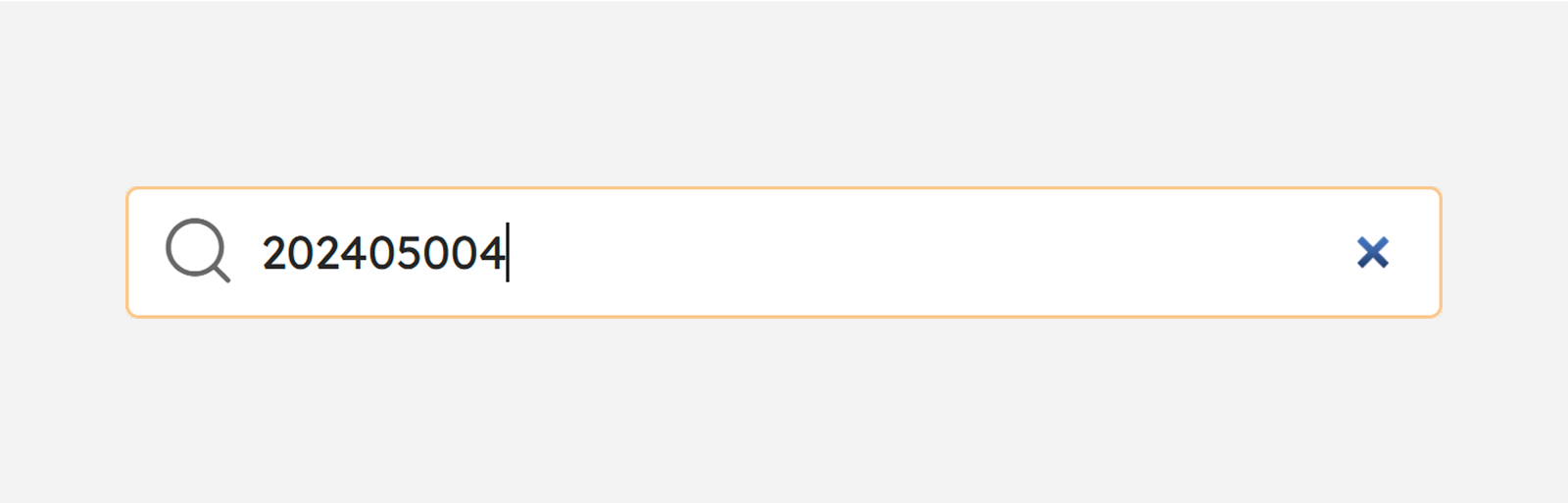
Search Employee by Employee No.
To search for a particular employee by Employee No., enter the Employee No. in the search bar as shown in the snip below:
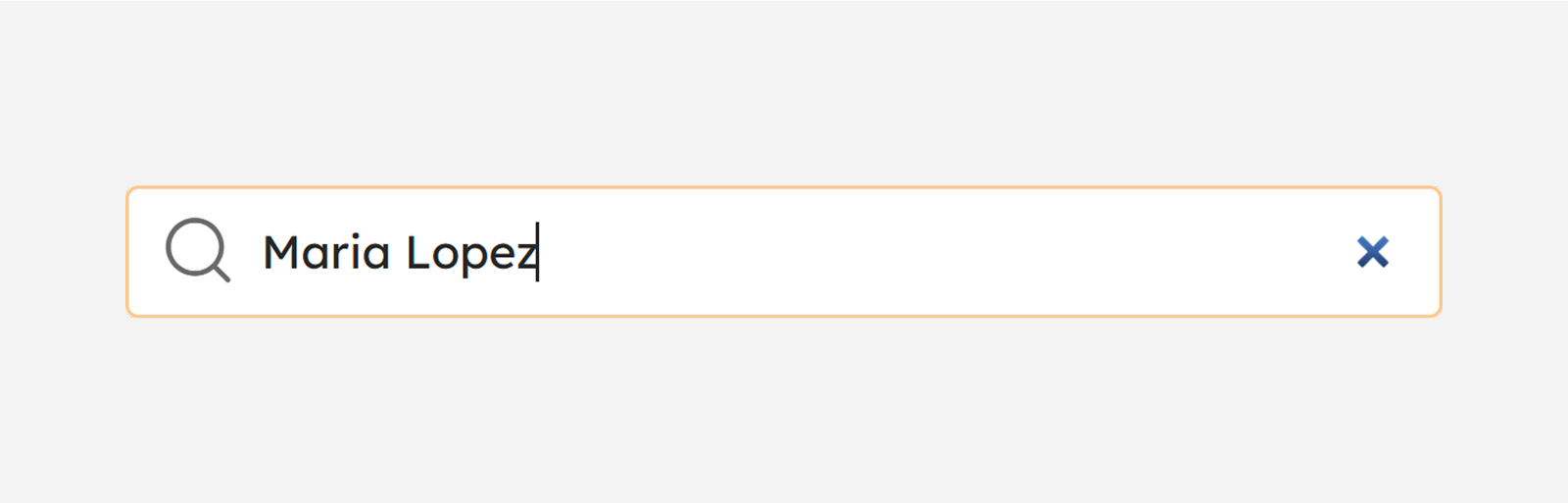
Search Employee by Employee Name
To search for a particular Employee by Name, key in the Employee first name or last name in the Search Bar as shown in the snip below:
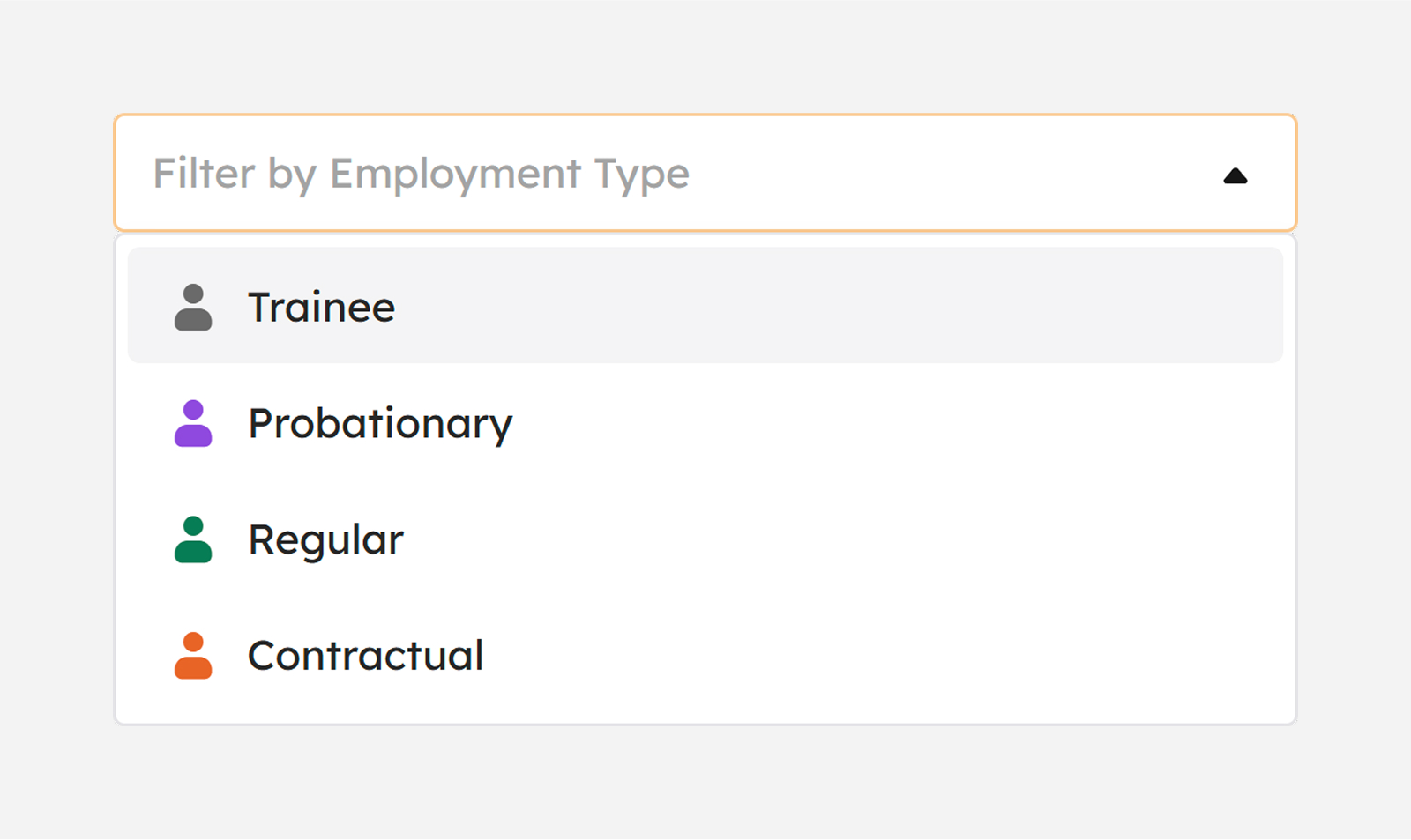
Filter Employees by Employment Status
This feature gives the option to filter Employees by Employments Status.
Trainee. This temporary position indicates that the employee is currently undergoing a training period.
Probationary. This is a temporary employment arrangement in which an employee is hired on a trial basis to assess their suitability for the job. During this period, the employee's performance is measured and evaluated.
Regular. This is a permanent employment status, and an employee who has this status is entitled to the rights and benefits associated with regular employment.
Contractual. This is a fixed-term or project-based employment arrangement, where an employee is hired for a specific duration or task as defined by company policy or applicable labor regulations.
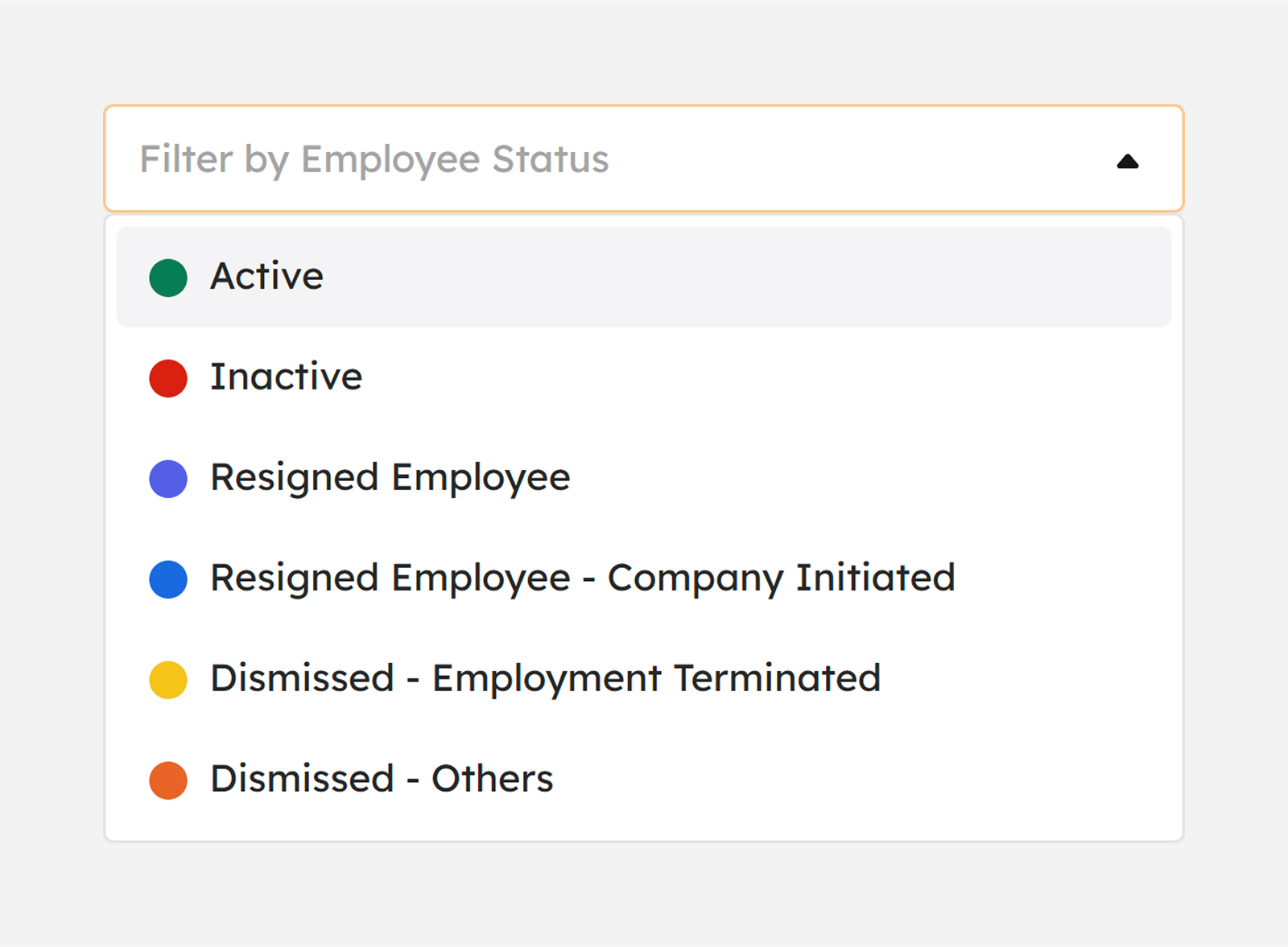
Filter Employees by Status
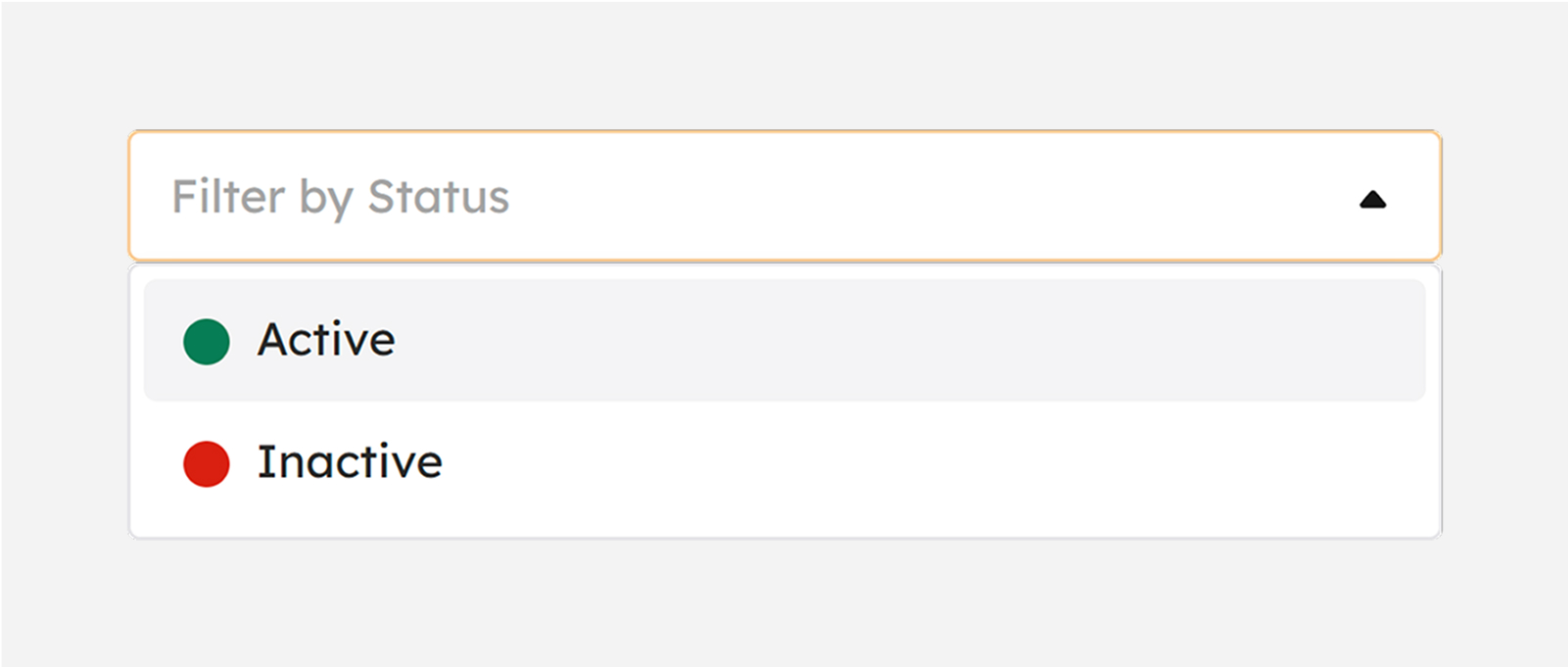
This feature gives the option to filter employees by status.
Active. This green-colored status indicates employees who are currently active in the system. The "Active" option can be selected from the status drop-down filter to display records of employees with active employment status.
Inactive. This red-colored status indicates employees who are no longer active in the system. The "Inactive" option is available in the status drop-down filter to display records of employees with inactive employment status.
Resigned Employees. This dark blue-colored status displays a list of all employees who have voluntarily resigned from their positions. To view these records, select "Resigned Employees" from the "Filter by Status" drop-down menu.
Resigned Employees (Company Initiated). This light blue-colored status represents employees whose resignations were initiated by the company. It indicates that the organization has requested or required the employee to resign from their position, resulting in the termination of their employment. The corresponding records can be viewed by selecting this status from the drop-down filter.
Dismissed (Employment Terminated). This yellow-colored status represents employees whose employment was terminated by the company. It indicates that the affected individuals either failed to meet job expectations or were dismissed due to misconduct. Records associated with this status can be viewed by selecting the corresponding option from the drop-down filter.
Dismissed (Others). This orange-colored status represents employees whose employment was terminated for various reasons not directly related to performance issues, misconduct, or redundancy. Records associated with this status can be accessed by selecting the corresponding option from the drop-down filter.
Create List of Employee
Click the plus Create button.
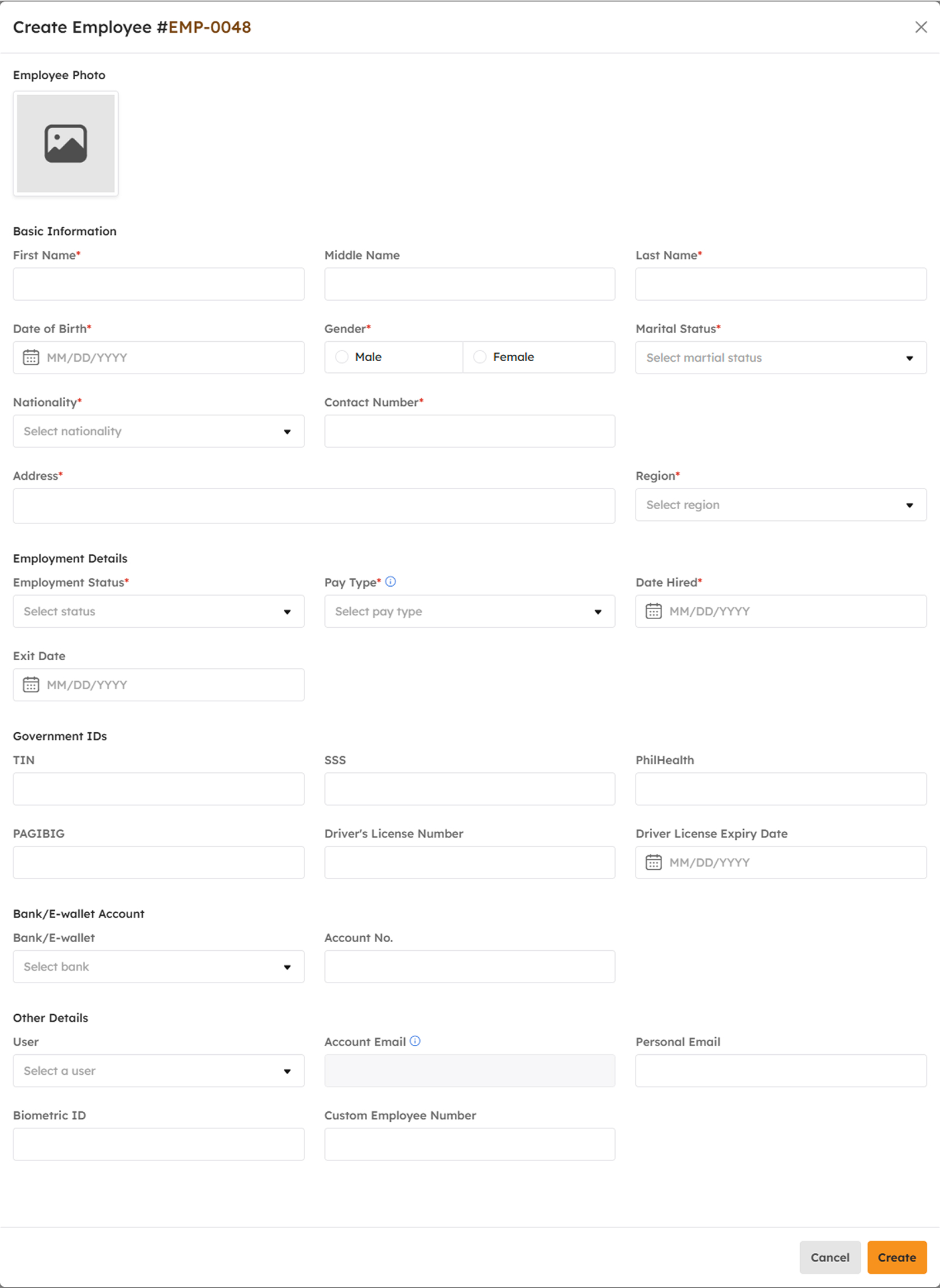
Fill in Employee details.
Basic Information
First Name
Middle Name
Last Name
Date of Birth
Gender
Marital Status
Nationality
Contact Number
Address
Region
Employment Details
Employment Status
Pay Type
Date Hired
Exit Date
Government IDs
TIN
SSS
PhilHealth
PAGIBIG
Driver’s License Number
Driver’s License Expiry Date
Bank/E-wallet Account
Bank/E-wallet
Account No.
Other Details
User
Account Email
Personal Email
Biometric ID
Custom Employee Number
exclamation-circle
Note
Fields with (*) are required.
Click the Create button.
A successful notification will show.
Employee successfully created
Step 3 will successfully create new employee otherwise, proceed to Step 6.
Click the Cancel button to cancel the creation of Employee.
The screen closes the modal.
The system will not create nor save the employee information.
Edit Employee Information
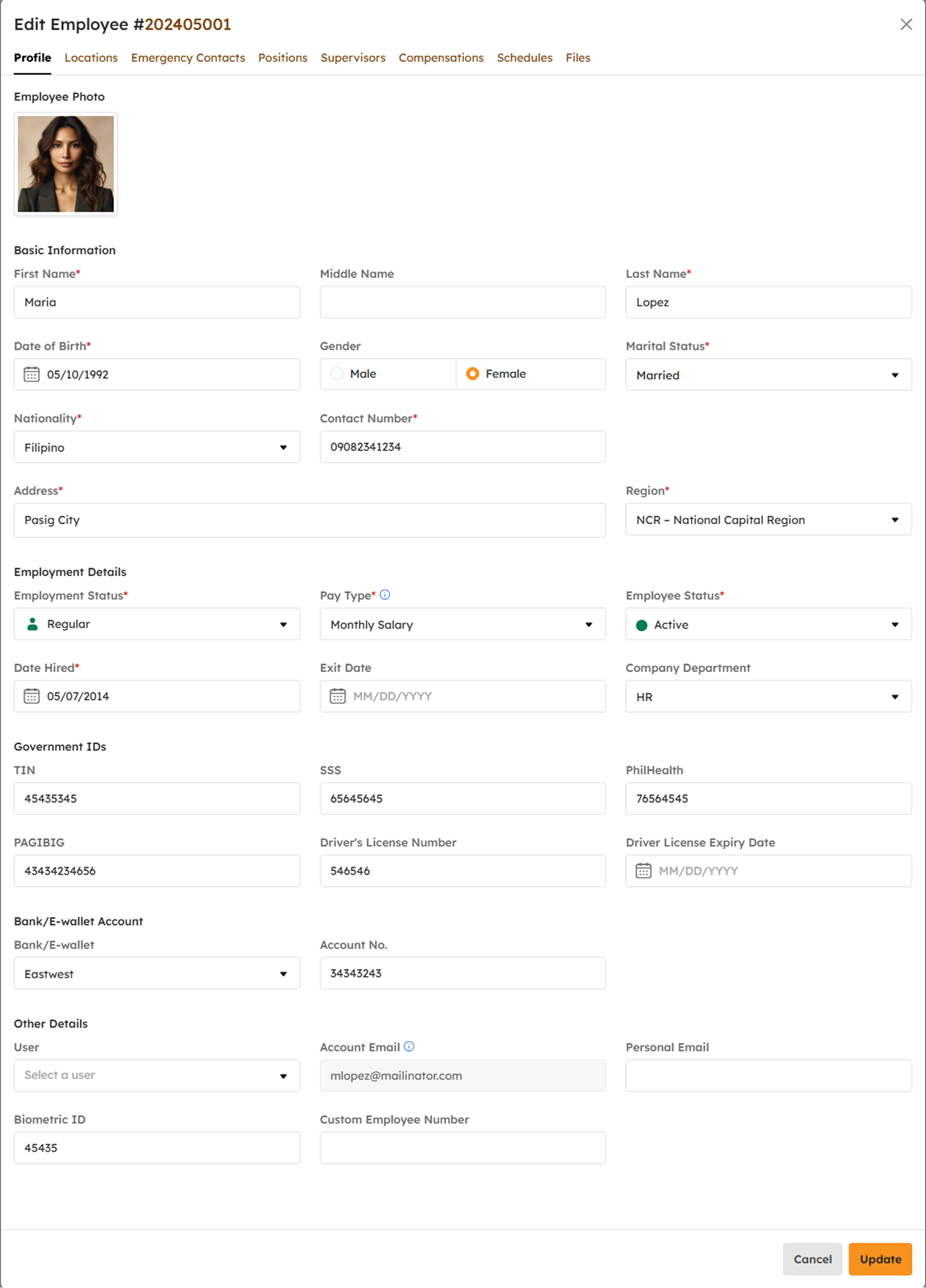
Click the pen Edit button.
Fill in Employee details.
Basic Information
First Name
Middle Name
Last Name
Date of Birth
Gender
Marital Status
Nationality
Contact Number
Address
Region
Employment Details
Employment Status
Pay Type
Date Hired
Exit Date
Government IDs
TIN
SSS
PhilHealth
PAGIBIG
Driver’s License Number
Driver’s License Expiry Date
Bank/E-wallet Account
Bank/E-wallet
Account No.
Other Details
User
Account Email
Personal Email
Biometric ID
Custom Employee Number
exclamation-circle
Note
Fields with (*) are required.
Click the Update button.
A successful notification will show:
Employee successfully updated
Step 3 will successfully update Employee information otherwise, proceed to Step 6.
Click the Cancel button to cancel updating Employee information.
The screen closes the modal.
The system will not create nor save the employee information.
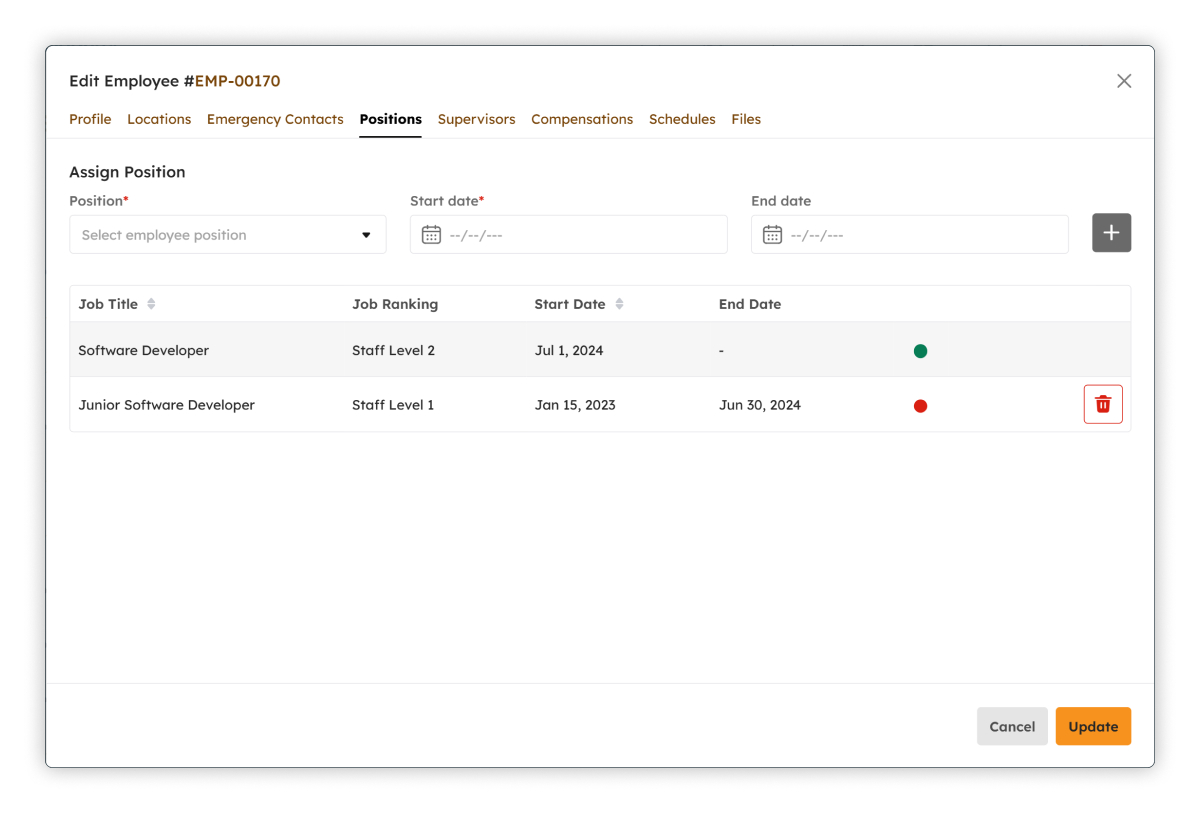
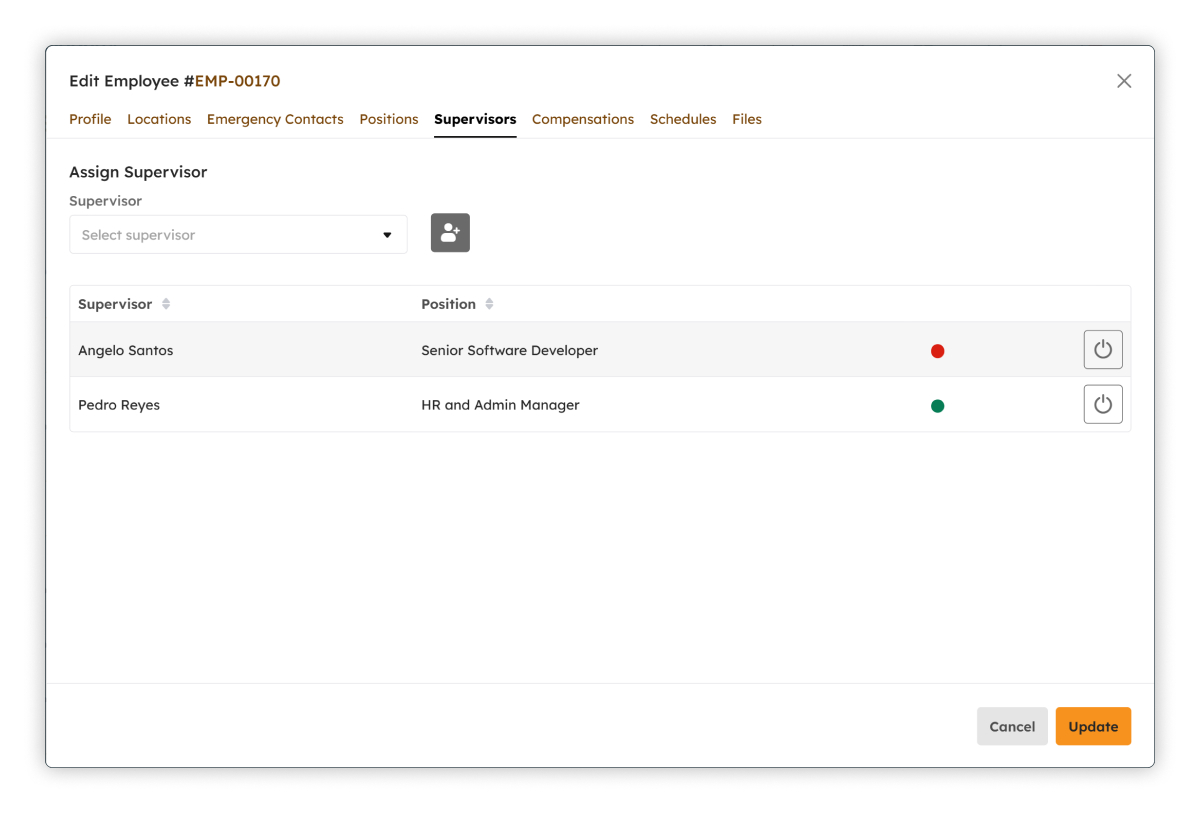
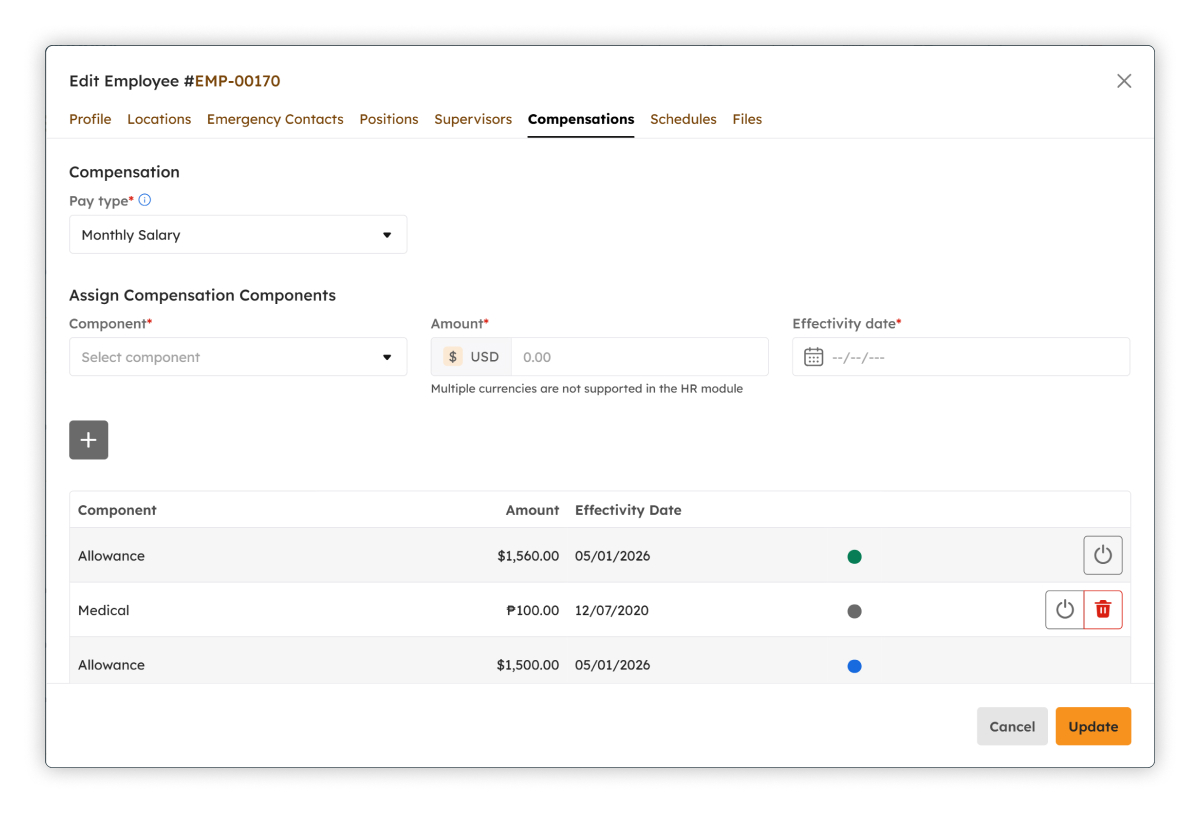
In Edit Employee, users can also add the following information below:
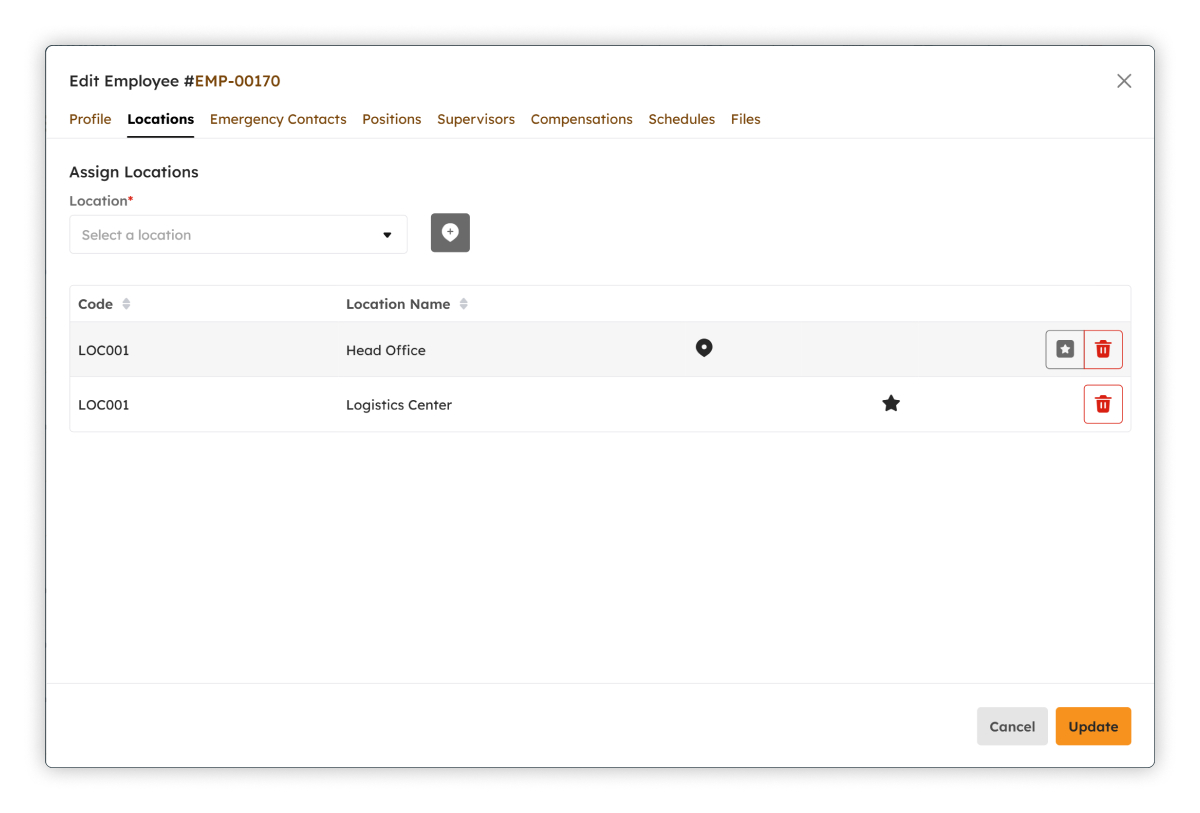
Locations. Selecting a location from the dropdown then clicking location-pin-plus will allow the user to add a location.
The user can also click star-square to set a Default Location and trash to delete a location.
Emergency Contacts. After filling up the required fields, the user can click user-plus to add an emergency contact.
Positions. After filling up the required fields, the user can click plus to add a position.
The user can also click trash to delete an inactive position.
Supervisors. Selecting an employee from the dropdown then clicking plus will allow the user to add a supervisor.
The user can also click power-off to activate or deactivate a supervisor.
Compensations. After filling up the required fields, the user can click plus to add a compensation
The user can also click power-off to activate or deactivate a compensation and trash to delete it.
Schedules. The user can click eye to view the employee's working hours.
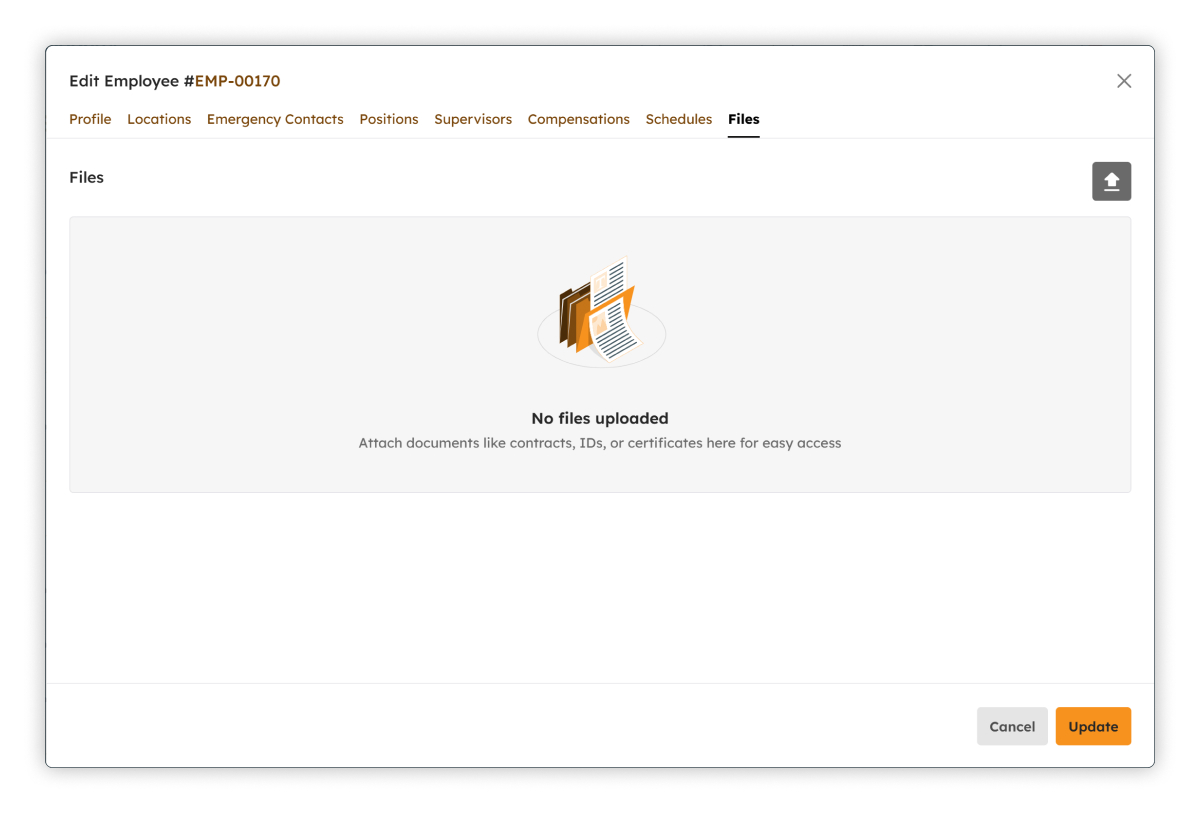
Files. To attach documents like contracts, IDs, or certificates, the user can simply click upload-alt.
Import Multiple Employee Information
Click the upload Import button.
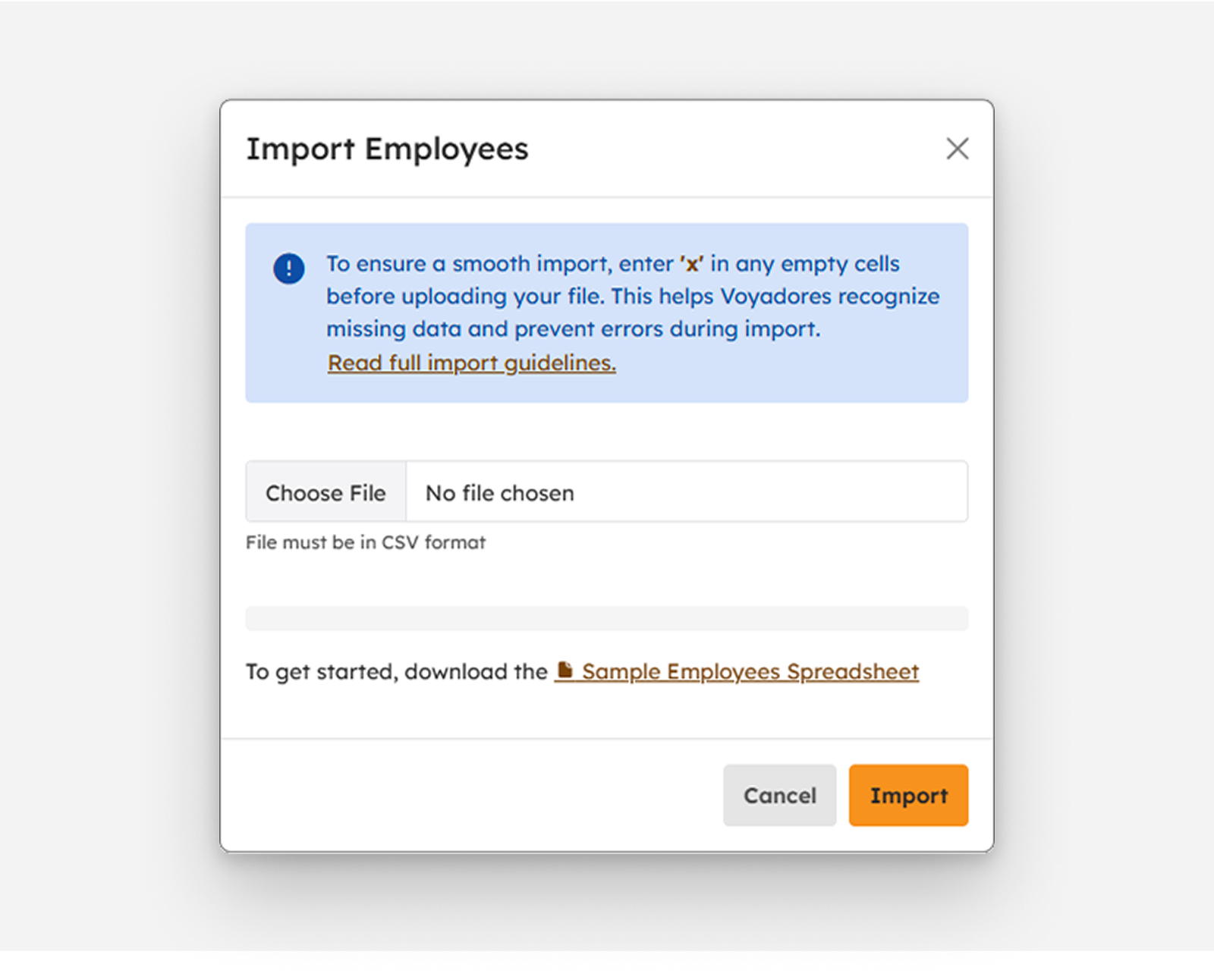
The screen displays a modal below to begin importing multiple employees' information.
In the import modal, click Choose File and select the file to be imported.
Click the Import button to successfully import the file.
A successful notification message will show:
Employees successfully imported
Step 4 will successfully import the file otherwise, proceed to Step 7.
Click the Cancel button to cancel the import of Employees.
The screen closes the modal.
The system will not continue uploading the import file.
Download List of Employees
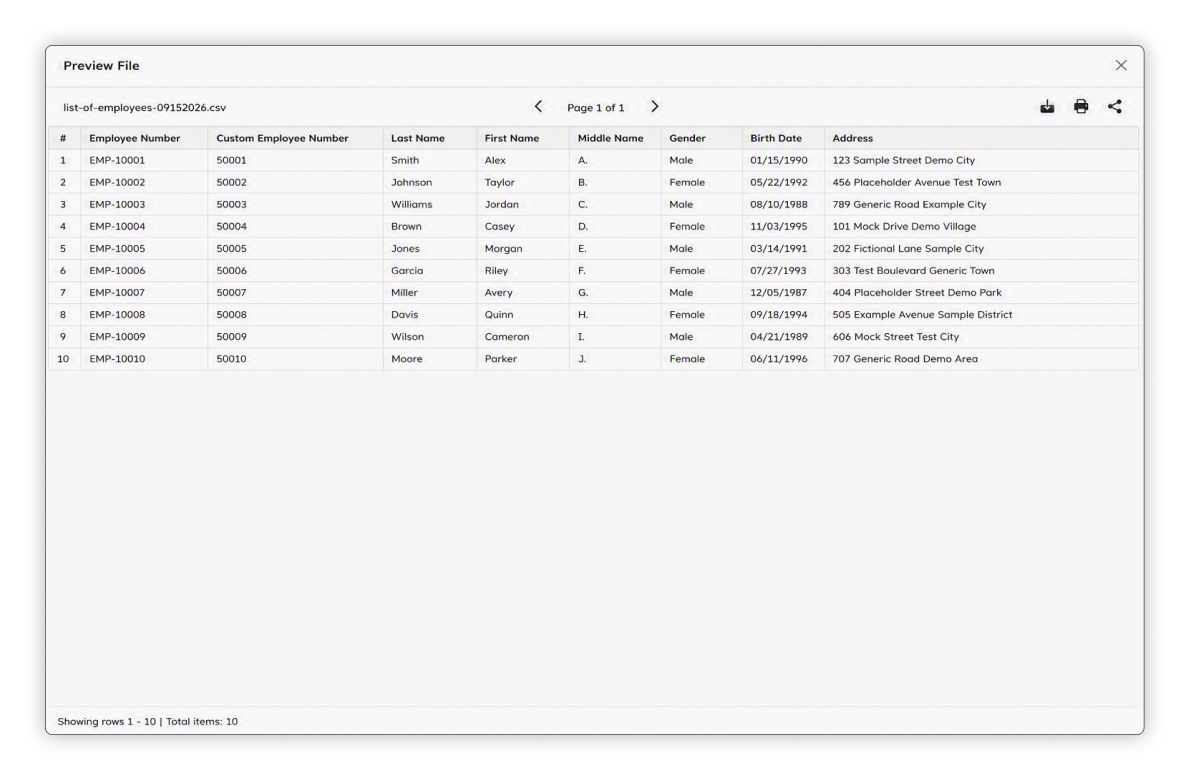
Click the to open the Employee Preview Report modal.
Click download to download the list of employees in a .csv file.
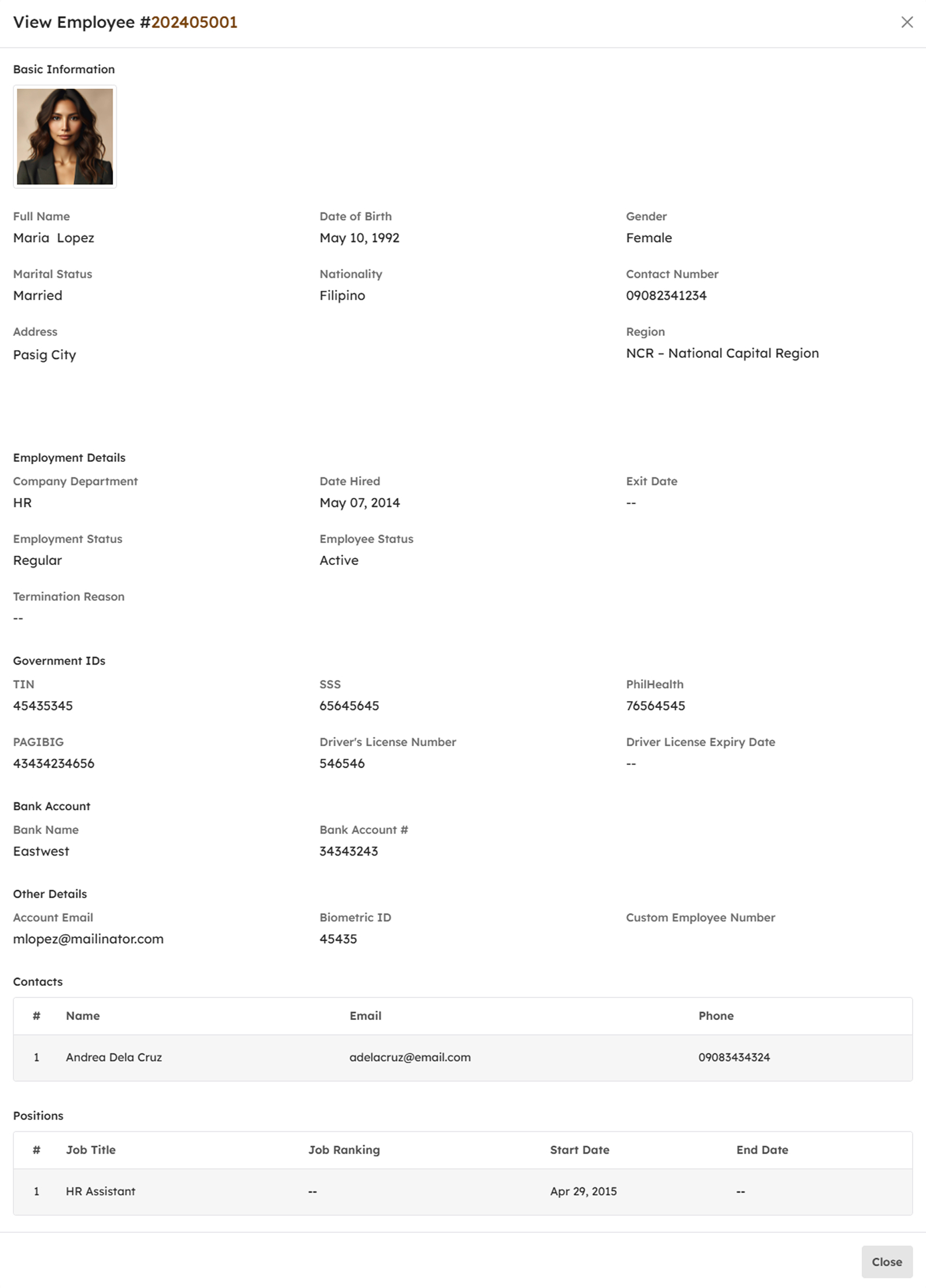
View Employee Information
Click the eye View button.
The screen displays a modal below that shows the Employee Information:
Basic Information
Employment Details
Government IDs
Bank or E-Wallet Account
Other Details
Emergency Contacts
Positions
Supervisors
Compensations
Schedules
Files
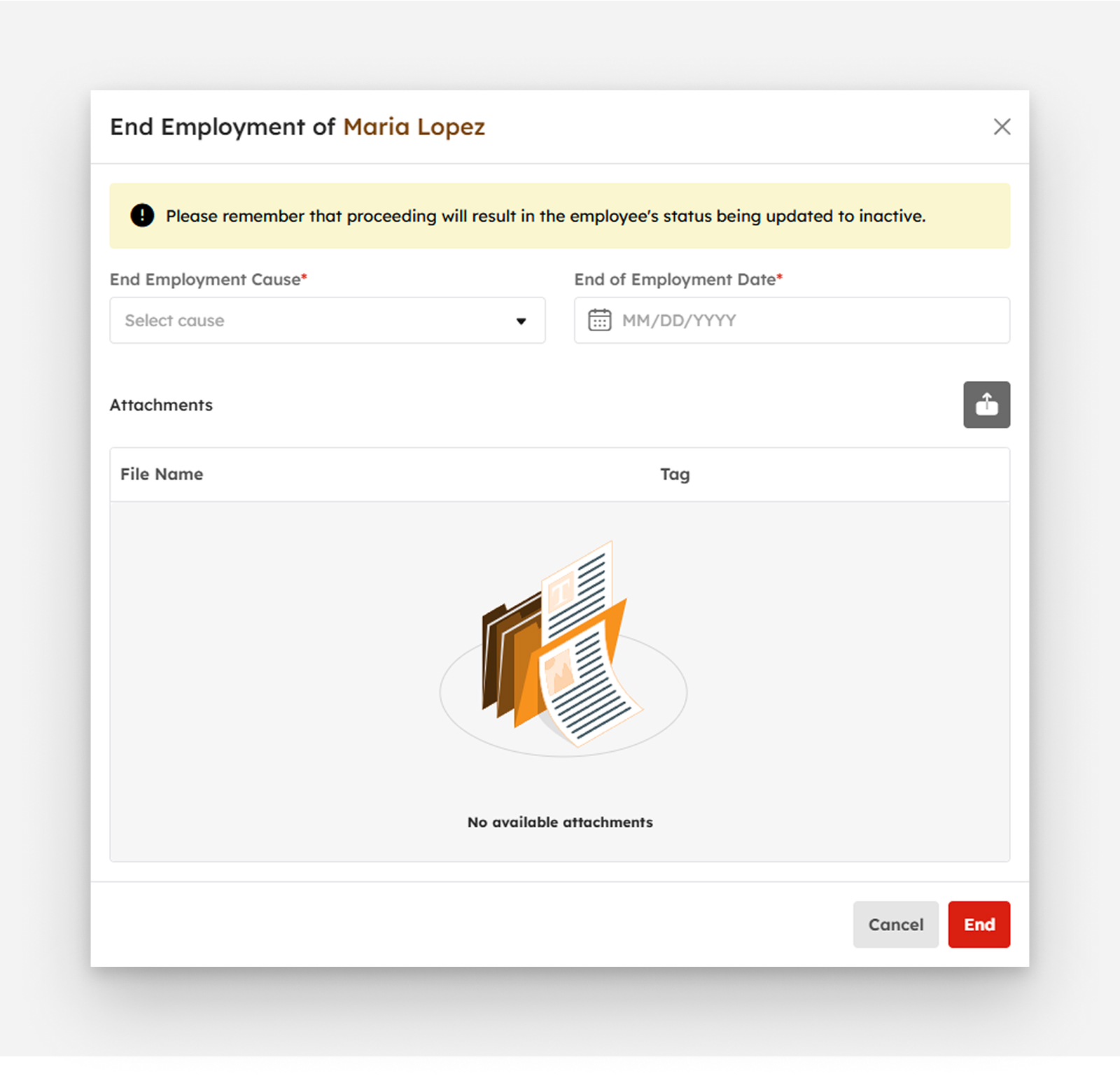
End Employment
Click the user-times End Employment button.
Fill in the required details
Employment end reason
Last working day
upload Upload Attachment if applicable
Click the End Employment button.
A successful notification message will show:
Employee's employment has successfully ended
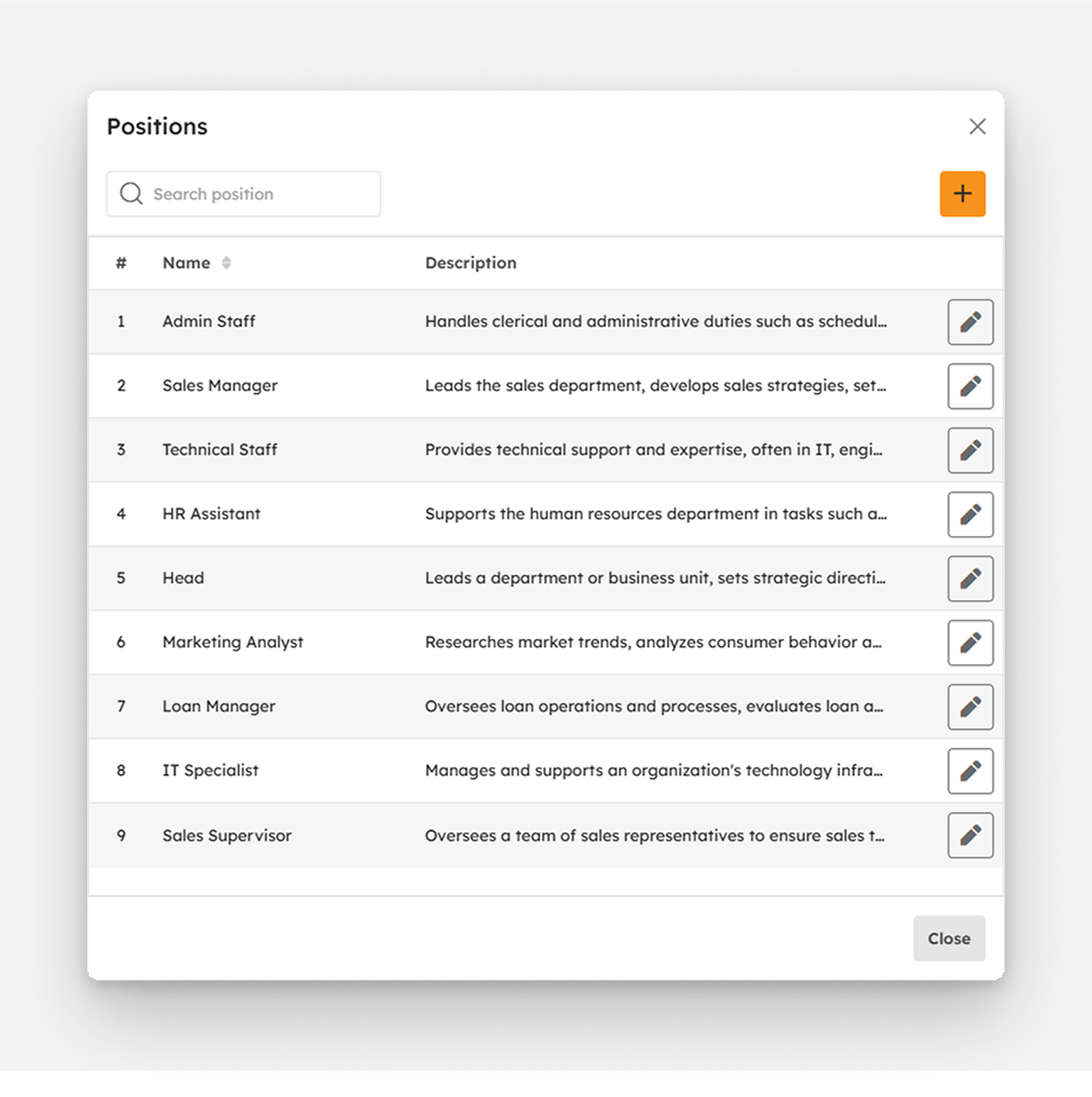
Positions
To view positions, click bookmark-user.
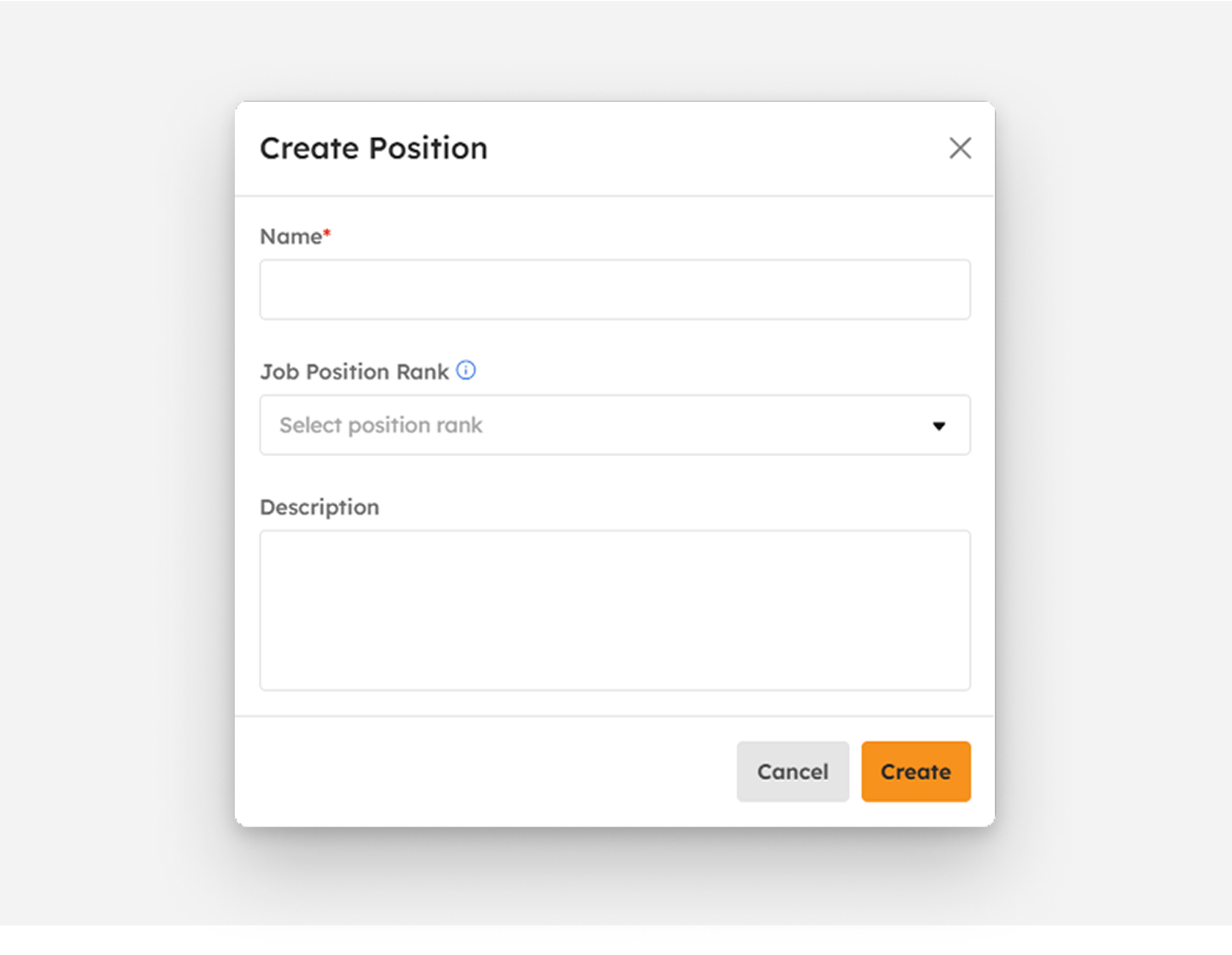
To create positions, click plus button.
Fill in the required details and click Create to save the new position and Cancel to discard changes.
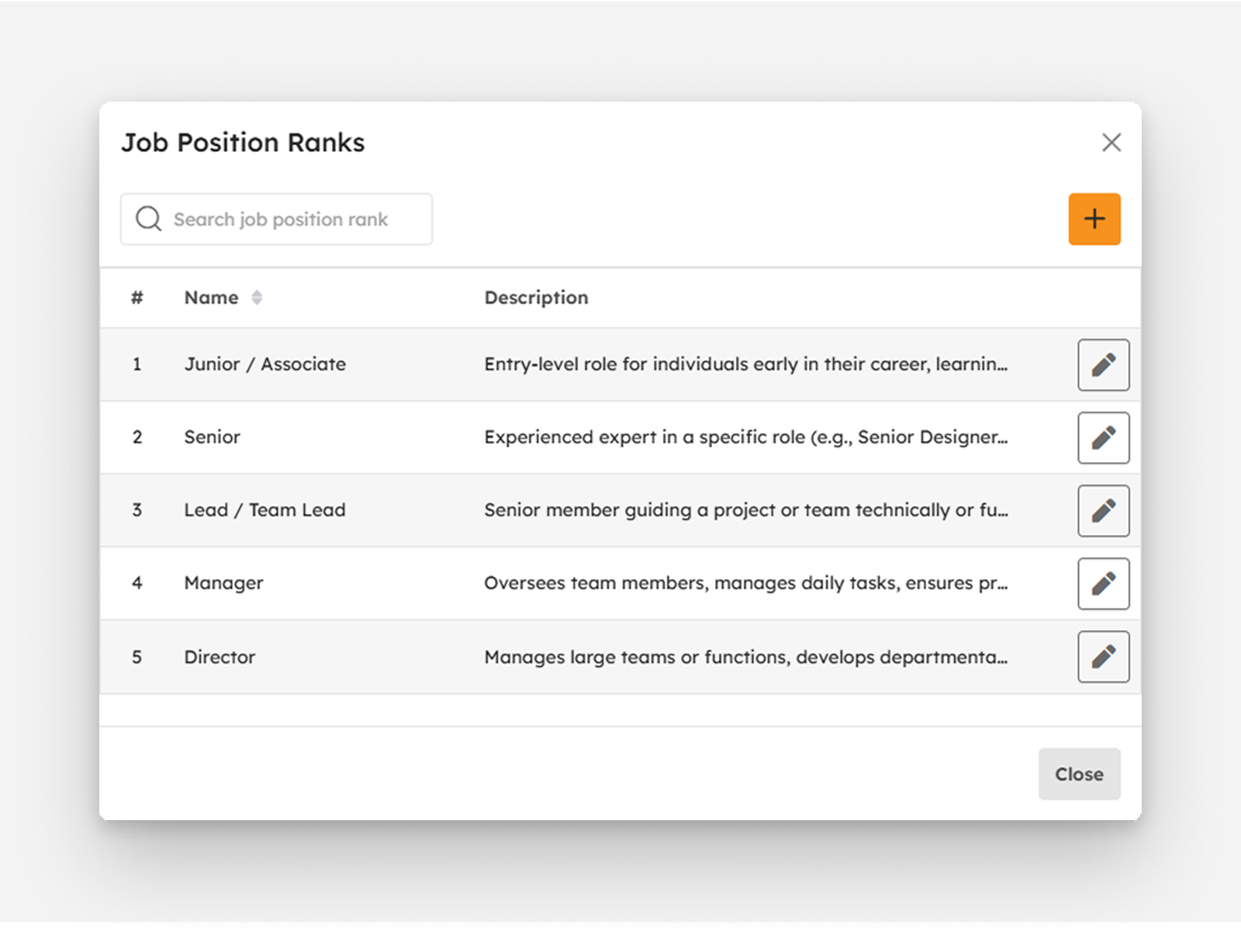
Job Position Ranks
To view Job Position Ranks, click user-star.
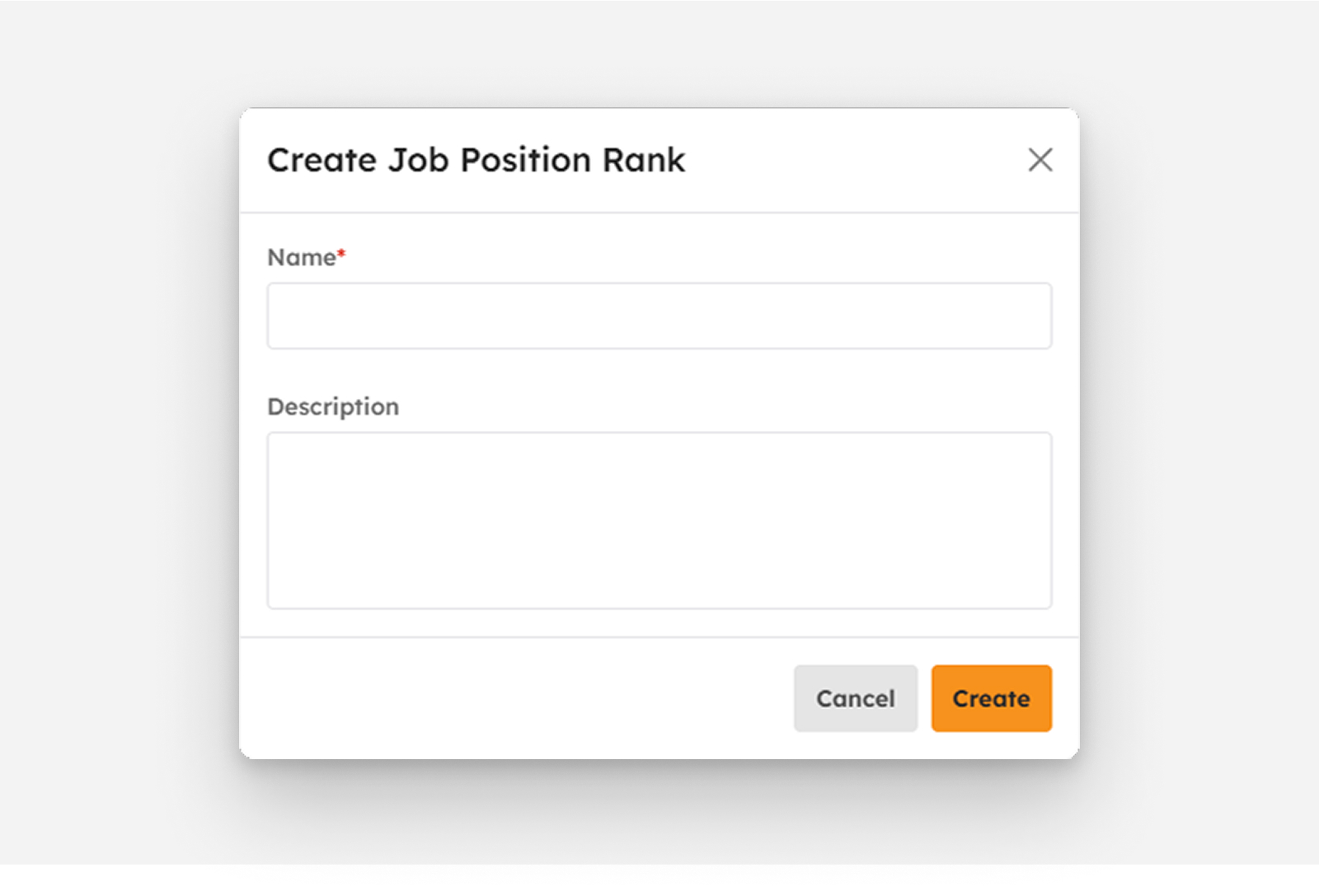
To create a position rank, click plus button.
Fill in the required details and click Create to save the new Job Position Rank and Cancel to discard changes.
Leaves
Introduction to Leaves Page
This page manages the leave-related information and activities of employees within the company. It serves as a centralized platform for configuring leave policies and handling employee leave applications.
The overall function of this page is to manage holidays, define leave types, and process leave requests. It also allows users to apply for leaves on behalf of employees, ensuring efficient and organized leave tracking across the organization.
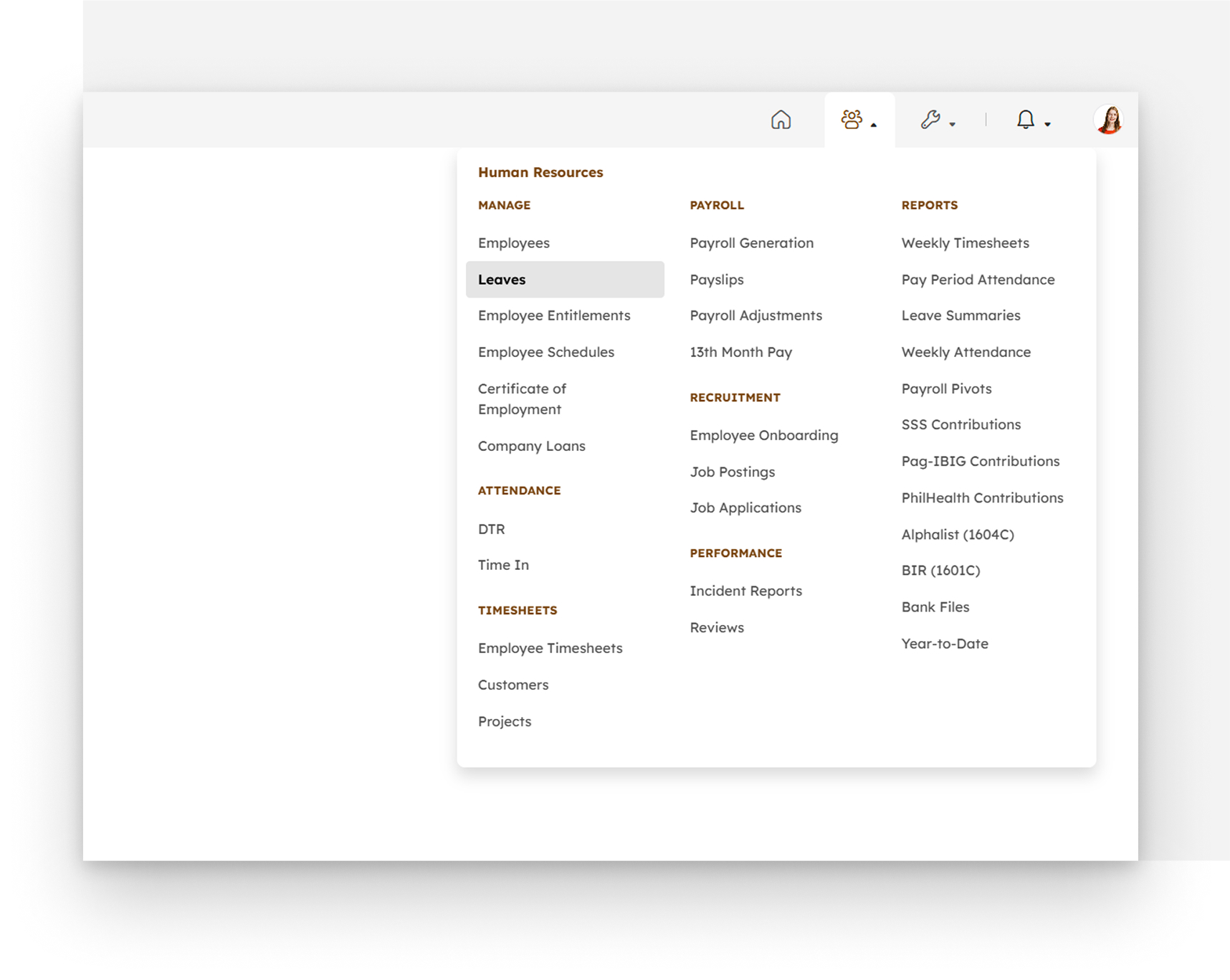
To access this page, navigate to the Human Resources Module by selecting 'Leaves' under the Manage Submodule, as shown in the image below.
Leaves Page Features
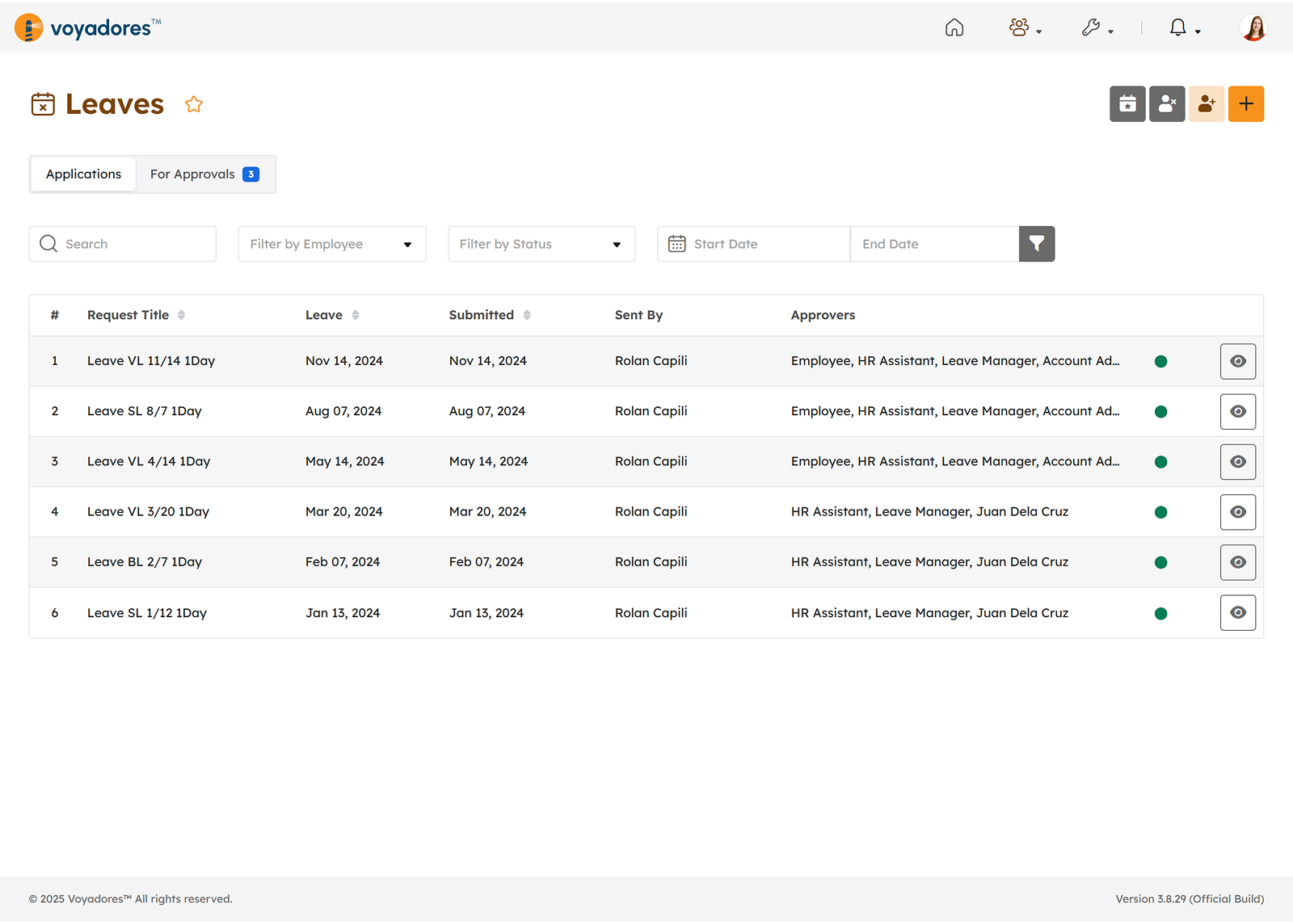
The snippet below presents an overview of the Leaves page, where the Applications tab is currently active. The page features two functional tabs: Applications and For Approval.
Leave Page Header Actions
home-dash
Set as Default Page
star
Add to Quick Links
plus
Apply for Leave, Apply Leave on Behalf
calendar-star
View Holidays
Preview Report
Leave Applications Summary Table
The Applications tab contains a summary table that displays all submitted leave applications. The table includes the following columns:
Request Title
Leave
Submitted
Sent By
Approvers
Status
Actions
eye View Leave
ban Cancel Leave
pen Edit Leave
Load More Employee Leave under Applications
If there are more than 20 leave requests on the list, click the arrows-repeatLoad More button to display other leaves since the default item number displayed on the screen is from count 1 to 20.
Search Records of Leaves
To search for a leave, follow the steps below:
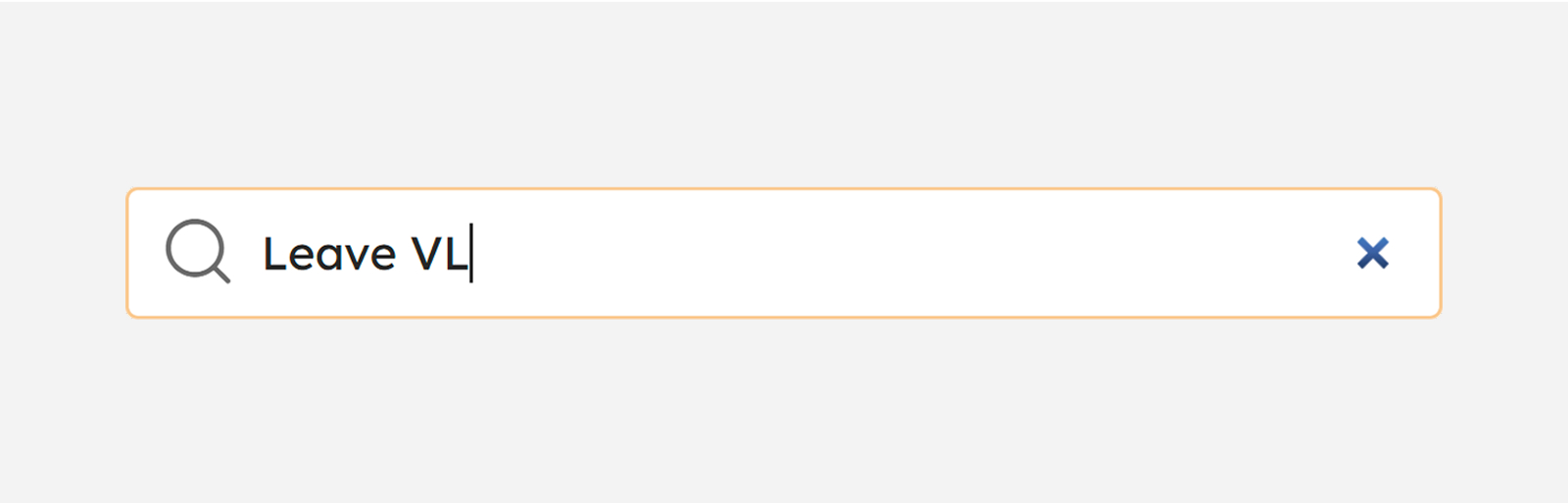
Key in the name of the leave record in the Search Bar as shown in the snip below:
The Summary Table will display the searched leave title.
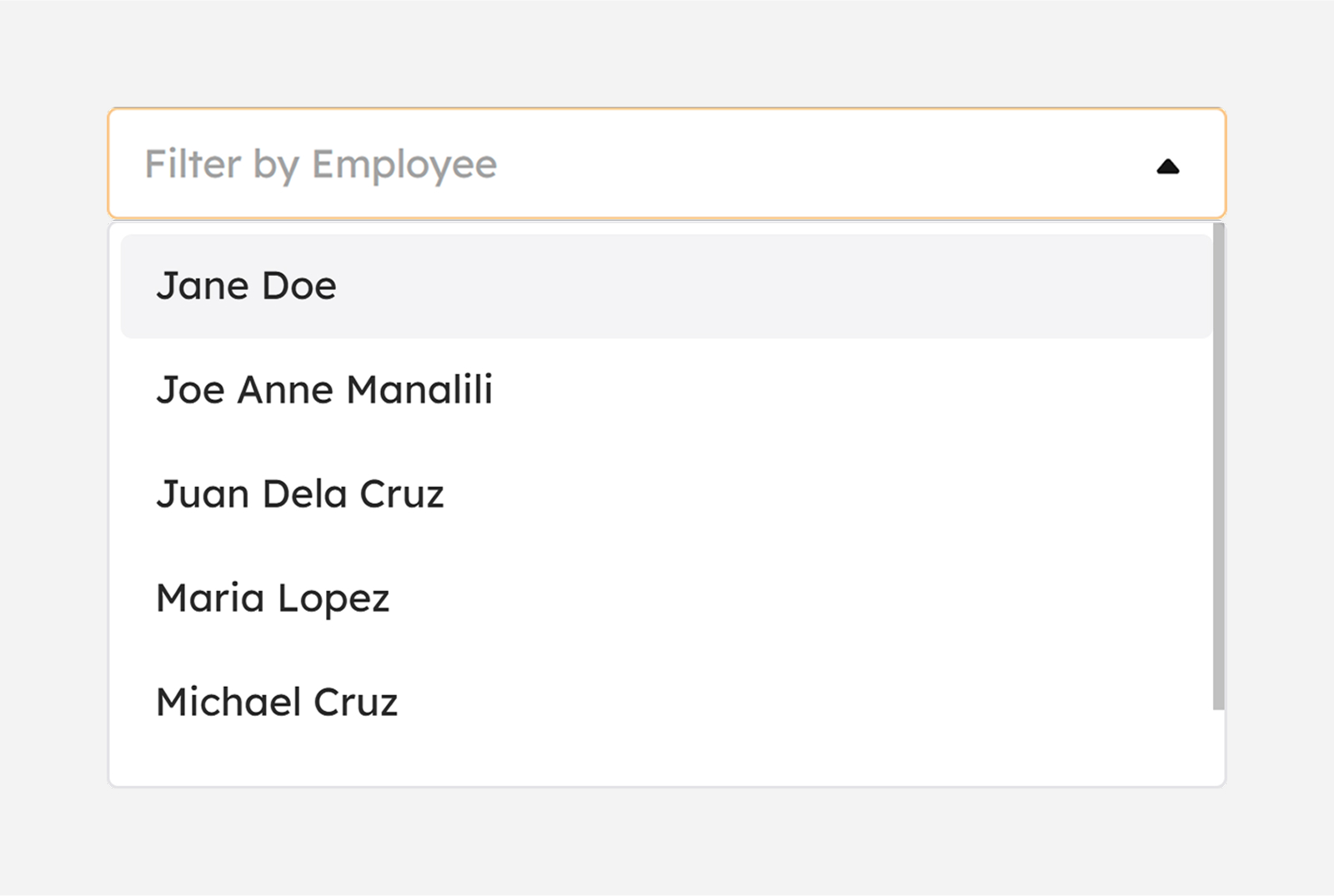
Filter Leaves by Employee Name
This feature is to filter Leaves by employee name.
Filter Leaves by Status
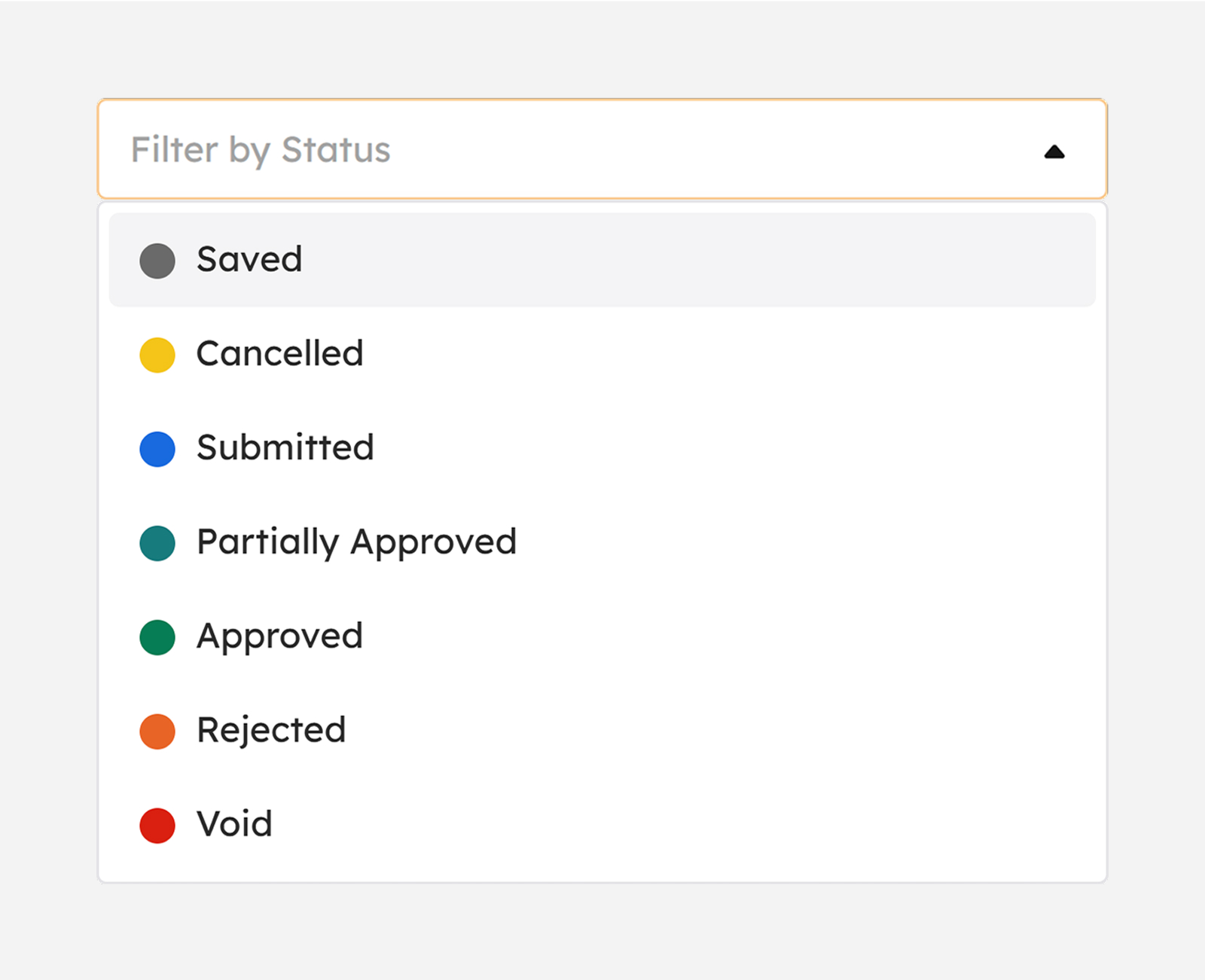
This feature is to filter Leaves by status.
Saved. This gray-colored status shows all saved Leave requests. Leaves with this status are still editable for submission. To display all saved Leaves, click the filter by status drop-down and select “Saved”.
Cancelled. This yellow-colored status shows all cancelled leaves. To display all cancelled Leaves, click the filter by status drop-down and select “Cancelled”.
Submitted. This blue-colored status shows all submitted Leaves. Submitted Leaves are not editable unlike saved Leaves. To display all submitted Leaves, click the filter by status drop-down and select “Submitted”.
Partially Approved. This light-green-colored status shows all partially approved Leaves. This Leave status indicates that one of the Approvers had already approved the Leave request. To display all partially approved Leaves, click the filter by status drop-down and select “Partially Approved”.
Approved. This green-colored status shows all Approved Leaves. These Leaves indicate that all the Approvers approved the Leave request. To display all approved Leaves, click the filter-by-status drop-down and select “Approved”.
Rejected. This orange-colored status shows all rejected Leaves. These leaves are rejected by one of the Approvers. Click the filter-by-status drop-down and select “Rejected” to display all rejected Leaves.
Void. This dark-red-colored status shows all applied Leaves voided by one of the Approvers. To display Leaves with void status, click the filter-by-status drop-down and select “Void”.
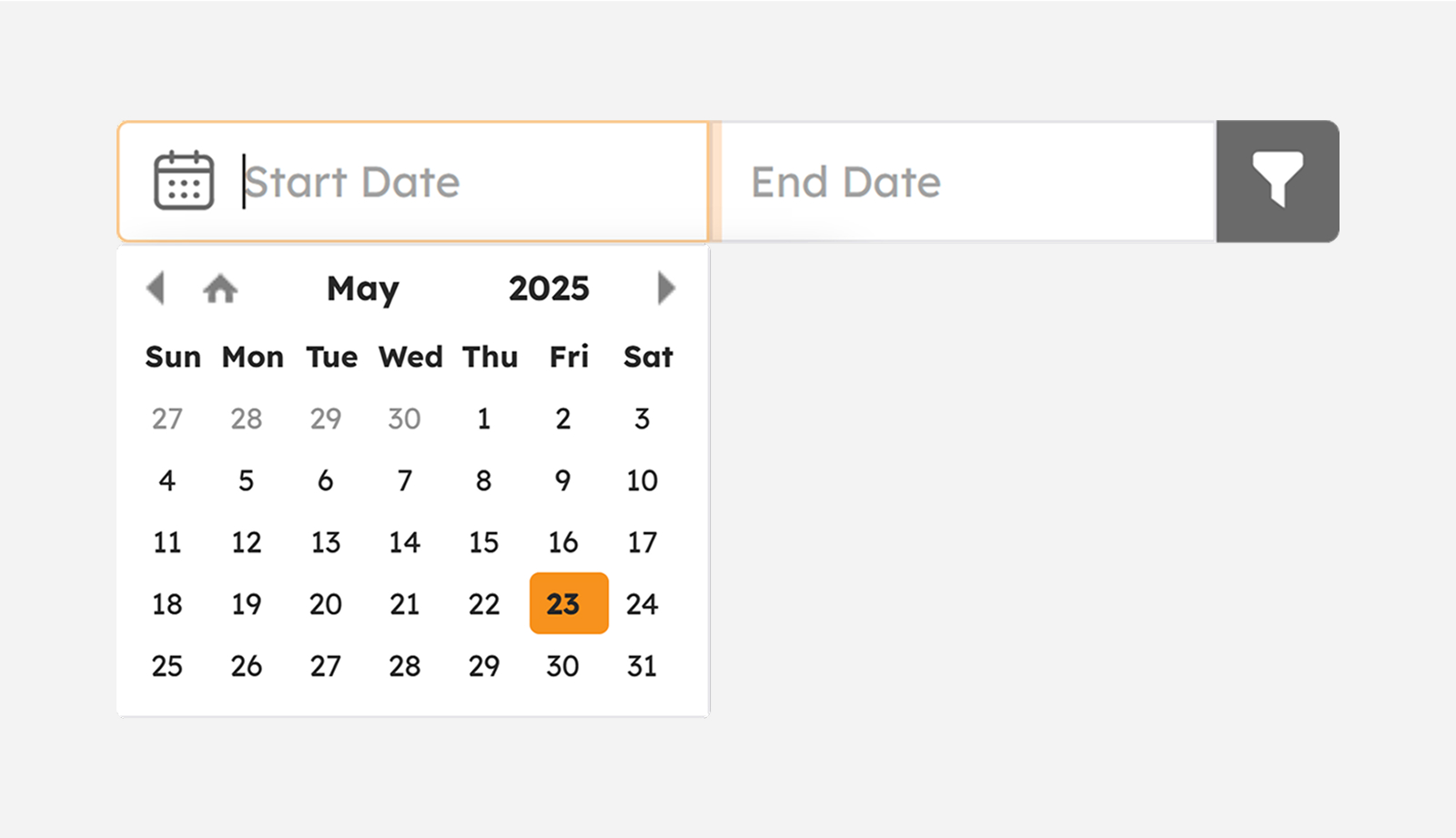
Filter Leaves by Date Range
This feature enables users to refine leave records based on a specified period. By setting the Start Date and End Date, it allows for focused tracking and review of leave applications submitted within the selected timeframe.
Apply for Leave
Follow the systematic guide below to apply/file for Leave.
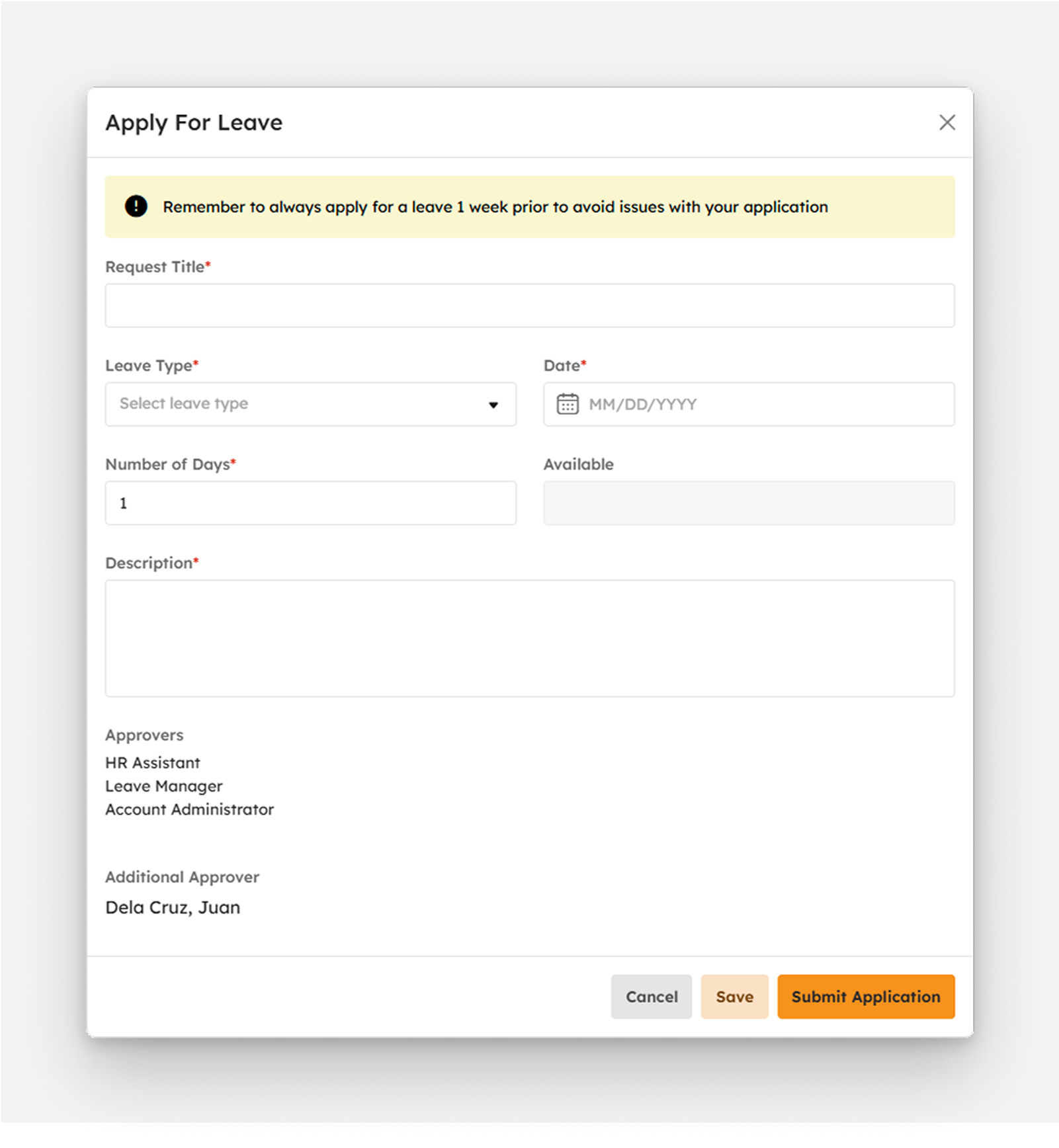
Click plus and select Apply for Leave
The list below shows all fields available in the modal. Required fields with an asterisk (*) must be completed by the user:
Request title
Leave Type
Available credits
Start date
End date
Number of days
Return date
Remarks
Approvers
Submit Leave Application
Click Submit after providing correct information in the fields mentioned above.
exclamation-circle
Note
Application is final and unchangeable after clicking the button.
Success notification message will show.
Leave successfully submitted
Successfully submitted leaves will be displayed on the Applications tab summary table with a Submitted status.
Otherwise, an error notification message will show.
Please fill the required fields
Save Leave Application
Click the Save Draft button to edit and submit the leave request later.
Success notification message will show.
Leave successfully saved
Successfully saved leaves will be displayed on the Applications tab summary table with a Saved status.
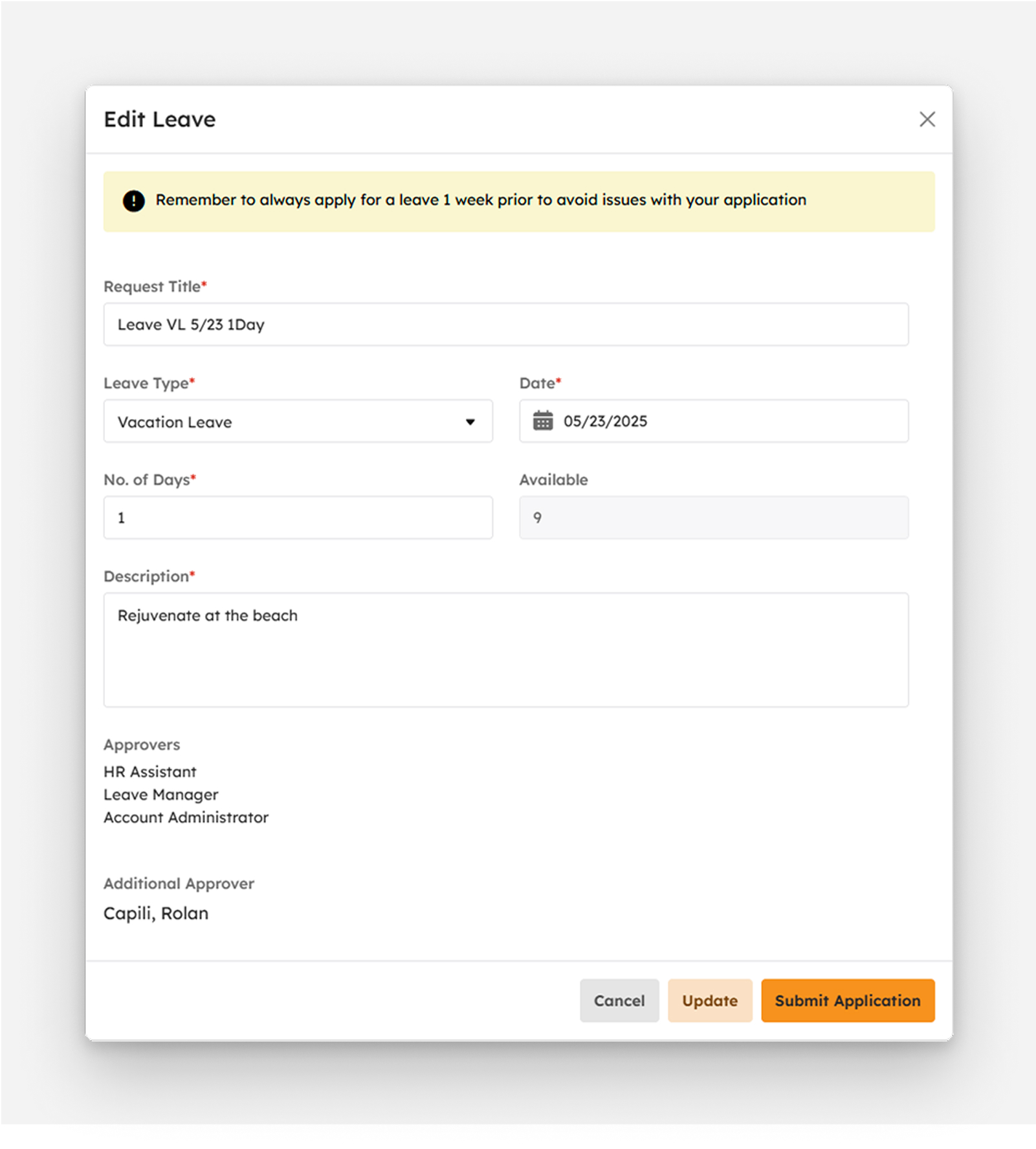
Leave applications with a Saved status are editable. To make changes, click the pen button.
The user may click Update to keep the application as a draft or Submit to submit the application.
An error notification message will show if the user failed to fill in the required fields:
Please fill the required fields
Cancel Leave Application
Click the Cancel button to close the form without submitting the leave application.
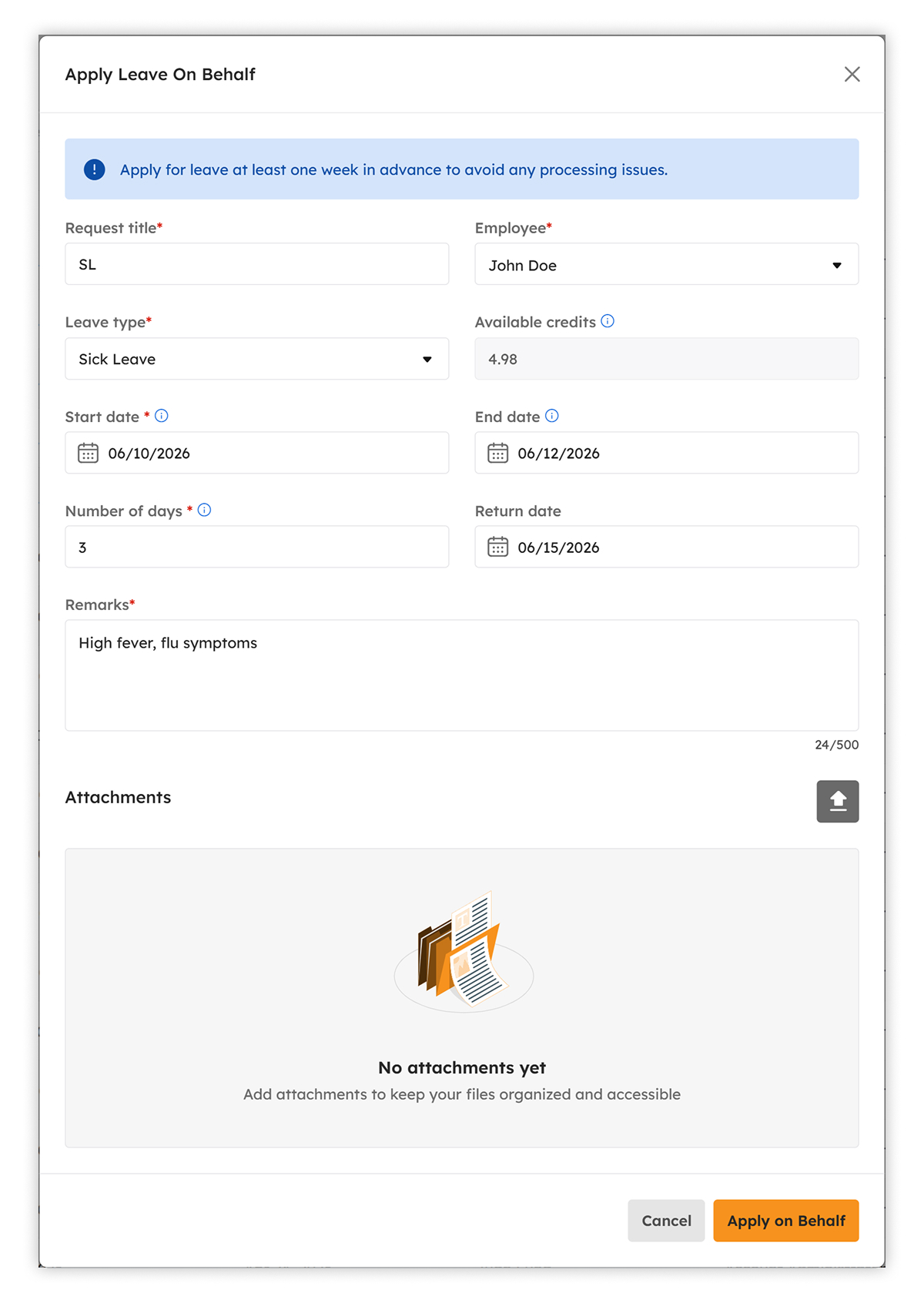
Apply Leave on Behalf
Applying leave on behalf of the employee following the procedures as follows:
Click plus and select Apply Leave on Behalf
Fill in the necessary fields displayed in the modal.
exclamation-circle
Note
Required (*) fields should not be empty.
Click the Apply on Behalf button to submit the application.
Success notification message will show.
Leave applied on behalf of [Employee Name]
Leave Application with Supporting Documents
Some leave types give users the option to attach supporting documents.
Click plus and select Apply for Leave
The list below shows all fields available in the modal. Required fields with an asterisk (*) must be completed by the user:
Request title
Leave Type
Available credits
Start date
End date
Number of days
Return date
Remarks
Approvers
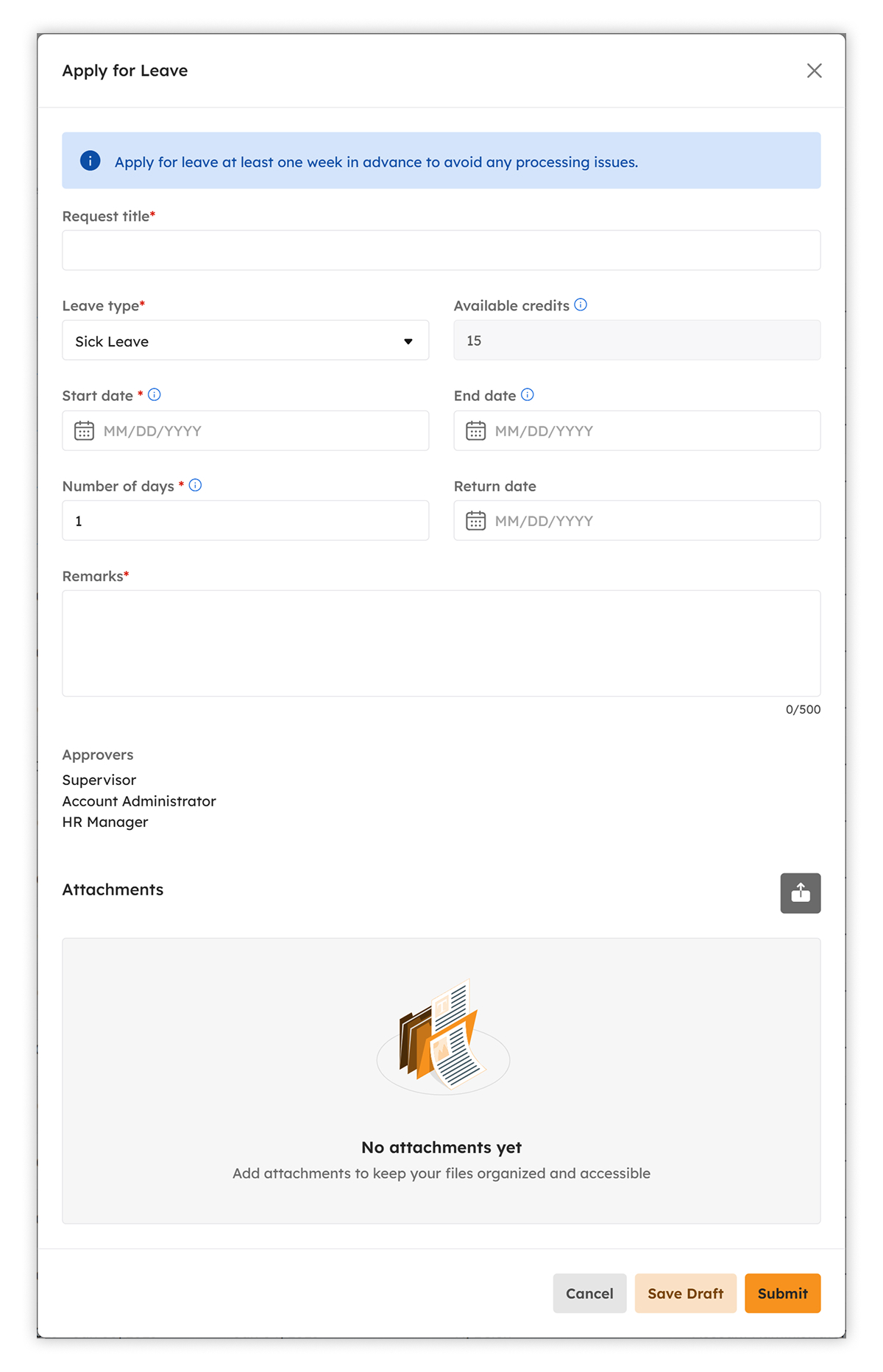
Depending on the selected leave type, an Attachments section may appear in the modal, allowing users to attach supporting documents when required.
This option appears when you select Apply Leave on Behalf as well.
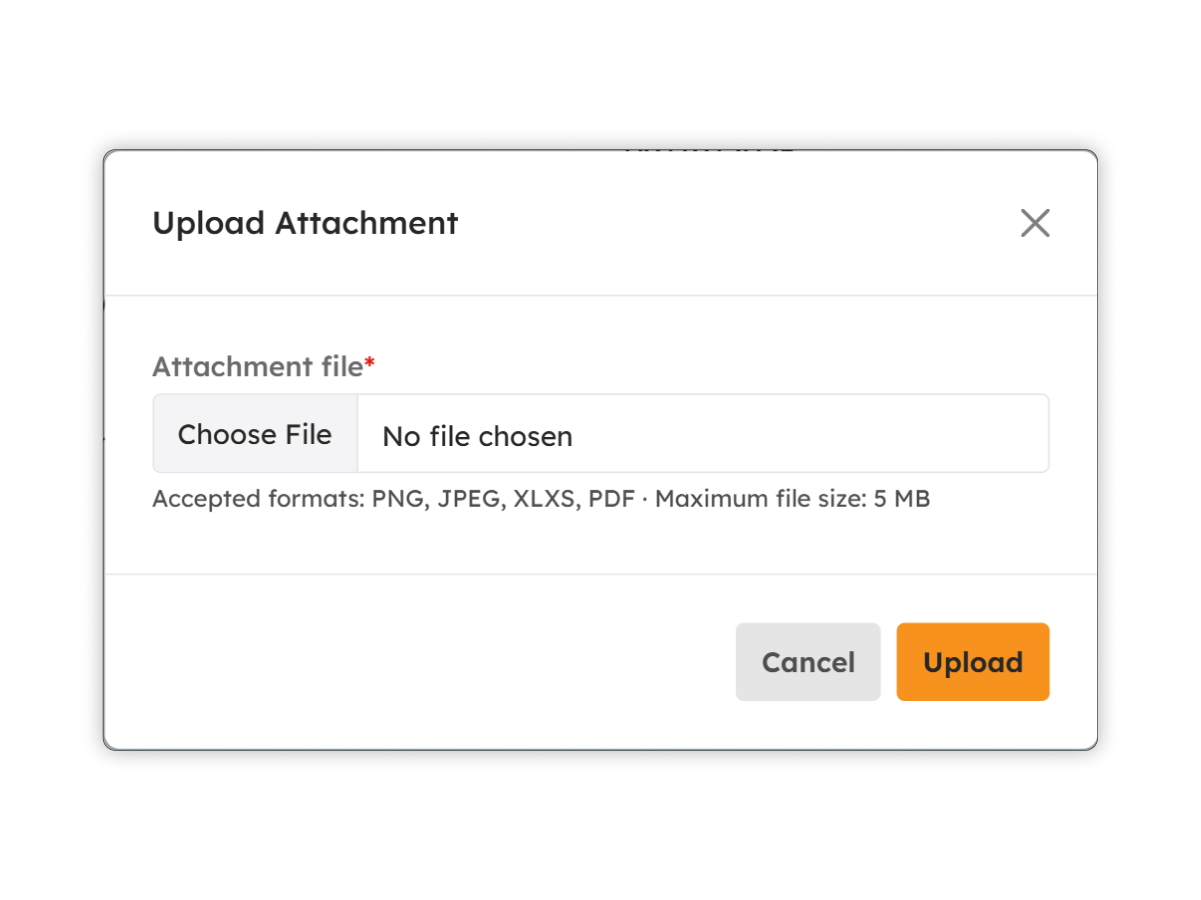
To upload a supporting document, simply click upload-alt and the upload file modal will appear.
In the import modal, click Choose File and select the file to be imported.
Click the Upload button to successfully import the file.
Once all required fields have been completed, click Submit to submit the application for approval.
To save the application and continue editing it later, click Save as Draft.
Cancel Leave Application
To cancel a leave that has already been applied for any reason, please follow these steps:
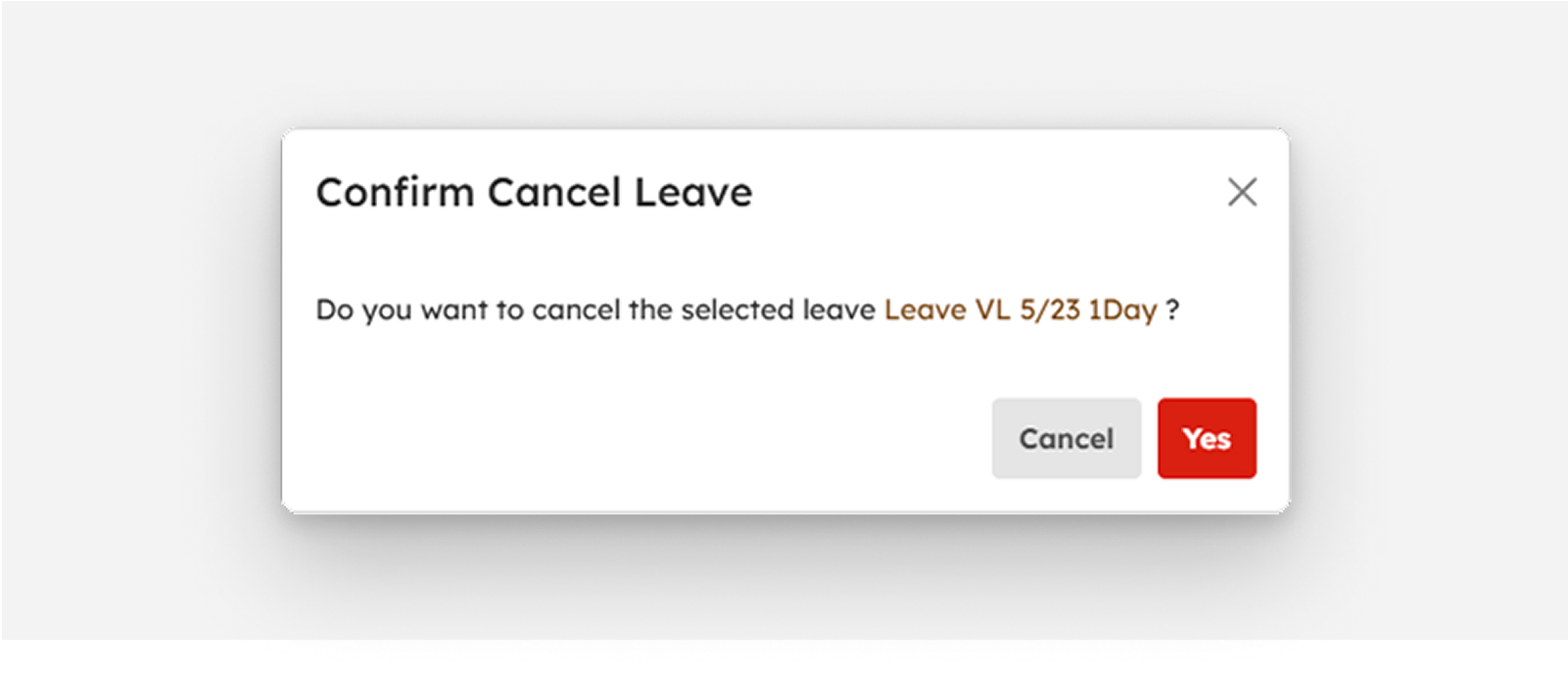
Click the ban Cancel button to open a confirmation modal.
Click the Yes button to confirm.
Success notification message will show and the leave status will be set to Cancelled.
Leave successfully cancelled
To prevent leave from being cancelled, click the Cancel button.
View Leave Application
To view the details of an applied Leave, follow the procedures below:
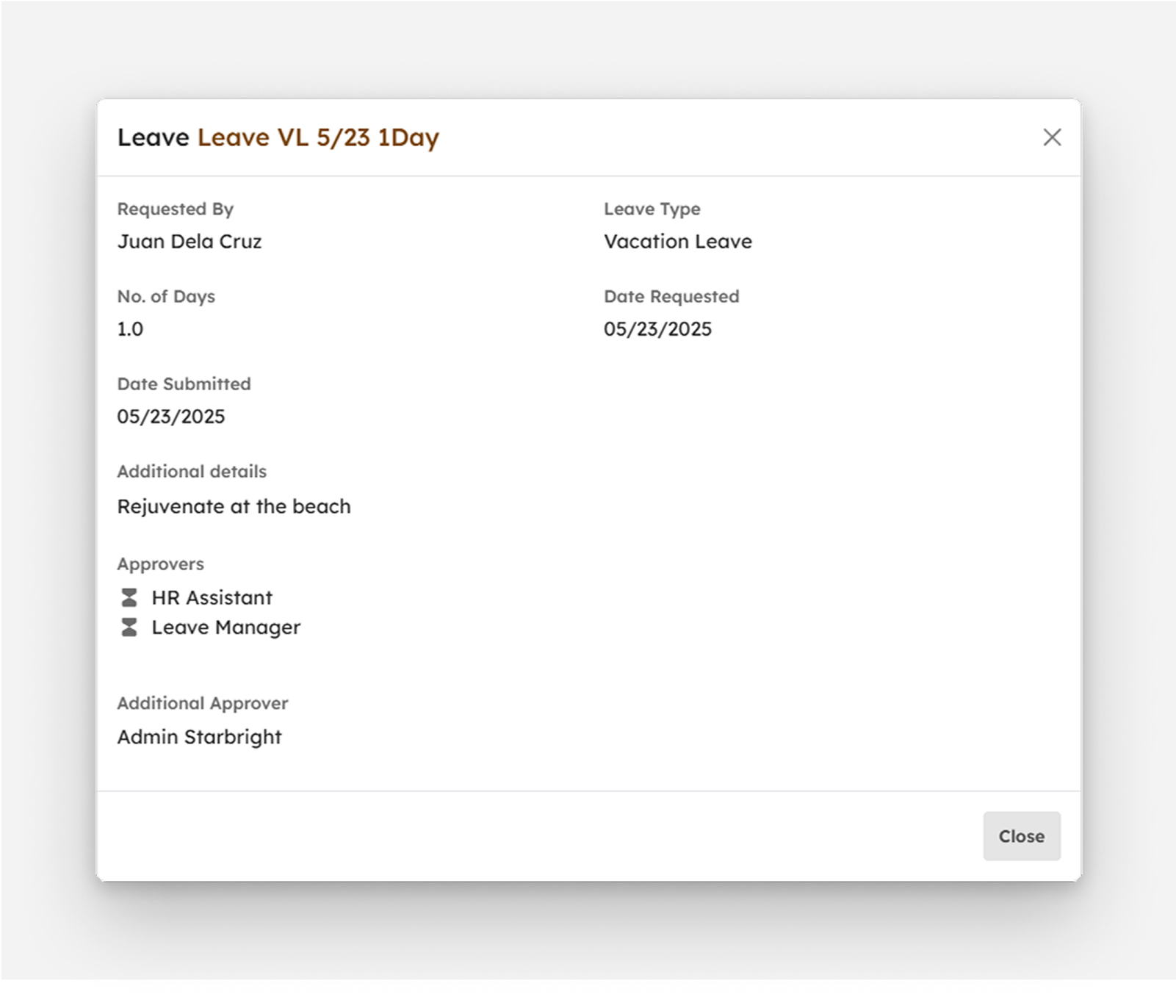
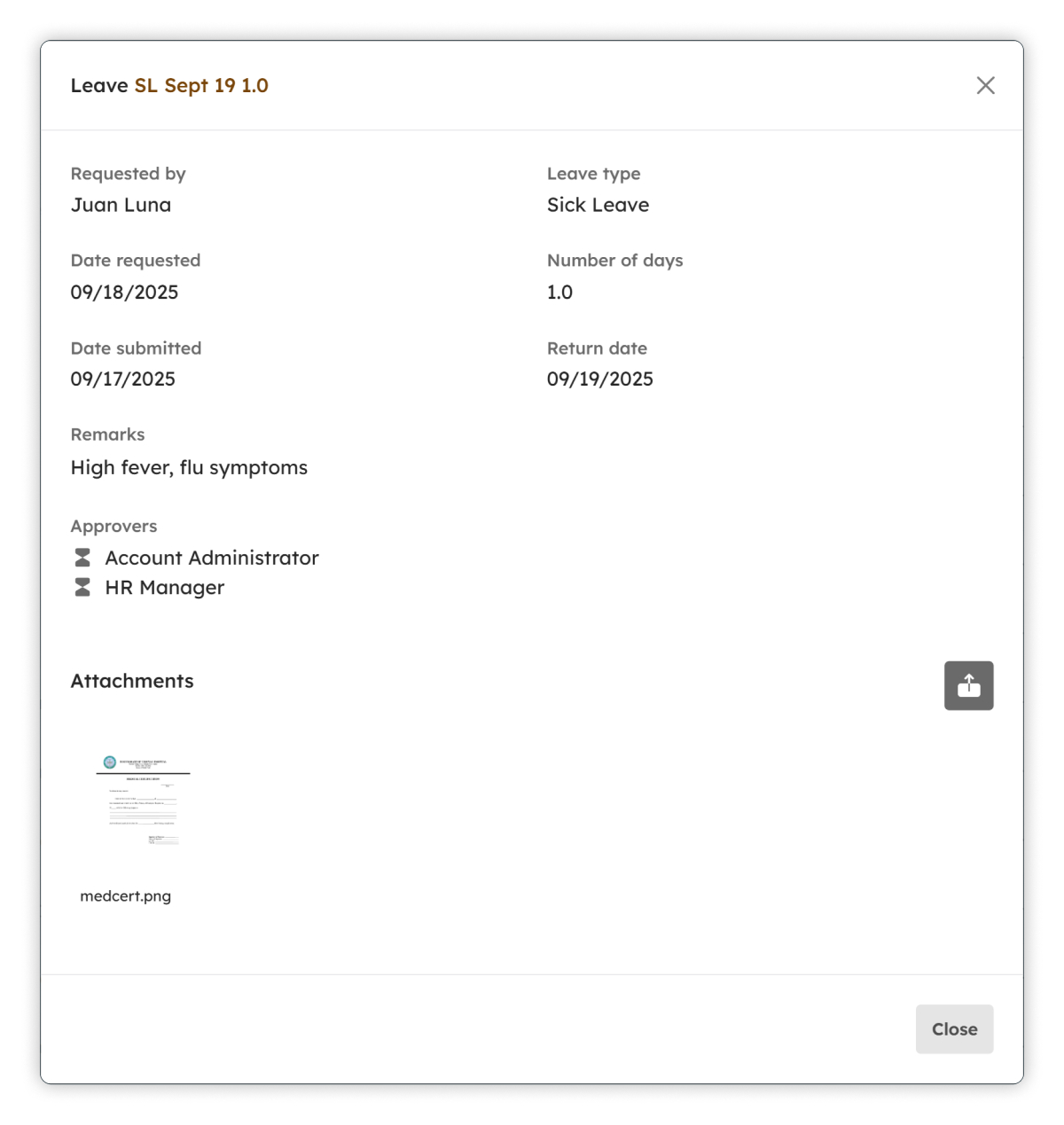
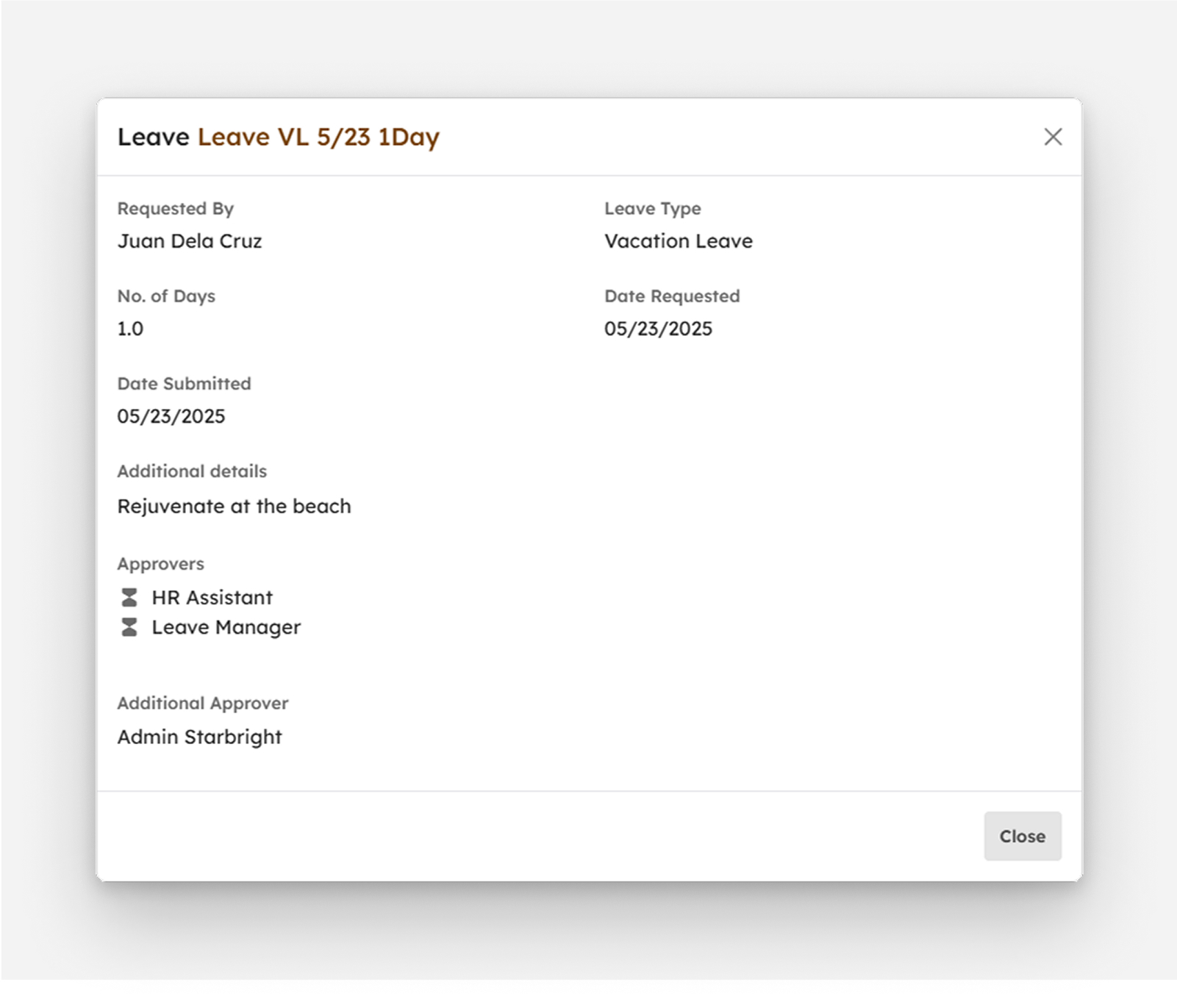
Click the eye View Leave button to display the View Leave modal as shown in the snip below:
The View Leave modal displays the following information:
Requested by
Leave type
Date requested
Number of days
Date submitted
Return date
Remarks
Approvers
Leave applications for specific leave types may contain an extra section for supporting documents, enabling users to review and download attached files as needed.
Leave For Approvals Summary Table
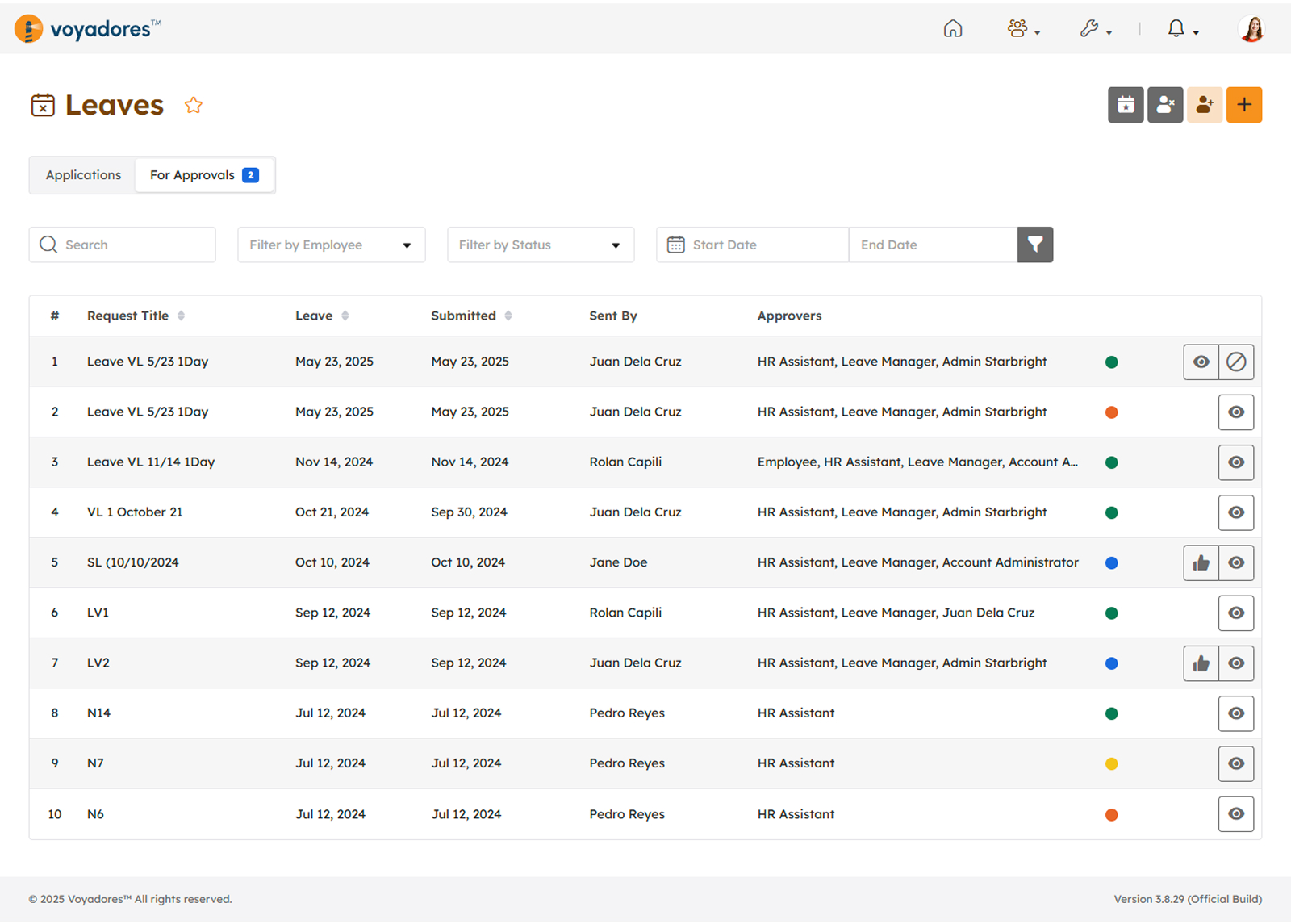
The For Approvals tab contains a summary table that displays all leave applications pending review or action. The table includes the following columns:
Request Title
Leave
Submitted
Sent By
Approvers
Status
Actions
like Approve Leave
eye View Leave
ban Void Leave
Load More Employee Leaves under For Approvals
If there are more than 20 leave requests on the list, click the arrows-repeatLoad More button to display other leaves since the default item number displayed on the screen is from count 1 to 20.
Approval of Leaves
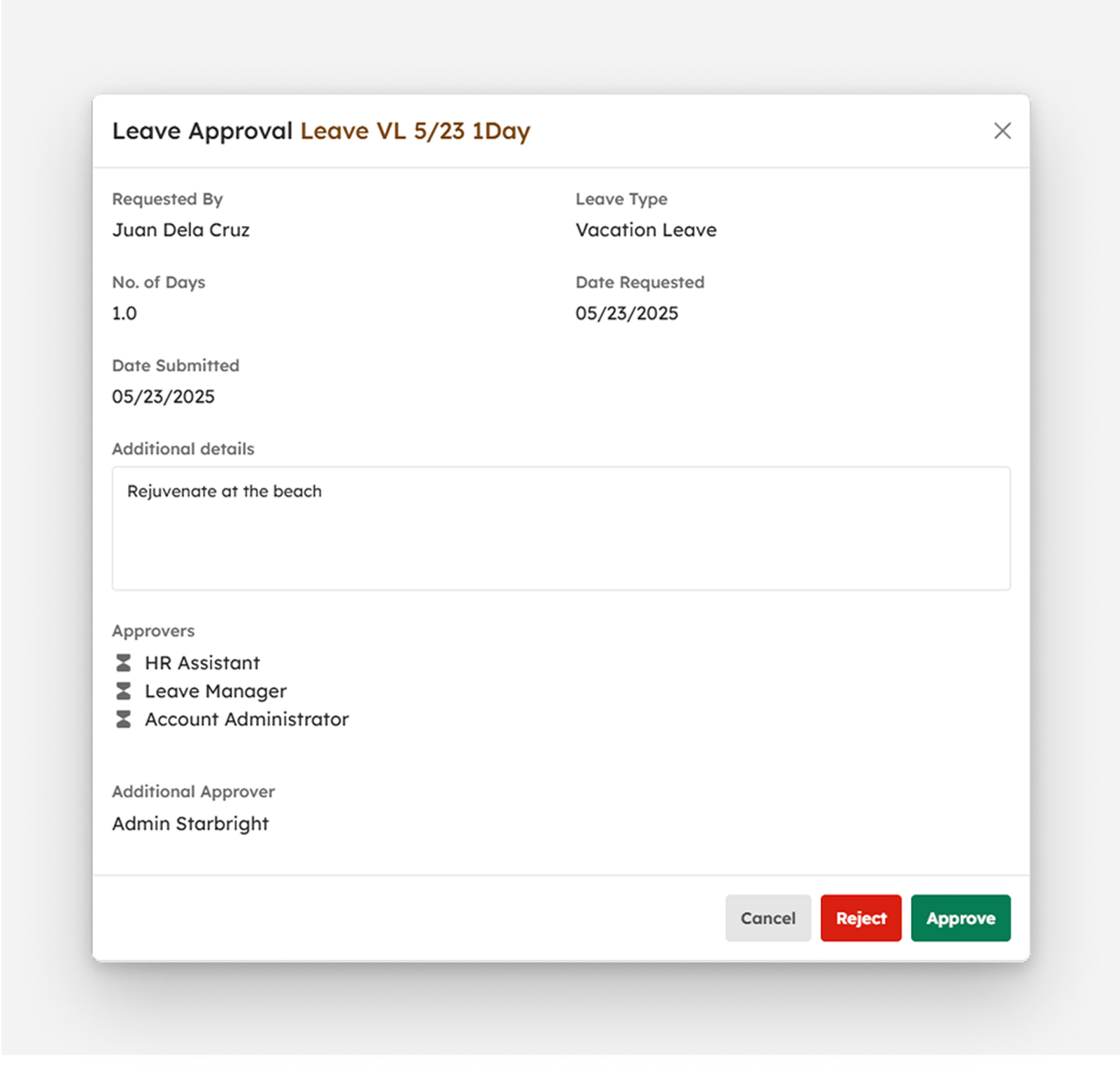
By selecting the For Approvals tab, the user is able to approve/reject leaves that are submitted for approval.
This opens the approve modal where you can review the leave application details.
After clicking the Approve button, a success notification message will show.
Leave successfully approved
The leave request status will be updated to Approved. An option to void the leave will be available for approved leave requests.
To proceed without approving the applied Leave, click the Cancel button.
Reject Leave Requests
To reject the applied Leave, click the Reject button.
Success notification message will show.
Leave successfully rejected
Leave status will update to Rejected
To proceed without rejecting the applied leave, click the Cancel button.
Void Leave Requests
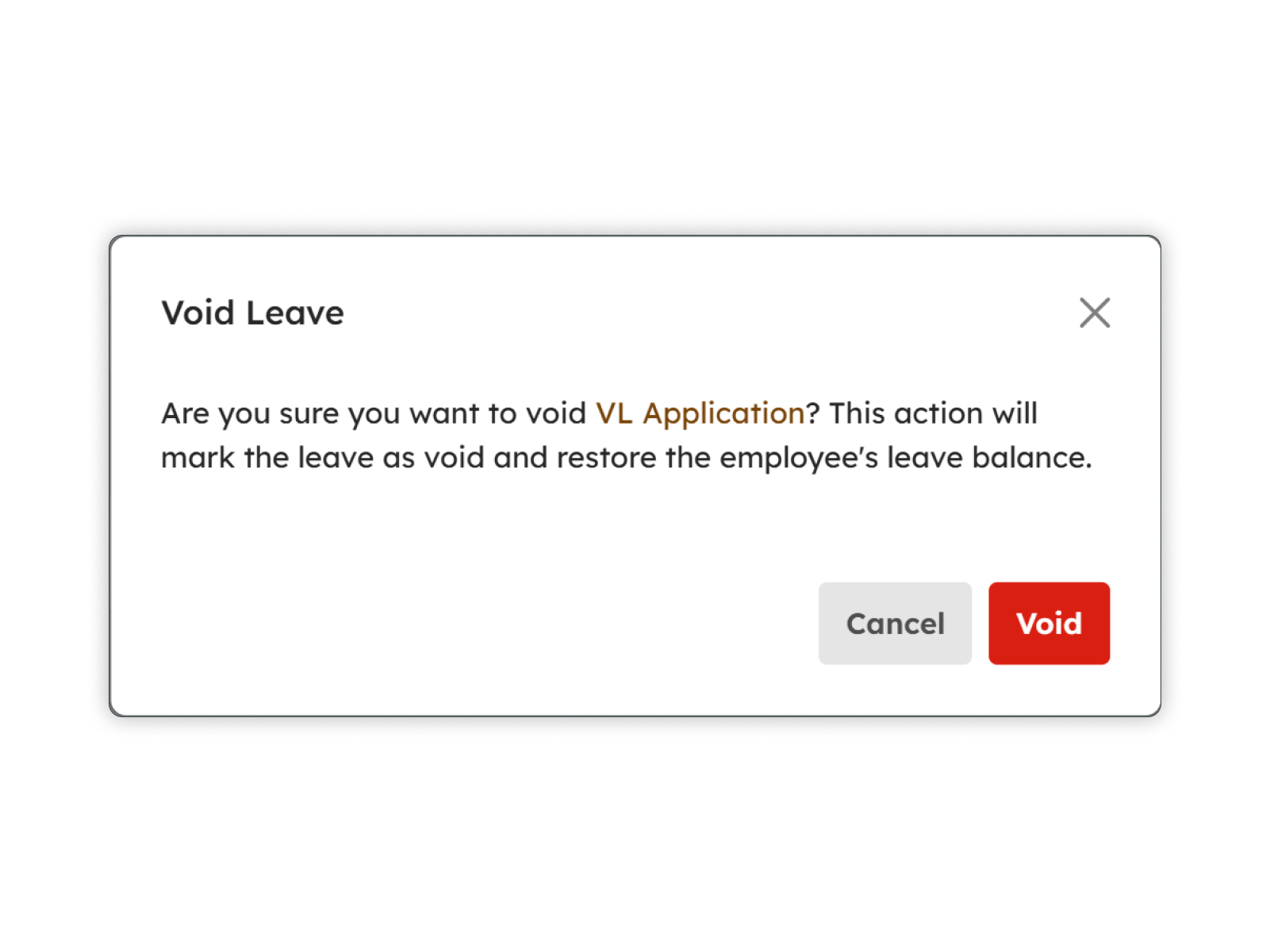
To void a leave that has already been approved for any reason, please follow these steps:
Click the ban button to open a confirmation modal.
Click the Void button to confirm.
Success notification message will show.
Leave successfully voided
Leave status will update to Void.
Click the Cancel button to keep the leave request unchanged and prevent it from being canceled.
View Details of Leave Request
To view the details of a Leave needing approval, follow the procedures below:
Click the eye View Leave button to display the View Leave modal as shown in the snip below:
The View Leave modal displays the following information:
Requested by
Leave Type
Date requested
Number of days
Date submitted
Return date
Remarks
Approvers
View Holidays
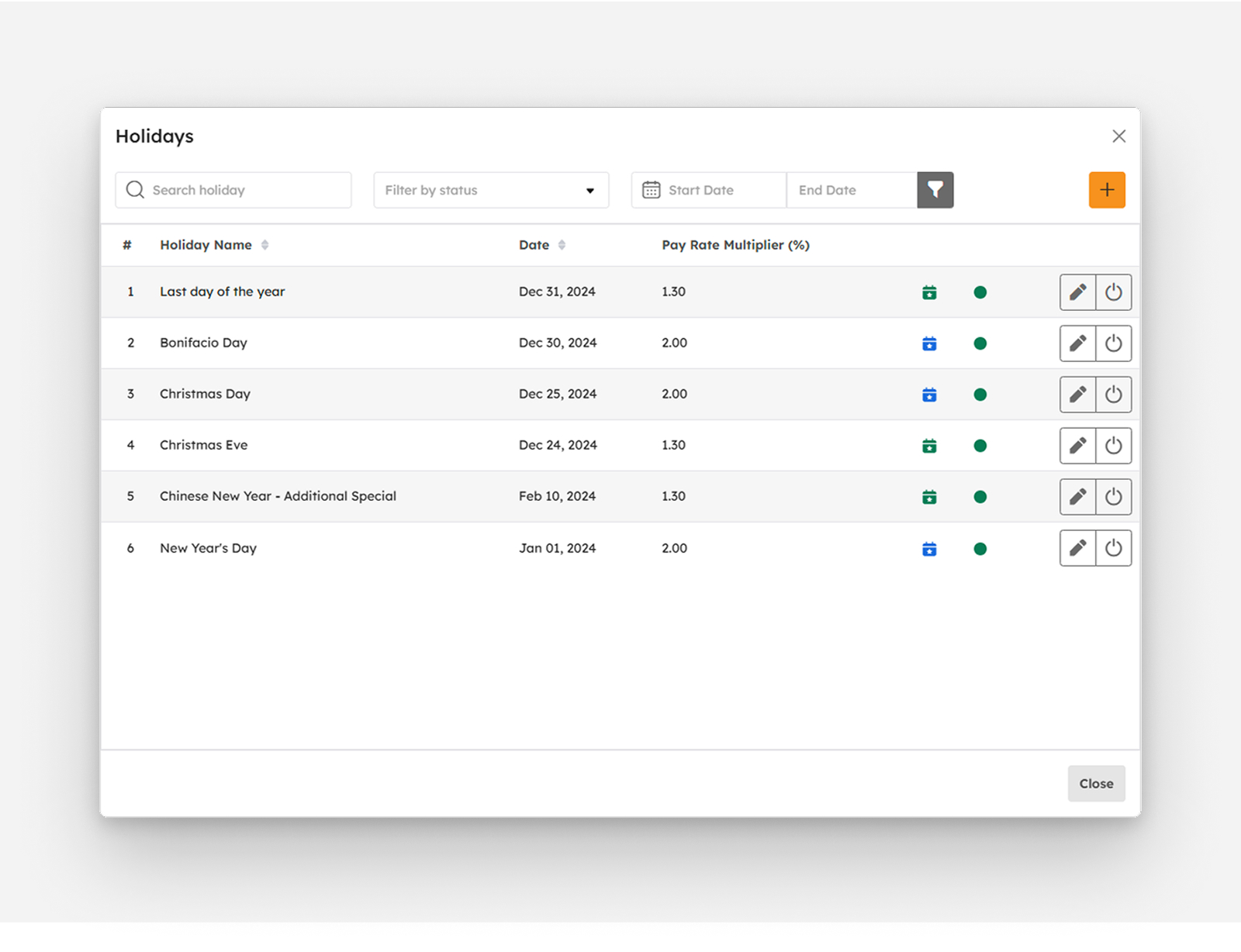
To open the Holidays modal, click the calendar-star button.
The summary table displays the list of created holidays with the following columns:
Holiday Name
Date of Holiday
Pay Rate Multiplier (%)
Holiday Type
Status
Actions
pen Edit Holiday
power-off Activate/Deactivate Holiday
Search Holidays
To search for a holiday, follow the steps below:
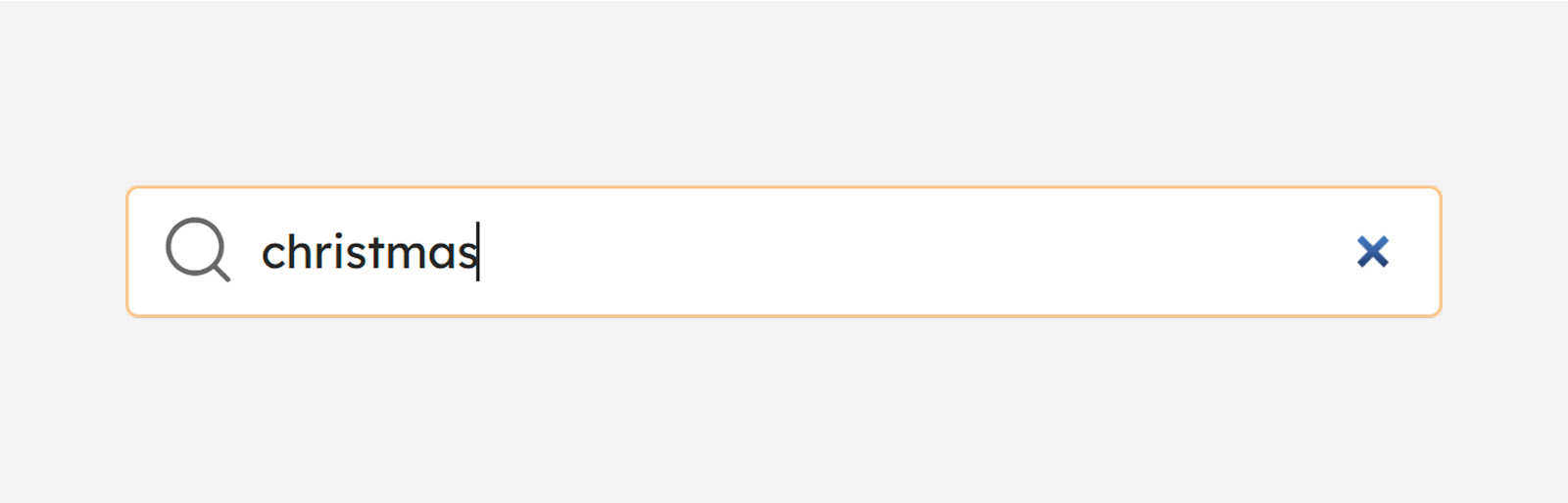
Key in the name of holiday in the Search Bar as shown in the snip below:
The Holidays Summary Table will display the searched holiday.
Filtering Holidays by Status
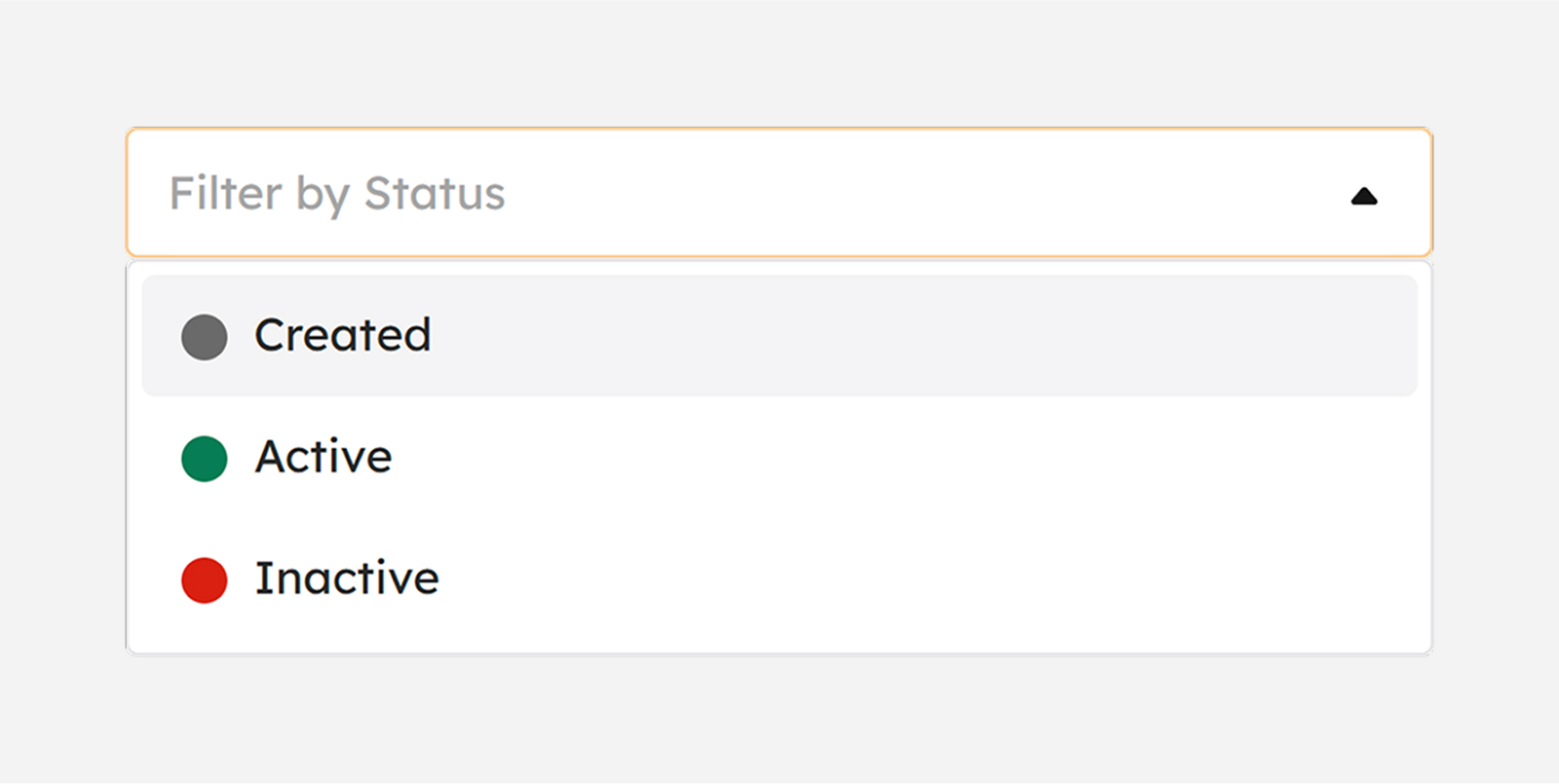
This feature is to filter Holidays by status.
Created. This gray-colored status shows the newly created Holiday. Click the filter by status dropdown and select “Created”.
Active. This green-colored status shows the active Holidays. Click the filter by status dropdown and select “Active”.
Inactive. This red-colored status shows the inactive Holidays. Click the filter by status dropdown and select “Inactive”.
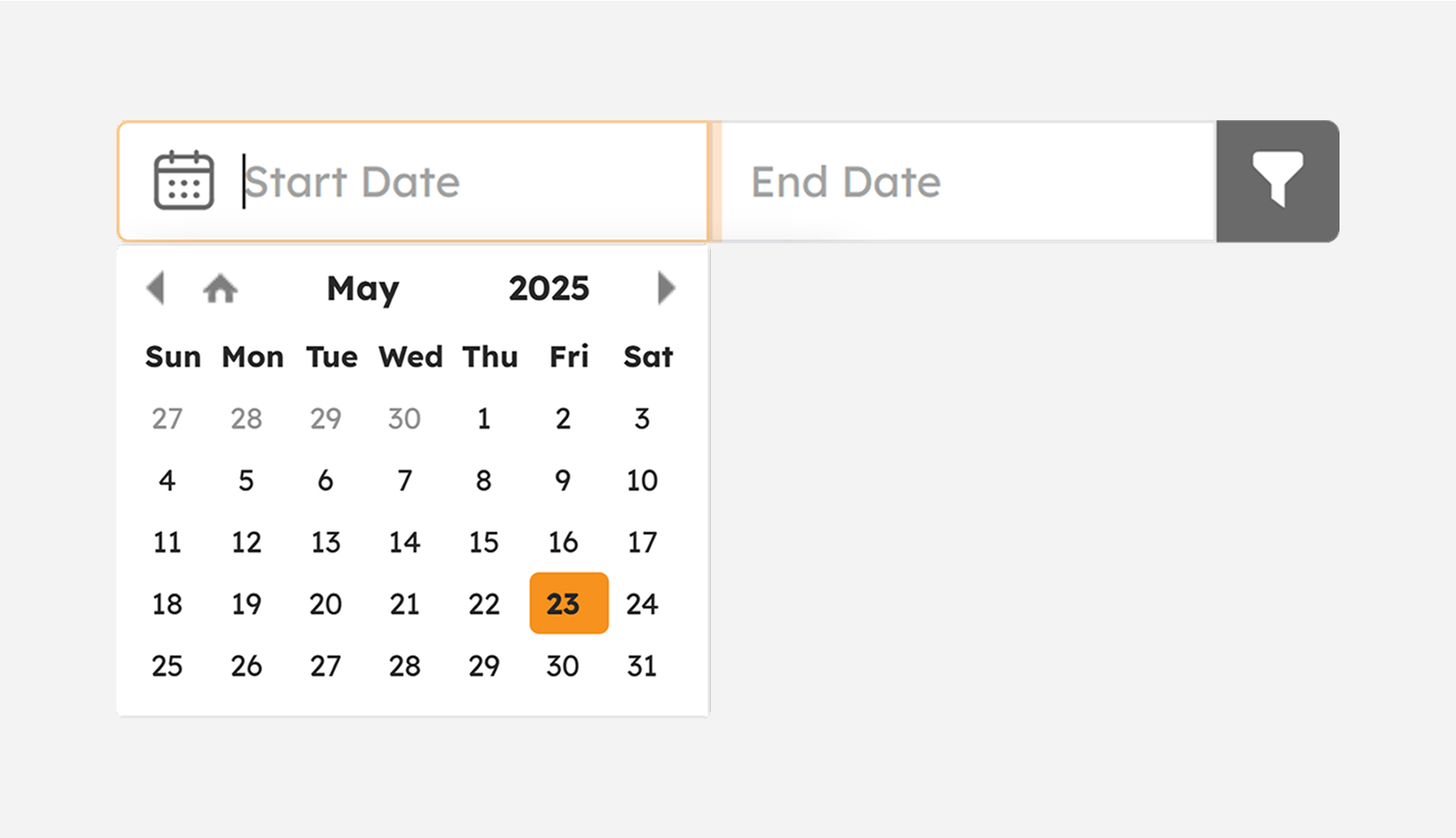
Filtering Holidays by Date Range
This feature allows users to filter the list of holidays based on a specified start and end date. It helps streamline holiday management by displaying only the holidays that fall within the selected date range.
Creating Holidays
Create a record of Holidays by following the procedures as follows:
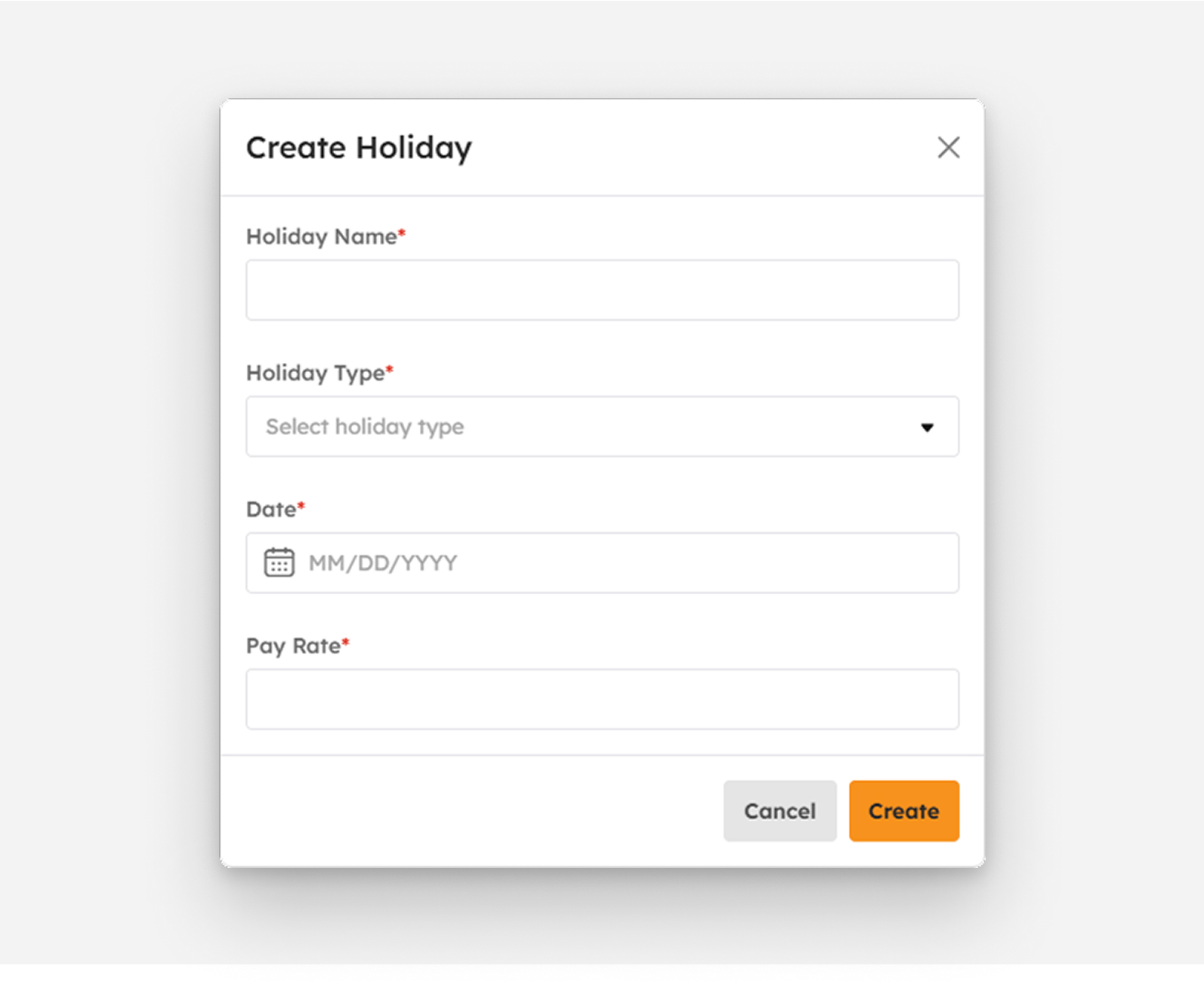
Click the plus Create button. A modal will display to begin creation of holidays.
Fill in the necessary fields displayed in the modal. Required (*) fields should not be empty.
Holiday Name
Holiday Type
Regular Holiday
Special Non-Working Holiday
Special Working Holiday
exclamation-circle
Note
Customize more holiday types according to the company’s preference or holiday types that are applicable in the organization.
Date
Pay rate multiplier (%)
exclamation-circle
Note
Customize holiday rates according to the company’s preference or rates that are applicable in the organization.
Click the Add button to create the holiday.
A successful notification message will show:
Holiday successfully added
If one of the required fields is empty or creation is unsuccessful, an error message will show:
Please fill the required fields
Click the Cancel button to close the form without creating a new holiday.
Editing Holidays
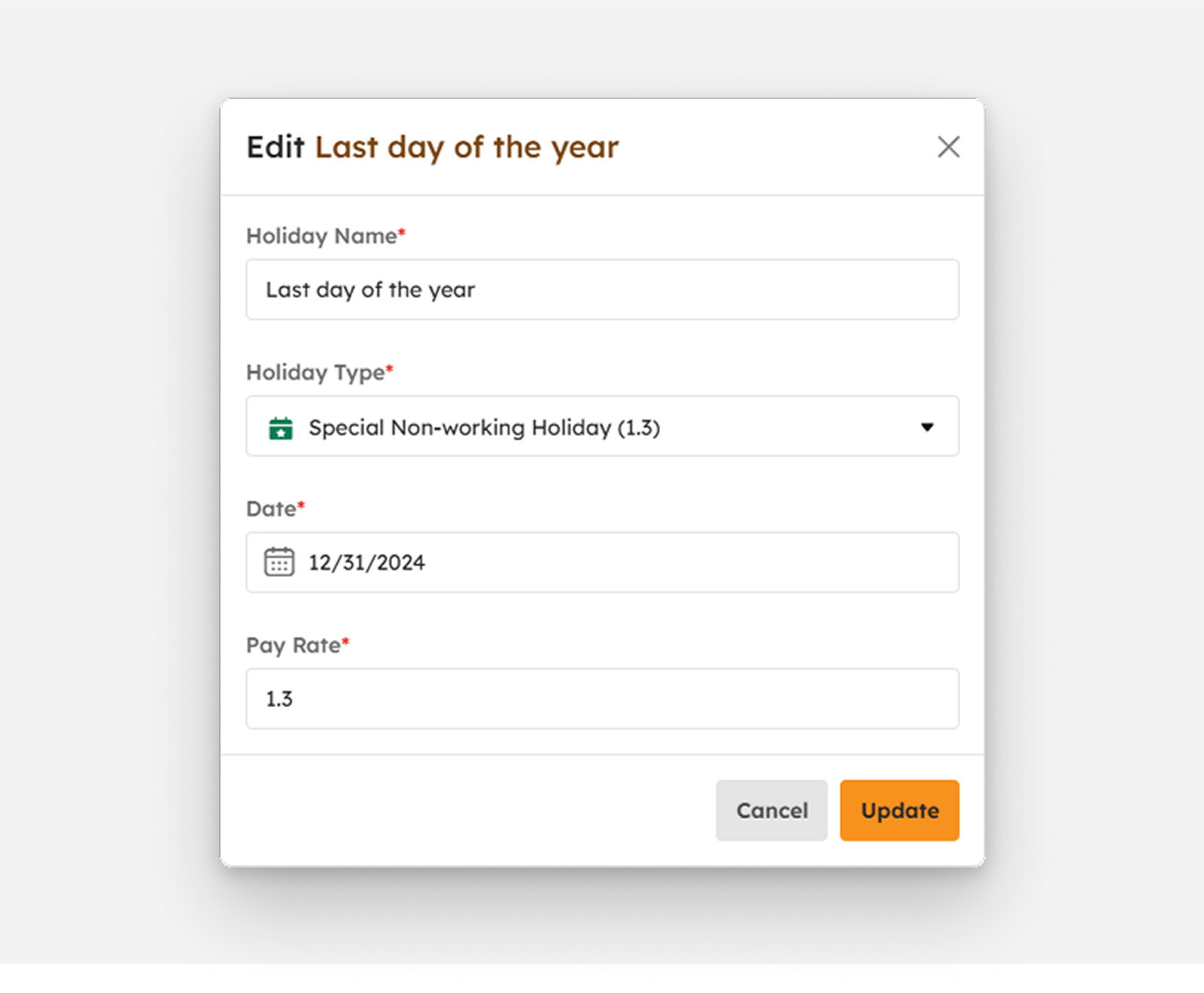
Click the pen Edit button. This will show the Edit Holiday modal.
Fill in the necessary fields displayed in the modal. Required (*) fields should not be empty.
Holiday Name
Holiday Type
Regular Holiday
Special Non-Working Holiday
Special Working Holiday
exclamation-circle
Note
Customize more holiday types according to the company’s preference or holiday types that are applicable in the organization.
Date
Pay rate multiplier (%)
exclamation-circle
Note
Customize holiday rates according to the company’s preference or rates that are applicable in the organization.
Click the Update button to update the holiday.
A successful notification message will show:
Holiday successfully updated
If one of the required fields is empty or creation is unsuccessful, an error message will show:
Please fill the required fields
Click the Cancel button to close the form without changing the details of the holiday.
Activating Holidays
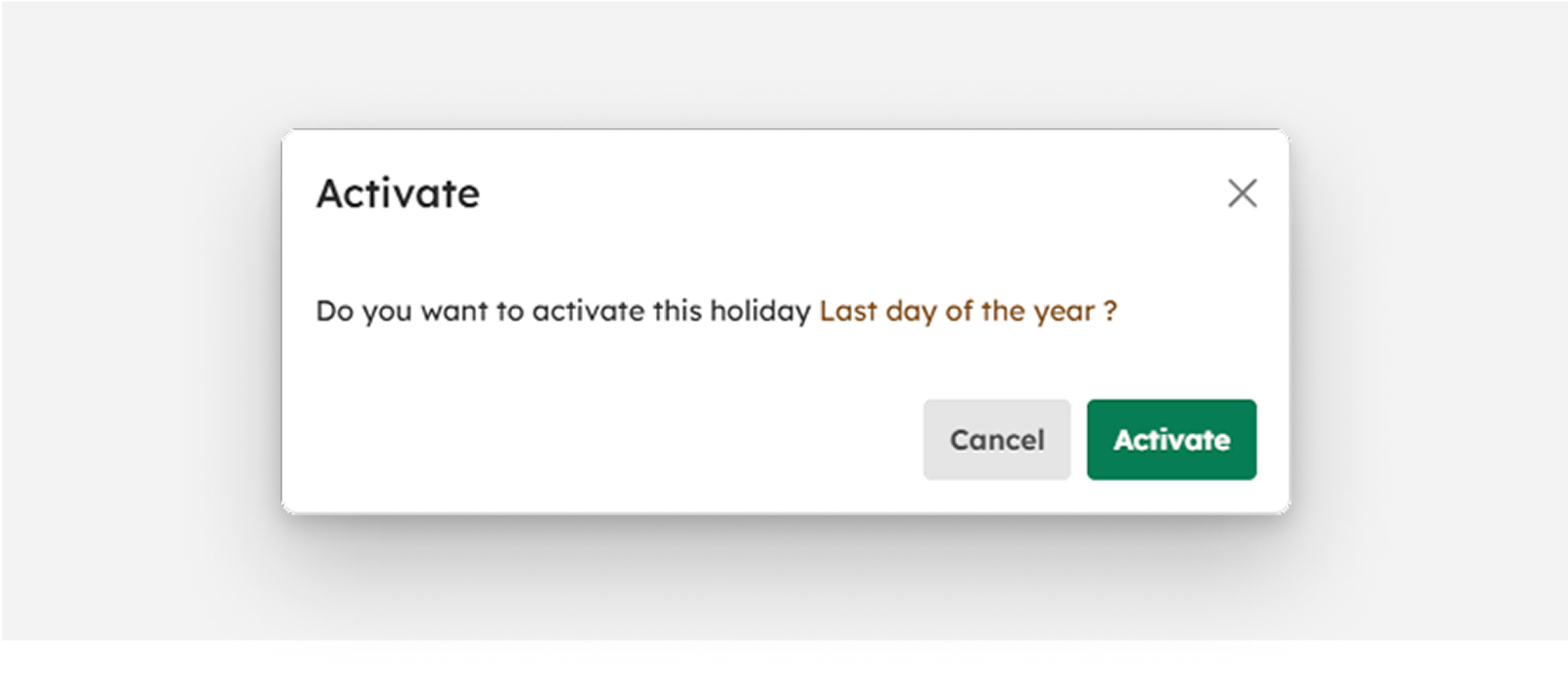
Click the power-off Activate button to activate an inactive holiday type. This will show a confirmation modal.
From the modal, click Activate to successfully activate the holiday type, otherwise, click Cancel button.
Activation success message will show.
Holiday successfully activated
Deactivating Holidays
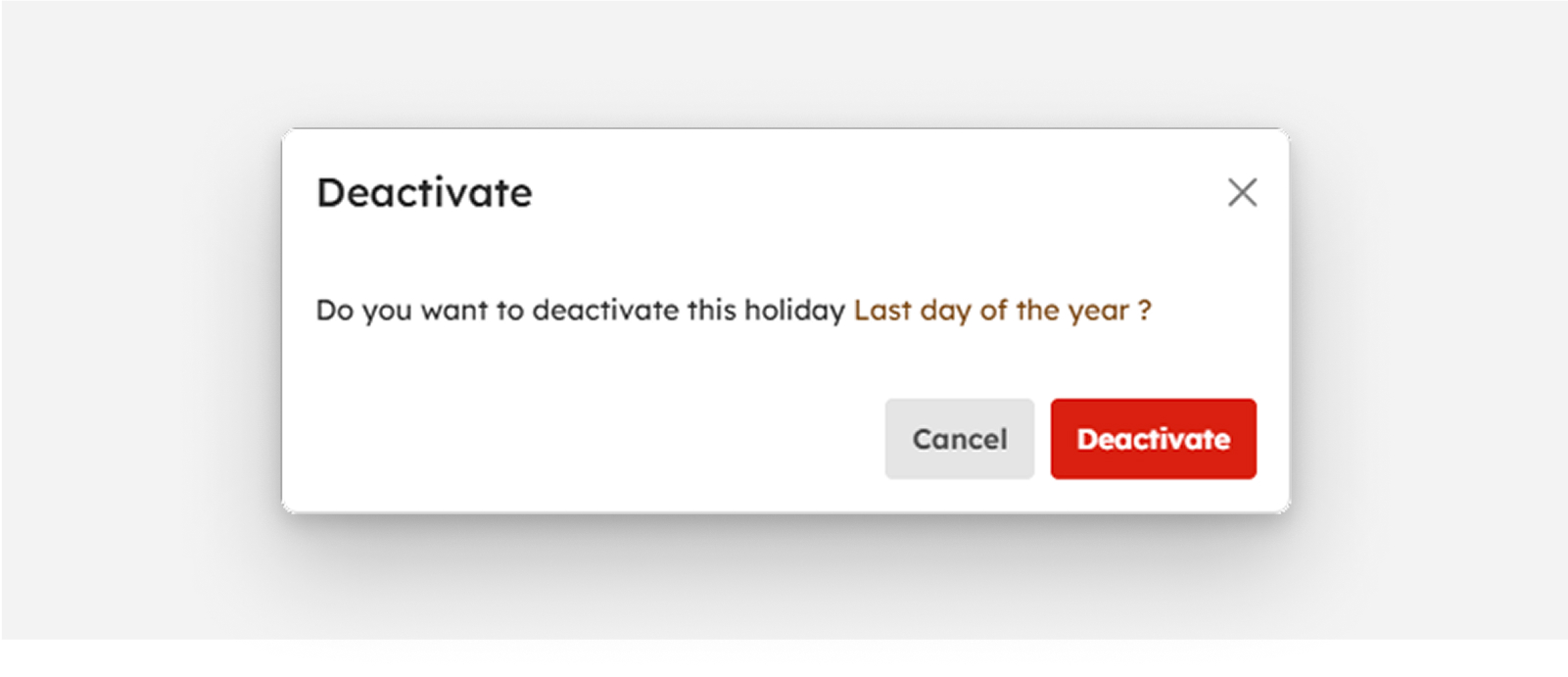
Click the power-off Deactivate button to deactivate an active holiday type. This will show a confirmation modal.
From the modal, click Deactivate to successfully deactivate the holiday type, otherwise, click Cancel button.
Deactivation success message will show.
Holiday successfully deactivated
Load More Holidays
If there are more than 20 holidays on the list, click the arrows-repeatLoad More button to display other holidays since the default item number displayed on the screen is from count 1 to 20.
Entitlements
Introduction to Entitlements Page
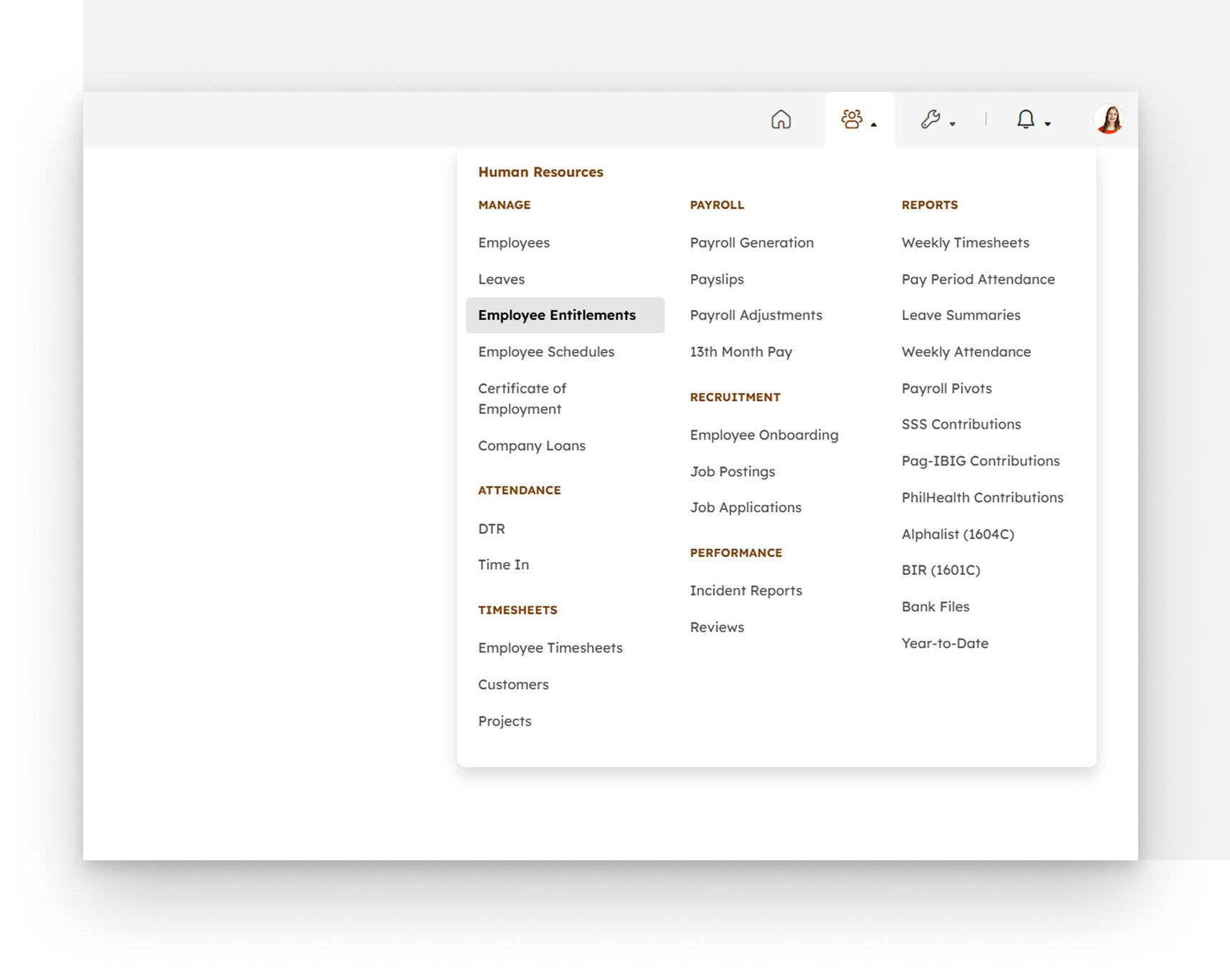
Assign Entitlements to employees to help manage leaves and attendance entries. To access this page, navigate to the Human Resources Module and click "Entitlements” under Manage Submodule as shown in the image below:
Features in Entitlements Page
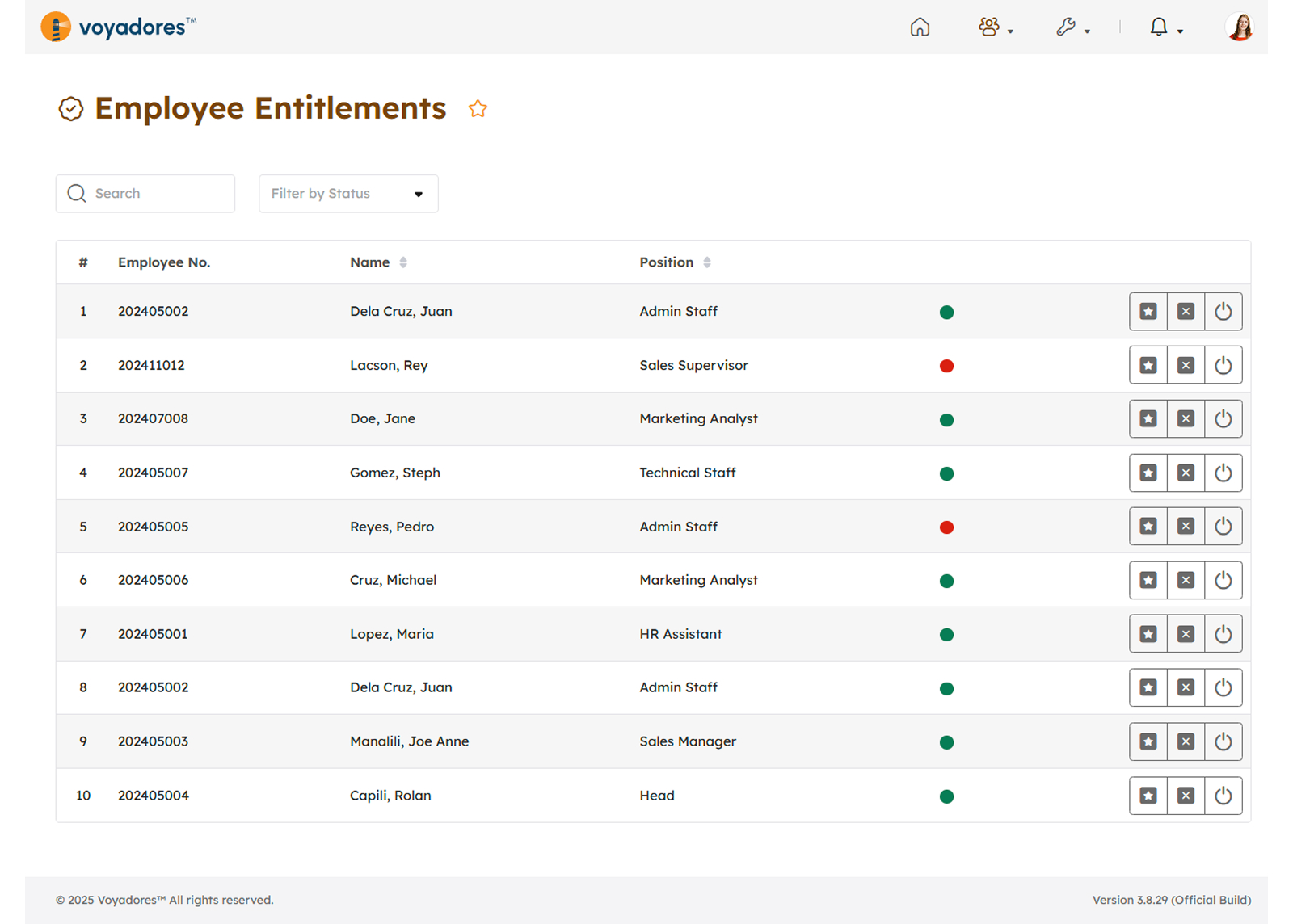
The snip below is the high-level view of the Entitlements page along with its built-in features.
Entitlements Page Header Actions
home-dash
Set as Default Page
star
Add to Quick Links
user-star
Manage Entitlement Profiles
user-times
Manage Leave Types
Preview Entitlements
Entitlements Summary Table
The summary table displays the list of active employees with the following columns:
Employee No.
Name
Position
Status
Actions
user-tag Assign Attendance Entitlements
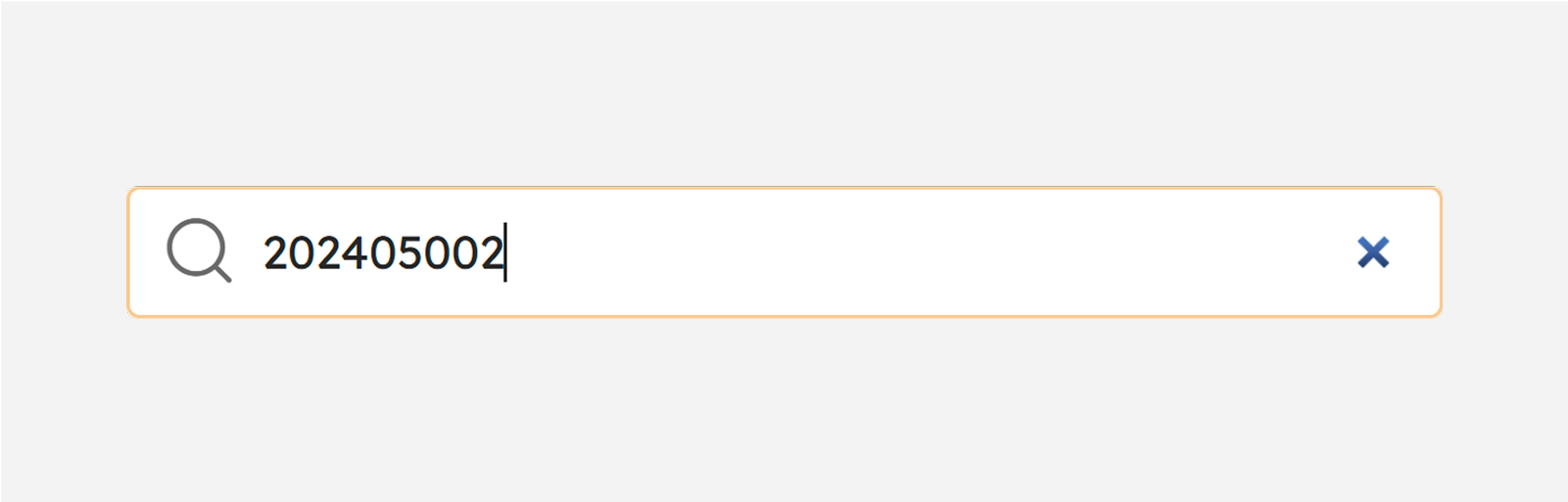
Searching Employee Name or ID
To search for an employee, follow the steps below:
Key in the name or ID of the employee in the Search Bar as shown in the snip below:
The Entitlements Summary Table will display the searched employee name or ID.
Filtering Entitlements by Status
This feature is to filter Entitlements by status.
Active. This green-colored status shows the active Entitlements. Click the filter-by-status drop-down and select “Active.”
Inactive. This red-colored status shows the inactive Entitlements. Click the filter-by-status drop-down and select “Inactive.”
DTR Entitlements
A list of all available DTR Entitlements used in the Daily Time Record (DTR) to accurately capture employee attendance, work conditions, and pay-related adjustments. These entitlements help ensure compliance with company policies, labor rules, and payroll generation by automatically or manually identifying specific attendance scenarios.
#
Entitlement Name
Description
How it works?
1
Late
This reflects the tardiness recorded in attendance records.
With Schedule
Auto tag – Applied when an employee is late and exceeds the account’s grace period.
Manual tag – Used when you manually edit the employee’s time-in and add this entitlement.
Flexible Schedule
Auto tag – Applied when an employee is late and exceeds the account’s grace period.
2
Undertime
This reflects the recorded early out in the daily time record.
With Schedule
Auto tag – Applied when both time-in and time-out are completed, but the employee clocks out earlier than the scheduled time.
Manual tag – Used when time-in and time-out are completed, but the employee clocks out earlier than scheduled. This entitlement can be manually added in the DTR and removed by properly adjusting the time-out.
3
Overtime
This reflects the approved extra working hours recorded in the daily time record.
With Schedule
Manual tag – Applied when an employee clocks in or clocks out and requests overtime. This entitlement can be added in the DTR by adjusting the time-out, adding the entitlement, and setting the overtime value.
4
Absent
This reflects the recorded absence in attendance records.
With Schedule
Auto tag – Applied when time-in and time-out are not completed during the workday.
Manual tag – To add this entitlement manually, leave the time-in and time-out blank.
Flexible Schedule
Auto tag – Applied when time-in and time-out are left blank.
5
NightDifferential
This reflects the approved nighttime work hours recorded in the daily time record.
With Schedule
Auto tag – If the time-in value falls between 10:00 PM and 6:00 AM and if the time-out value falls between 10:00 PM and 6:00 AM
6
SpecialOT
This reflects the approved extra work hours on special days recorded in the daily time record.
With Schedule
Auto tag – If time-in and time-out are completed on a holiday or rest day.
Manual tag – If time-in and time-out are completed on a holiday or rest day, you can manually set this.
7
OffsetPlus
This reflects the approved excess time credited in the daily time record.
With Schedule
Manual tag – Request an offset by setting the hour value at time-in or time-out.
8
OffsetMinus
Represents time deducted from the employee’s attendance record.
With Schedule
Manual tag – This reflects deducted time in attendance records.
9
PaidHoliday
This reflects the approved holiday hours recorded in the daily time record.
With Schedule
Manual tag – You can specify this entitlement in the DTR if the employee’s duty includes holidays.
Flexible Schedule
Auto tag – When time-in and time-out are set and the date is filtered by holidays.
10
Rest Day
This reflects the approved rest day hours recorded in the daily time record.
With Schedule
Auto tag – When the DTR is generated, it will automatically determine whether it is a rest day.
Manual tag – This entitlement can be added or removed based on specific conditions.
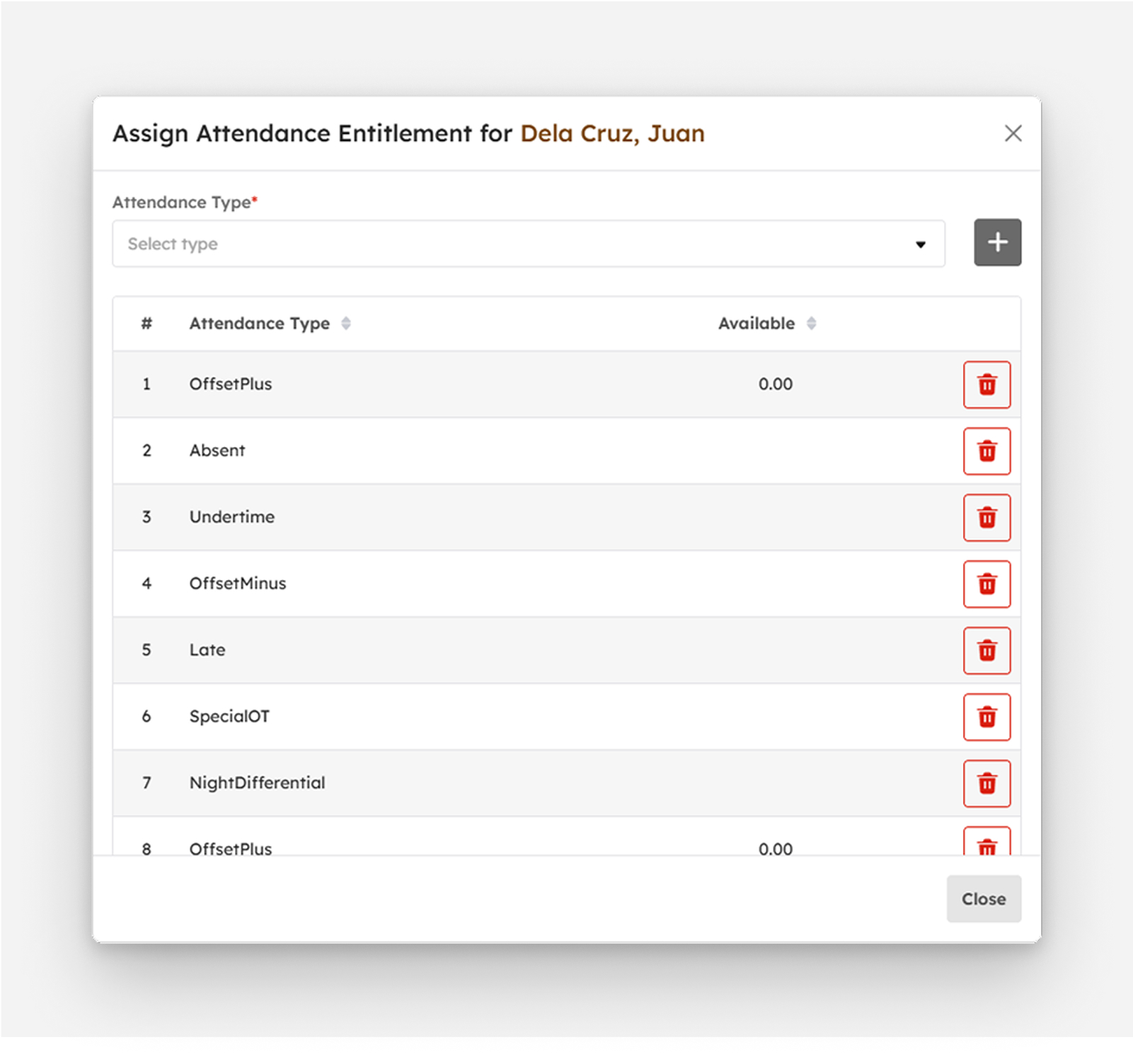
Assign Attendance Entitlements
Assign attendance entitlements to employees by following these steps:
Click the user-tag button corresponding to the employee record to open the Assign Entitlements modal.
Select the Attendance tab to view and assign available attendance entitlements
Select an attendance type from the dropdown list, then click the plus button to add it to the employee's attendance entitlements.
To remove the entitlement type, simply click the trash button to remove the assigned entitlement type.
Review the details as shown in the table below:
Attendance Type. Displays the selected attendance type.
Available. Shows the total number of attendance entitlement filed by an employee based on the employee's DTR.
Repeat steps 2-3 to assign more Attendance Entitlements to employee, otherwise close the modal by clicking Close button on the bottom right or times button on the top right of the modal.
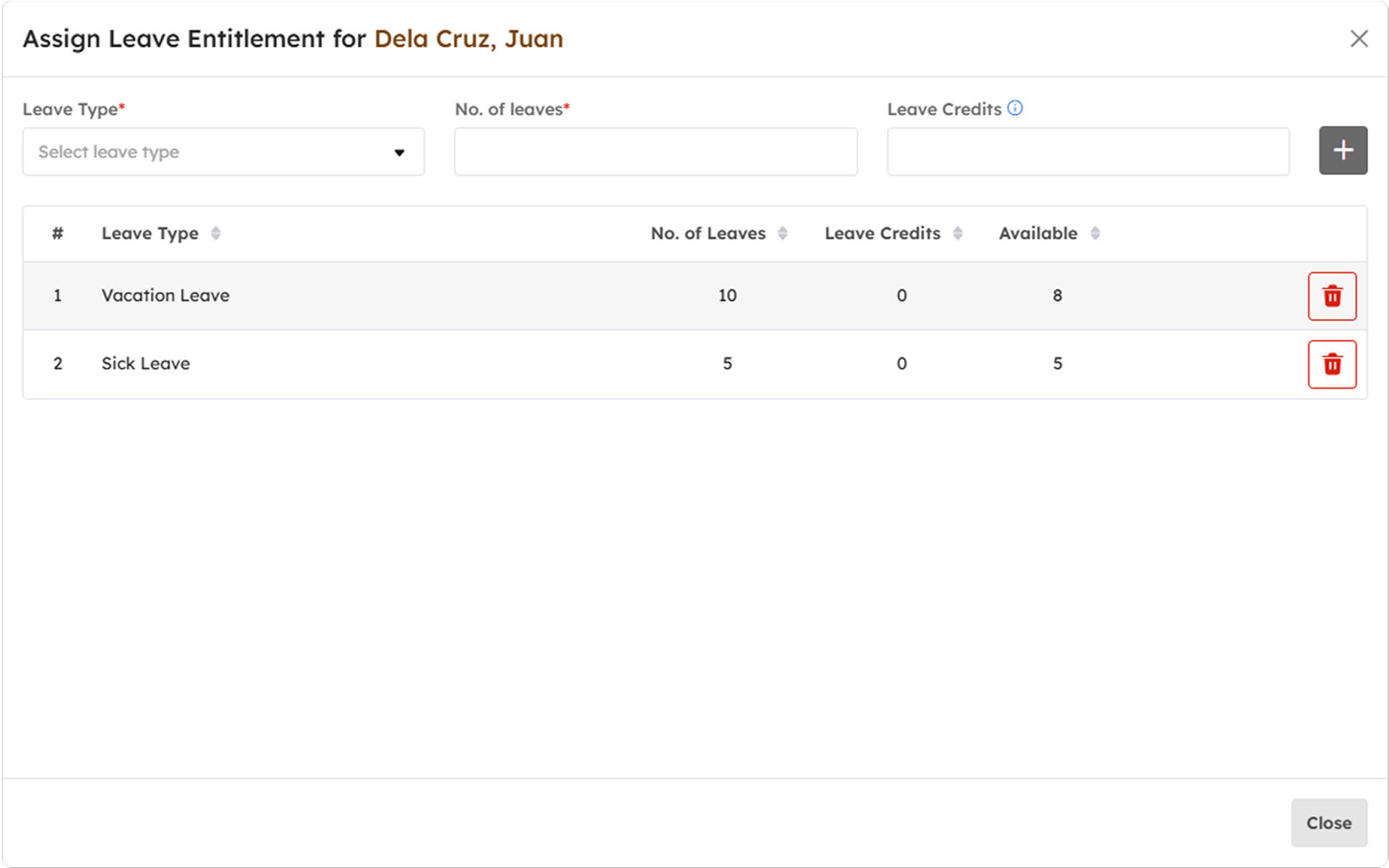
Assign Leave Entitlements
Follow the procedures below to assign Leave Entitlements to employees.
Click the user-tag button corresponding to the employee record to open the Assign Entitlements modal.
Select the Leave tab to view and assign available leave entitlements
Select a leave type from the Leave Type dropdown list.
Input the number of leaves available for an employee.
Sample computation for accrued VL with pay per month.
Leave Type
No. of Leaves to Earn Annually
No. of Months per Annum
Monthly Leave Credits
Vacation Leave
10
12
0.83
If Leave Credits are not accrued per month, set the Leave Credits field value to Zero (0) and disregard the auto-computed value for leave credits as shown in the table below:
Leave Type
No. of Leaves
Leave Credits
Vacation Leave
10
0
Click the plus button to add it to the employee's leave entitlements.
Review the details as shown in the table below:
Leave Type. Displays the selected leave type.
No. of Leaves. Displays the number of leaves.
Leave Credits. Displays the leave credits.
Available. Displays the total available leaves of an employee.
The default value for accrued leaves is zero (0). Leave credits will accumulate every 1st day of the month through a system job.
For non-accrued leave types, the total number of leave days shall be equal to the total number of available leave credits as shown in the image below:
Balance. Displays the remaining leave credits after approved or used leaves have been deducted from the employee's available leave credits.
To remove the entitlement type, simply click the trash delete button to remove the assigned entitlement type.
Repeat steps 3-7 to assign more Leave Entitlements to employee, otherwise close the modal by clicking Close button on the bottom right or times button on the top right of the modal.
Entitlement Profiles
Entitlement Profiles provide a centralized way to group attendance and leave entitlements that can be assigned to multiple employees. Instead of configuring the same entitlements individually for each employee, an administrator can create a profile, add the required entitlement types, and apply the profile to selected employees.
This guide explains how to create, manage, and assign an Entitlement Profile, including how attendance and leave entitlements are added to a profile.
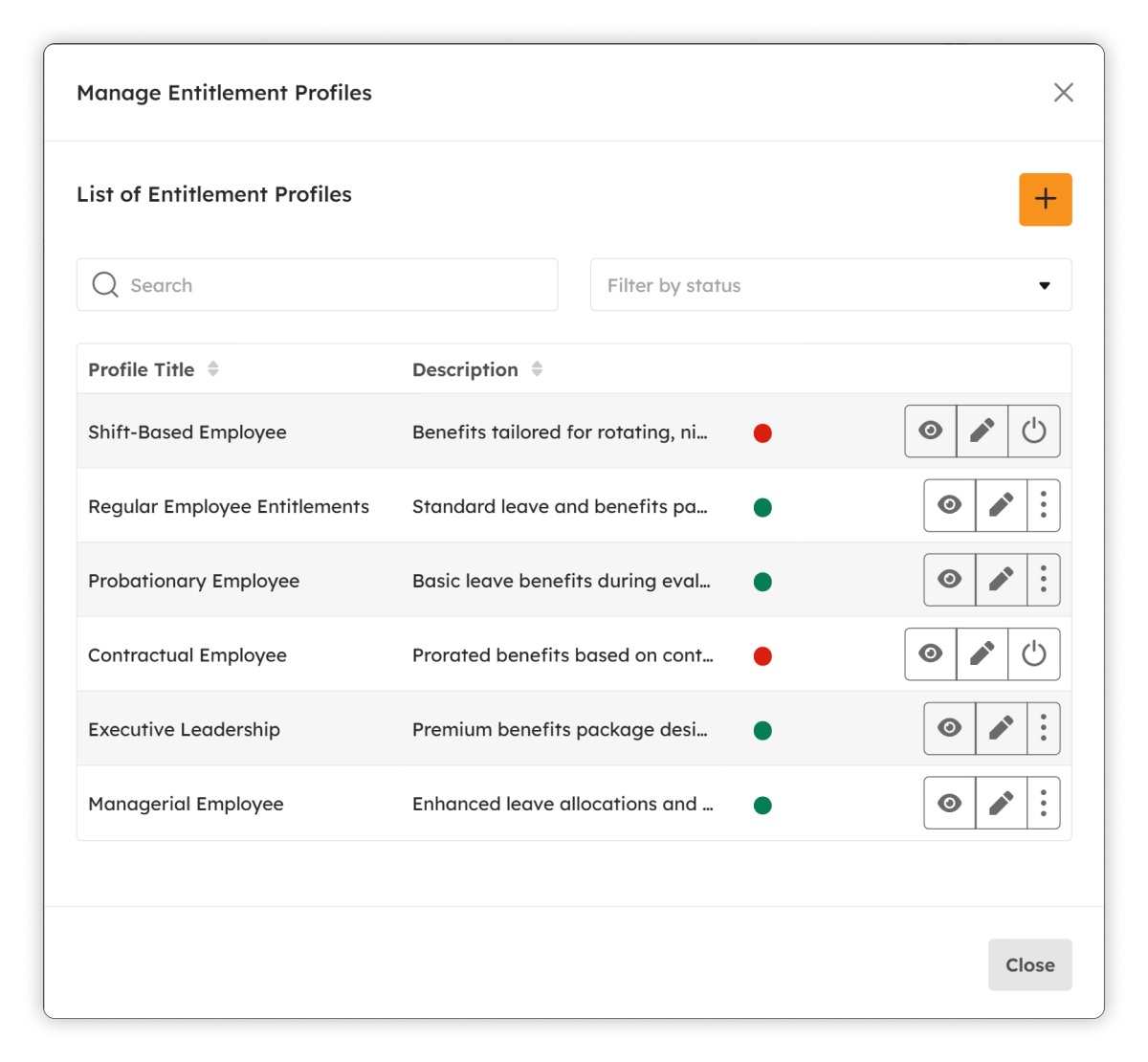
Manage Entitlement Profiles
The Manage Entitlement Profiles window displays all existing entitlement profiles. Each profile contains a profile title, description, status, and available actions.
The following controls and actions are available in the Manage Entitlement Profiles modal.
Search. Locates an entitlement profile by its profile title or related information.
Filter by status. Filters profiles based on their current status.
plus Opens the Create Entitlement Profile modal.
Actions
eyeView Entitlement Profile Opens the selected profile for viewing.
penEdit Entitlement Profile Allows the profile details and entitlements to be modified.
power-offActivate/Deactivate Entitlement Profile Activates/deactivates a specific entitlement profile.
user-plus-altAssign Entitlement Profile Opens the Assign Entitlement Profile modal.
user-minus-altUnassign Entitlement Profile Opens the Unassign Entitlement Profile modal.
Create Entitlement Profiles
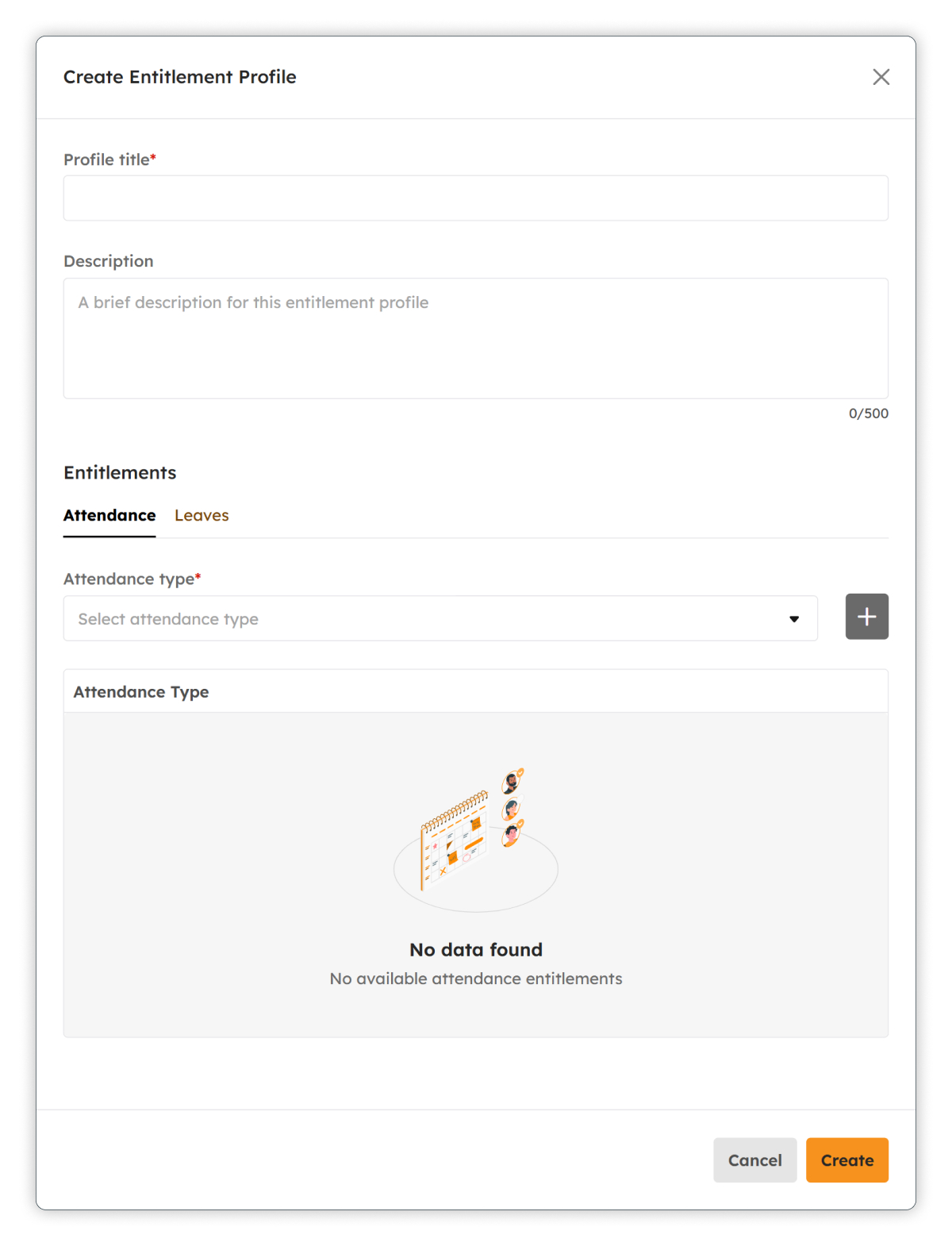
To create a new profile, the administrator selects the plus button. The Create Entitlement Profile window opens, where the profile information and applicable entitlements can be configured.
Complete the following fields to create an entitlement profile:
Profile title. Identifies the entitlement profile. This field is required.
Description. Provides a brief explanation of the profile. The description can contain up to 500 characters.
Add Attendance Entitlements
The Attendance tab allows the administrator to select attendance-related entitlement types that will be included in the profile.
Available attendance entitlement types may include, depending on the system configuration:
Absent
FlexibleSchedule
Late
NightDifferential
OffsetMinus
OffsetPlus
Overtime
RestDay
exclamation-circle
Note
The list shown in the system may vary based on the attendance entitlements configured for the organization.
To include an attendance type in the entitlement profile, complete the steps below:
The administrator chooses the required entitlement from the Attendance Type dropdown.
After clicking the plus button, the selected attendance entitlement is added to the profile.
The selected entitlement appears in the entitlement list and becomes part of the profile.
Add Leave Entitlements
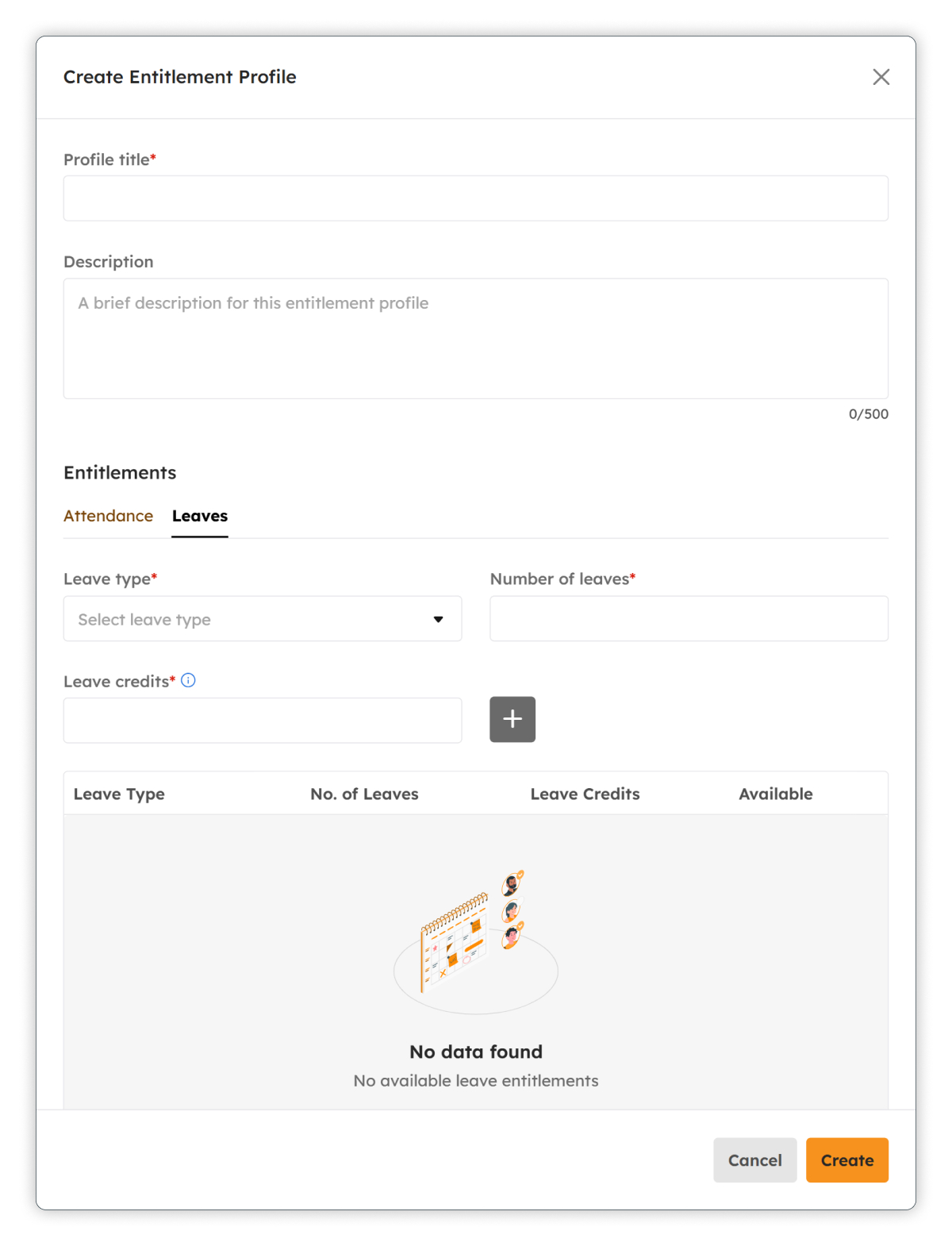
The Leave tab is used to define the leave entitlements included in the profile. A leave type, number of leaves, and leave credits are entered before the entitlement is added.
To include leave type in the entitlement profile, complete the steps below:
The user selects a leave type from the dropdown.
Enter the number of leaves to the corresponding field.
Leave credits field is automatically filled after the number of leaves is entered.
After clicking the plus button, the selected leave type is added to the entitlement profile.
After an entitlement is added, it is displayed in the table with its Leave Type, No. of Leaves, Leave Credits, and Available information. If no leave entitlements have been added yet, the table displays a No data found message.
Save the Entitlement Profile
After the required profile information and entitlements have been configured, the administrator selects Create. The new entitlement profile is then added to the list of available profiles.
To close the Create Entitlement Profile modal without saving the new profile, click Cancel.
Edit Entitlement Profiles
To edit a profile, click the pen button associated with the selected profile. This opens the profile configuration page where changes can be made and saved.
The following fields become editable when the user opens the modal:
Profile title. Identifies the entitlement profile. This field is required.
Description. Provides a brief explanation of the profile. The description can contain up to 500 characters.
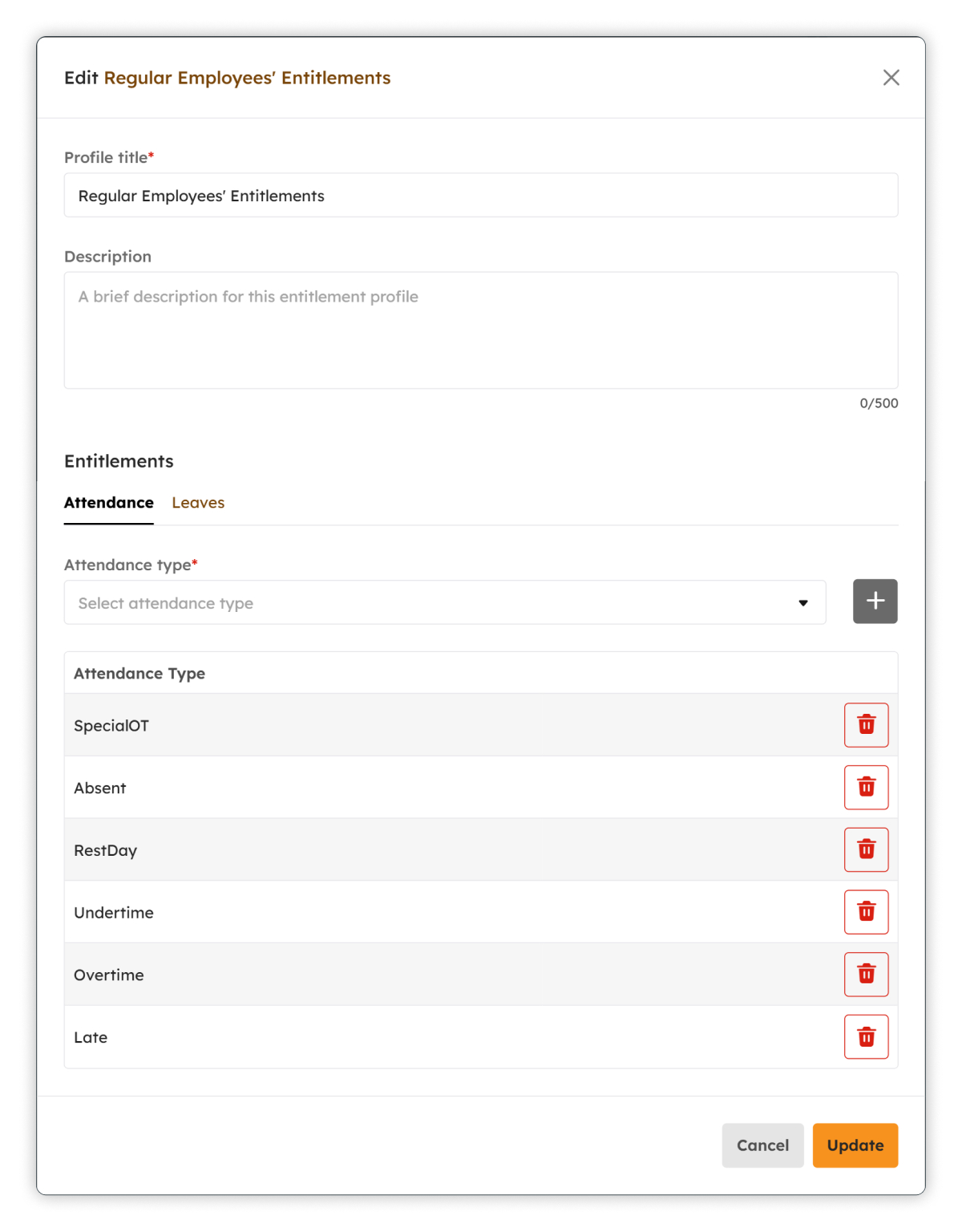
Edit Attendance Entitlements
The following actions can be performed in the Attendance tab:
To add a new attendance type simply follow the instructions below:
Select an attendance type on the dropdown list.
Click the plus button to include it in the profile
To remove an attendance type, click the trash button beside the corresponding entry.
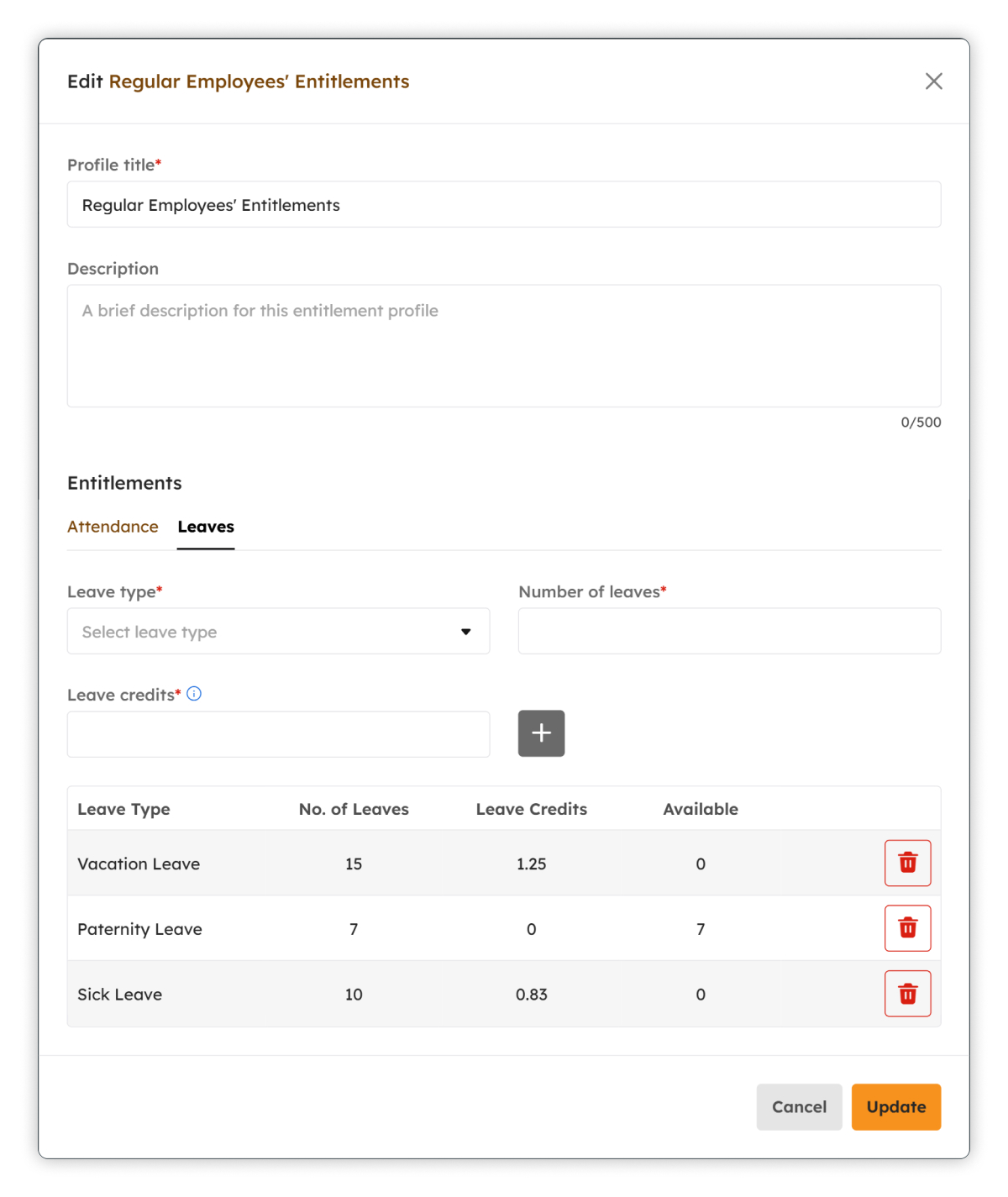
Edit Leave Entitlements
The following actions can be performed in the Leaves tab:
To add a new leave type simply follow the instructions below:
Select a leave type on the dropdown list.
Specify the number of leave days in the designated field. Then, the corresponding leave credits will be filled in automatically.
Click the plus button to include it in the profile
To remove a leave type, click the trash button beside the corresponding entry.
Update the Entitlement Profile
After the required profile information and entitlements have been configured, click Update to save the changes.
To close the Edit Entitlement Profile modal without saving the updated profile, click Cancel.
View Entitlement Profiles
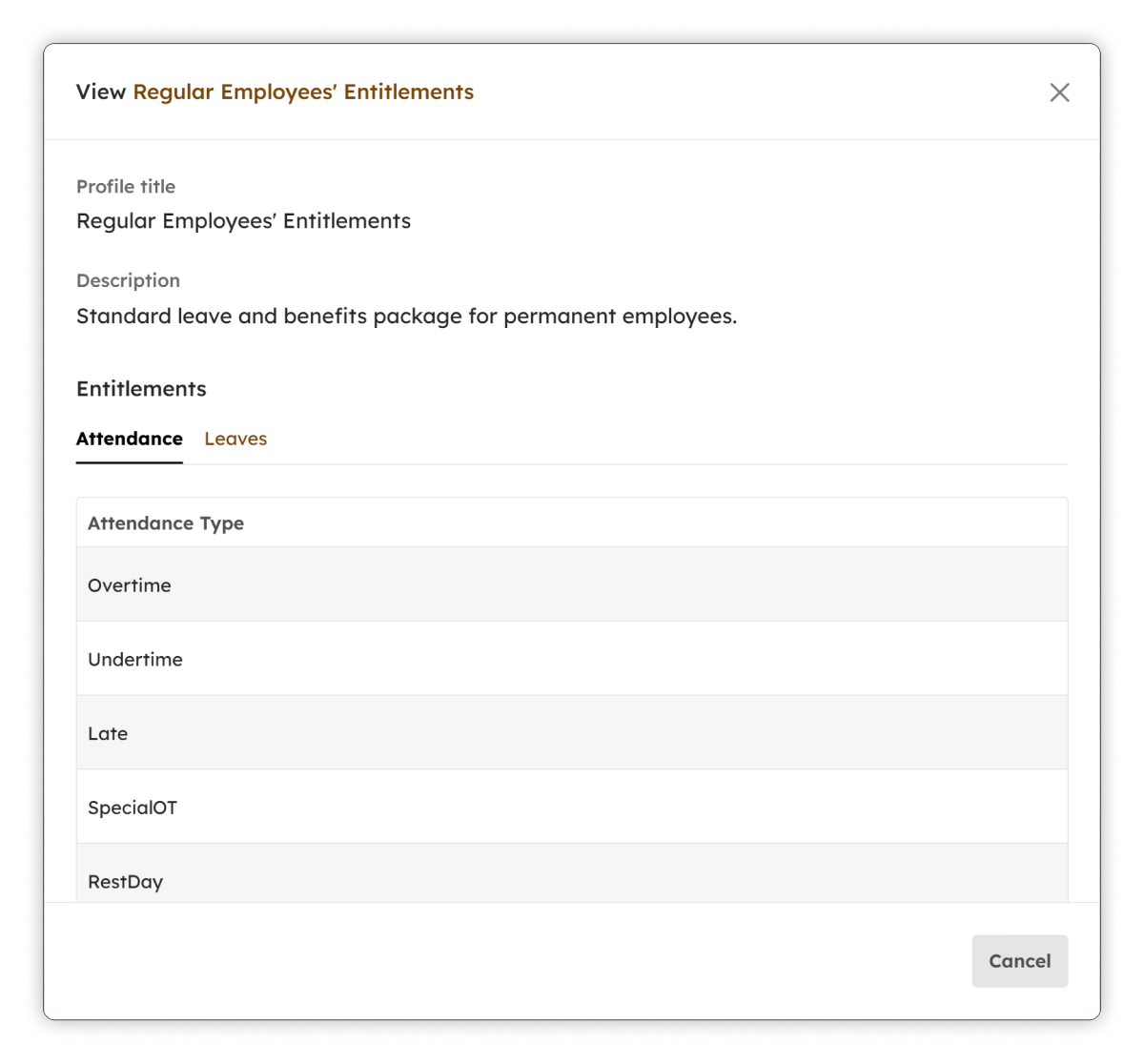
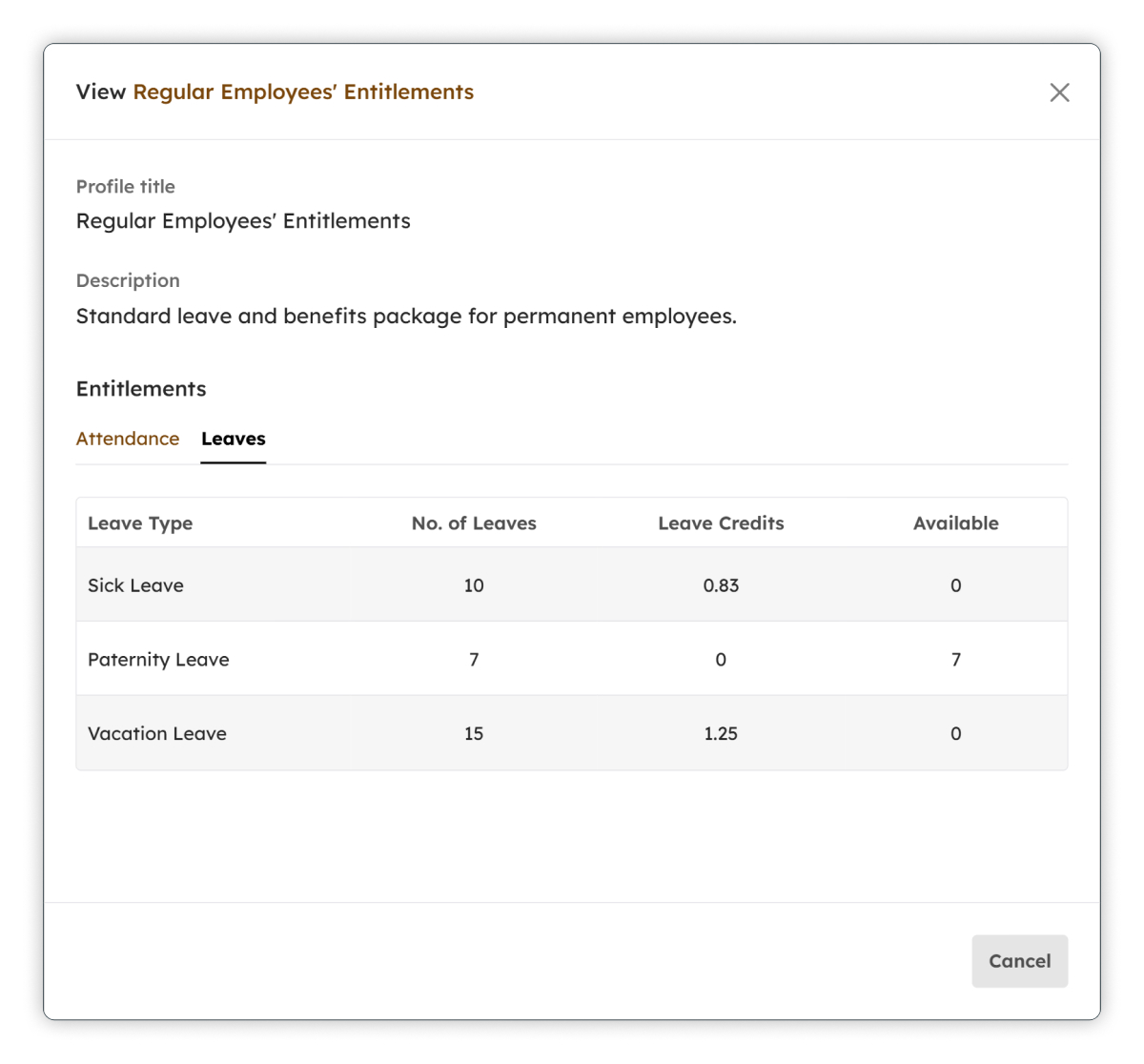
To view an entitlement profile, click the eye button associated with the selected profile.
The modal contains the following information:
Profile title. Displays the name of the entitlement profile.
Description. Displays the description and purpose of the profile.
The Attendance tab displays all attendance types included in the profile.
The Leaves tab displays the leave entitlements assigned to the profile, including:
Leave type. The type of leave included in the profile.
Number of leaves. The total leave days allocated for the leave type.
Leave credits. The corresponding leave credits assigned to the leave type.
Available leaves. The total leave balance available under the entitlement profile.
Assign Entitlement Profile to Employees
An entitlement profile can be applied to multiple employees at the same time. This allows the same set of attendance and leave entitlements to be assigned consistently to employees who share the same entitlement requirements.
To assign an entitlement profile to multiple employees, simply follow this procedure:
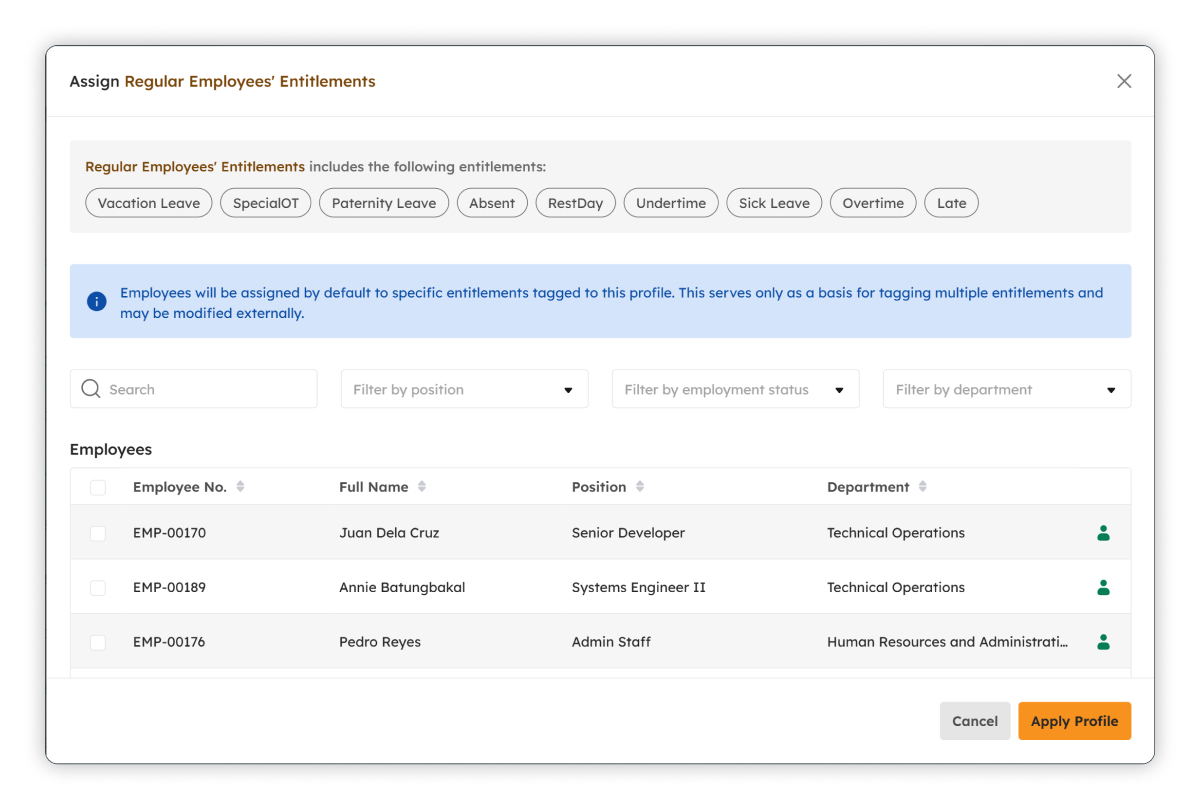
Open the modal by clicking user-plus-alt for the corresponding entitlement profile in the Manage Entitlement Profiles modal.
The following selections and filters can be found in the modal to easily identify the employees who should receive the profile:
Search. Searches for an employee using available employee information.
Filter by position. Narrows the employee list based on position.
Filter by employment status. Narrows the list based on employment status.
Filter by department. Narrows the list based on department.
Tick the checkbox check beside the employee/s to whom the profile will be applied.
After making your selection/s, click the Apply Profile button.
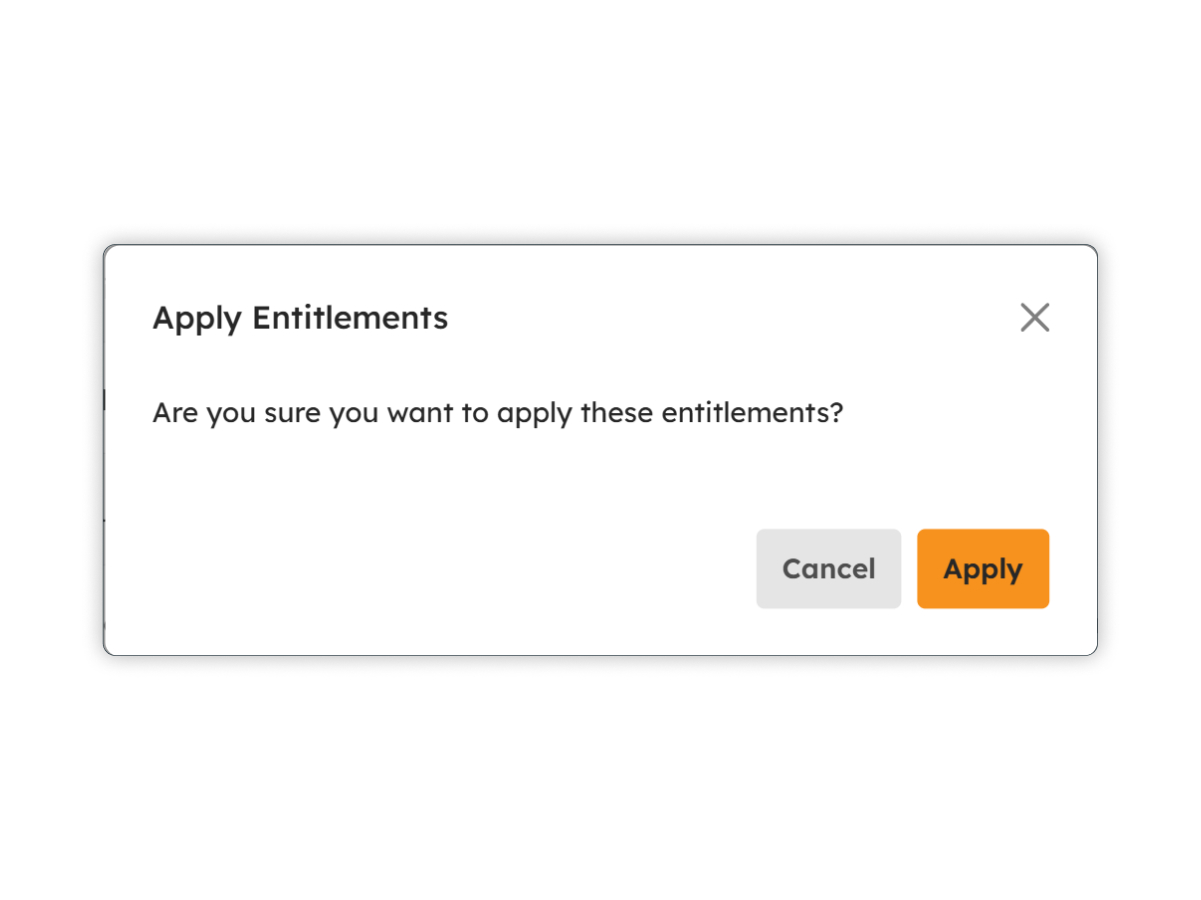
Click Apply button on the confirmation modal that will appear to update the employee/s entitlements.
Otherwise, click Cancel to discard changes.
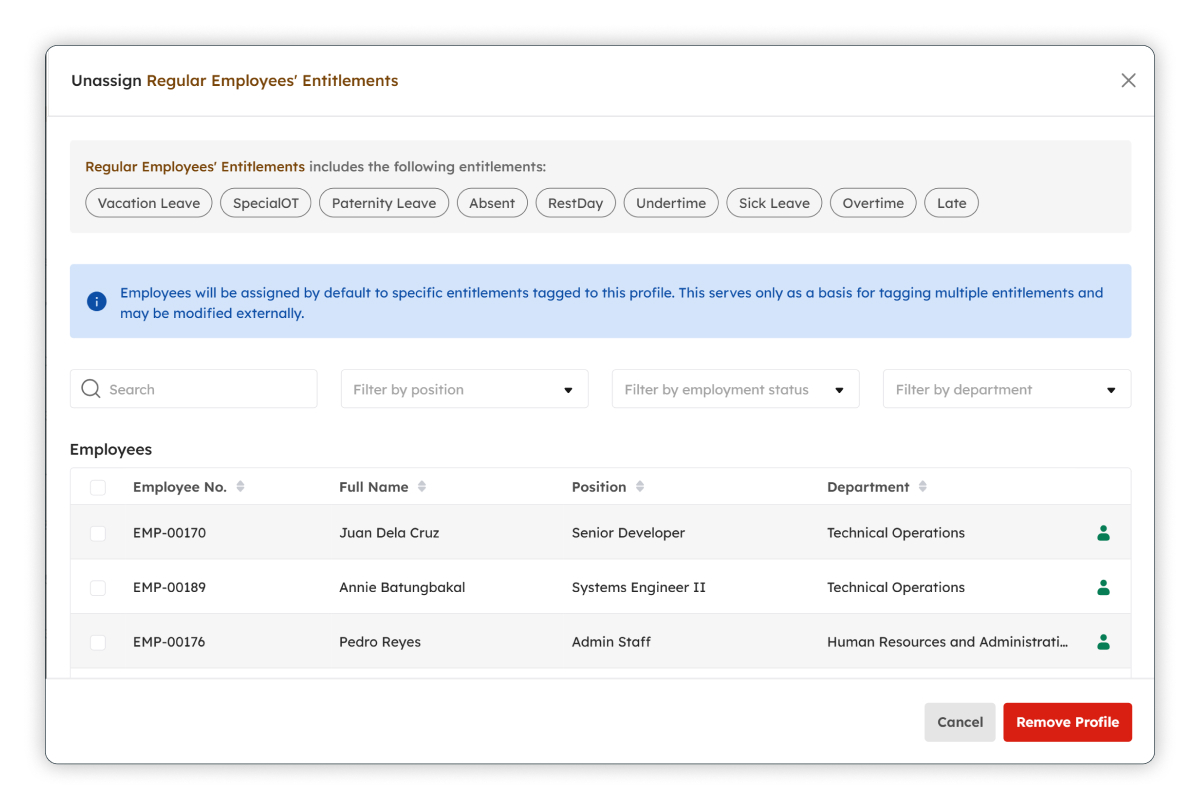
Unassign Entitlement Profile to Employees
An entitlement profile can be removed from multiple employees at the same time. This is useful when employees no longer need the entitlements included in the profile.
To unassign an entitlement profile to multiple employees, simply follow this procedure:
Open the modal by clicking user-minus-alt for the corresponding entitlement profile in the Manage Entitlement Profiles modal.
Use the available selections and filters in this modal to quickly find the employees to unassign from the entitlement profile:
Search. Searches for an employee using available employee information.
Filter by position. Narrows the employee list based on position.
Filter by employment status. Narrows the list based on employment status.
Filter by department. Narrows the list based on department.
Tick the checkbox check beside the employee/s to whom the profile will be removed.
After making your selection/s, click the Remove Profile button.
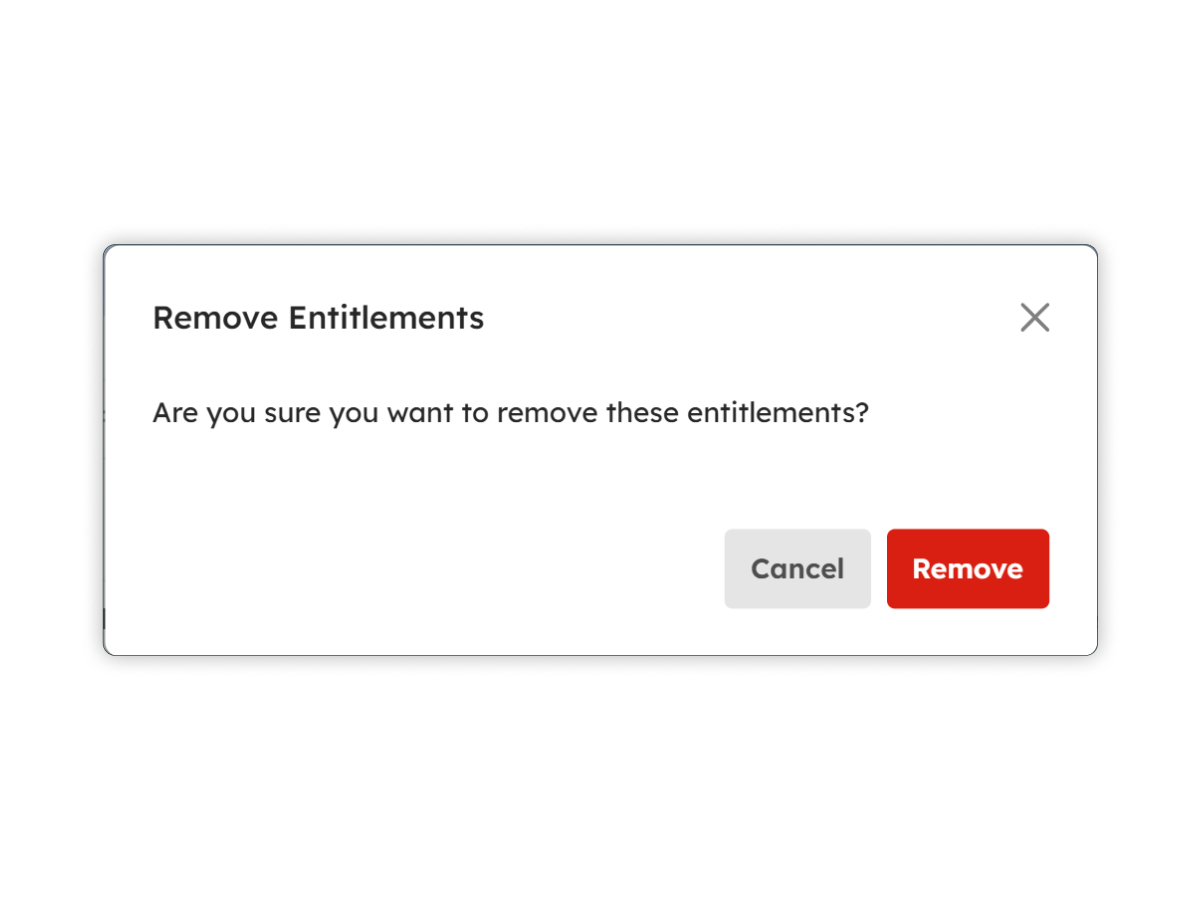
Click Remove button on the confirmation modal that will appear to update the employee/s entitlements.
Otherwise, click Cancel to discard changes.
Manage Leave Types
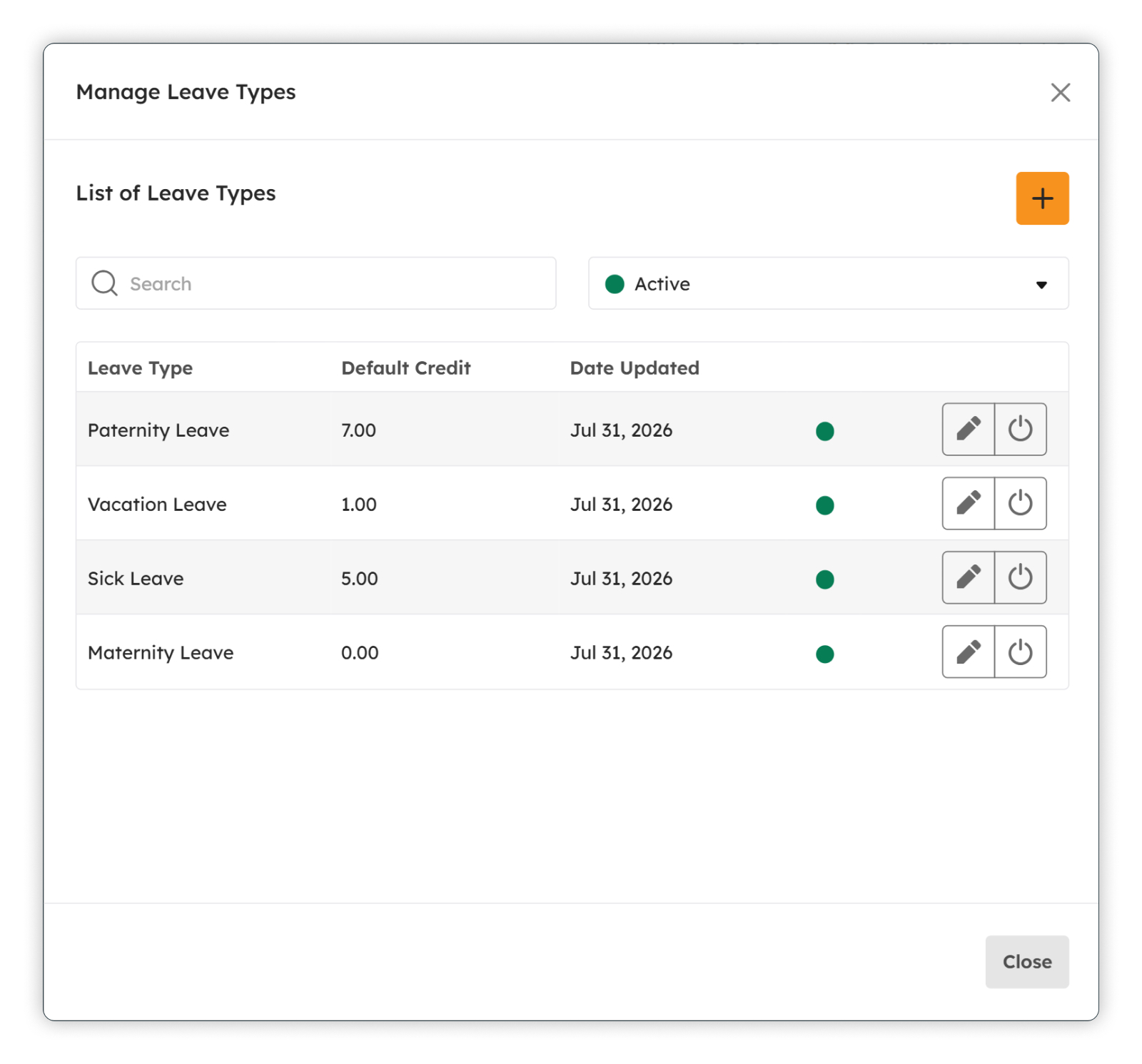
The Manage Leave Types modal allows administrators to view and manage all leave types available in the system. It provides options to create new leave types, search and filter existing records, update leave type details, and manage their availability.
The following controls and actions are available in the Manage Leave Types modal.
Search. Locates a leave type by its title or other related information.
Filter by status. Filters leave types based on their current status.
plus Opens the Create Leave Type modal.
Actions
pen Edit Leave Type
power-off Activate/Deactivate Leave Type
Create Leave Type
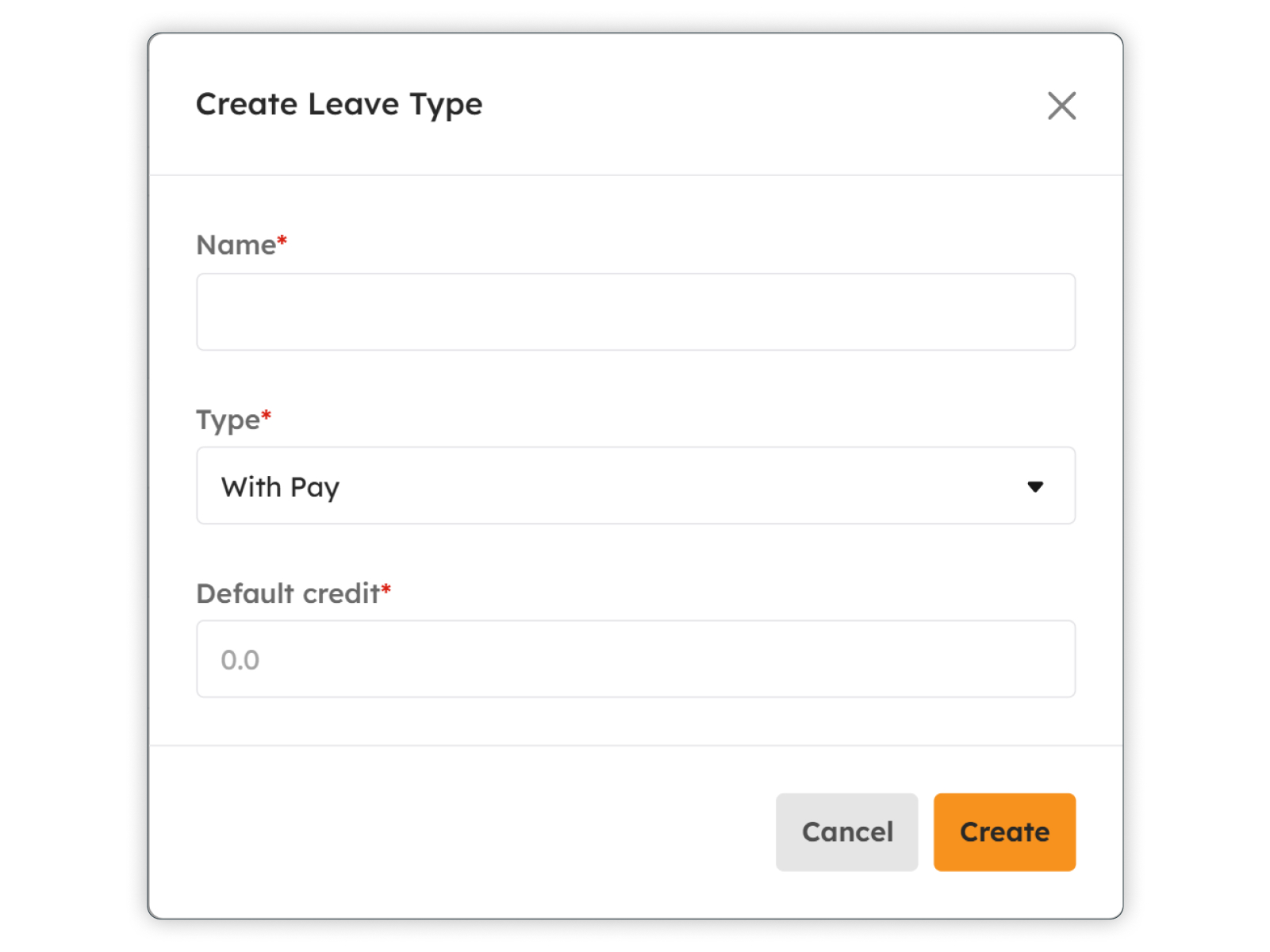
This creates a new leave type that will be added to the list of available leave types and can be assigned to entitlement profiles as needed. A new leave type can be created by following the steps below.
Click the plus button to open the Create Leave Type modal.
Fill out all required information:
Name. The name should clearly identify the leave category.
Type. Specify whether this leave type is with pay or without pay.
Default credit. Select on the dropdown list whether the leave type is with/without pay.
Click the Create to create and save it to the leave types
Edit Leave Type
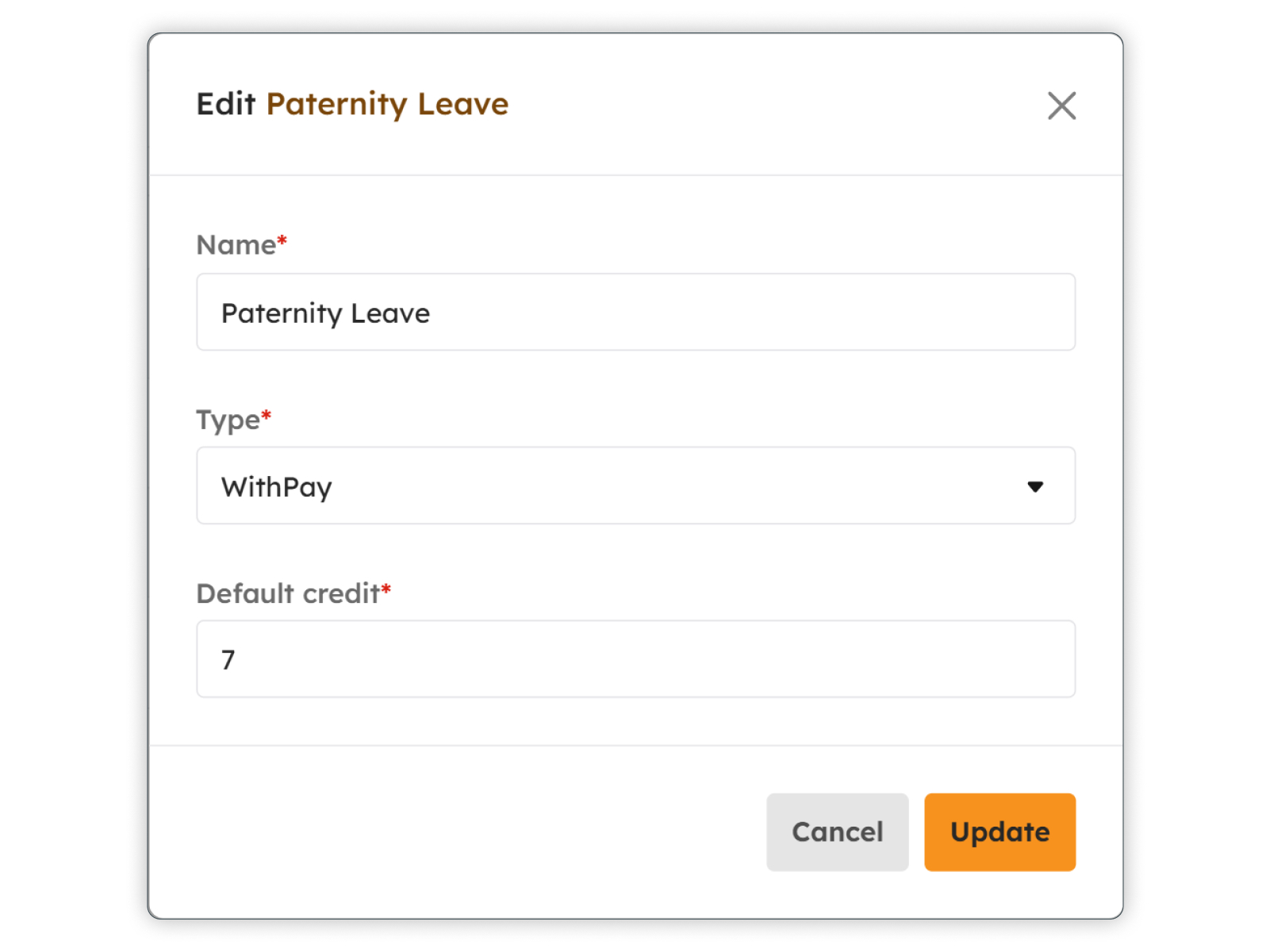
This feature allows administrators to modify the details of an existing leave type, such as its name, pay classification, and default leave credits. Changes made to the leave type will be reflected wherever it is used in the system. To edit a leave type, follow the steps below.
Click the pen button next to the leave type you want to edit.
The following fields are now editable:
Name. The name should clearly identify the leave category.
Type. Specify whether this leave type is with pay or without pay.
Default credit. Select on the dropdown list whether the leave type is with/without pay.
Click the Update to save the changes.
To close the modal without changing any information, click Cancel.
Activate/Deactivate Leave Type
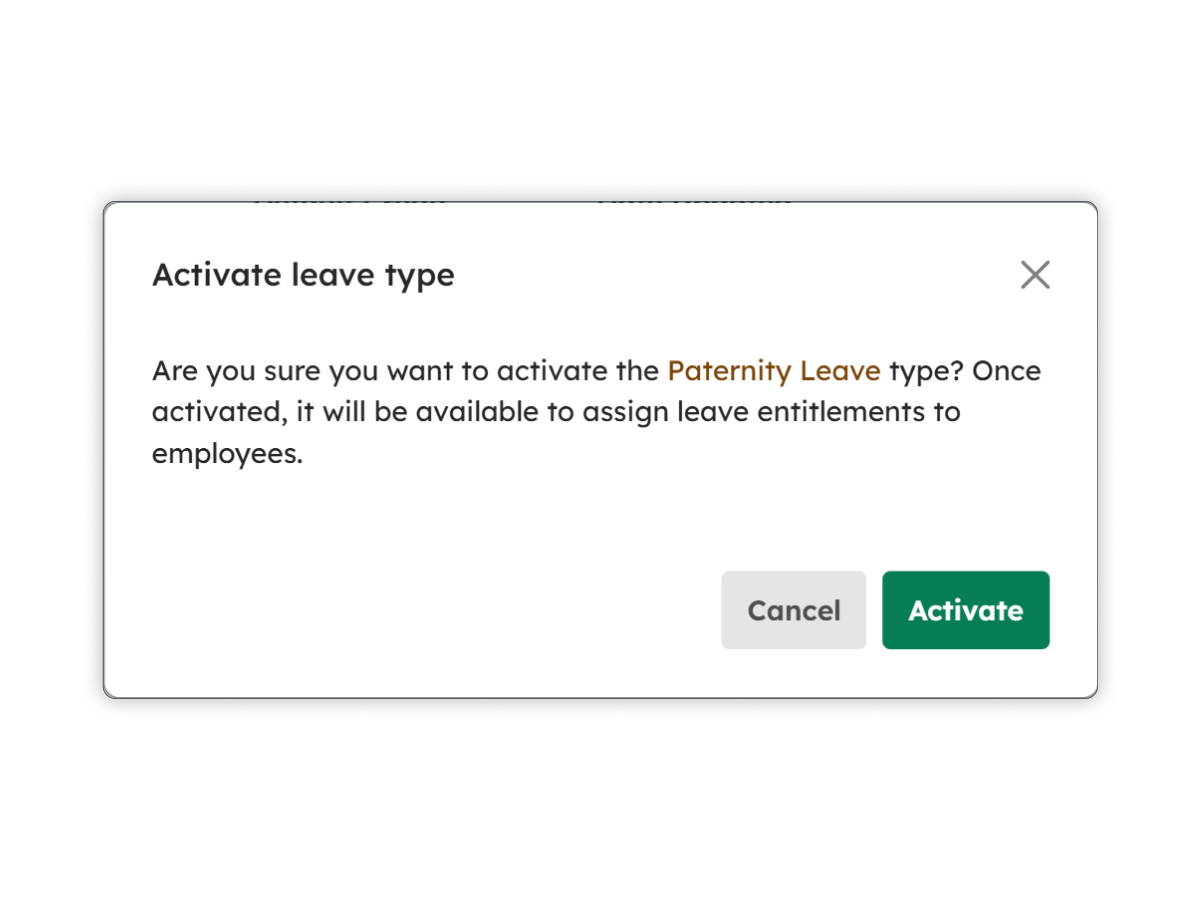
To activate a leave type, simply click power-off button of an inactive leave type to activate it.
Then, confirm changes by clicking Activate. Otherwise, click Cancel.
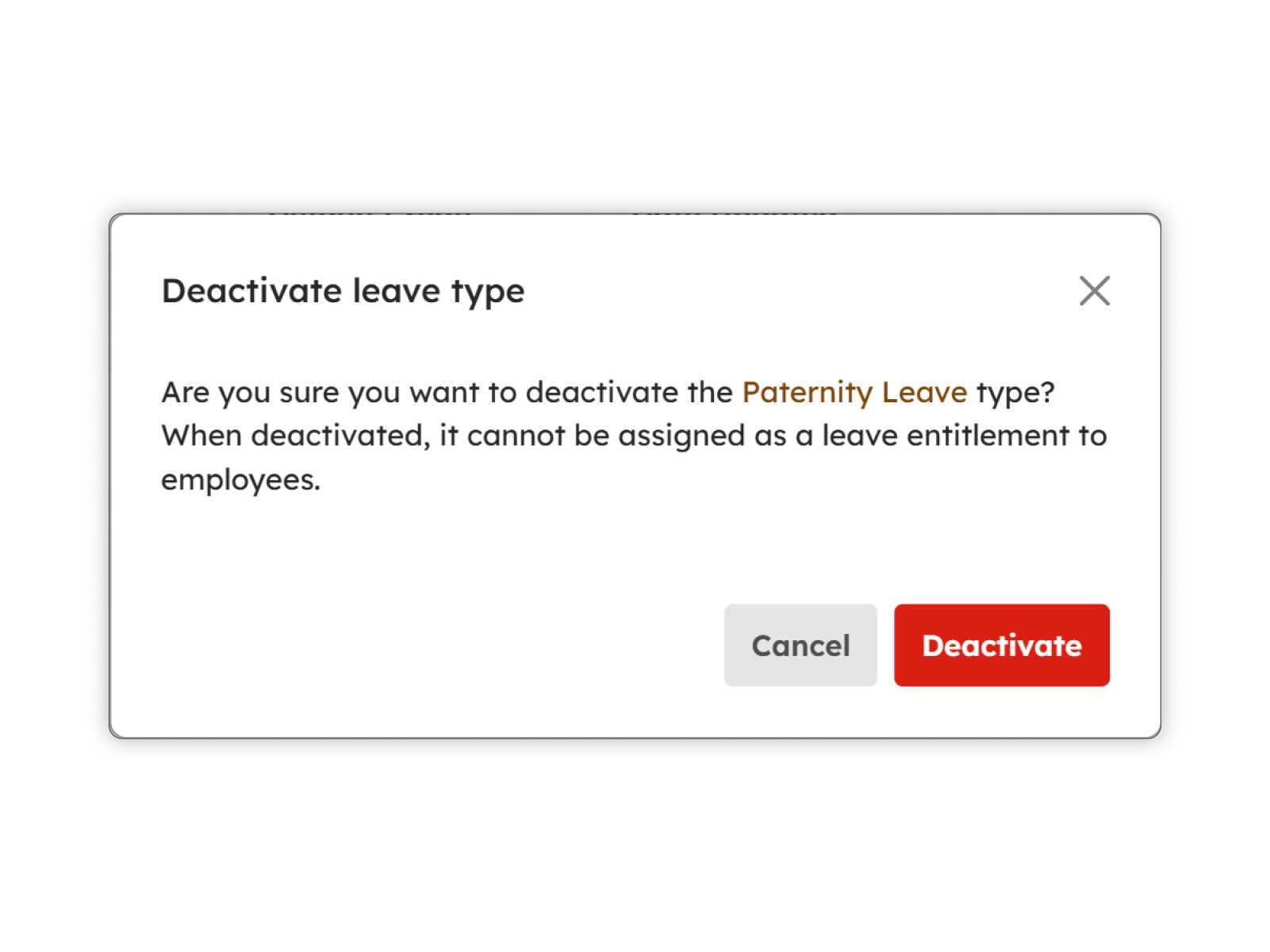
Deactivating a leave type is just as simple. Just click power-off button of an active leave type to deactivate it.
Then, confirm changes by clicking Deactivate. Otherwise, click Cancel.
Schedules
Introduction to Employee Schedules Page
This page manages and maintains information related to the work schedules of employees within the company. It is designed to assist in the effective scheduling and tracking of employee working hours, shifts, and availability.
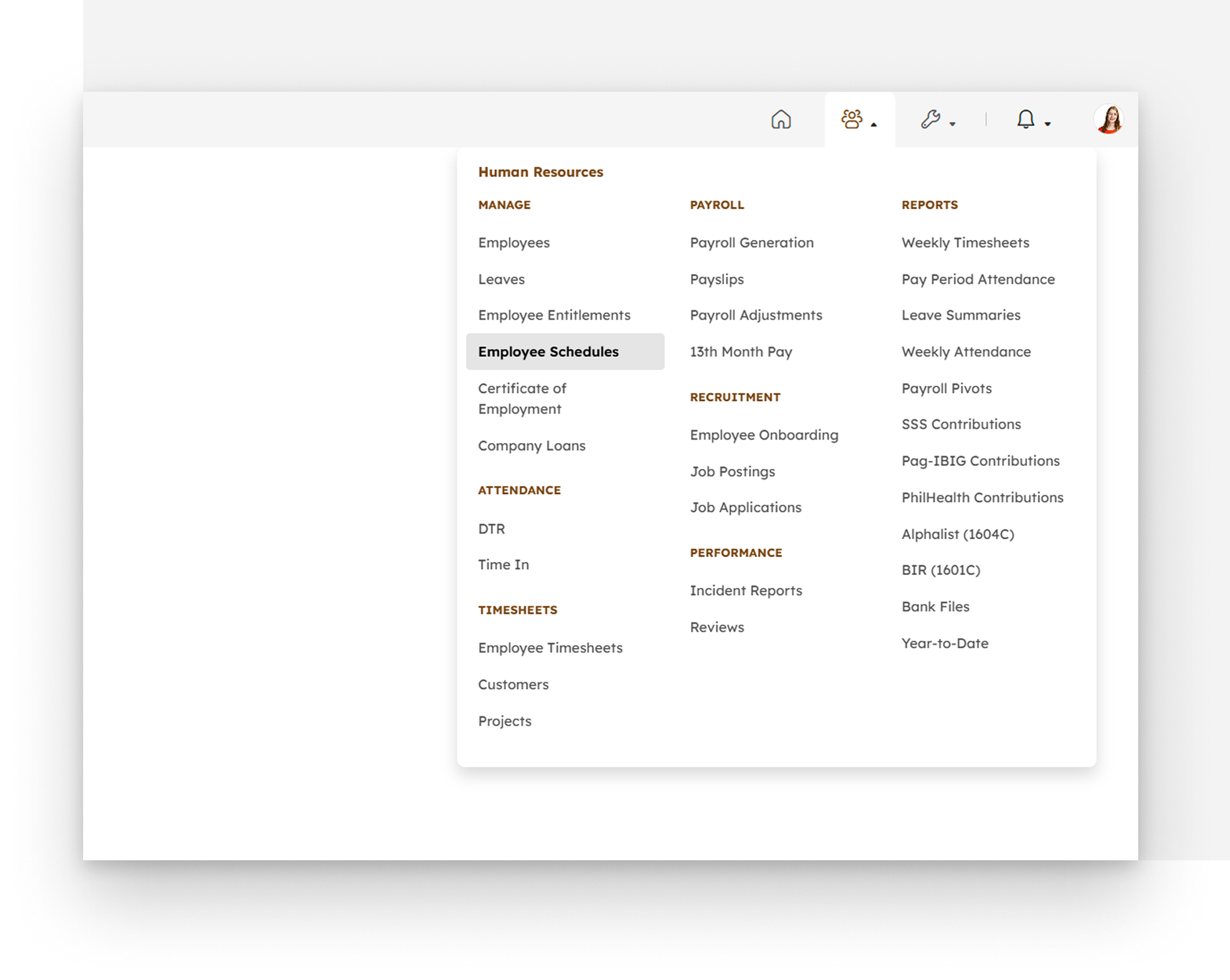
To access this page, navigate to the Human Resources Module by selecting 'Employee Schedules' under the Manage submodule, as shown in the image below.
Features in Employee Schedules Page
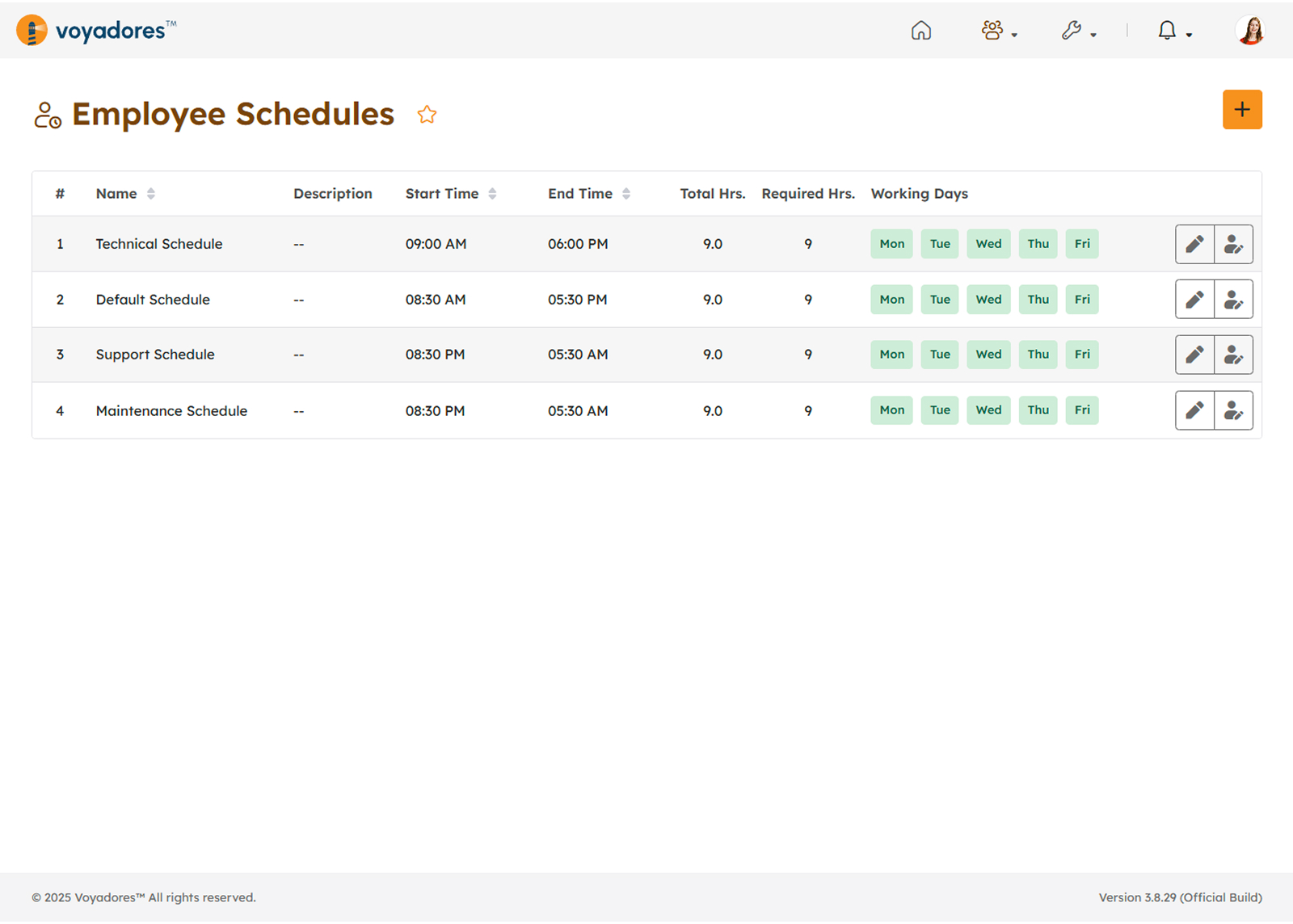
The snip below is the high-level view of the employees schedule page along with its built-in features.
Schedules Page Header Actions
home-dash
Set as Default Page
star
Add to Quick Links
plus
Create Schedule
Preview Entitlements
Schedules Summary Table
The summary table displays the list of Schedules with the following columns:
Name
Description
Time
Break Periods
Total Hours
Required Hours
Working Days
Action
pen Edit Schedule
mug-hot Add Breaktime
user-edit Assign Schedule
eye View Working Hours
Create Employee Schedule
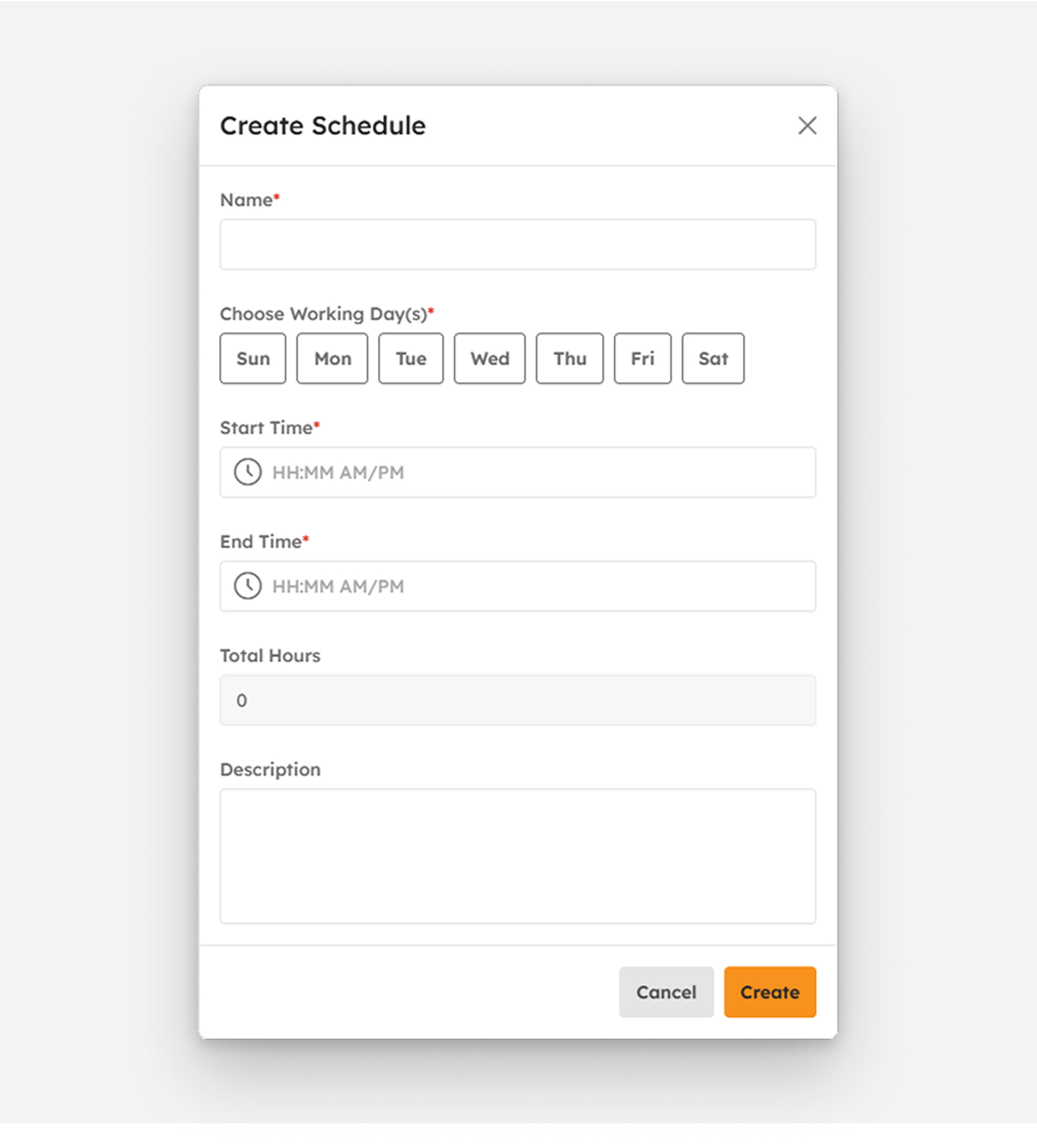
Click the plus Create button.
Fill in Schedule details.
Name
Start Time
End Time
Total Hours (automatically filled)
Working Days
Description
Click the Create button.
A successful notification will show:
Schedule successfully created
Step 3 will successfully create a new schedule otherwise, proceed to Step 6.
Click the Cancel button to cancel the creation of new schedule.
The screen closes the modal.
The system will not proceed on creation of new employees schedule.
Edit Employee Schedule
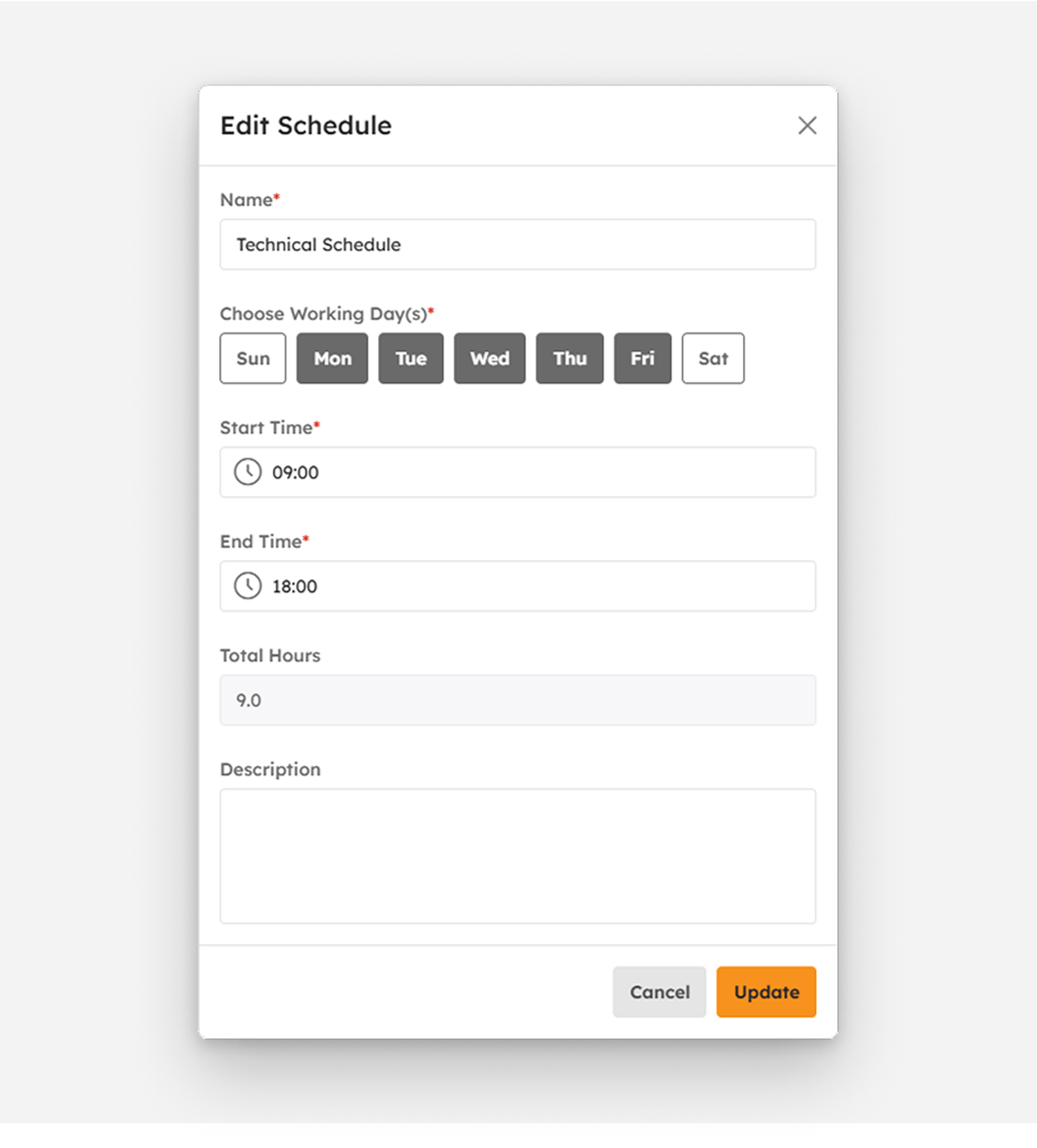
Click the pen Edit button.
The following fields become editable when the user opens the modal:
Name. Identifies the role or group of employees this schedule is intended for
For flexible schedules, the user can customize the start and end time for each working day.
Working Days Tick the checkbox check beside the day the employee is scheduled to work.
Start Time Specify the time the employee starts work for the selected day.
End Time Specify the time the employee ends work for the selected day.
exclamation-circle
Note
The start and end times you set apply only to the corresponding day, allowing different schedules for different days.
Description. A brief summary of the schedule, including its purpose, working days, work hours, or any special scheduling requirements.
Click the Update button.
A successful notification will show:
Schedule successfully updated
Step 3 will successfully update schedule details otherwise, proceed to Step 6.
Click the Cancel button to cancel updating the work schedule.
The screen closes the modal.
The system will not proceed with updating the work schedule.
Assign Employees Schedule
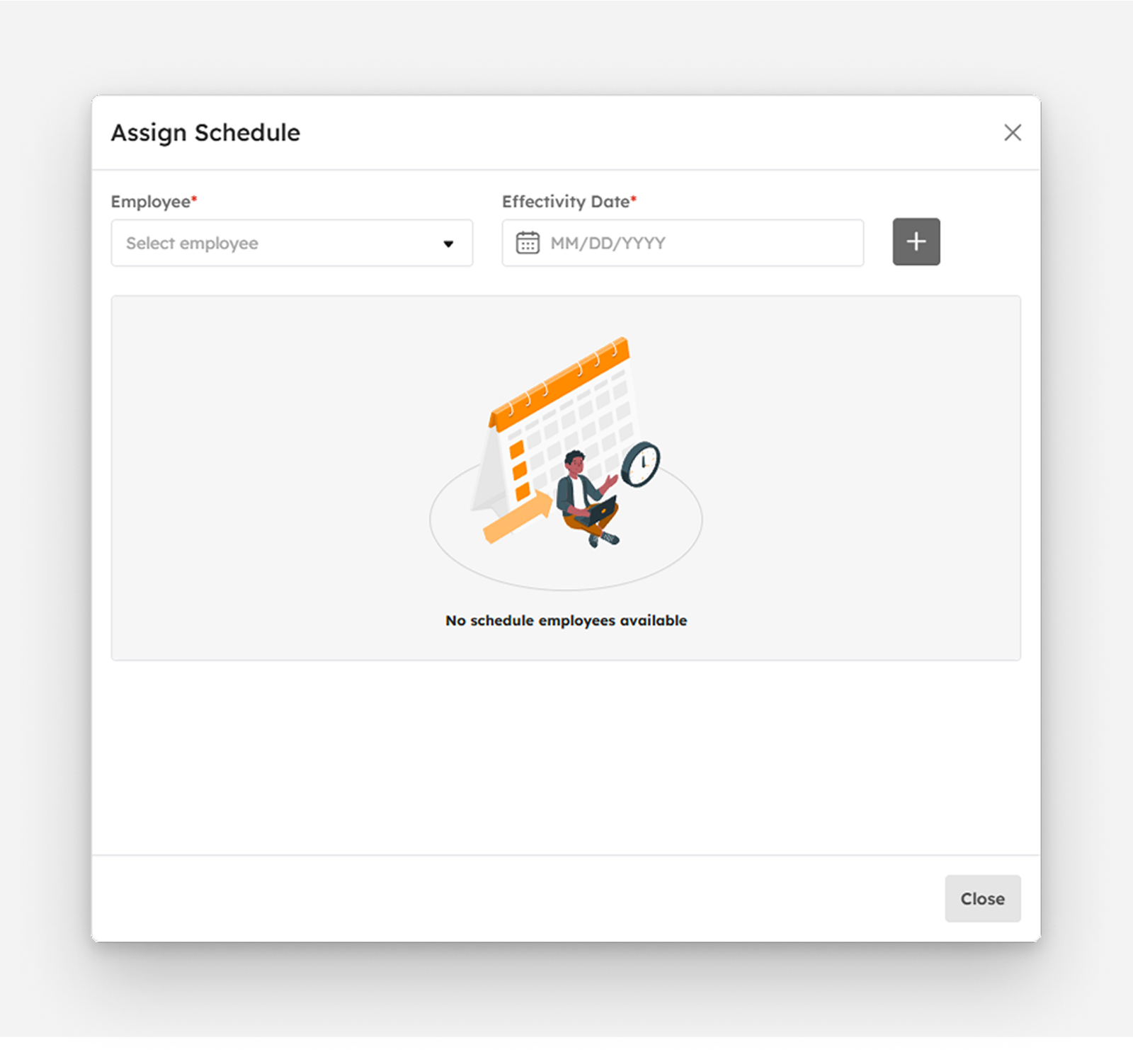
The Assign Schedule modal allows entitlement profiles to be assigned to employees. To open this modal, click the user-edit button.
The first section of the modal shows schedule information such as:
Schedule Name. The name of the selected schedule.
Working Days. The days included in the schedule.
Time. The scheduled start and end times.
To add an employee to the schedule assignment list, follow the procedure below:
Select an employee from the dropdown list.
Select the date when the schedule should take effect in the Effectivity date field.
exclamation-circle
Note
The effectivity date takes priority when attendance is generated. Existing attendance records may be updated or overwritten based on the selected date.
Add the employee by clicking plus
The table at the bottom of the modal displays all employees assigned to the schedule.
Employee Name. The assigned employee.
Effectivity Date. The date the schedule becomes active.
Status. Indicates whether the assignment is active or inactive.
Actions
power-offActivate/Deactivate Employee Schedule. Temporarily enables/disables the employee's schedule assignment.
trashRemove Employee Schedule. Removes the employee from the schedule.
Add Breaktime
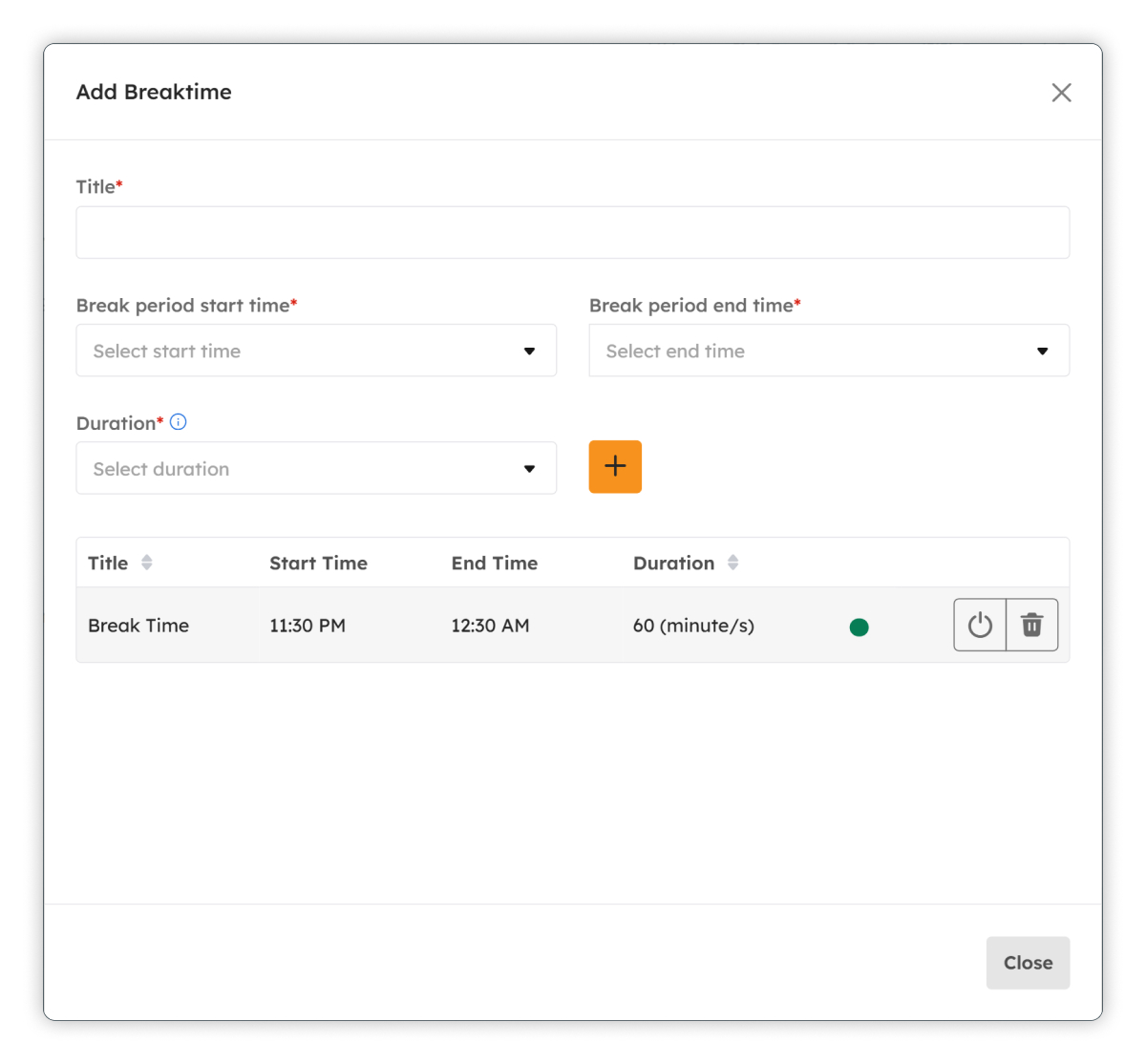
Break Time, also referred to as a Break Period, is used to define the break periods that apply to a created employee schedule. It allows an administrator to specify when a scheduled break starts and ends and to organize the break periods associated with a schedule.
To add a break period to a created schedule, the administrator selects the mug-hot button for the applicable schedule. The Add Breaktime window opens and provides the fields needed to define the break period.
exclamation-circle
Note
Each created schedule can have one or more break periods, such as a morning break, lunch, or afternoon break.
The first section of the modal allows the administrator to add a break period:
Enter a descriptive name for the break period.
Select the time when the break period begins from the duration dropdown list.
Select the time when the break period ends from the duration dropdown list.
Select the applicable break duration from the duration dropdown list.
Click the plus to add the break period to the table below.
The table at the bottom of the modal displays the configured break period's title, start time, end time, duration, and current status.
Title. Displays the name assigned to the break period.
Start Time. Displays the configured beginning of the break.
End Time. Displays the configured ending of the break.
Duration. Displays the configured break duration.
Status. Indicates whether the break period is active.
Actions
power-offActivate/Deactivate Breaktime. Allows the break period to be enabled or disabled, where applicable.
trashDelete Breaktime. Removes the break period from the schedule.
Certificate of Employment
Introduction to the Certificate of Employment Page
This page manages and maintains information related to the generation of Certificates of Employment for company employees. It is designed to assist in efficiently creating, viewing, and issuing certificates that confirm an employee’s job title, employment duration, and work status.
The overall function of this page is to allow employees to request a Certificate of Employment, track the status of their requests, and enable authorized users to approve, reject, or release certificates. It also supports HR-initiated COE issuance and provides features for setting validity periods, including salary details, and sending certificates via email.
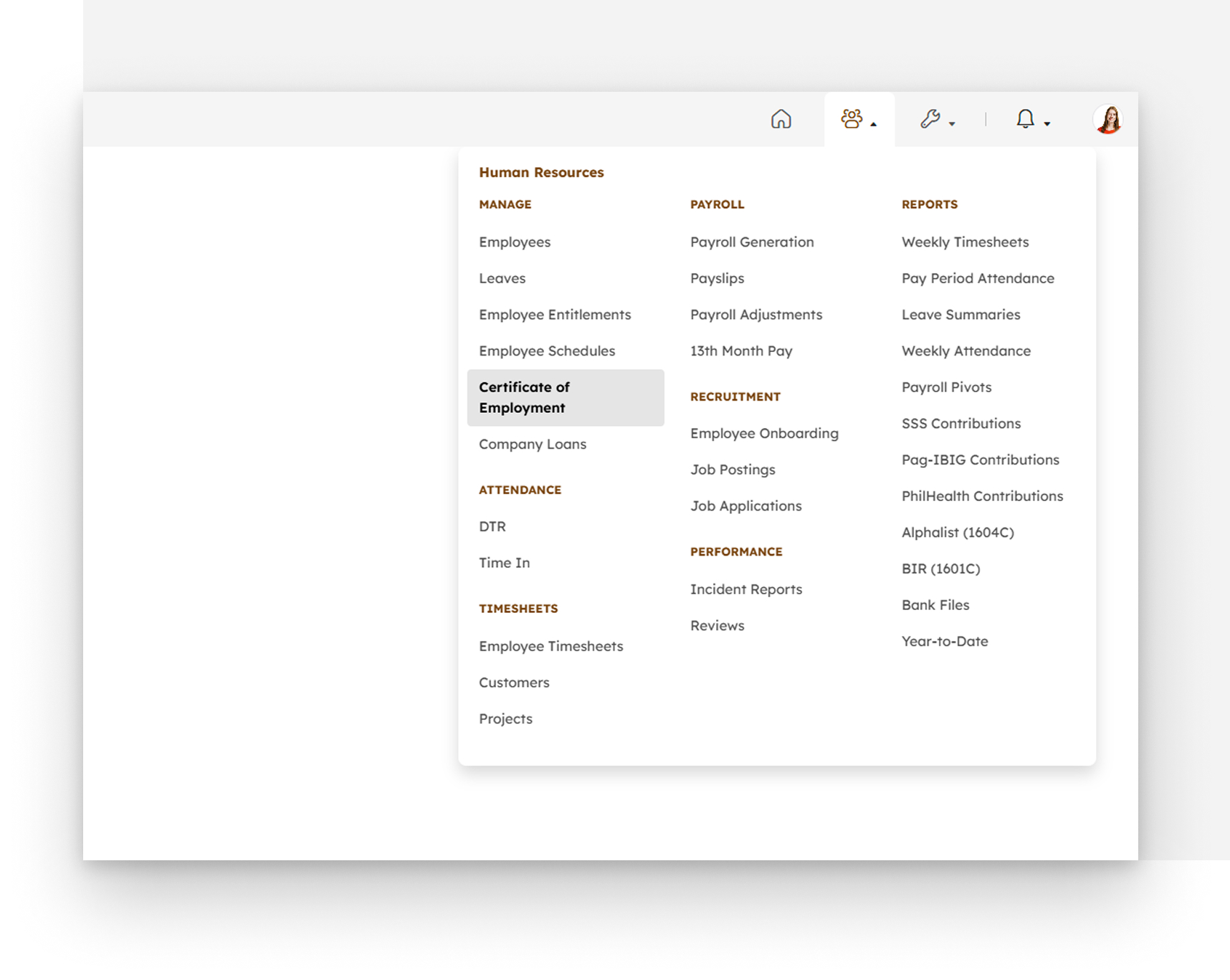
To access this page, navigate to the Human Resources Module by selecting 'Certificate of Employment' under the Manage submodule, as shown in the image below.
Applications Tab
This page manages and maintains information related to the generation of Certificates of Employment for company employees. It is designed to assist in efficiently creating, viewing, and issuing certificates that confirm an employee’s job title, employment duration, and work status.
Certificate of Employment Page Header Actions
home-dash
Set as Default Page
star
Add to Quick Links
file-upload
Request COE
file-export-alt
Issue COE
Certificate of Employment Summary Table
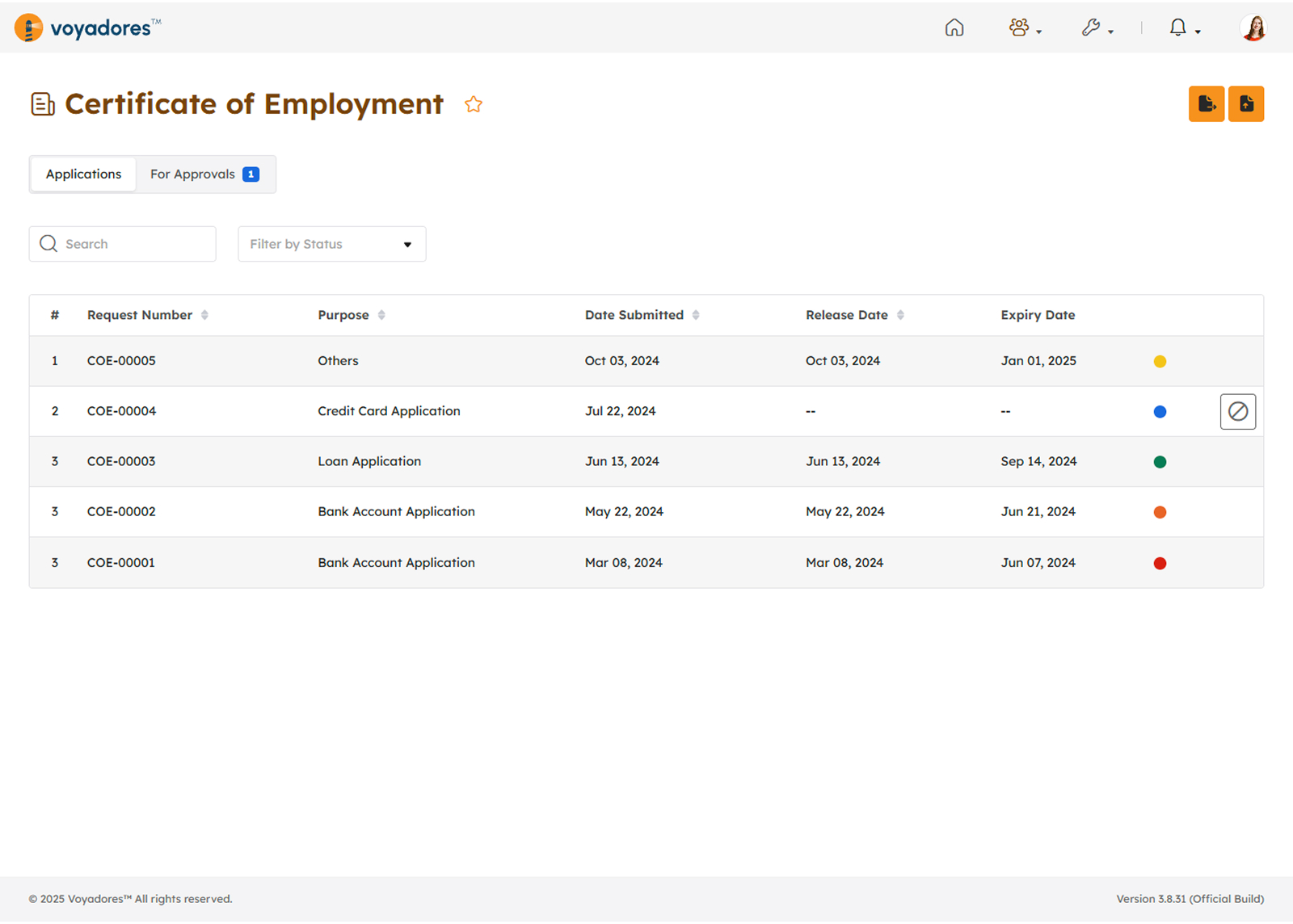
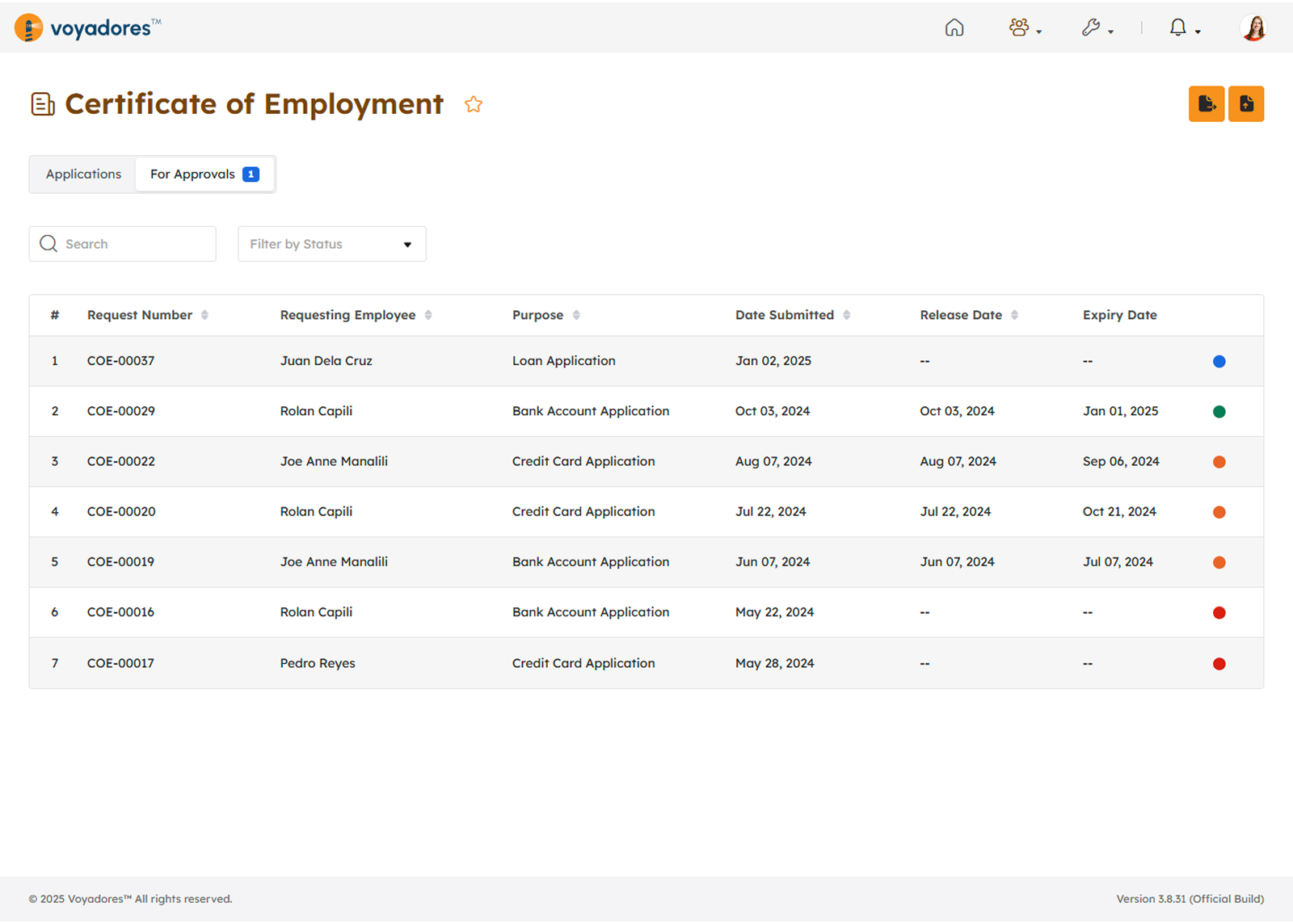
The Applications tab under the Certificate of Employment page displays all submitted certificate requests by employees along with their corresponding details and status. The summary table contains the following columns:
Request Number
Purpose
Date Submitted
Release Date
Expiry Date
Status
Action
ban Cancel Request
file-text Preview COE PDF
Searching Certificate of Employment Requests
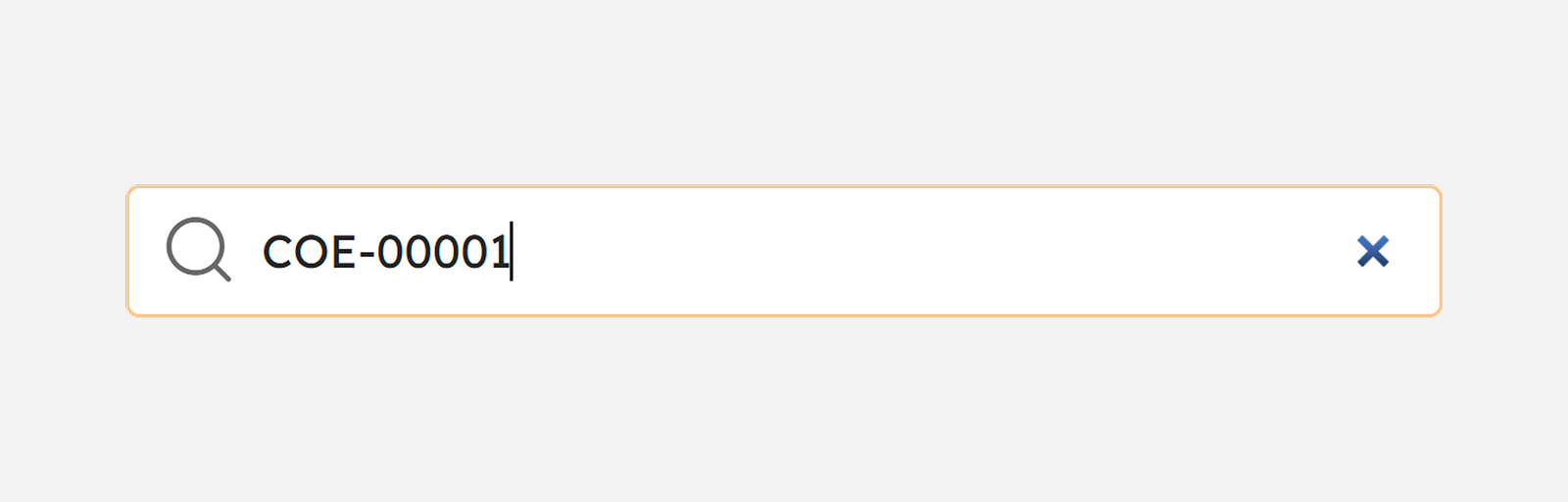
This feature allows users to search Certificate of Employment requests using the following criteria:
Request Number
Requesting Employee
Purpose
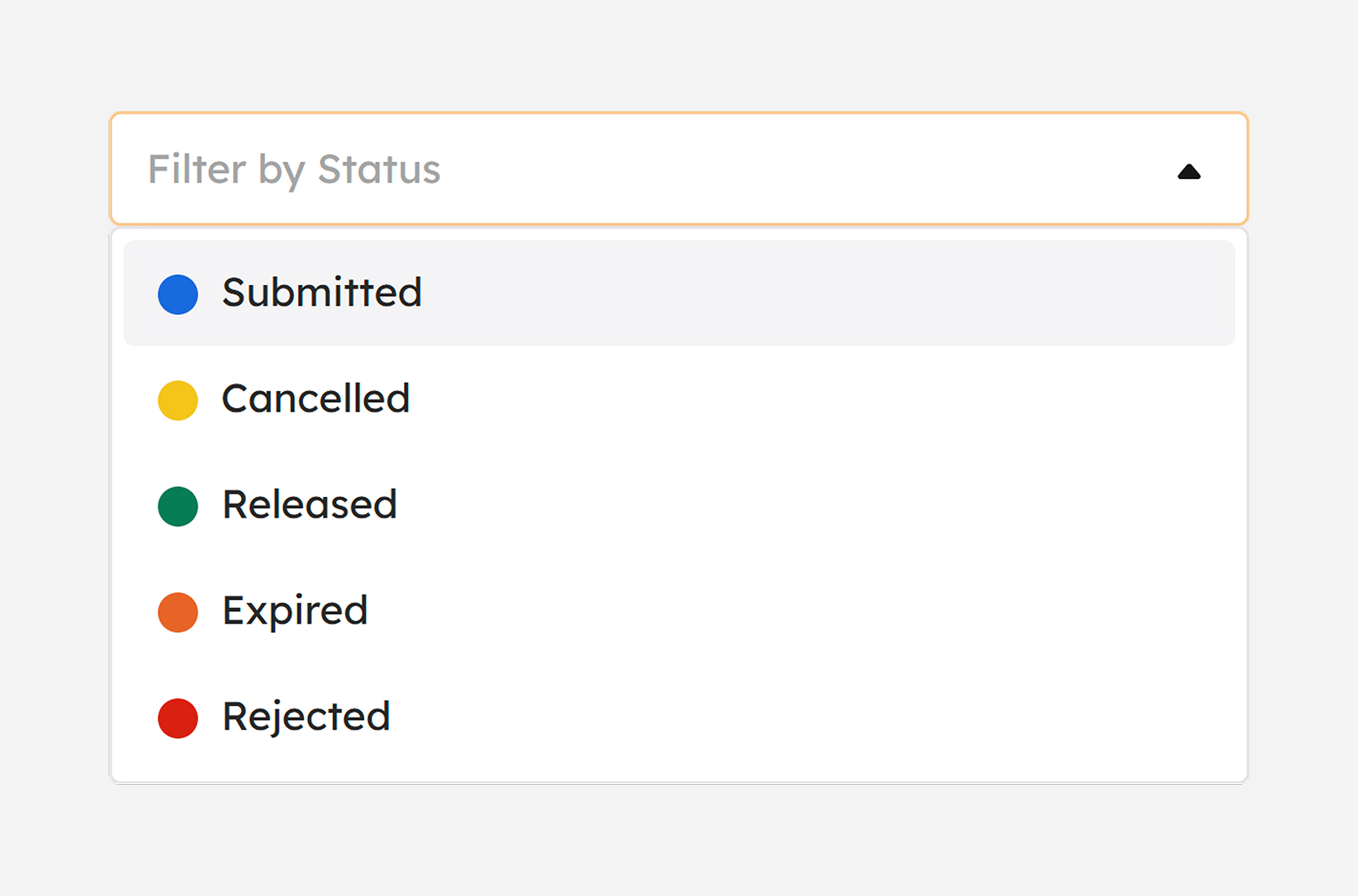
Filtering Certificate of Employment by Status
This feature allows users to filter Certificate of Employment applications by status.
Submitted. This blue-colored status displays all applications that have been submitted and are pending review. Click the filter-by-status drop-down and select “Submitted”.
Cancelled. This yellow-colored status shows applications that have been voluntarily cancelled by the employee. Click the filter-by-status drop-down and select “Cancelled”.
Released. This green-colored status indicates that the Certificate of Employment has been approved and officially released. Click the filter-by-status drop-down and select “Released”.
Expired. This orange-colored status represents applications that are no longer valid due to the expiration of their indicated validity period. Click the filter-by-status drop-down and select “Expired” to view expired records.
Rejected. This red-colored status shows applications that have been reviewed but were not approved. Click the filter-by-status drop-down and select “Rejected”.
Requesting COE
Follow the systematic guide below to request COE:
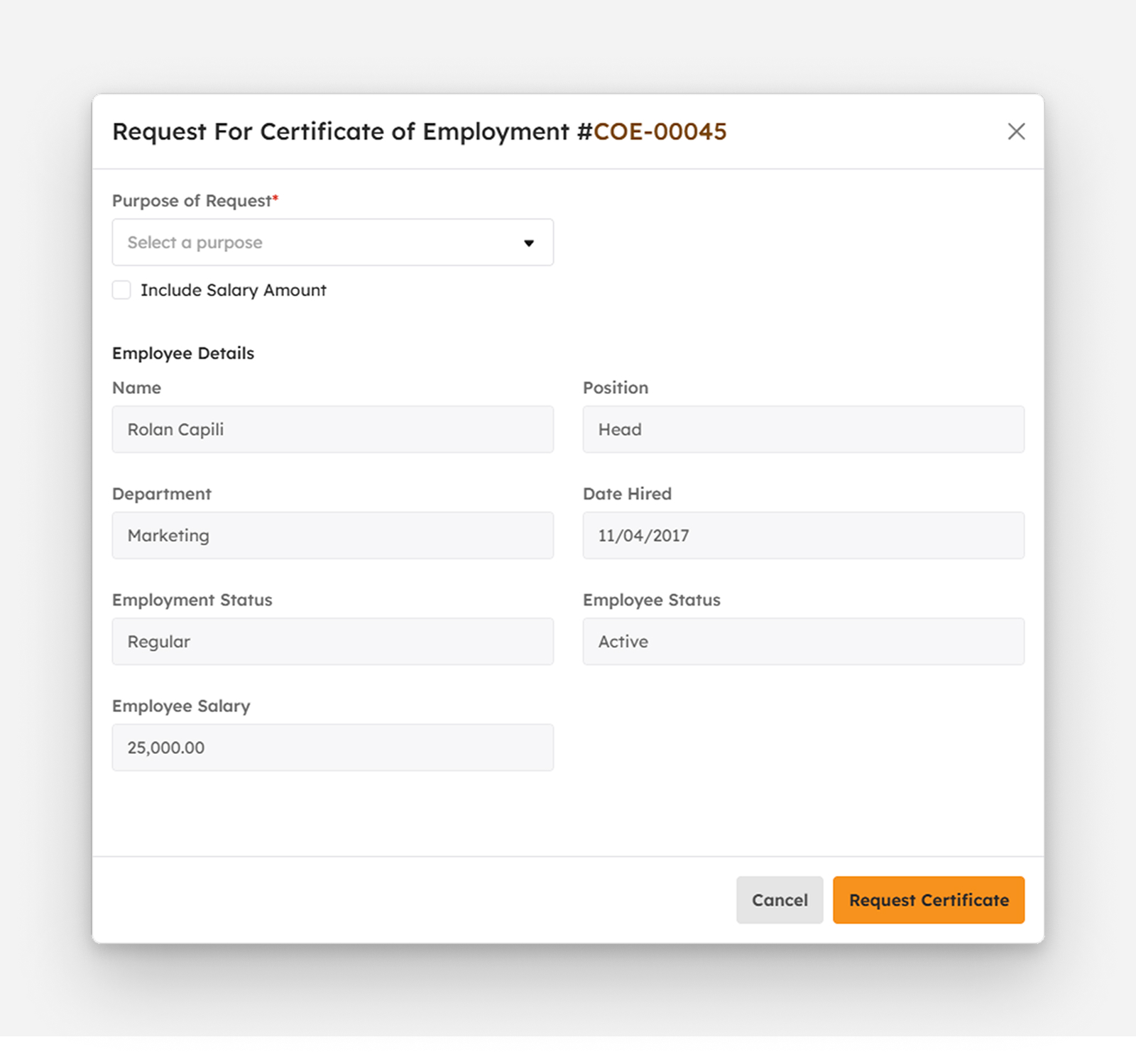
Click the file-upload button; a modal will be displayed.
Select the Purpose from the dropdown.
Tick the checkbox to include the employee's salary.
Click the Request Certificate to proceed.
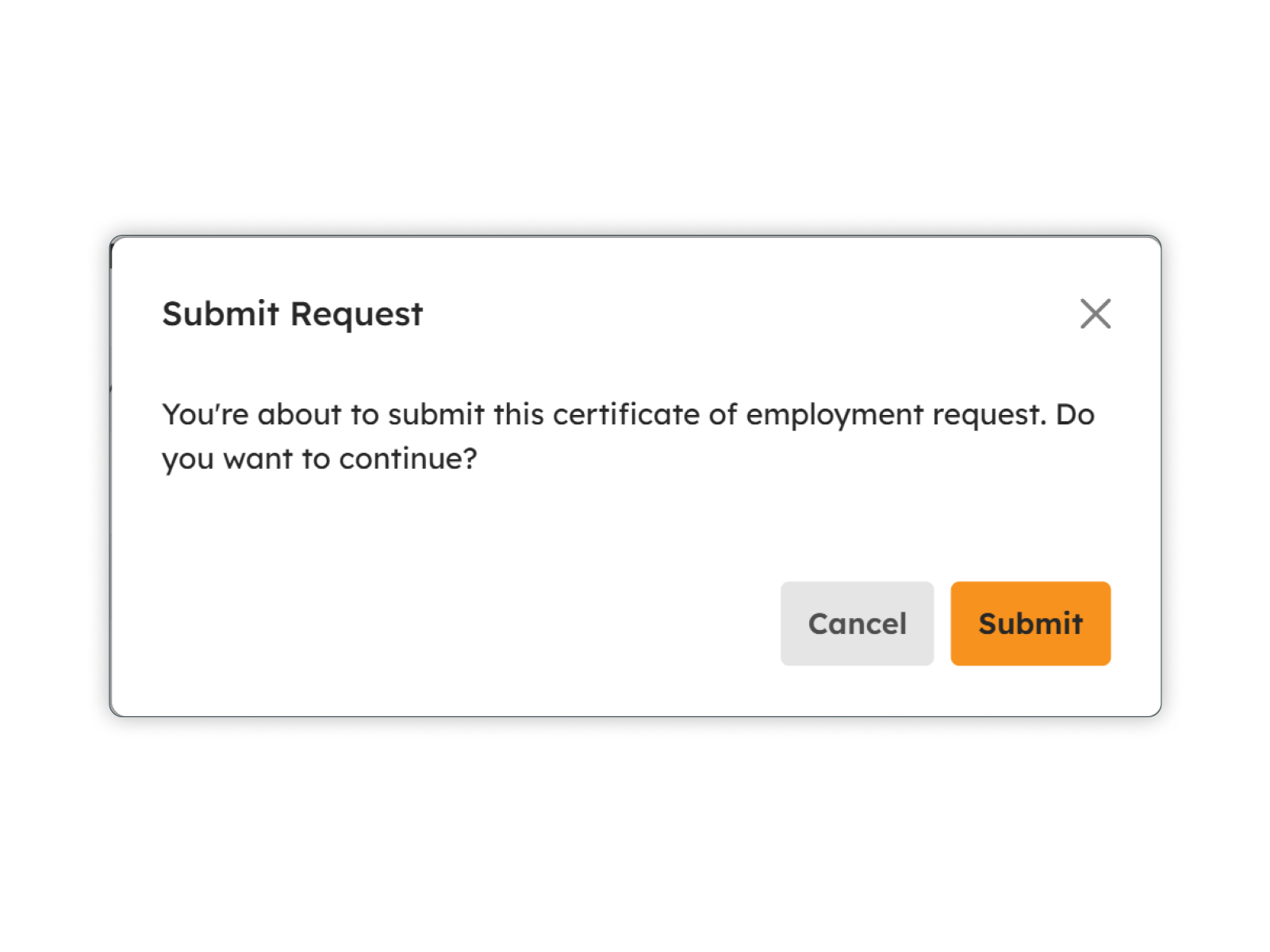
A confirmation modal will appear:
Click Submit to proceed
A successful notification will show:
Certification request submitted
Cancel COE Request
Locate the COE request you wish to cancel from the summary table.
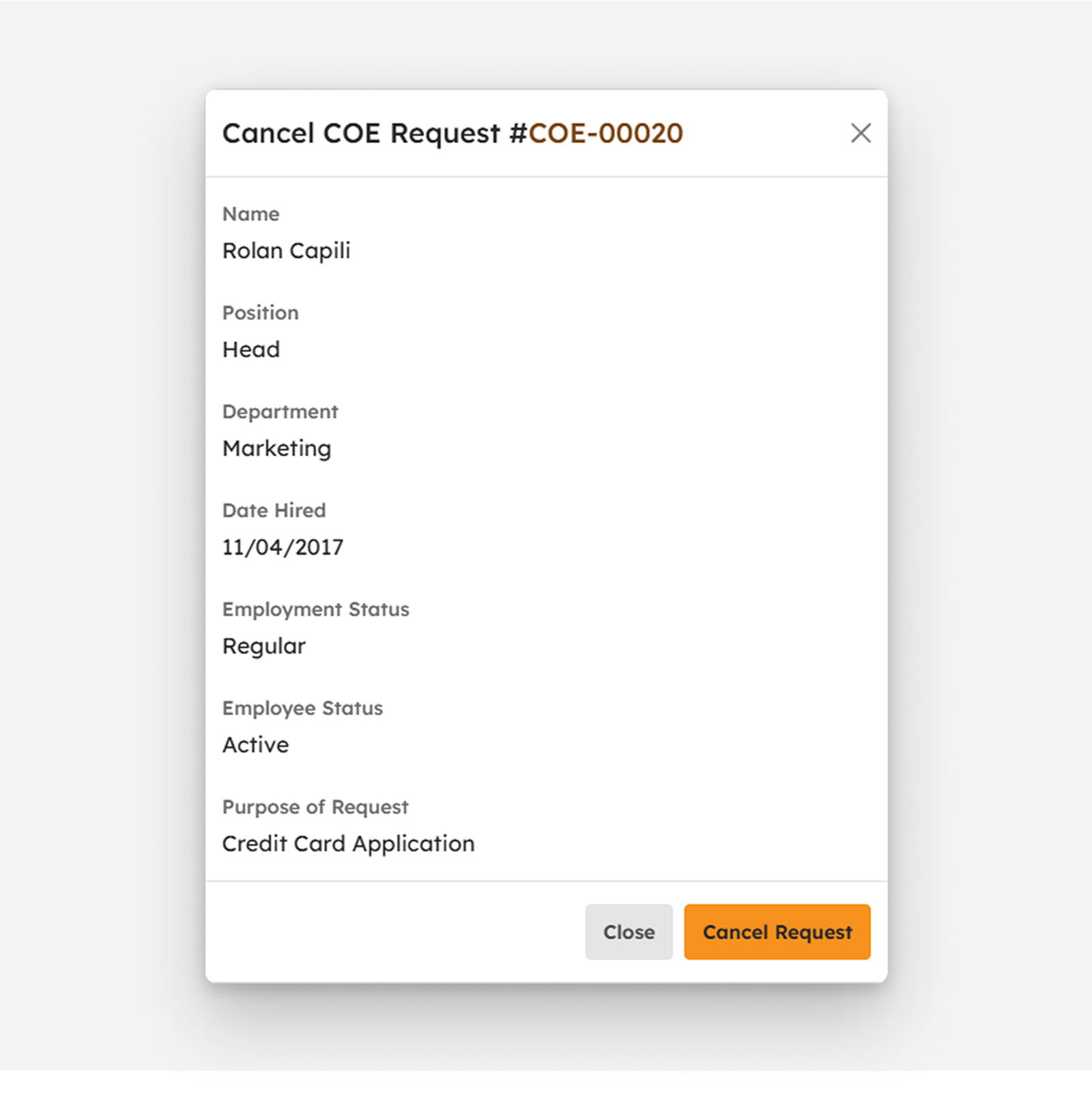
Click the ban Cancel button next to the corresponding request.
A confirmation modal will appear.
Click the Cancel Request to proceed with cancellation.
A cancellation confirmation message will be displayed.
Request cancelled
For Approvals Tab
The For Approvals tab under the Certificate of Employment page displays all certificate requests pending or processed for approval, along with their corresponding details and status. The summary table contains the following columns:
Request Number
Requesting Employee
Purpose
Date Submitted
Release Date
Expiry Date
Status
Action
like Approve COE Request
send Send COE Request
file-text Preview COE PDF
Approve and Reject COE Request
To Approve or reject a COE Request:
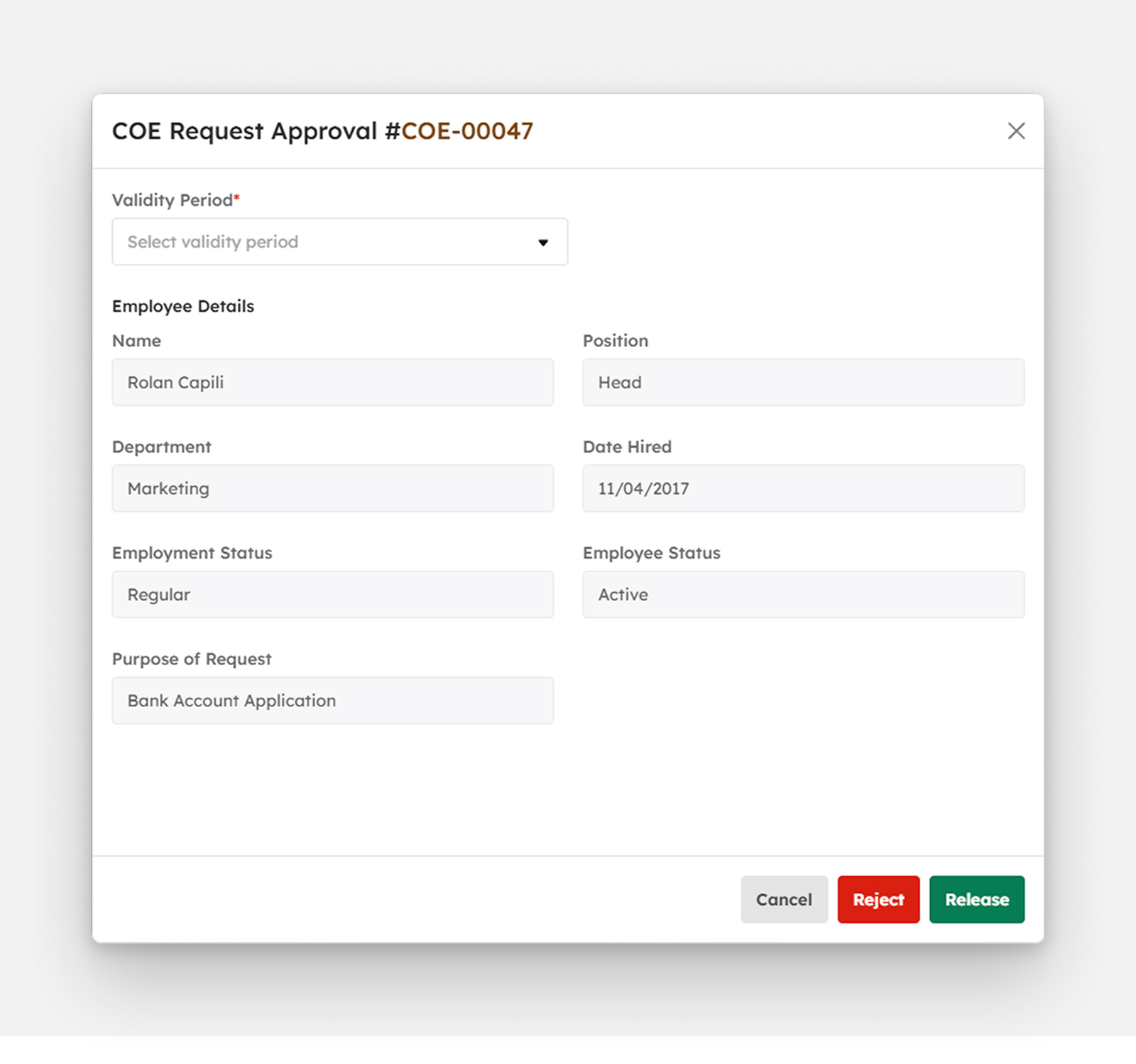
Go to the For Approval Summary Table and locate the COE request you want to approve or reject.
Click the like Approve button next to the corresponding request.
A modal will appear displaying the request details, along with Release and Reject options.
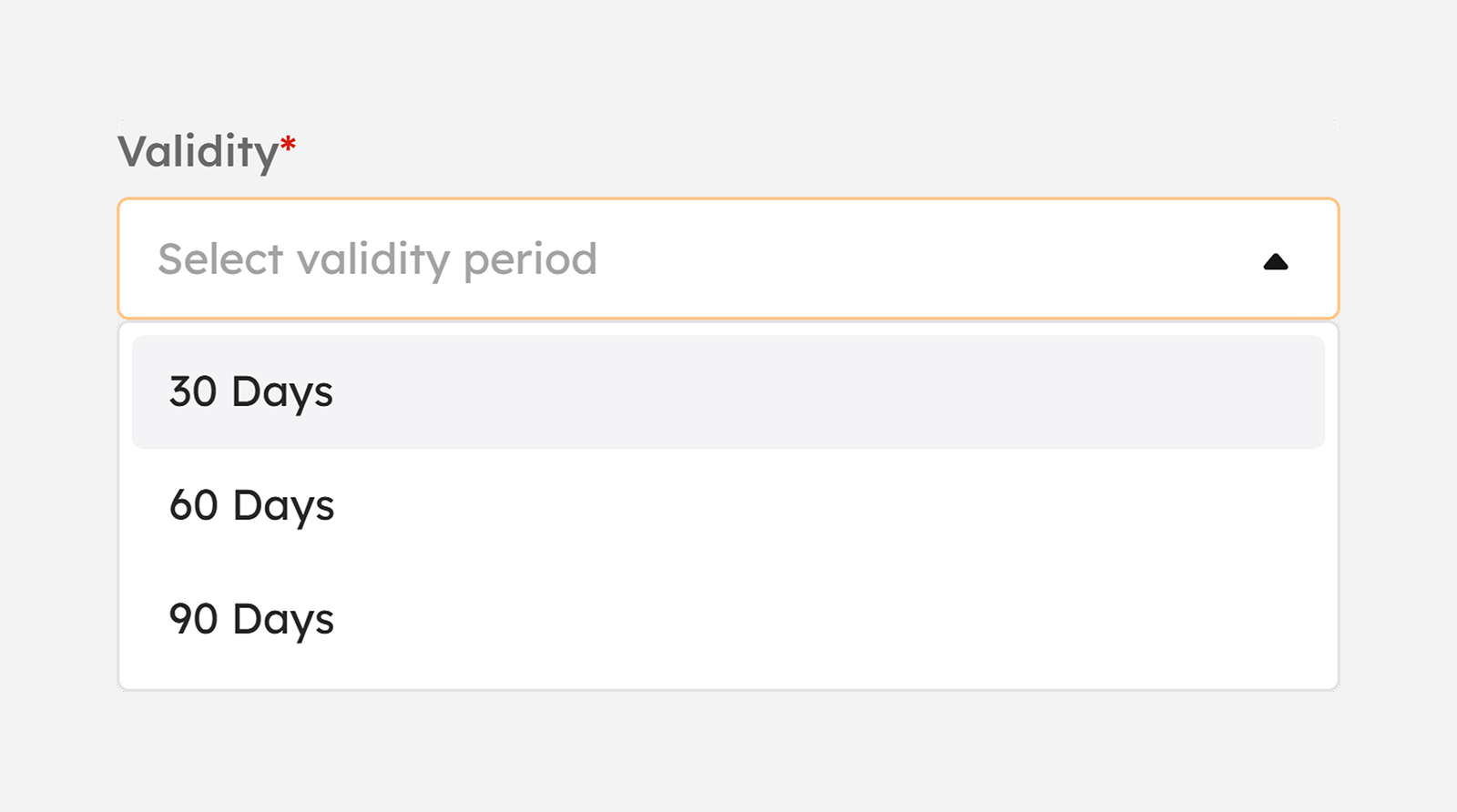
Choose the validity period (30 days, 60 days, or 90 days).
Click either Reject or Release to proceed with the appropriate action.
A notification message will be displayed.
Released notification
Request successfully released
Rejected notification
Request rejected
Send a COE
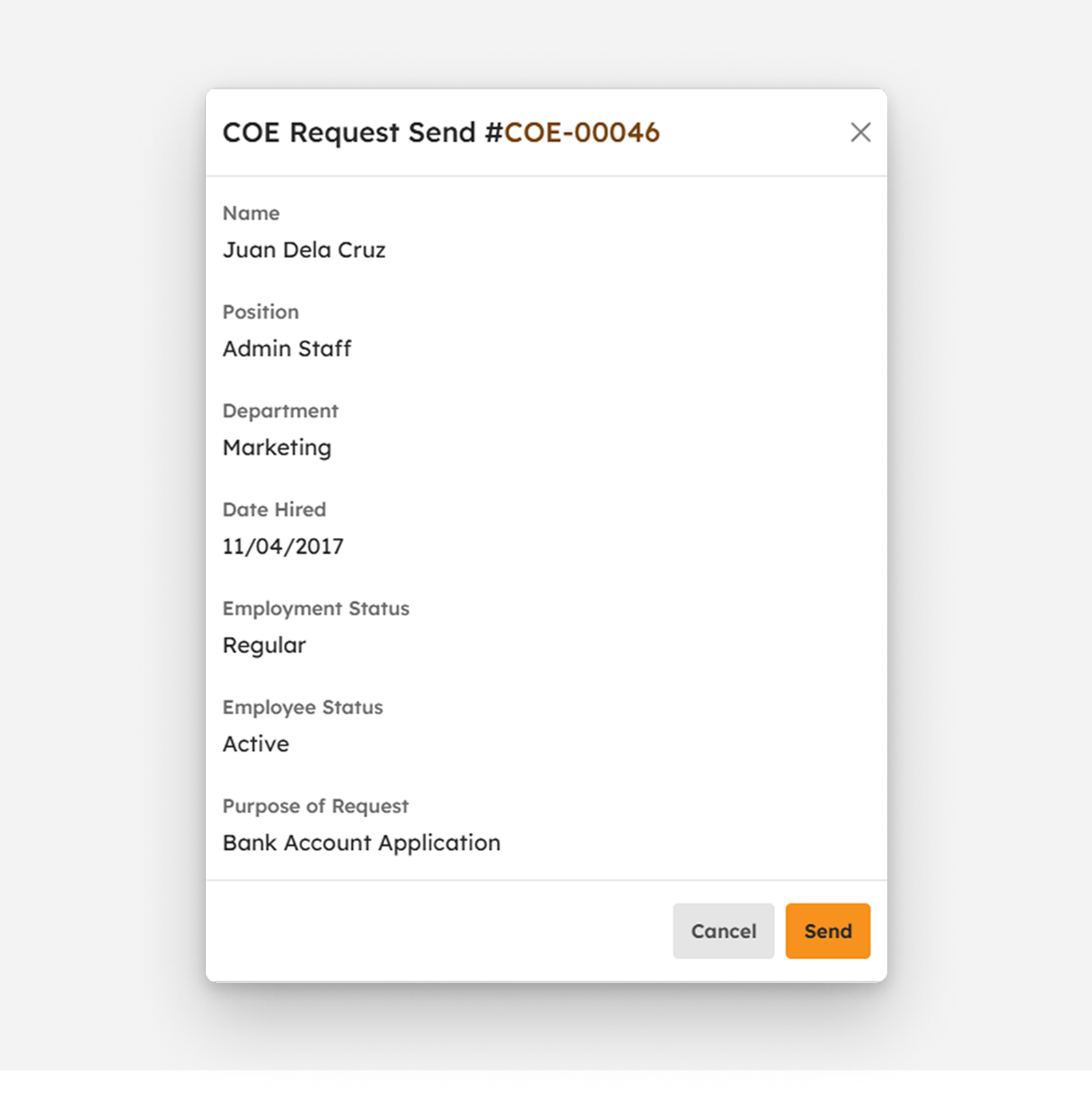
Go to the Application Summary Table and locate the approved Certificate of Employment.
Click the send Send button next to the request.
A modal will appear displaying the request information.
Review the details to ensure accuracy.
Click the Send button to proceed.
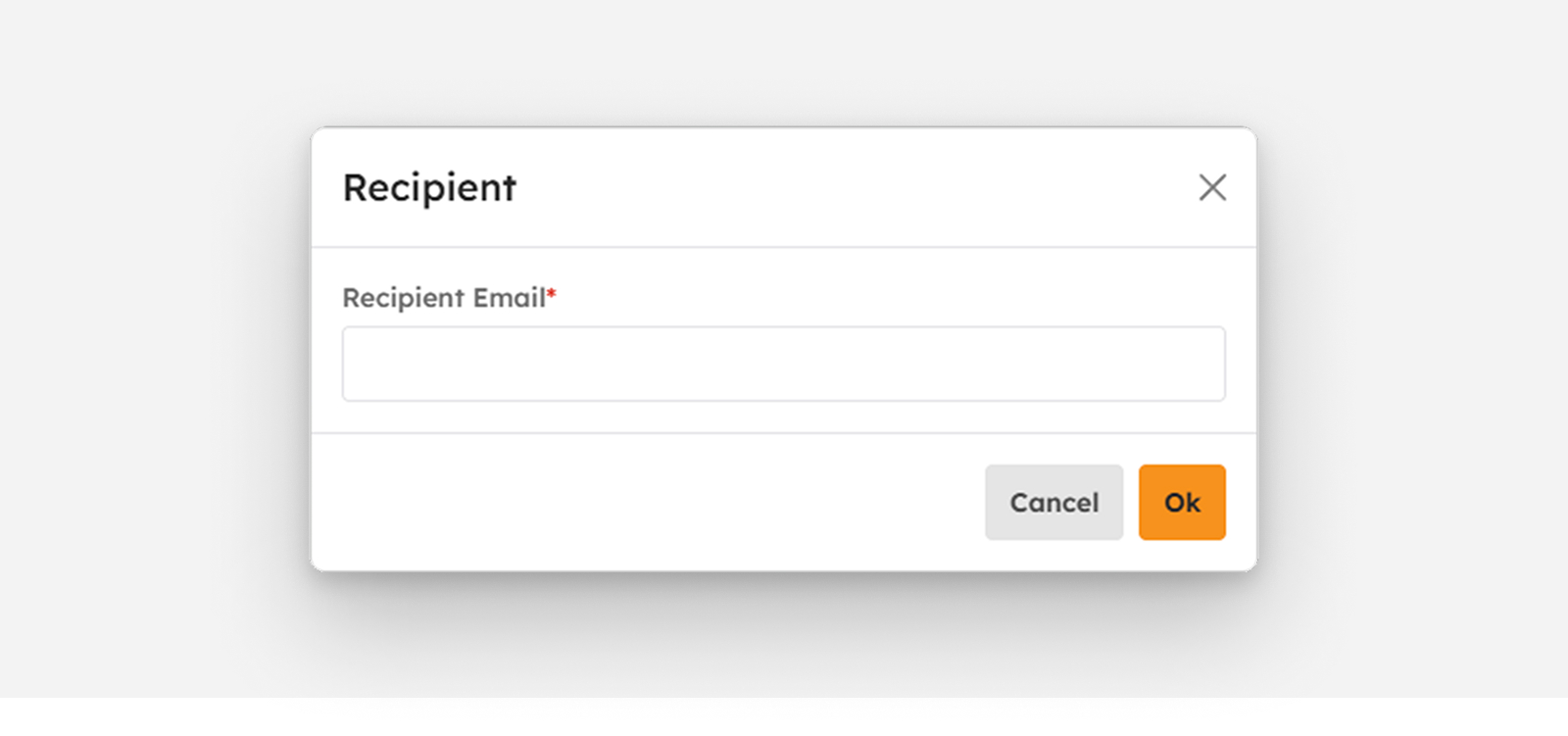
Enter the recipient's email address in the designated field.
Click Send button to proceed.
A success notification message will be displayed once the COE has been sent.
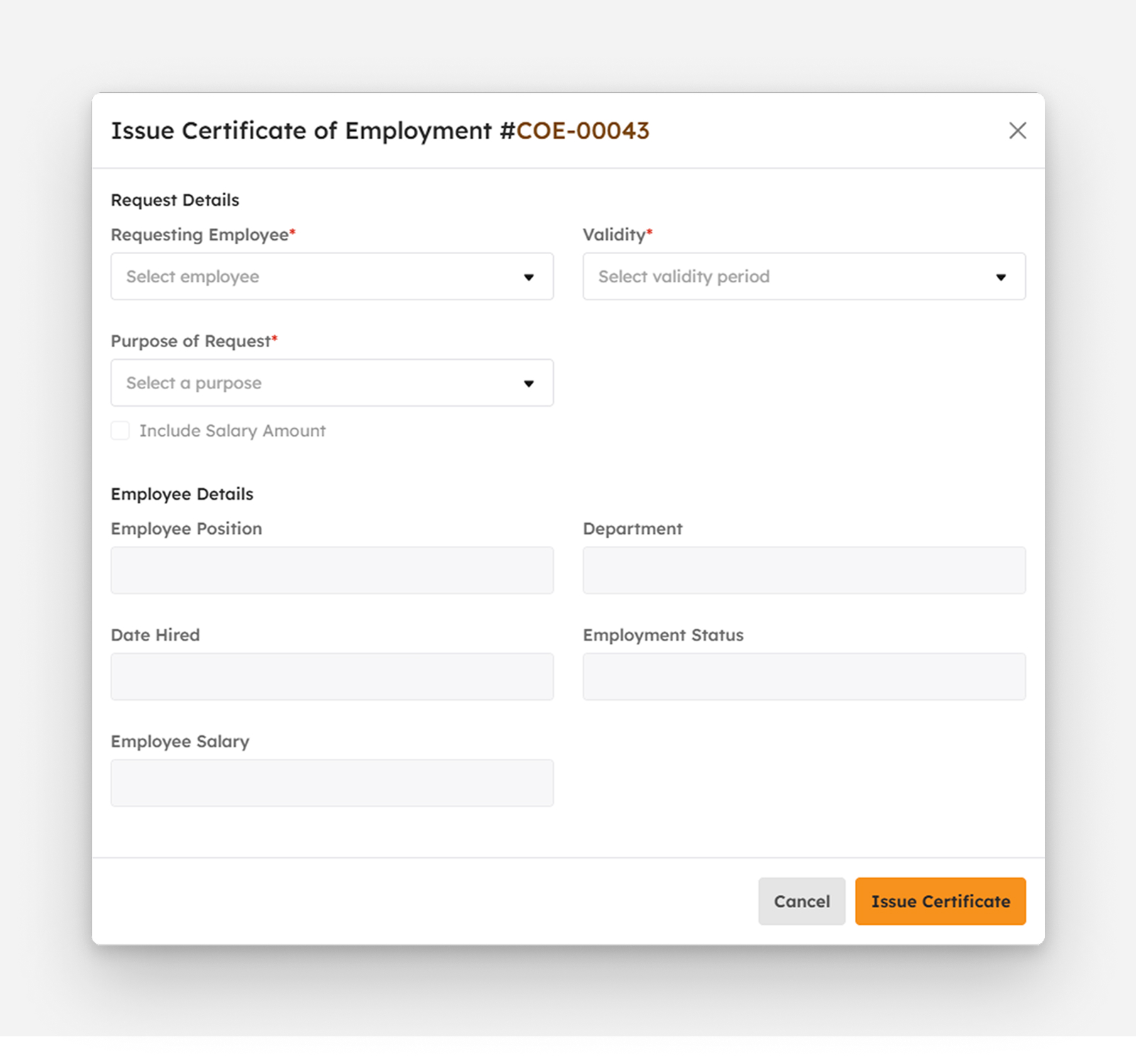
This process is not initiated by an employee request, but rather by the HR Manager who manually issues a Certificate of Employment to an employee.
Click the file-export-alt Issue button.
In the selection table, choose the Employee Name, Purpose, and Validity Period.
(Optional) Check the box to include the employee’s salary in the certificate.
Click the Issue COE to proceed.
A success notification message will be displayed once the COE has been issued.
Certification request issued
Company Loans
Introduction to the Company Loans Page
This page manages employee loan records within the organization, including applications for both company-provided and government loans such as SSS and Pag-IBIG.
It offers a centralized and organized process for applying, reviewing, approving, and tracking loan applications. Employees can view the status of their requests, disbursement details, and repayment schedules. Authorized users can efficiently oversee loan processing while ensuring compliance with internal policies and government requirements.
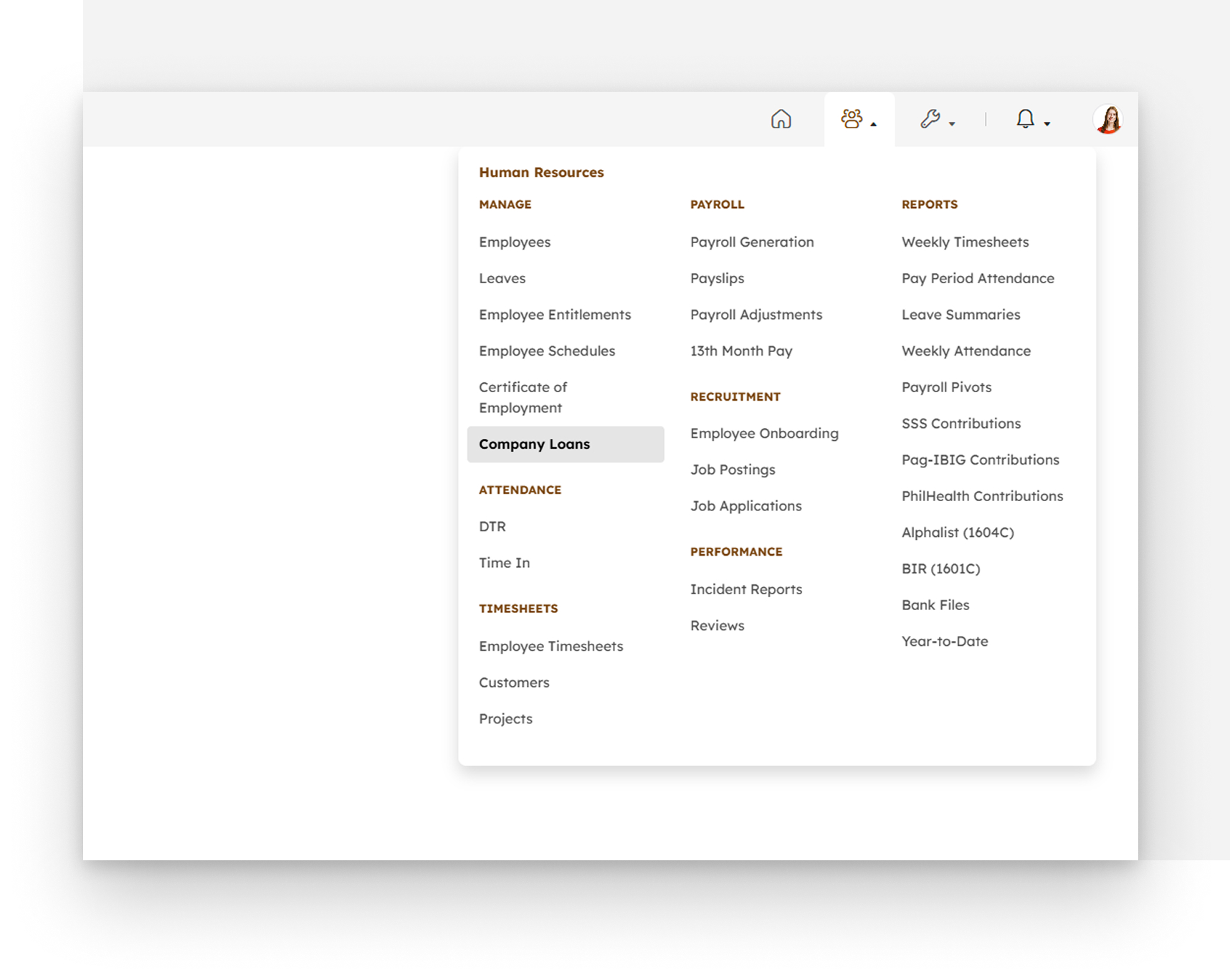
To access this page, navigate to the Human Resources Module and select 'Company Loan' under the Manage submodule, as shown in the image below.
Company Loans Page Features
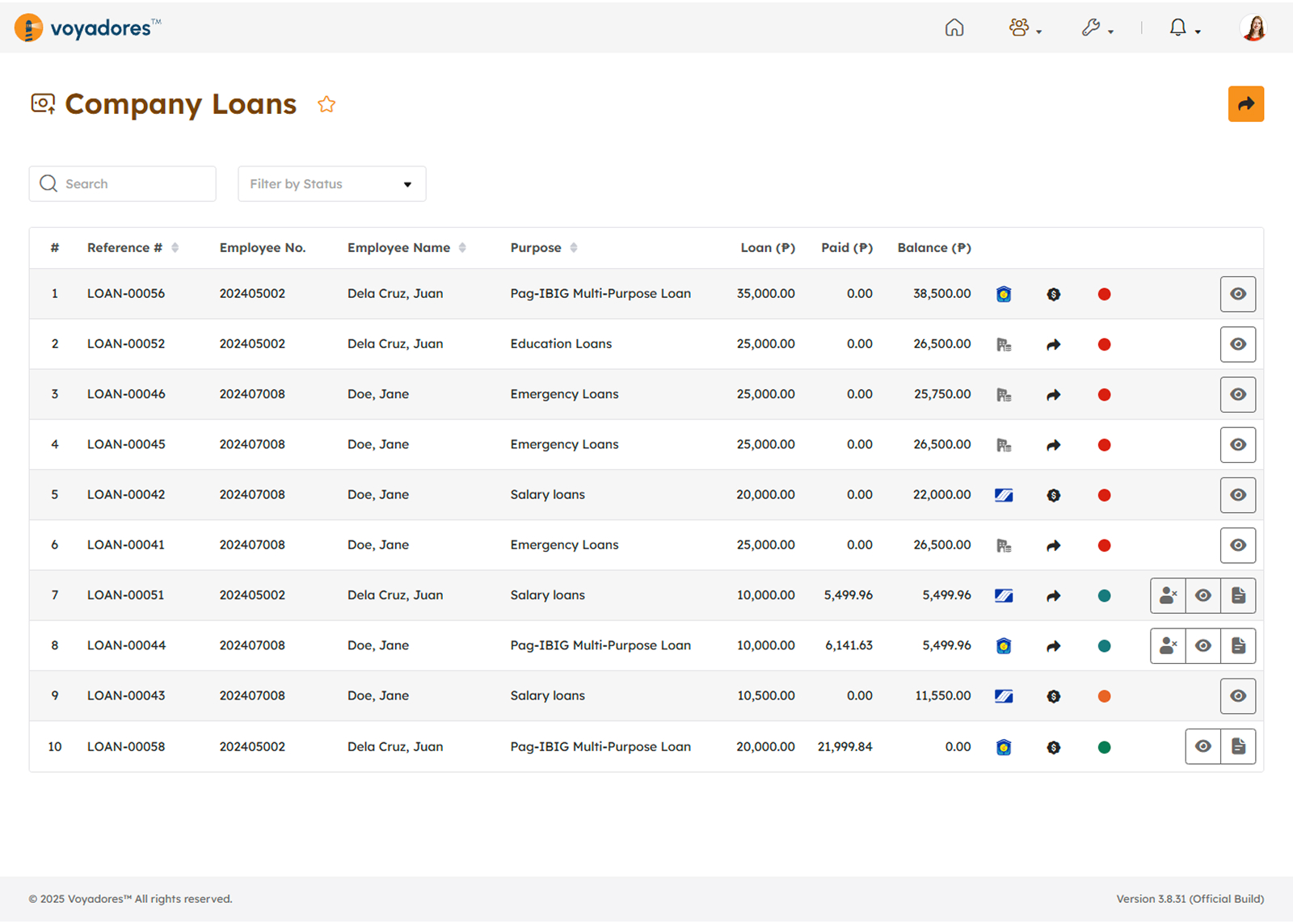
The snip below provides a high-level view of the Company Loan page along with its built-in features.
Company Loans Page Header Actions
home-dash
Set as Default Page
star
Add to Quick Links
badge-dollar
Grant Loan
arrow-share
Apply Loan
Preview Loans
Company Loans Summary Table
The summary table displays the list of company loans with the following columns:
Reference No.
Employee Name
Purpose
Loan
Paid
Balance
Provider
Loan Type
Status
Action
like Approve Loan
ban Cancel Loan
money-bill-receive Disburse Loan
user-times Default Loan
pen Edit Loan
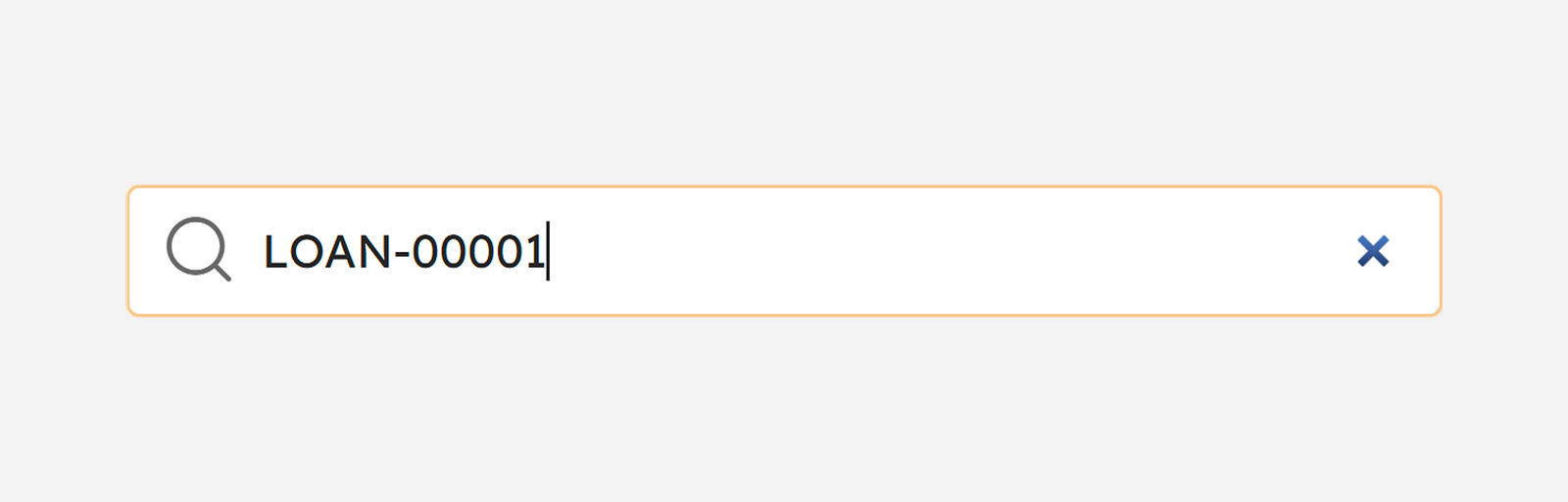
Search Loans
Loans can be searched by their reference number or employee name.
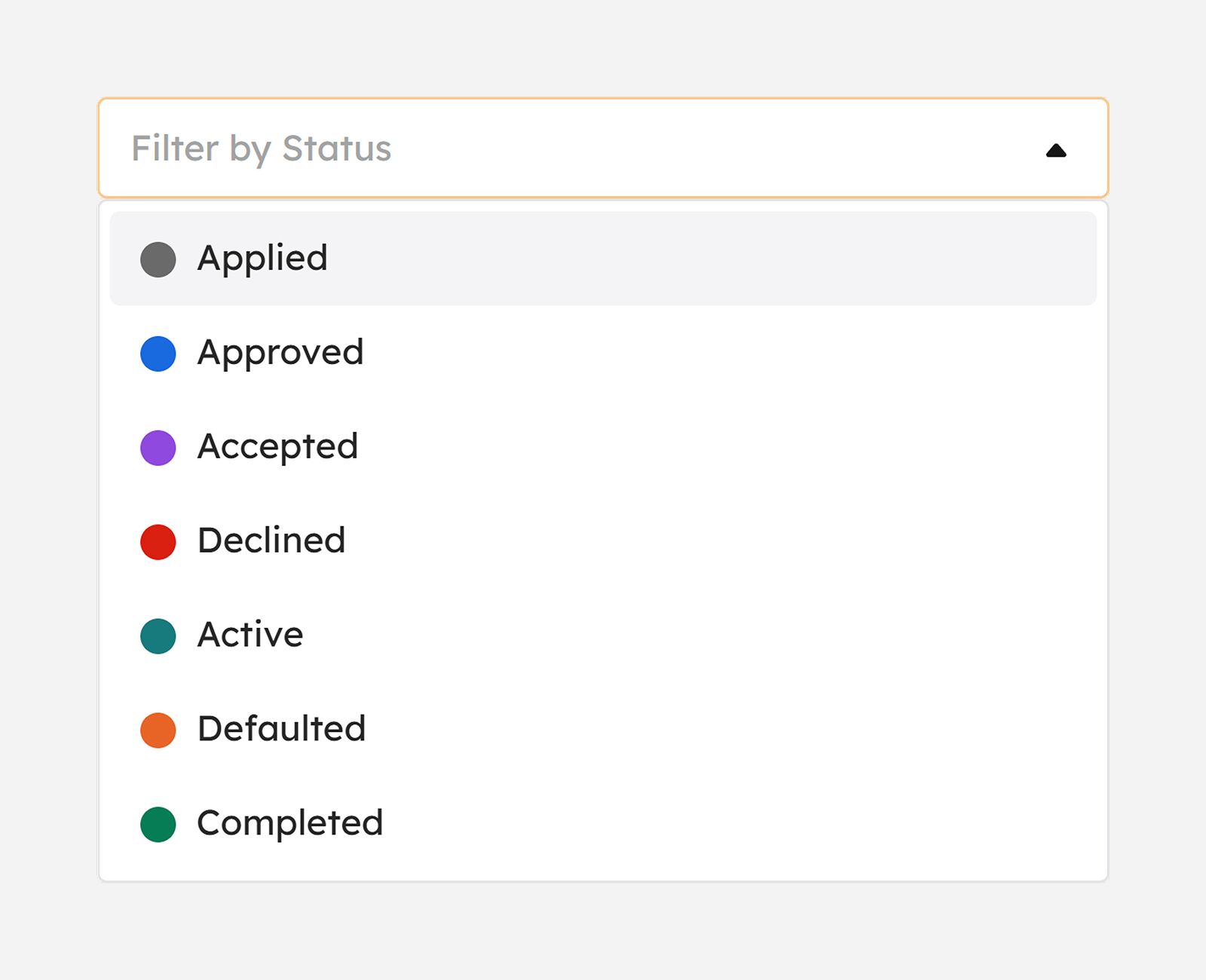
Filter by Status
Applied
Approved
Accepted
Declined
Active
Defaulted
Completed
Apply Loan
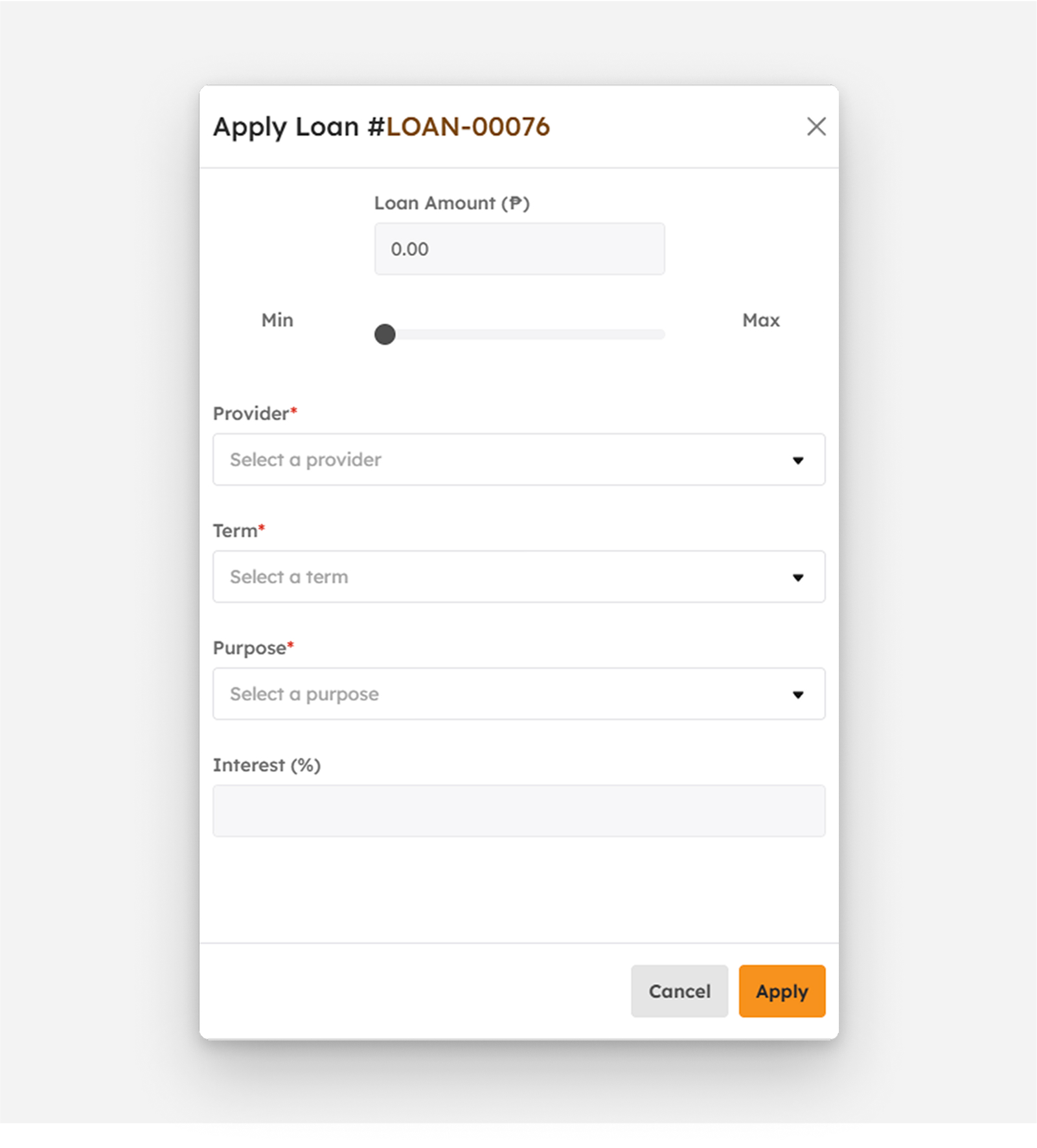
Click the arrow-share button to apply for a loan.
Users are required to fill in the necessary fields.
Click the Apply button to submit the loan.
Upon successful submission, a notification will display, and the loan will be listed in the Application table.
Loan applied
Approve Loan
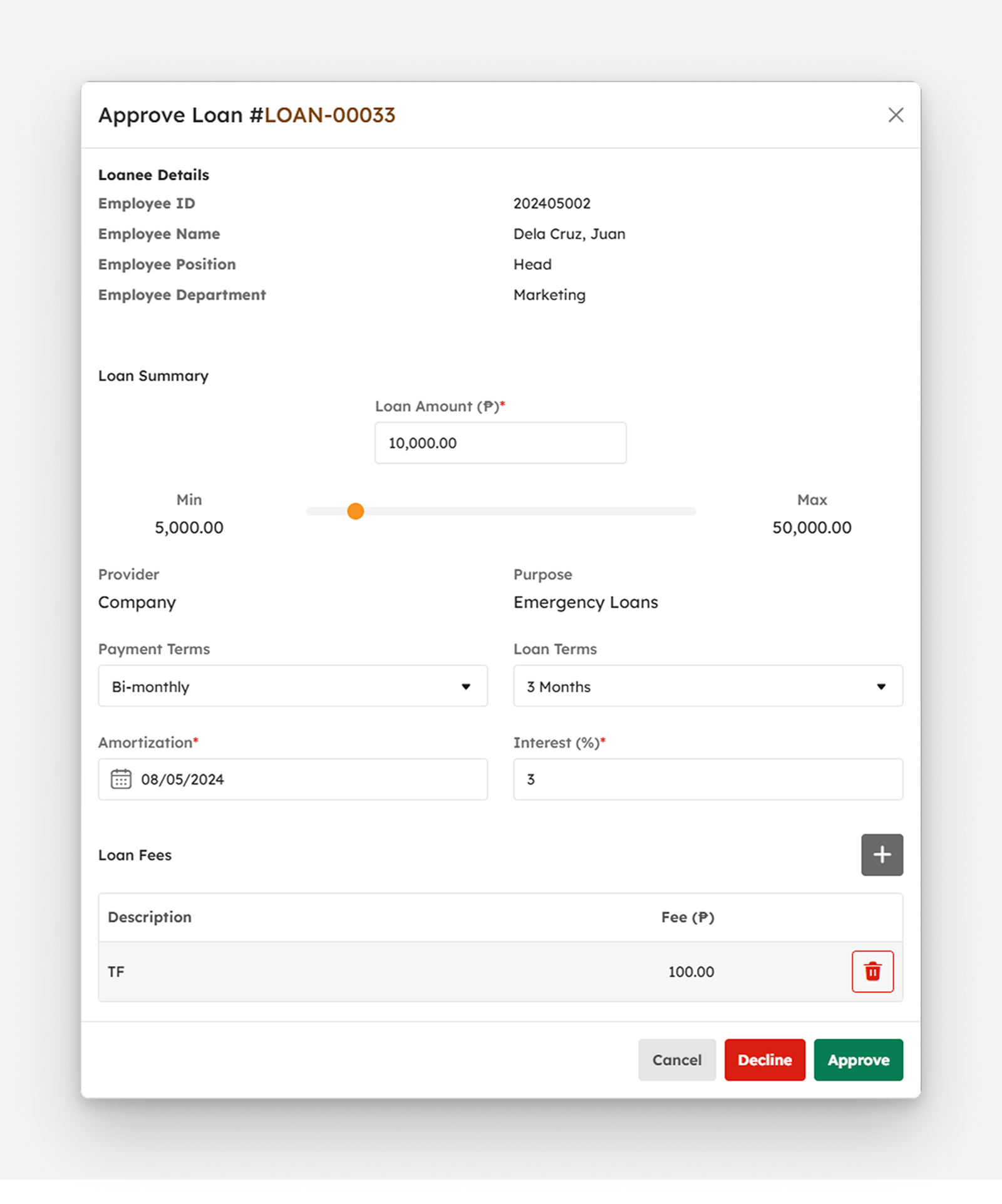
Click the like button to approve the loan.
Fill in the necessary fields.
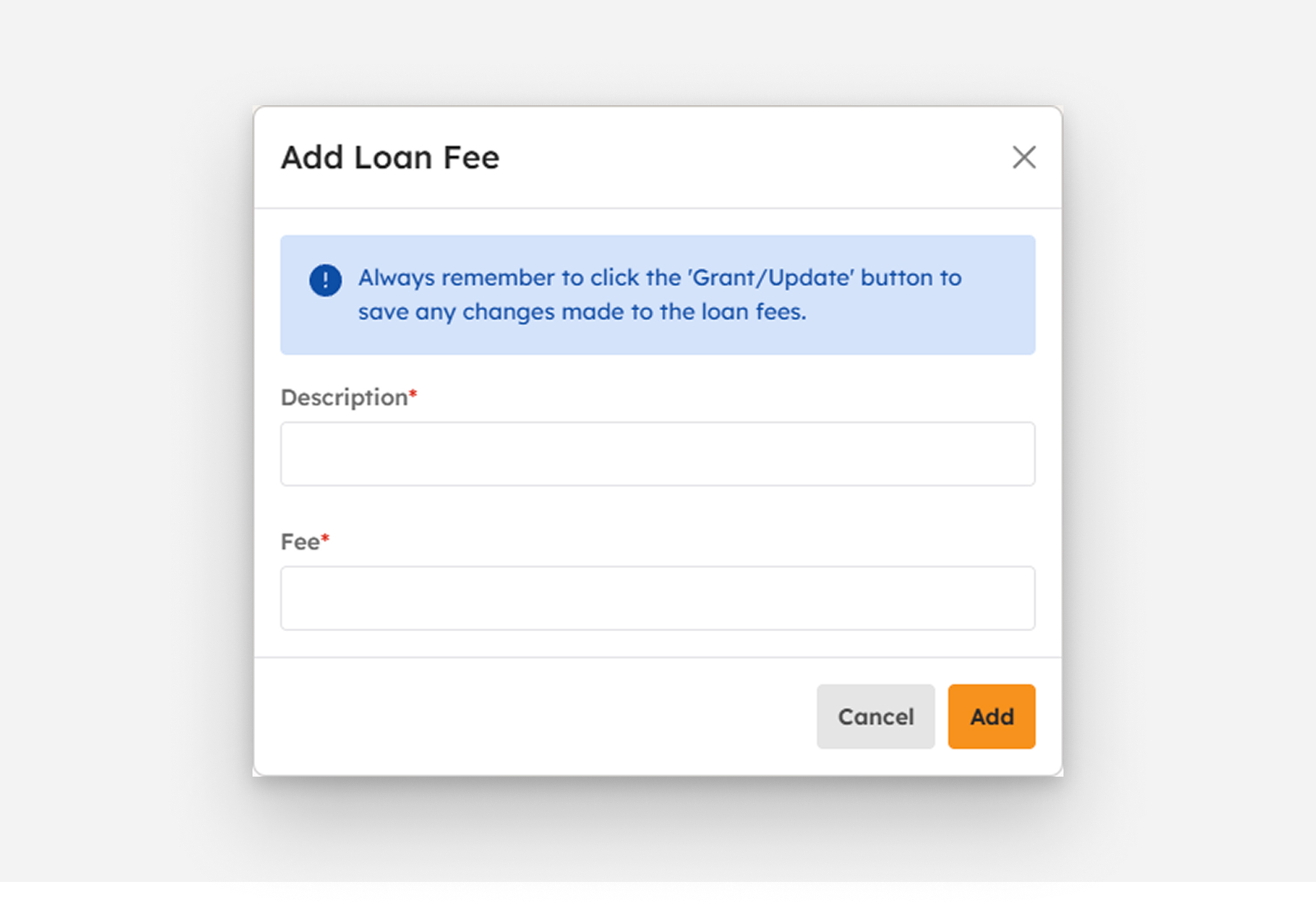
Loan fees may be added if necessary.
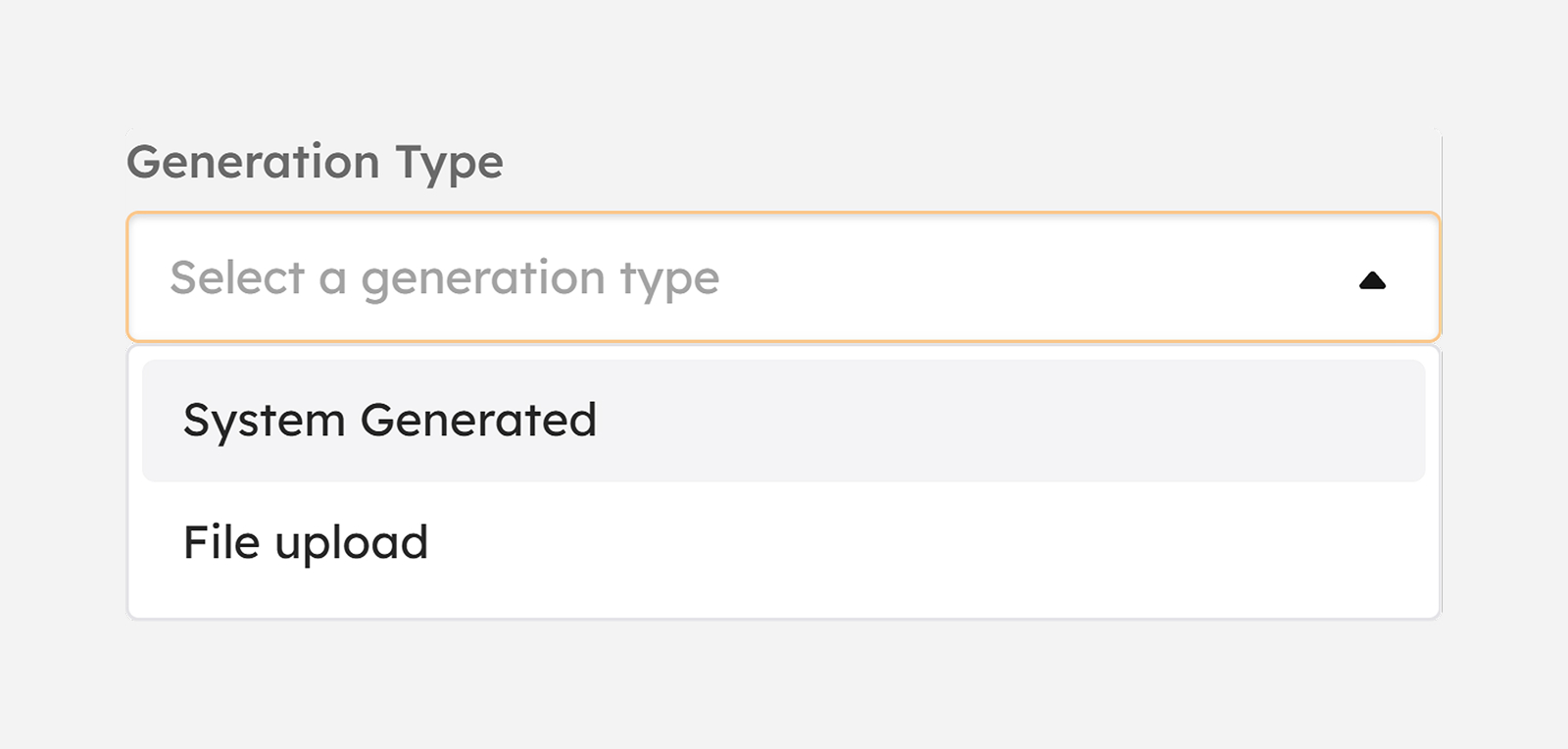
Choose the appropriate generation type.
Click the Approve button to approve the loan.
A notification will be displayed and the status will be "Approved."
Loan #LOAN-00001 approved
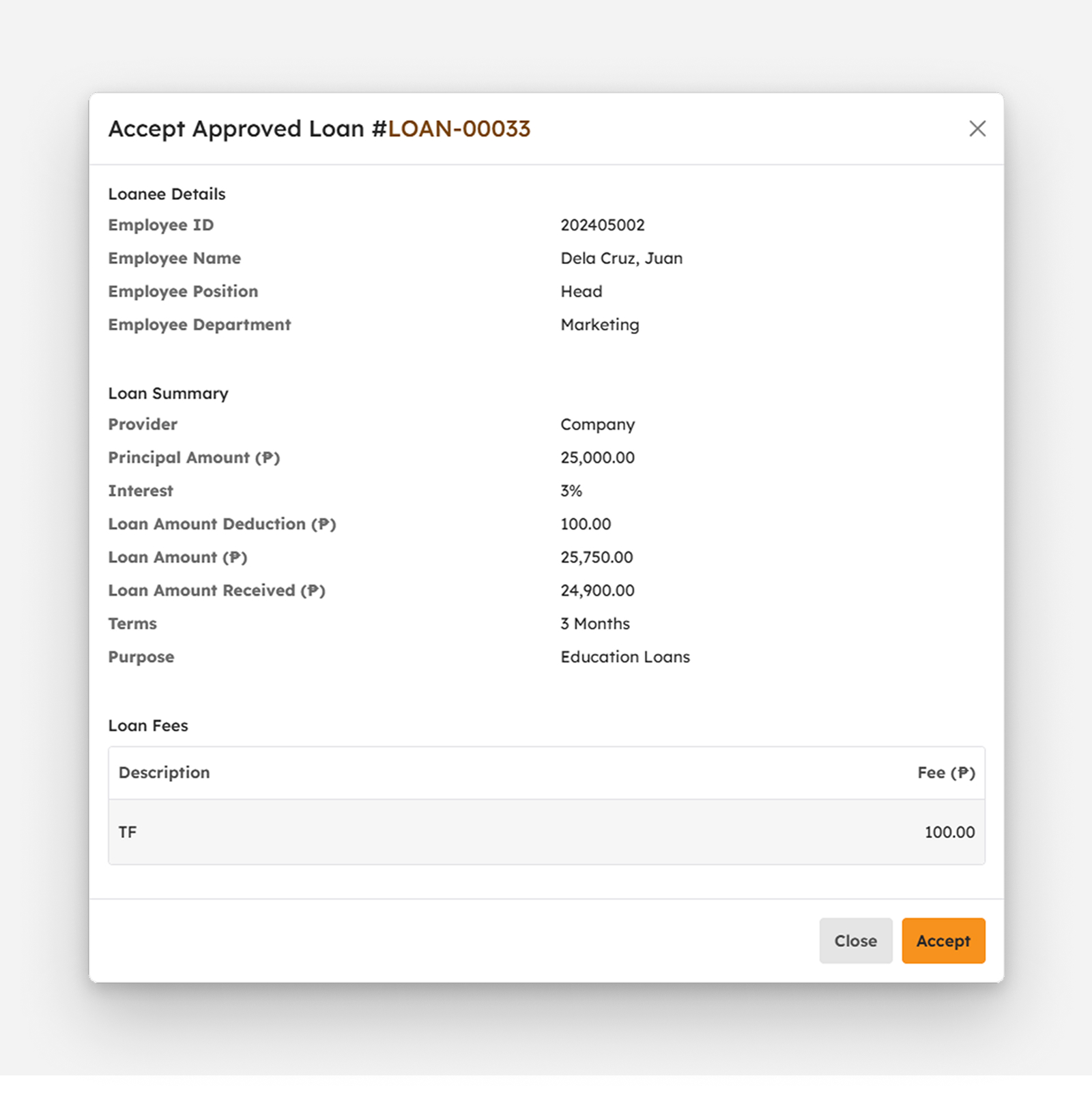
Click the like button to accept the approved loan.
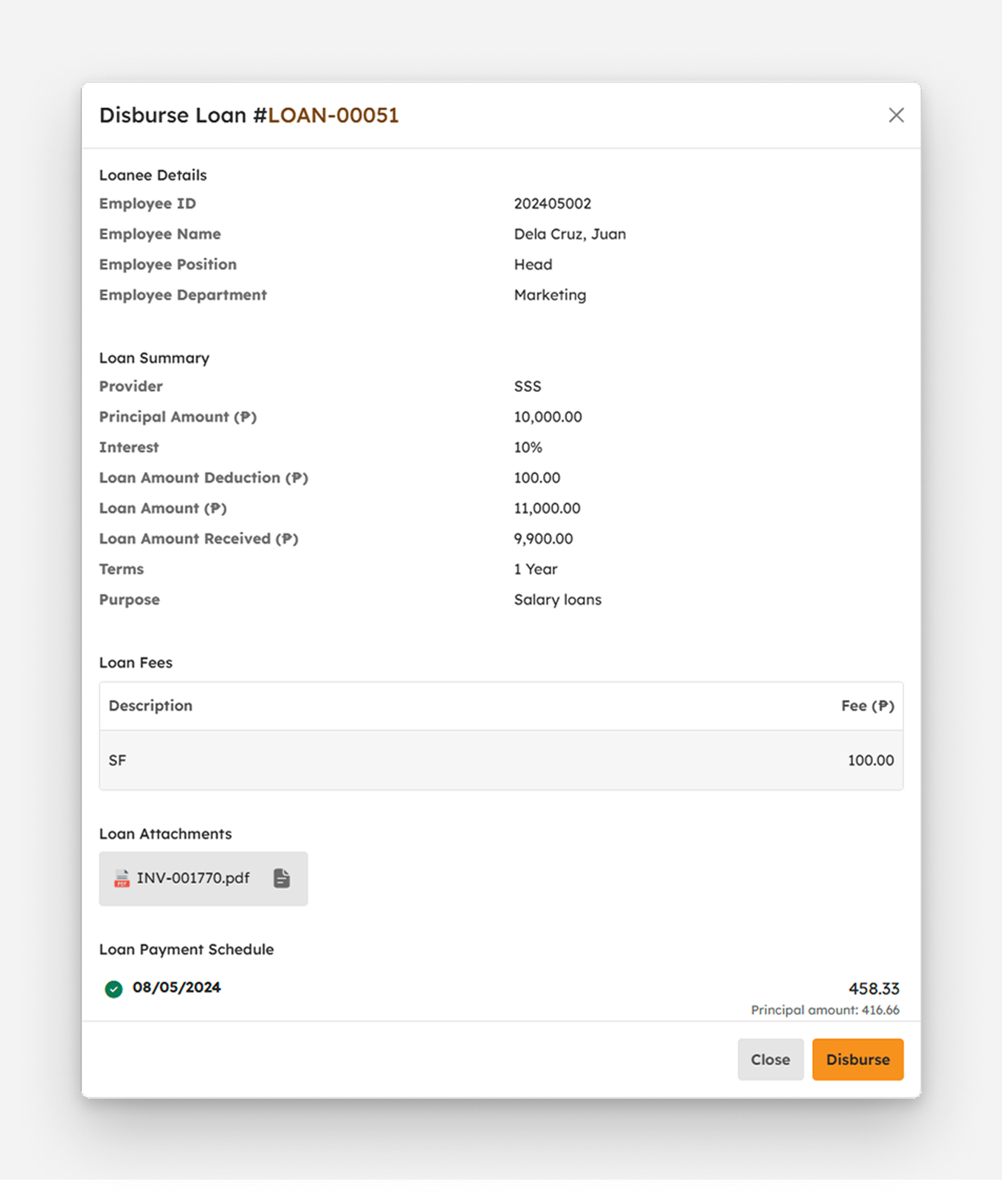
Once the status is accepted the user can click the money-bill-receive button to disburse the loan.
A notification will be displayed and the status will be Active
Loan #LOAN-00001 successfully disbursed
More features of Company Loans
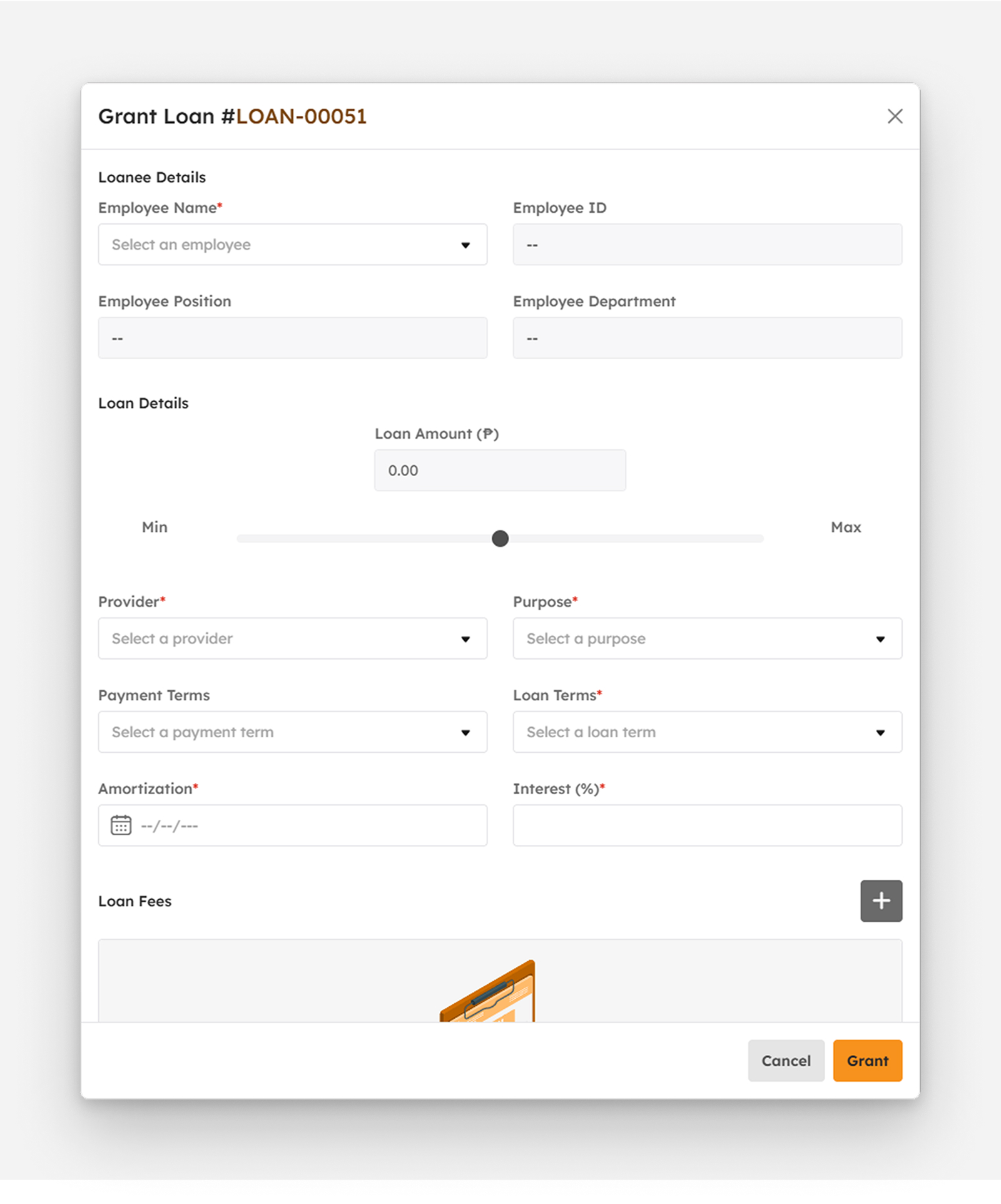
Grant Loan
The purpose of this is to assist employees who are unable to apply for a loan on their own and need help. This follows the same process as a regular loan application; the only difference is that it is submitted on behalf of the employee.
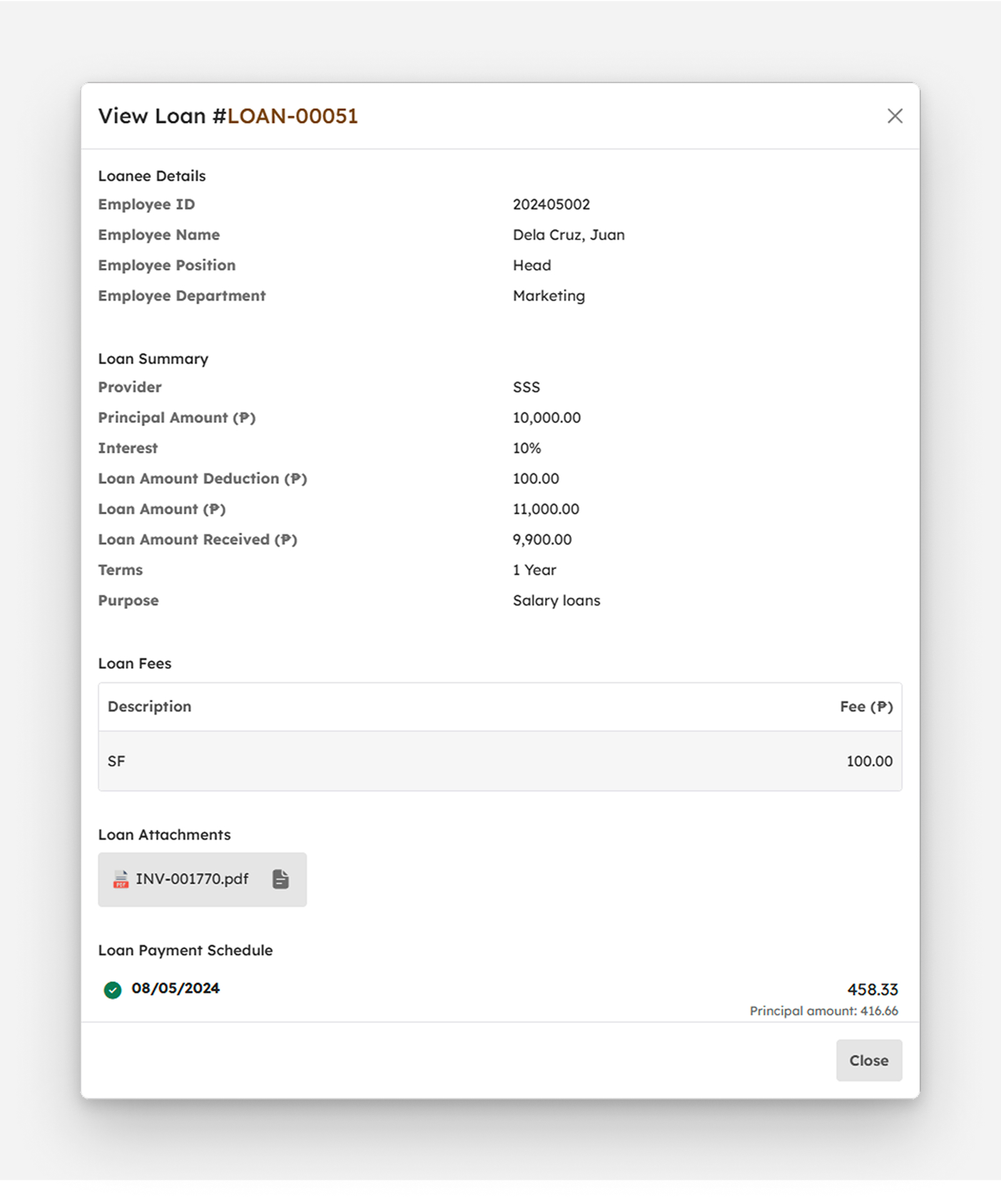
View Loan
This feature allows employees and authorized users to view the details of existing loan applications. It provides access to the loan status and other relevant information, ensuring transparency and efficient monitoring throughout the entire loan lifecycle.
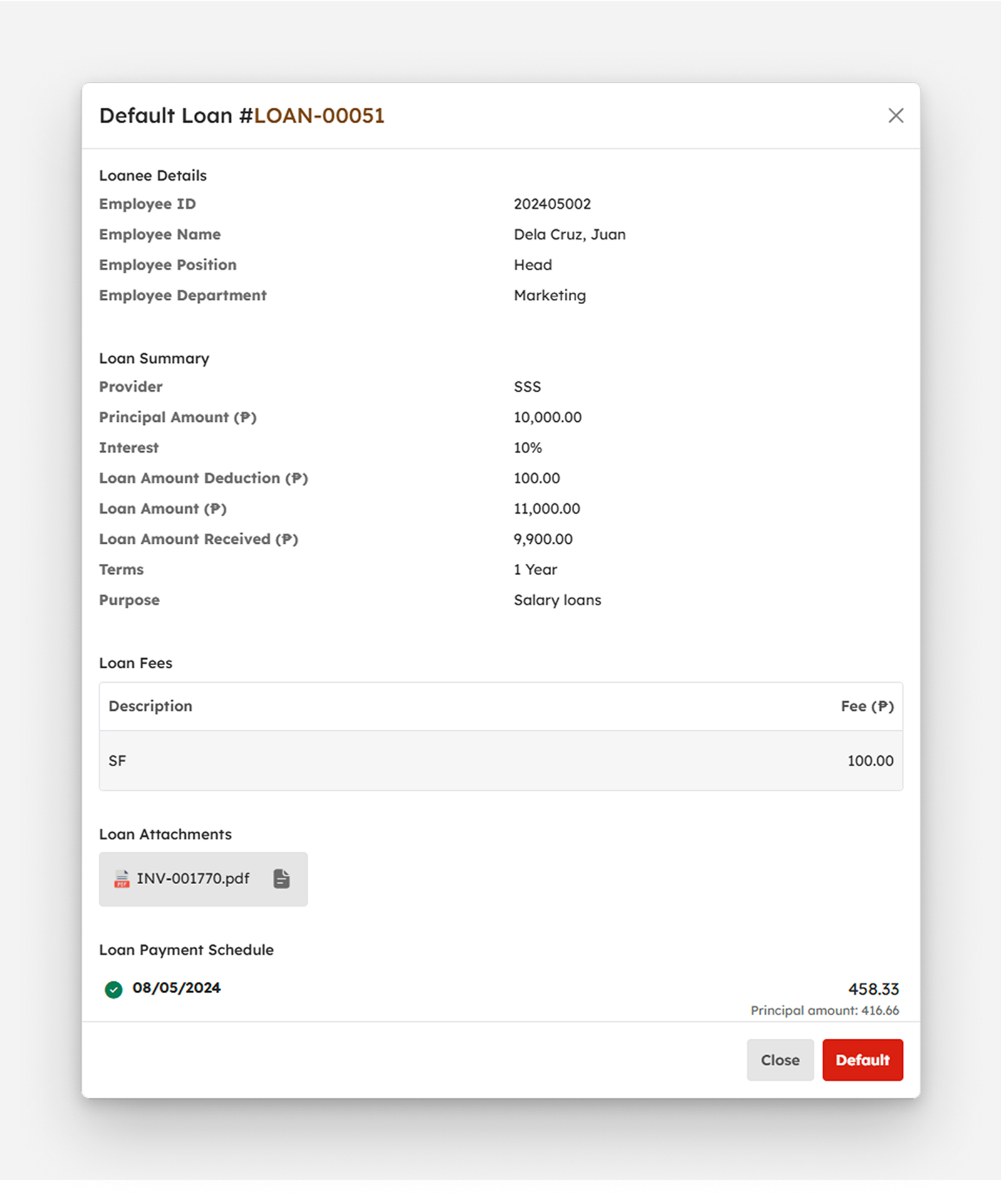
Default Loan
The Default Loan feature allows authorized users to mark a loan as defaulted when an employee fails to meet the agreed repayment terms. Once a loan is tagged as default, it will reflect in the system as a non-performing or overdue loan.
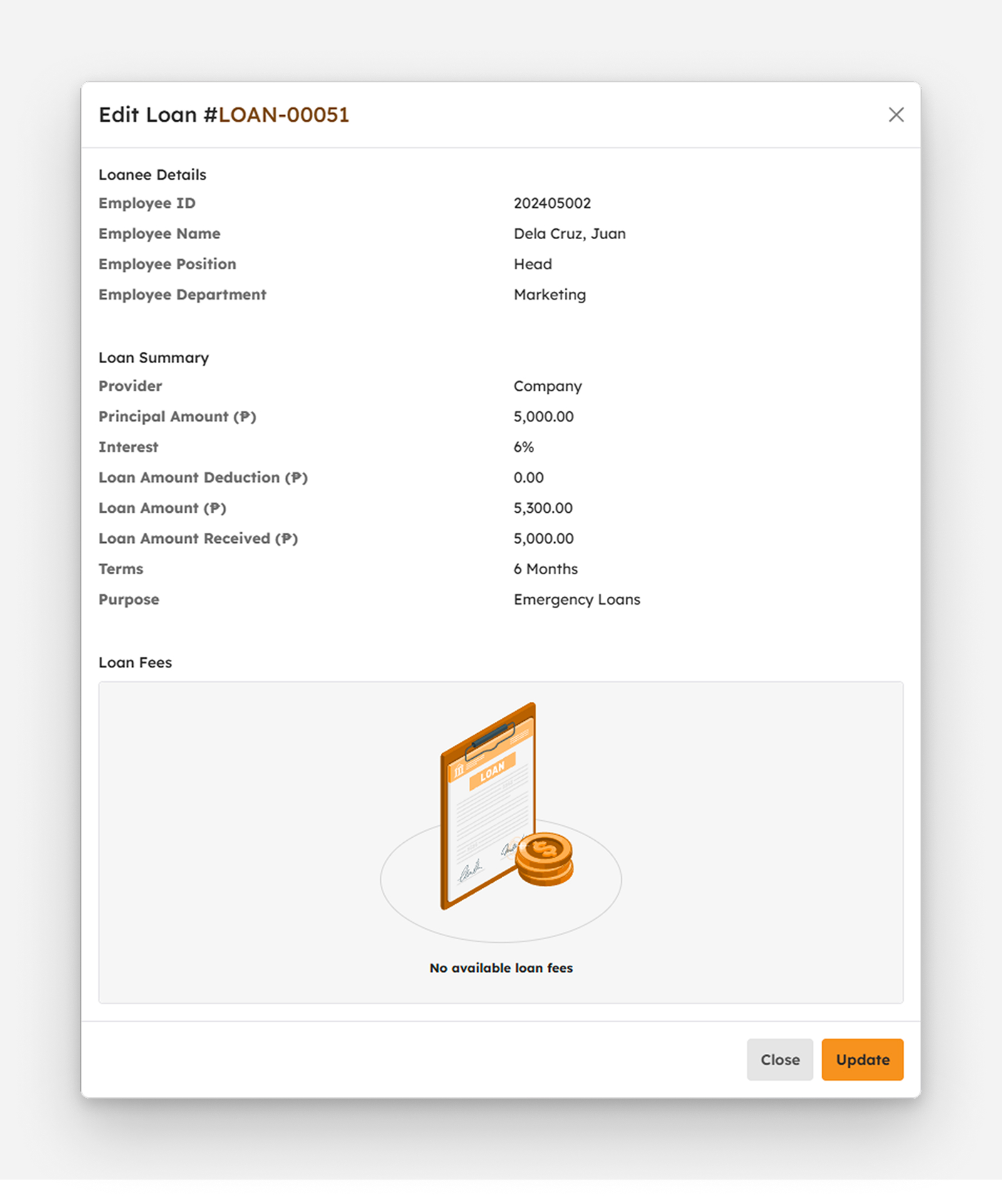
Edit Loan
Other features include the ability to edit the borrower's payment details.
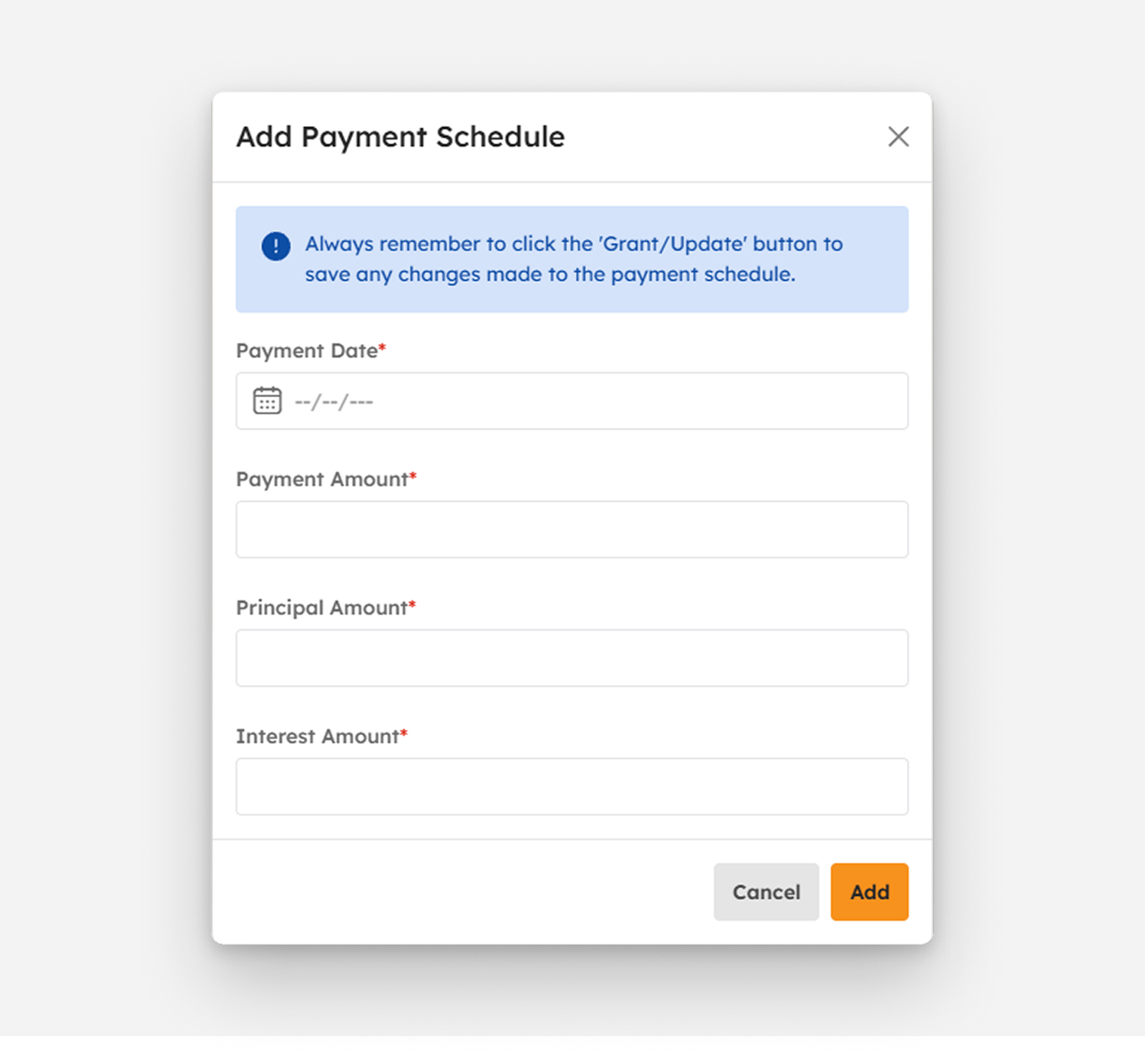
Additional payment schedule plus
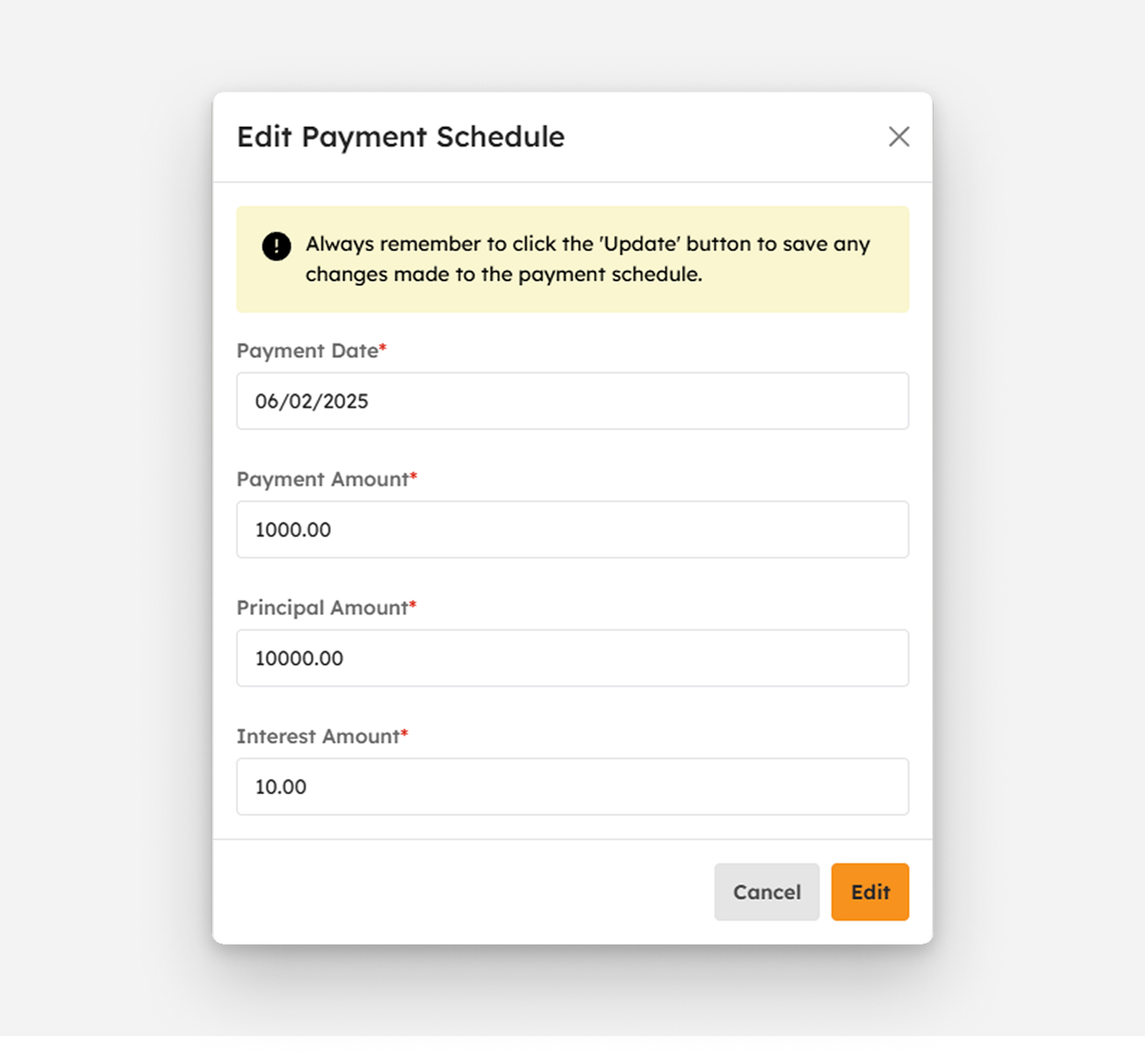
Edit pen
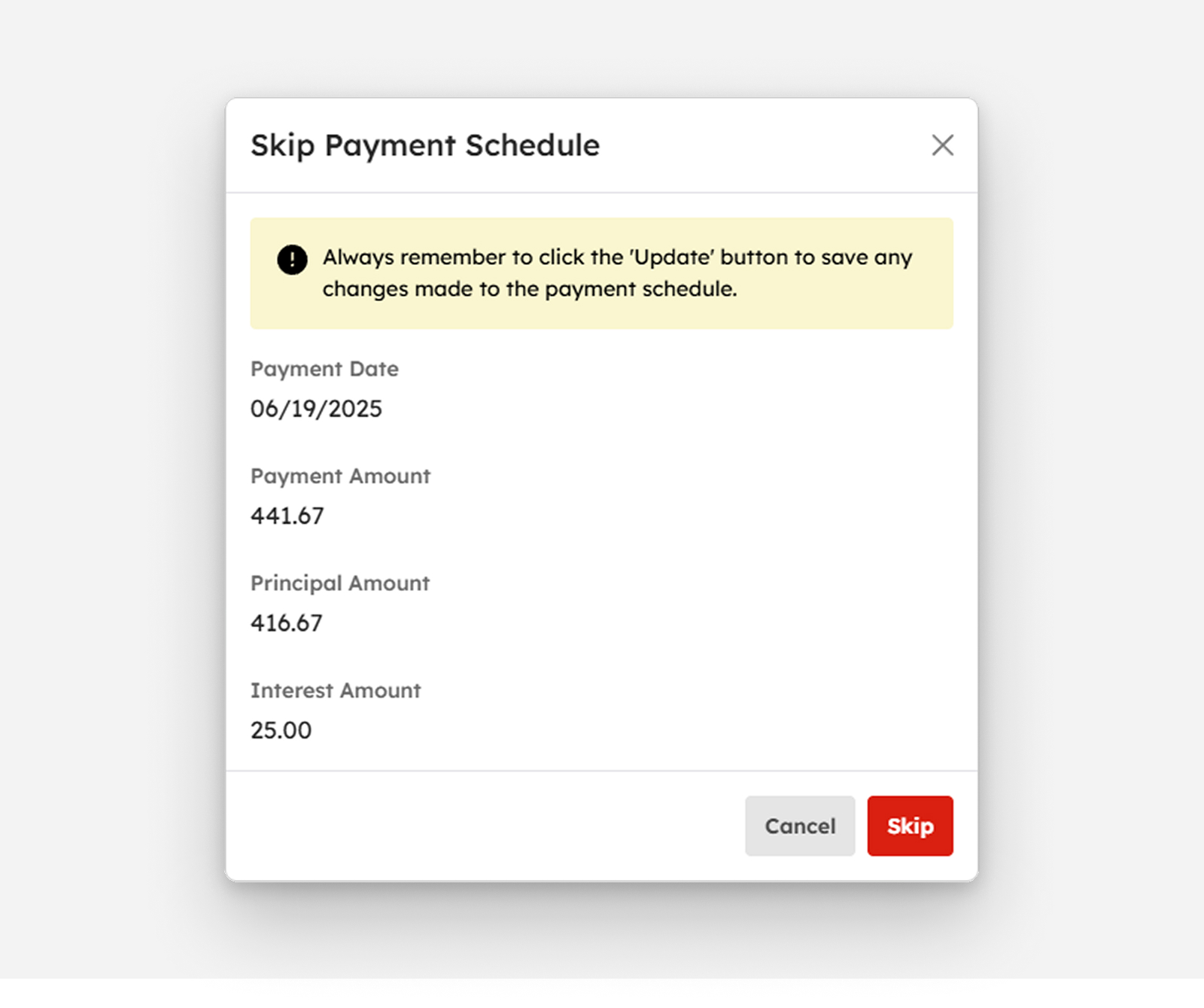
Set as skip forward
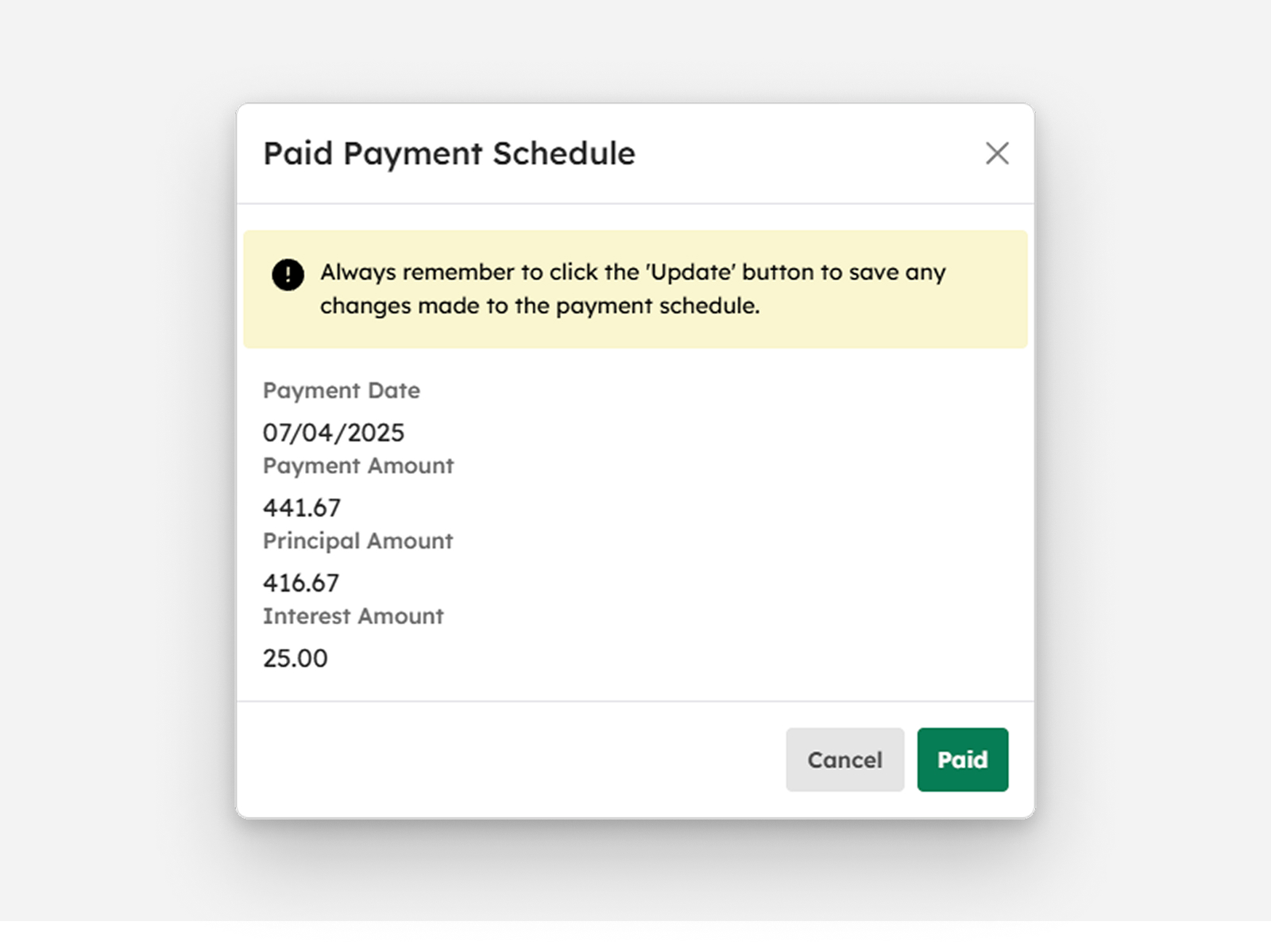
Set as paid check-circle
Load More Loans
To verify if there are more than twenty (20) Loans on the list, click the arrows-repeatLoad More button to display other loans since the default item number displayed on the screen is from count 1 to 20.
Timesheets
Introduction to Timesheets Page
The Timesheet page allows authorized users to record time spent by employees on projects and activities. A timesheet entry can be identified as billable or non-billable and can include the date, project, activity, work hours, and other relevant details.
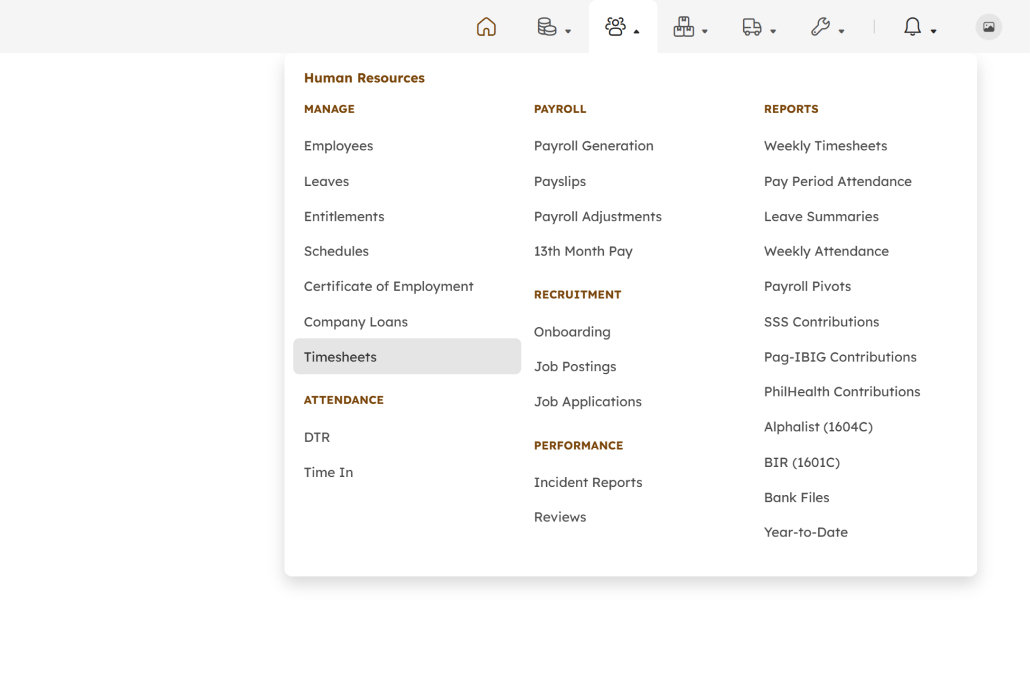
The Timesheet page can be accessed from the Human Resources module. From the Manage menu, the user selects Timesheets.
Features in Timesheets Page
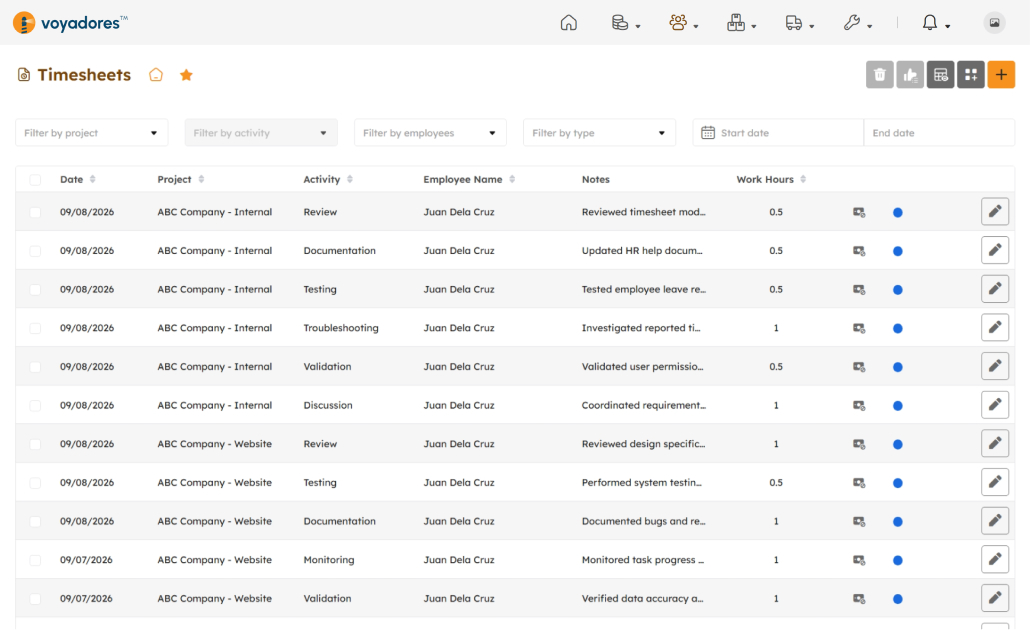
The snip below is the high-level view of the Timesheets page along with its built-in features.
Timesheets Page Header Actions
home-dash
Set as Default Page
star
Add to Quick Links
plus
Create Timesheet
grid-square-plus
Projects
Preview Timesheets
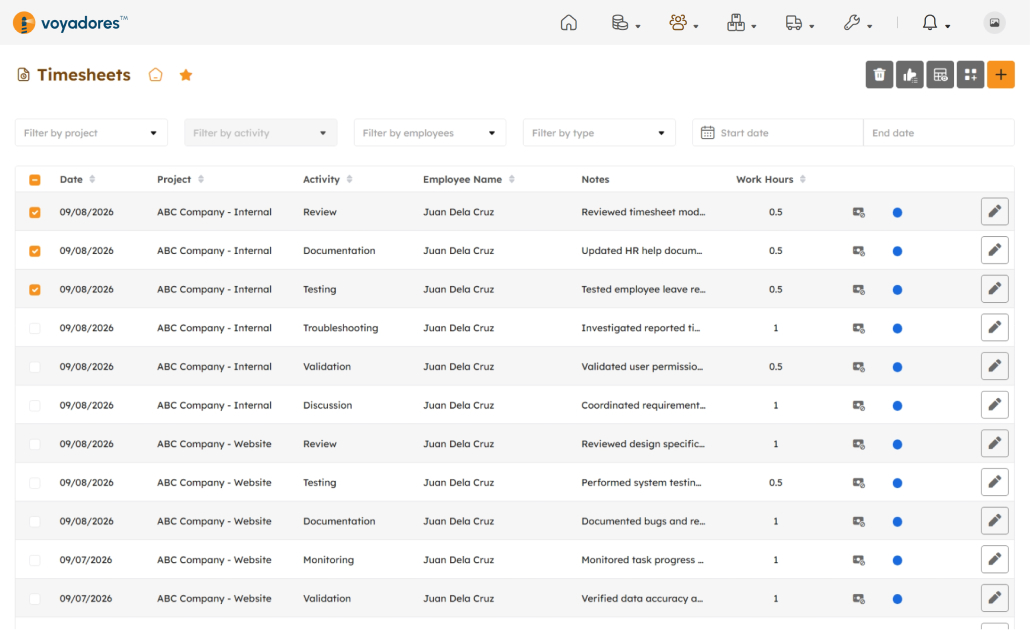
Selecting a timesheet using its checkbox enables the Clear and Approve actions in the page header for the selected records:
Approve Selected Timesheet
trash
Clear Selected Timesheets
Timesheets Summary Table
Checkbox
Date
Project
Activity
Employee Name
Notes
Work Hours
Type
Status
Actions
pen Edit Timesheet Item
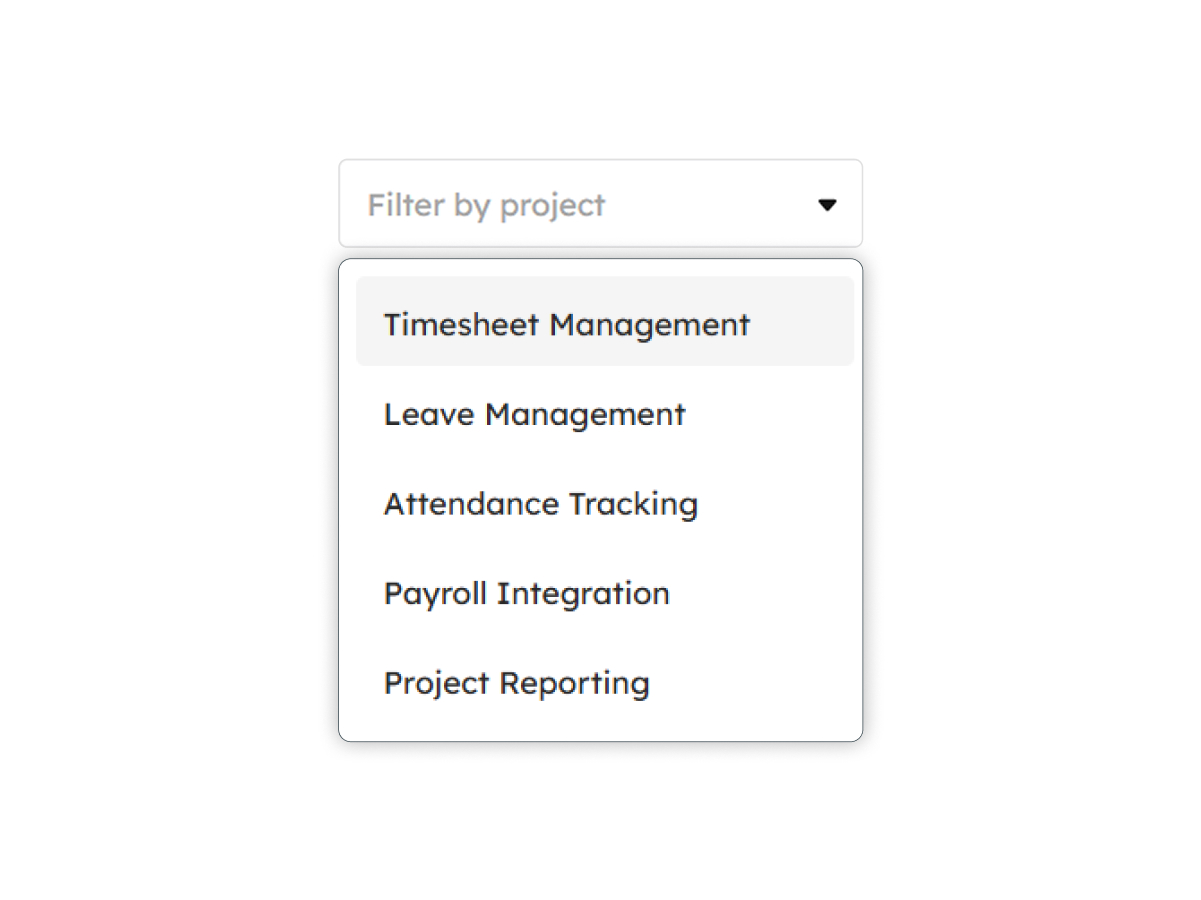
Filter Timesheets by Project
This feature is to filter Timesheets by project.
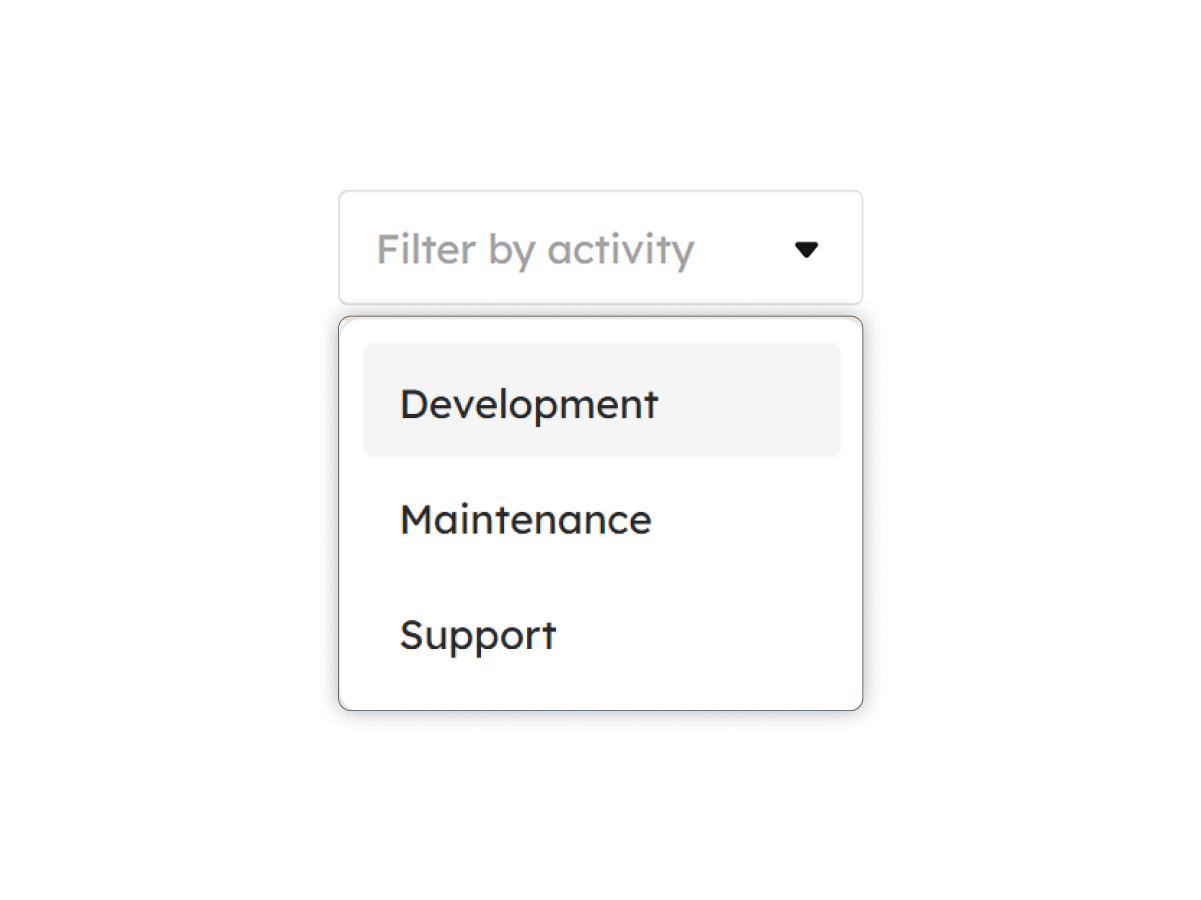
Filter Timesheets by Activity
This feature is to filter Timesheets by activity.
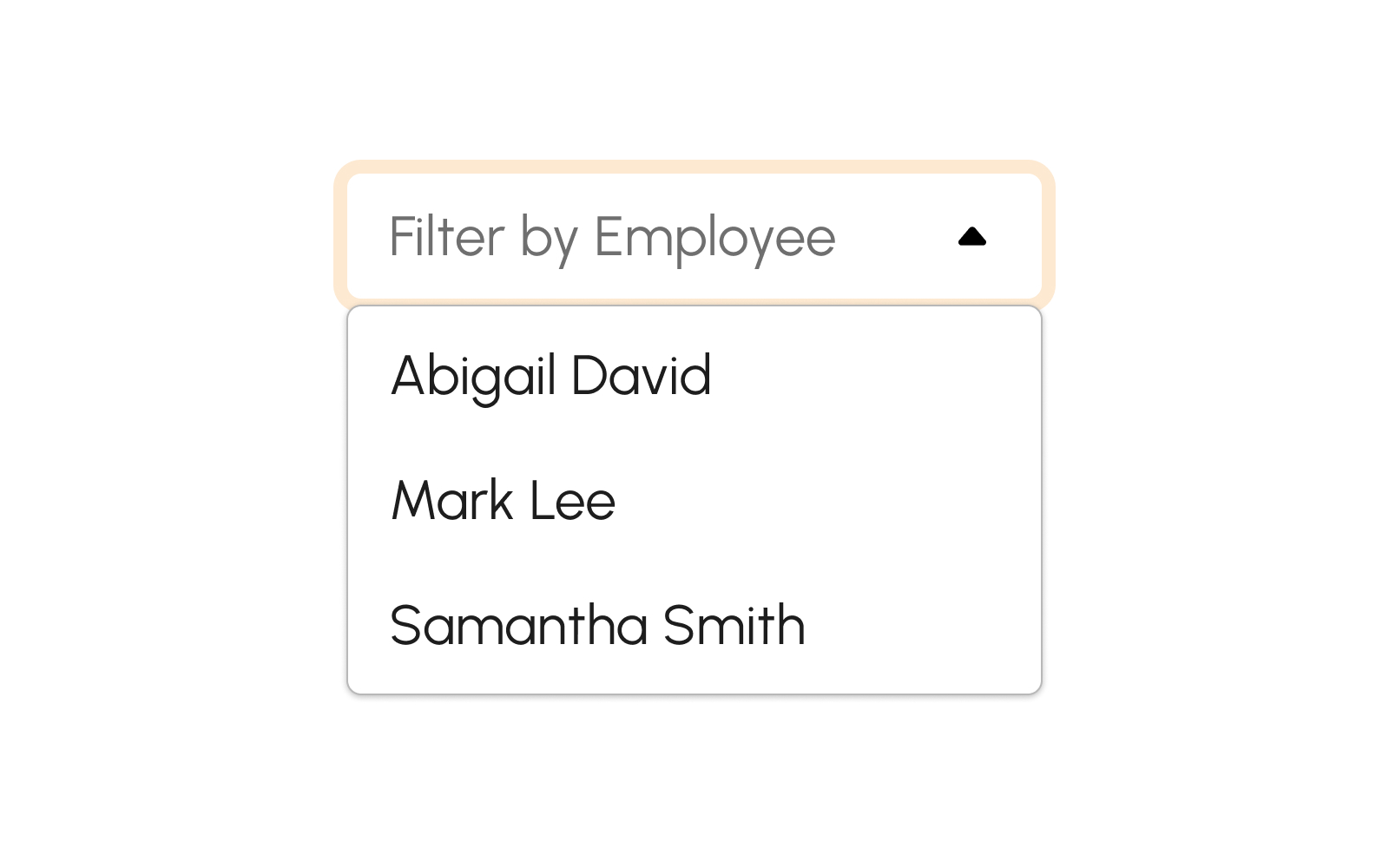
Filter Timesheets by Employee
This feature is to filter Timesheets by employee.
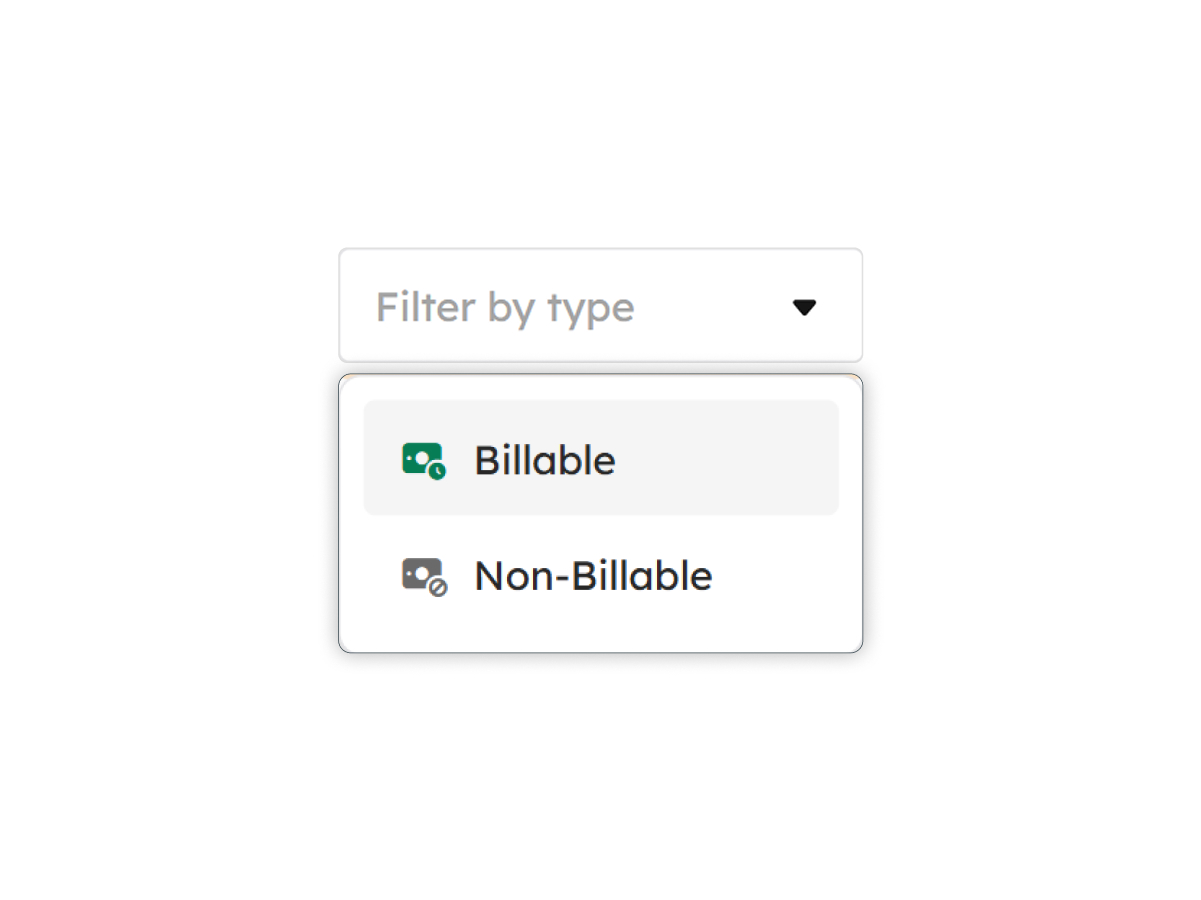
Filter Timesheets by Type
This feature is to filter Timesheets by type.
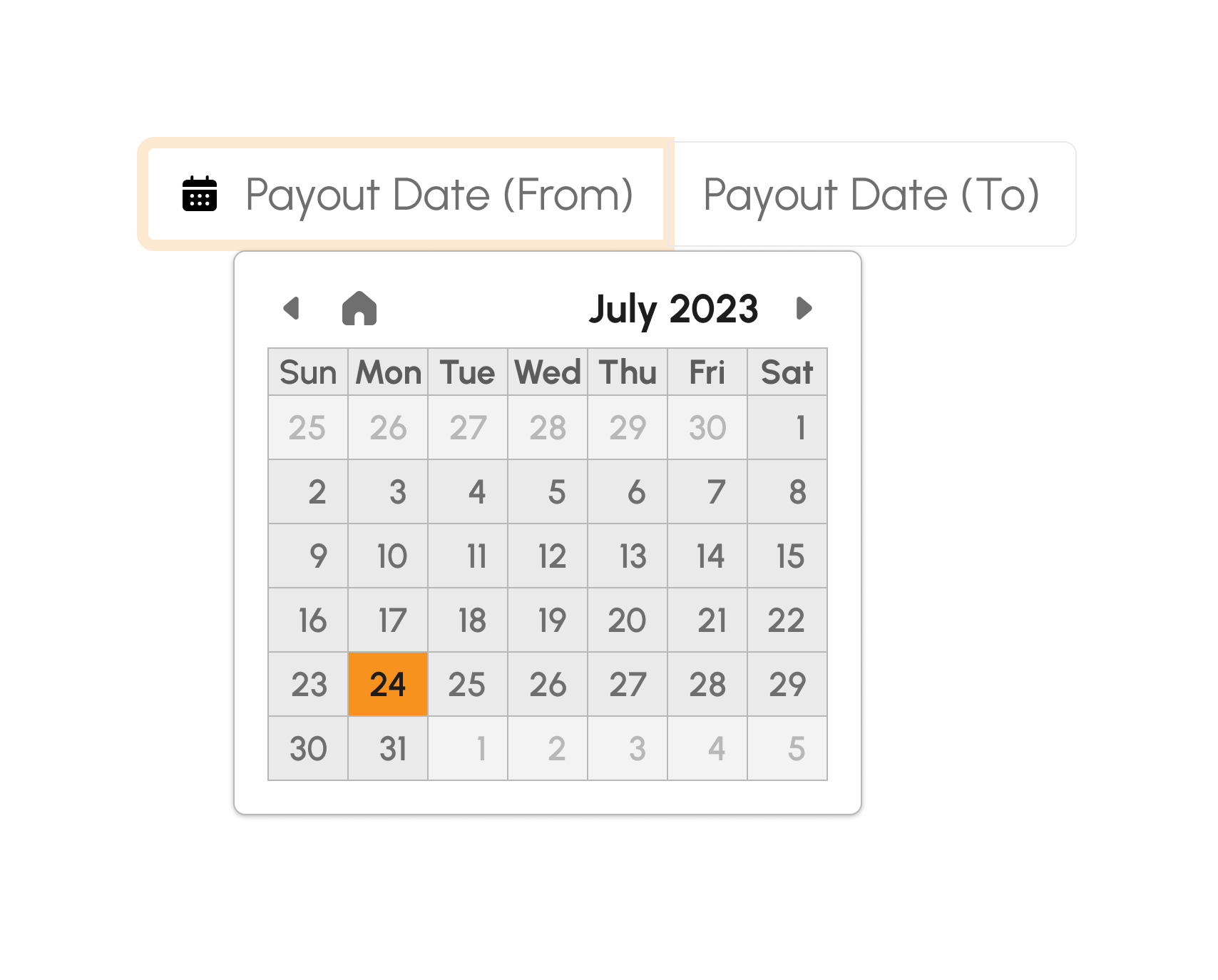
Filter Timesheets by Date Range
This feature enables users to filter timesheets based on a specified period. By setting the Start Date and End Date, it allows for focused tracking and review of timesheets created within the selected timeframe.
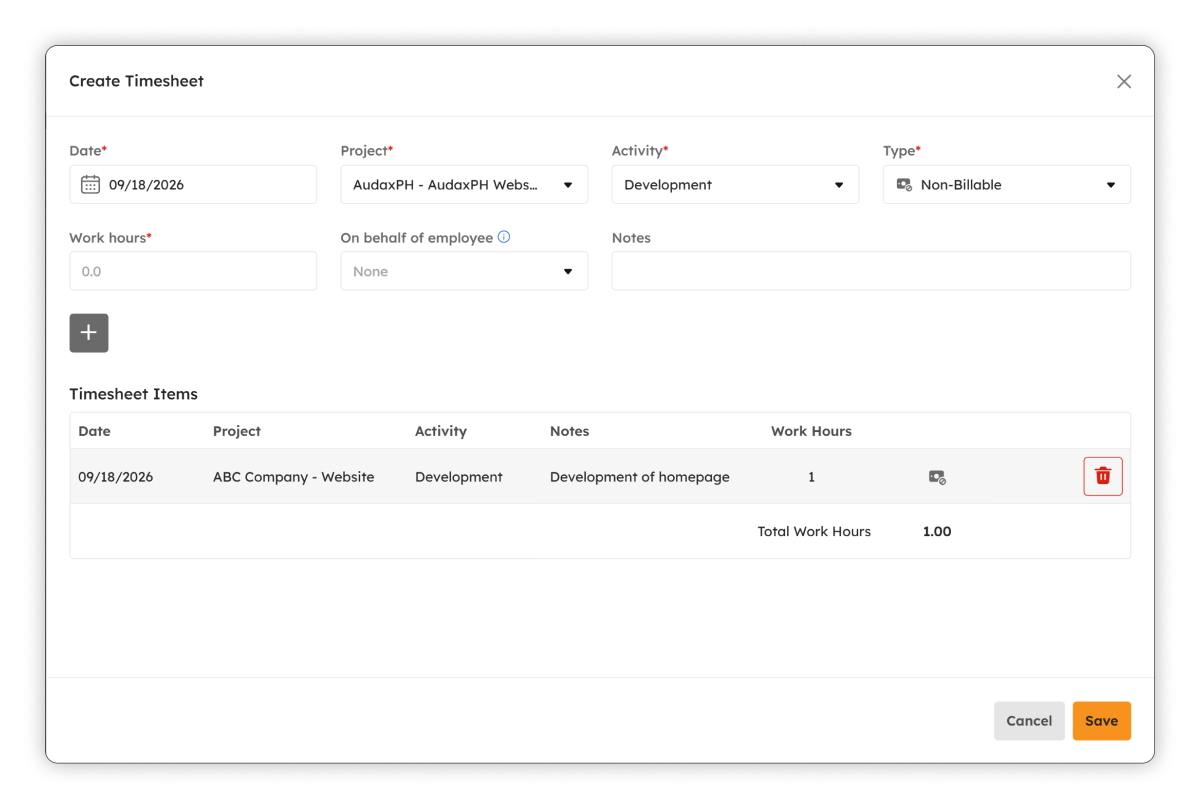
Create Timesheet
A timesheet can be created to record an employee's work hours for a specific project and activity. The entry can also be identified as billable or non-billable.
The following fields can be found in the modal:
Date. Identifies the date covered by the timesheet entry.
Project. Identifies the project where the work was performed.
Activity. Identifies the project activity related to the work performed.
Type. Identifies whether the entry is Billable or Non-Billable.
exclamation-circle
Note
The Billable or Non-Billable type should be selected based on how the recorded work should be classified.
Work Hours. Records the number of hours worked.
On behalf of employee. Allows the entry to be recorded on behalf of a specific employee, when applicable.
Notes. Provides additional information about the recorded work.
Timesheet Item Table. displays the timesheet entries added to the record.
To create a timesheet, follow the procedure below:
Open the Create Timesheet modal by clicking plus button on the page header.
Select the date for the work being recorded.
Choose a project from the Project dropdown list.
Select the activity associated with the selected project from the dropdown list.
Choose whether the entry is Billable or Non-Billable.
Enter the number of hours worked.
If applicable, select an employee from On behalf of employee to create a timesheet for another team member.
Enter a brief description of the work performed in the Notes field.
Click the plus button to add the entry to the Timesheet Items list.
Repeat Steps 2 to 9 to add additional work entries as needed.
To delete an entry from the Timesheet Items list before saving, select the trash button for the corresponding timesheet item.
Click Save to create the timesheet and save all entries.
Otherwise, click Cancel to close the modal without saving changes.
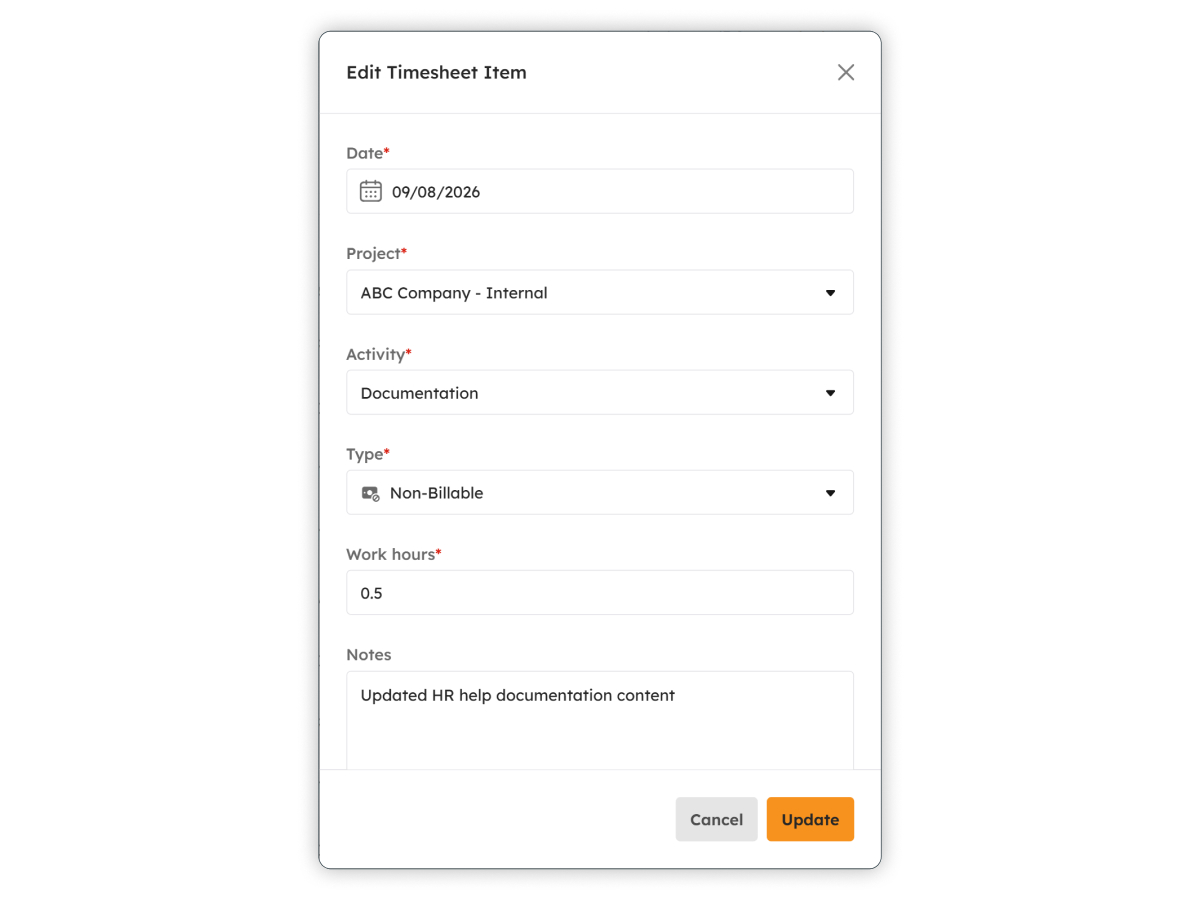
Edit Timesheet Item
Locate the timesheet item that requires modification.
Click the pen action associated with the timesheet item.
In the Edit Timesheet Item modal, review the current details.
Update the Date as needed.
Select a different Project if the work entry should be assigned to another project.
Select the appropriate Activity for the updated work entry.
Update the Type.
Modify the Work Hours field to reflect the correct amount of time spent on the activity.
Update the Notes field with the relevant work details or comments.
Review all changes to ensure the information is accurate.
Click Update to save the changes.
Otherwise, click Cancel to close the modal without saving changes.
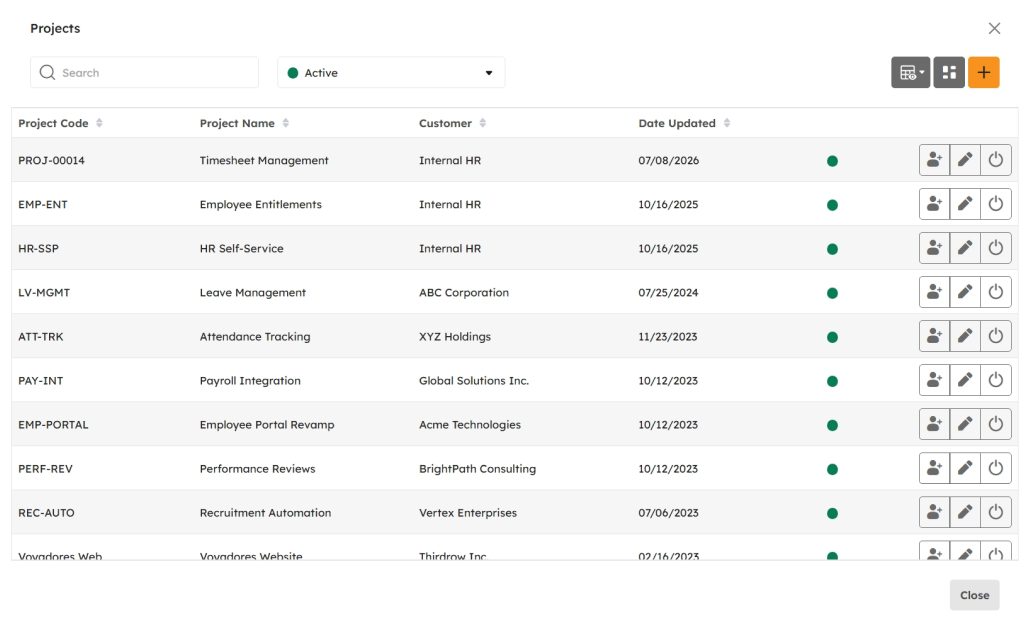
Projects
Projects are used as the main work category for timesheet entries. A project should be created before it can be selected when creating a timesheet.
Selecting the grid-square-plus opens the Projects modal, where existing projects can be viewed and managed.
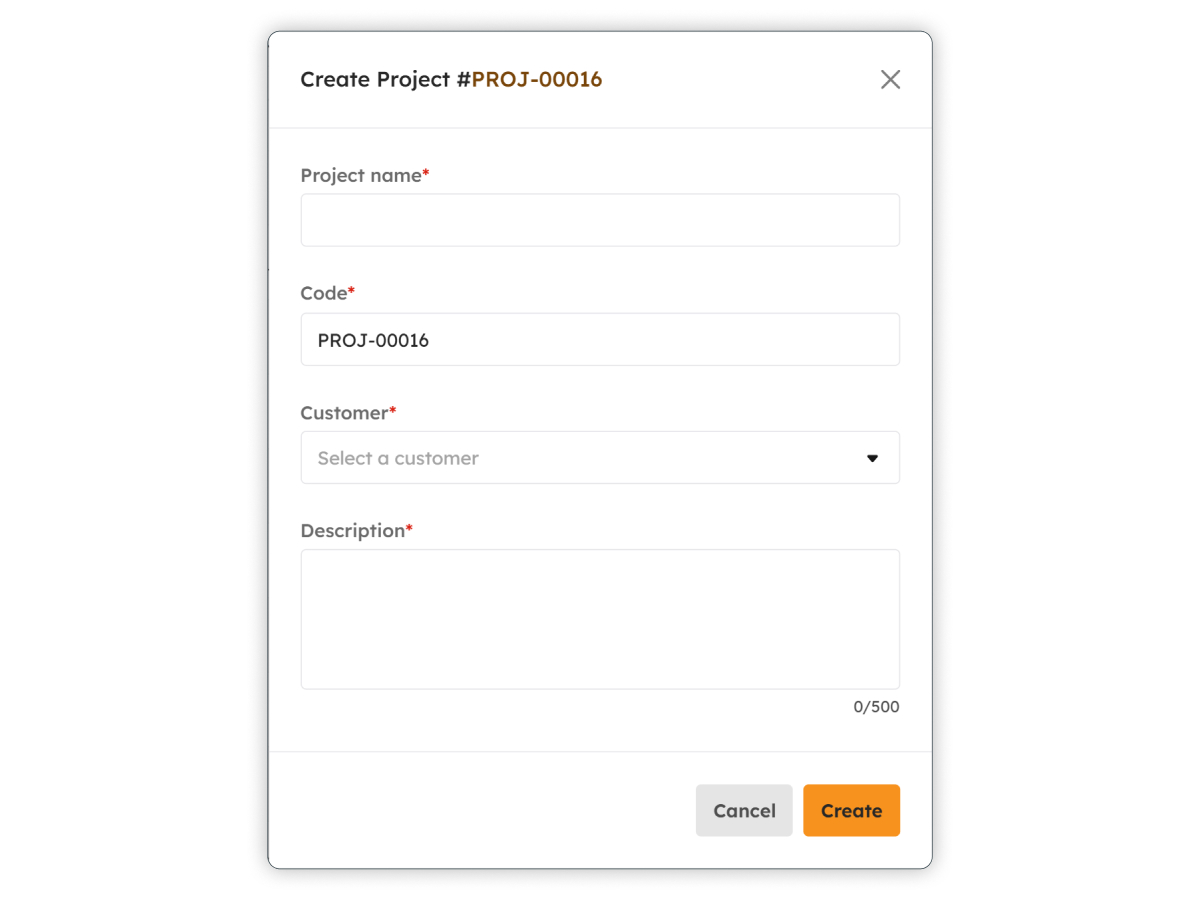
Create a Project
A project is created by selecting the plus button.
To create a project, simply complete the form with the following information:
Project Name. Identifies the project.
Code. Provides a unique or identifying code for the project.
Customer. Identifies the customer associated with the project.
Description. Provides a brief description of the project.
After reviewing the information, click Create to save the changes.
Otherwise, click Cancel to close the modal without saving changes.
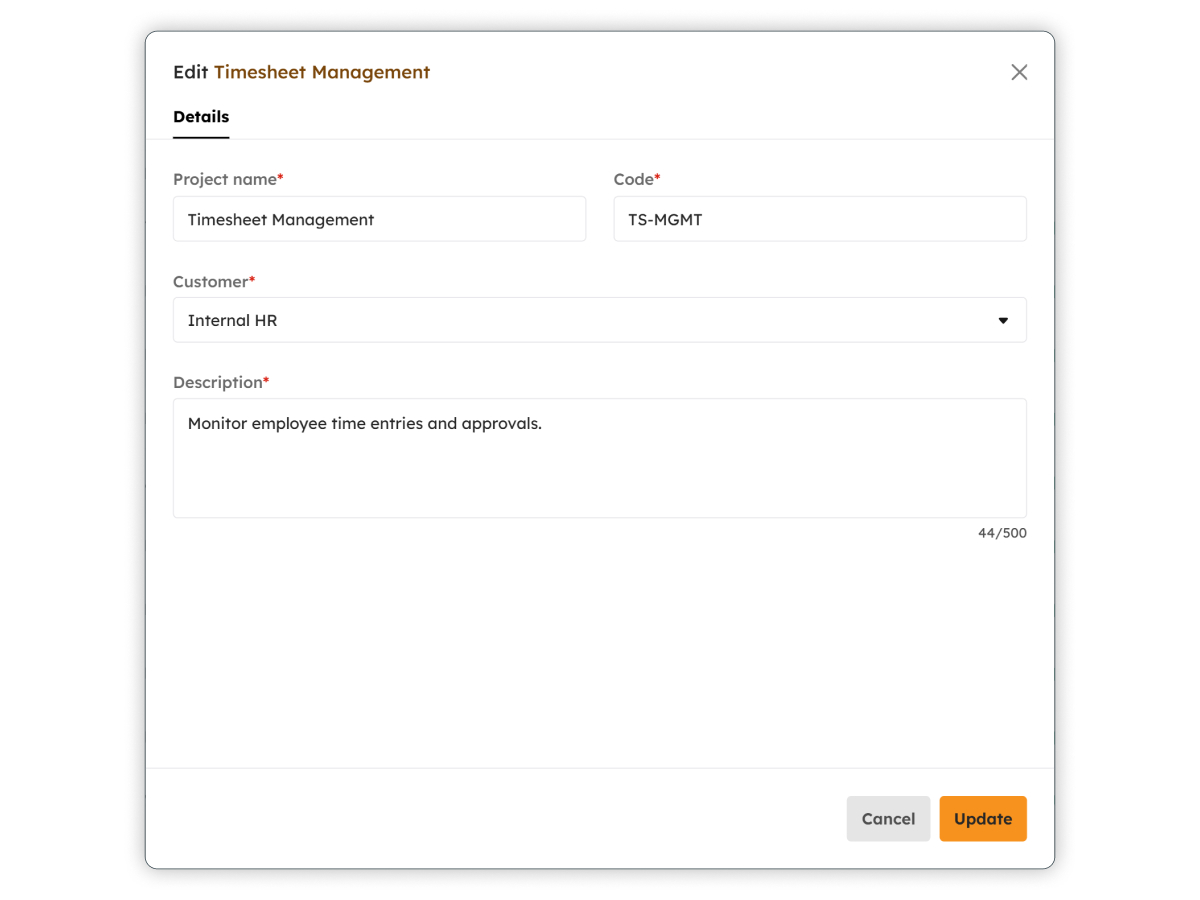
Edit a Project
An existing project can be updated by selecting the pen button. The project details can then be reviewed or changed before the update is saved.
To edit a project, simply update the required information:
Project Name. Identifies the project.
Code. Provides a unique or identifying code for the project.
Customer. Identifies the customer associated with the project.
Description. Provides a brief description of the project.
After reviewing the information, click Update to save the changes.
Otherwise, click Cancel to close the modal without saving changes.
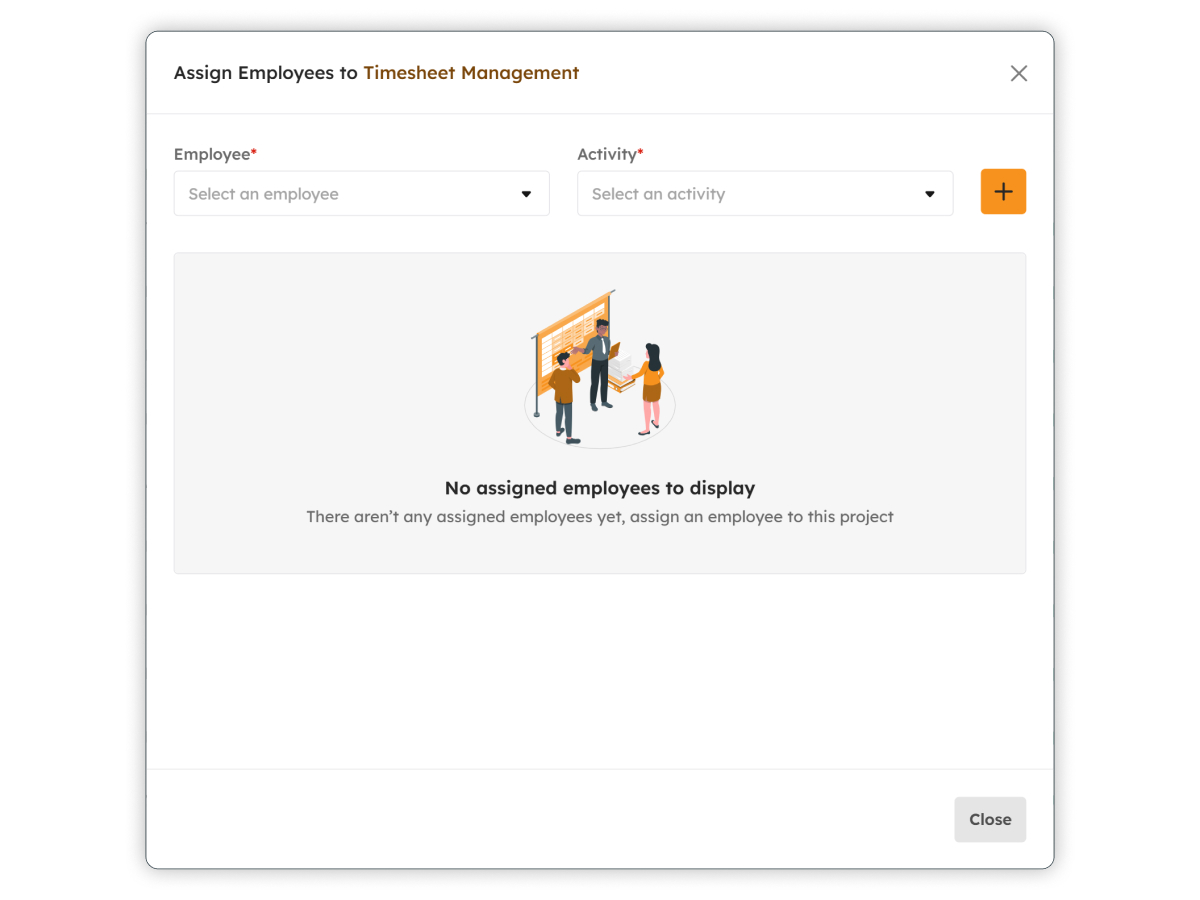
Assign a Project to an Employee
A project can be assigned to employees so that the project can be used for their applicable timesheet activities.
Selecting user-plus button opens the Assign Employees modal, where an employee and activity can be selected.
Follow these steps to assign an employee to a project:
Verify the project name displayed in the window header.
In the Employee field, select the employee to be assigned to the project.
In the Activity field, select the activity that will be assigned to the employee.
Click the plus button to add the assignment.
Review the newly added assignment in the Assigned Employees table.
Repeat Steps 2 to 5 to assign additional employees or activities to the project.
To remove an assignment, click the trash button corresponding to the employee assignment.
Click the Close to exit the window when all assignments have been completed.
exclamation-circle
Note
Project and activity assignments help ensure that the appropriate employees can use the project when recording time.
Activate/Deactivate a Project
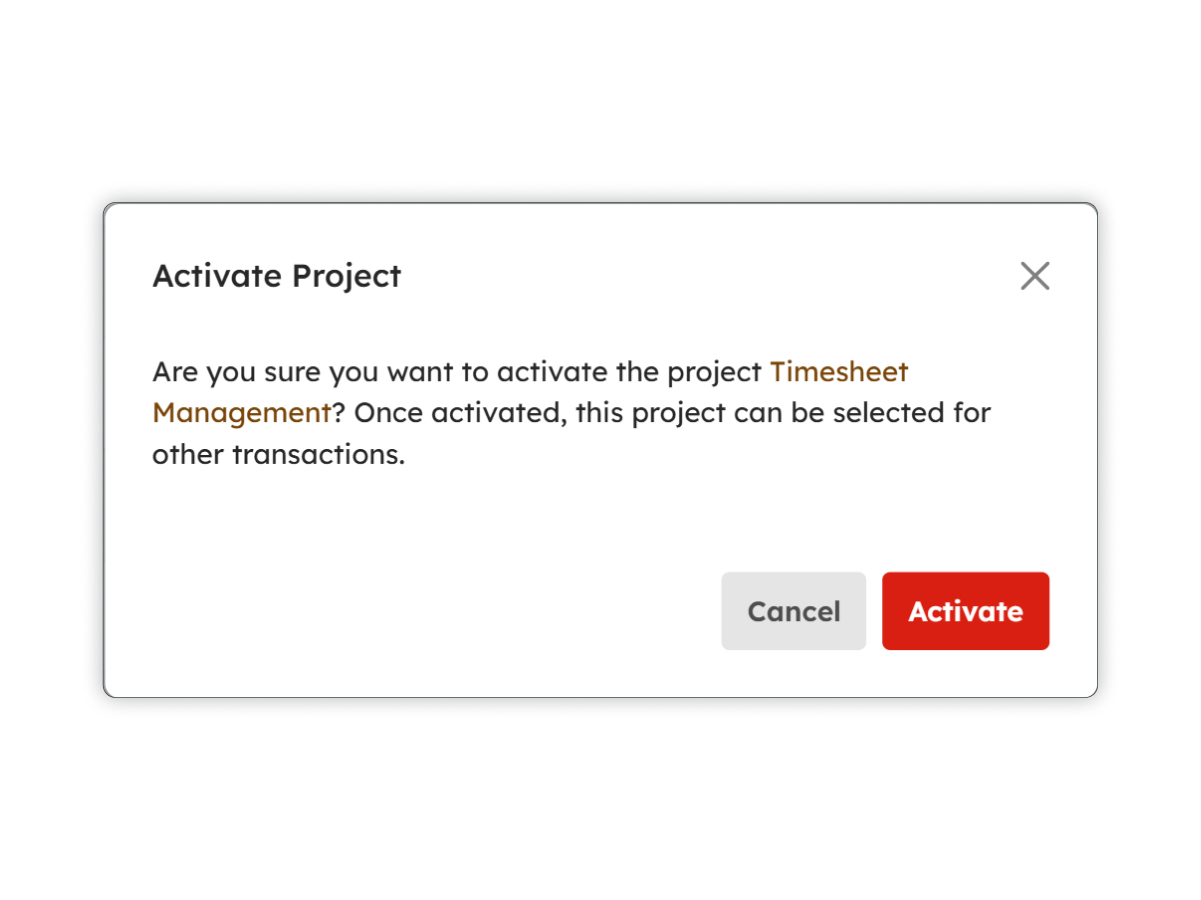
Activate an inactive project:
Click the power-off button to activate an inactive project. This will show a confirmation modal.
From the modal, click Activate to successfully activate the project, otherwise, click Cancel button.
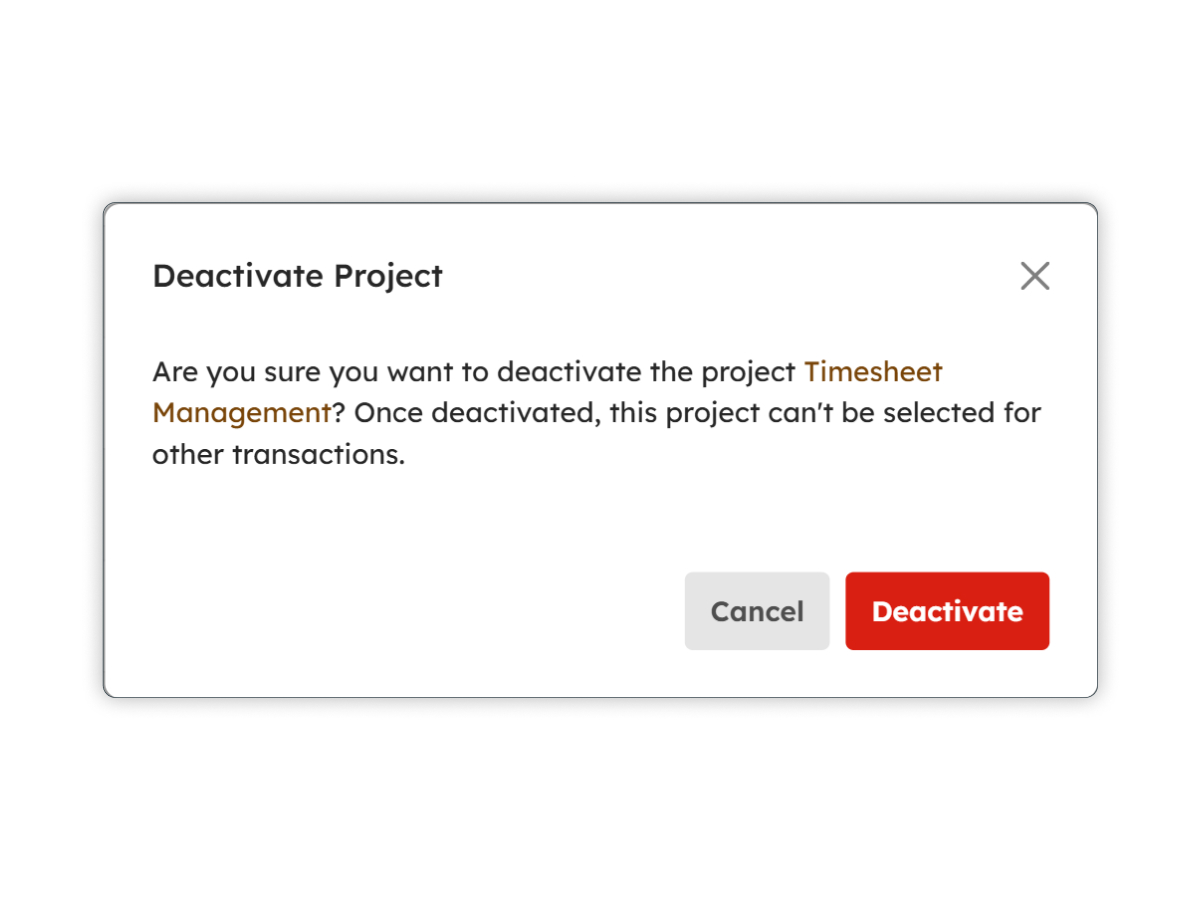
Deactivate an active project:
Click the power-off button to deactivate an active project. This will show a confirmation modal.
From the modal, click Deactivate to successfully deactivate the project, otherwise, click Cancel button.
exclamation-circle
Note
A project should be active before it is selected in a timesheet.
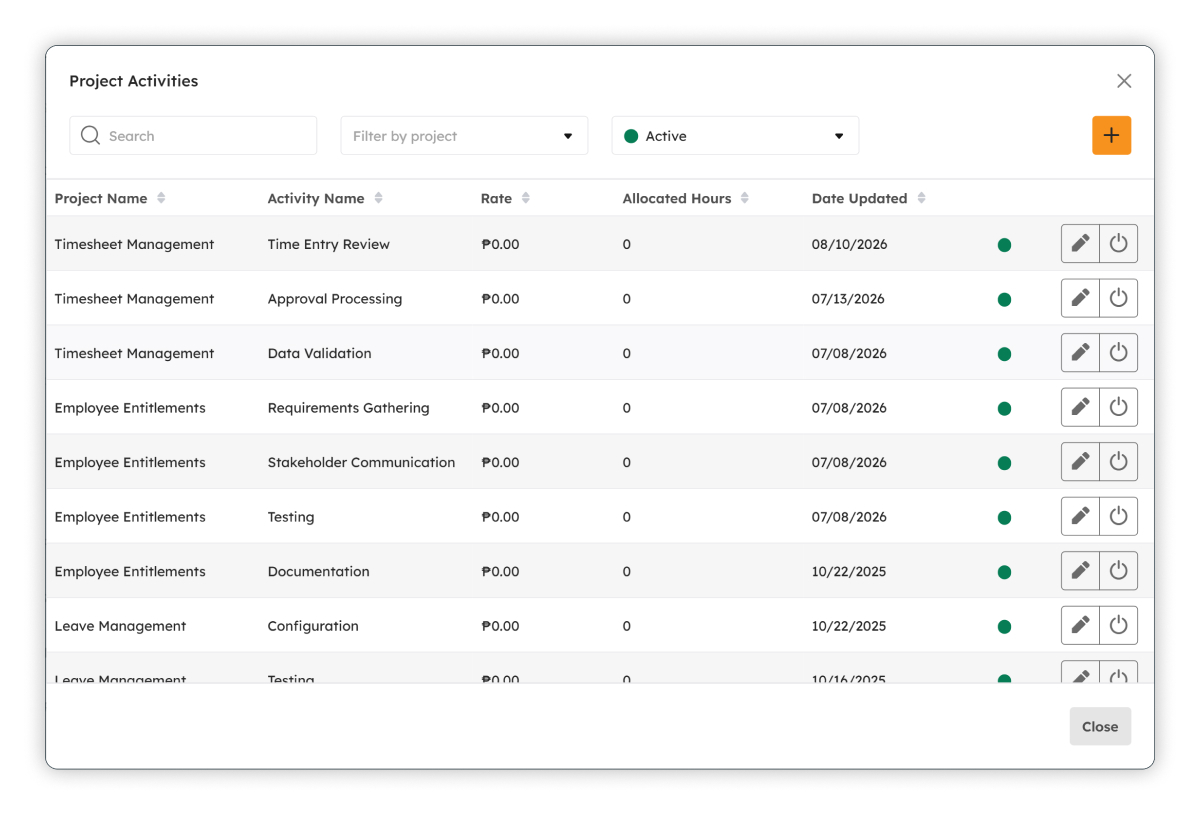
Manage Project Activities
Project Activities identify the specific type of work performed under a project. Activities are important because they are selected when a timesheet entry is created.
Open the modal by clicking grid-web-7 found in the Projects modal to see the activities associated with the project.
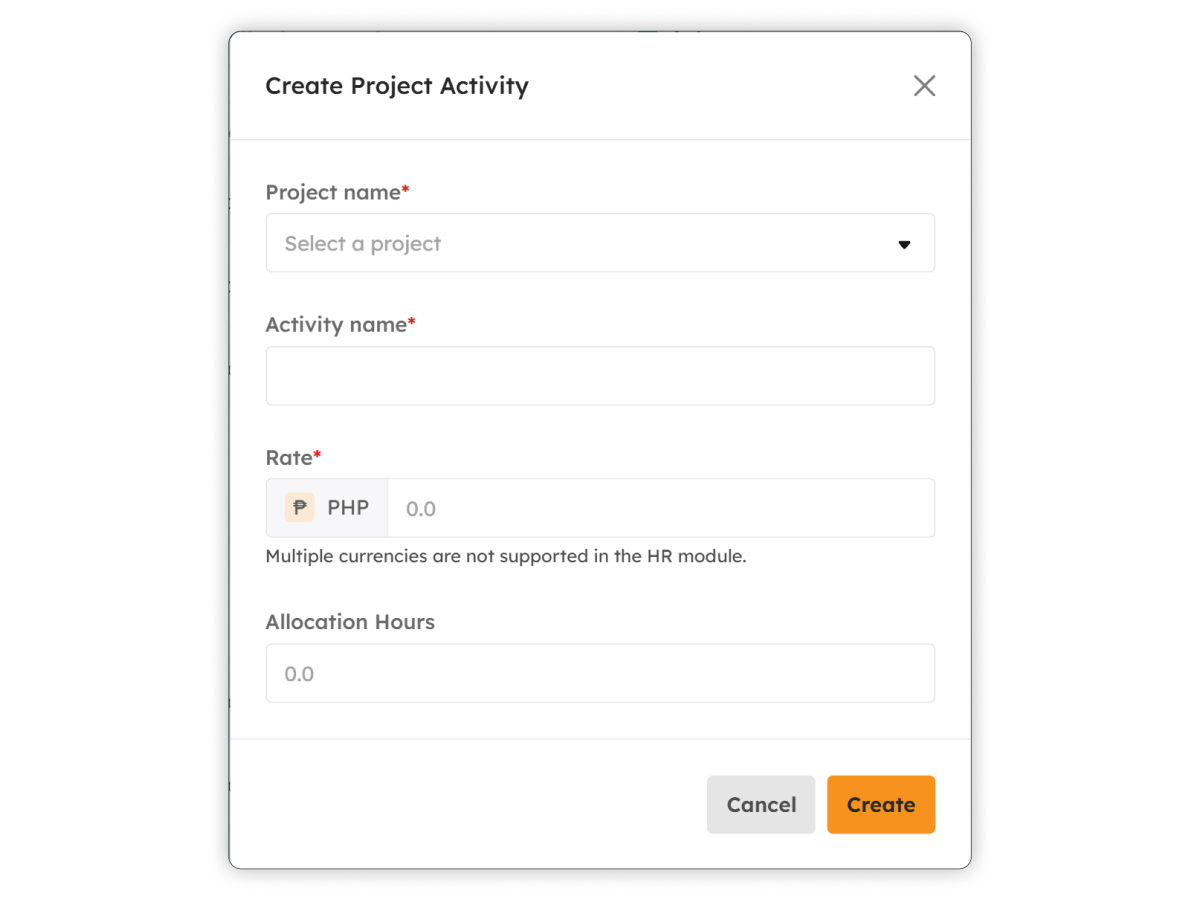
Create a Project Activity
A project activity is created by selecting the plus button.
To create a project activity, simply complete the form with the following information:
Project Name. Identifies the project where the activity will be added.
Activity Name. Identifies the activity.
Rate. Specifies the applicable rate for the activity. The screen indicates that multiple currencies are not supported in the HR module.
Allocation Hours. Specifies the applicable allocated hours for the activity. This field is not required.
After reviewing the information, click Create to save the changes.
Otherwise, click Cancel to close the modal without saving changes.
exclamation-circle
Note
Project activities are created under a project and are used when recording timesheet entries.
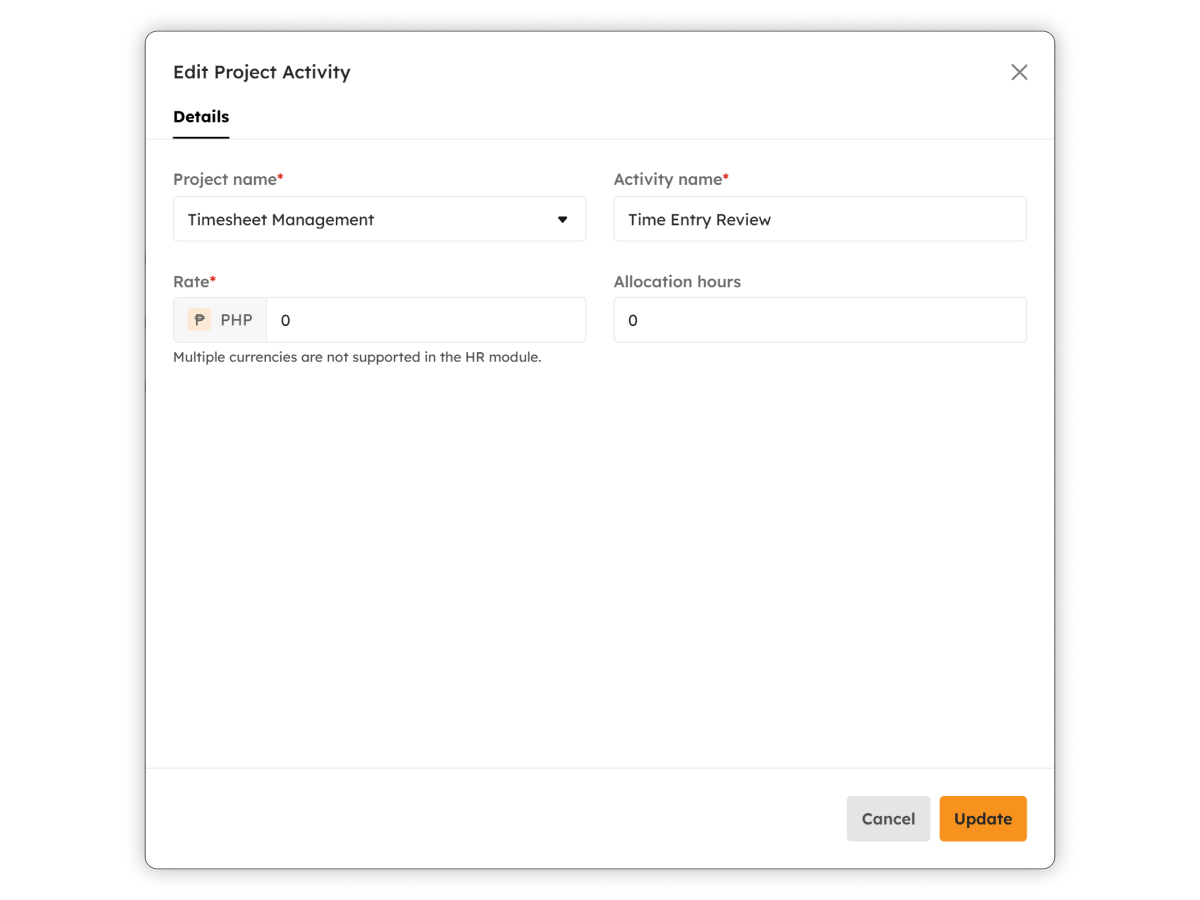
Edit a Project Activity
An existing project activity can be updated by selecting its pen button.
To edit a project, simply update the required information:
Project Name. Identifies the project where the activity will be added.
Activity Name. Identifies the activity.
Rate. Specifies the applicable rate for the activity. The screen indicates that multiple currencies are not supported in the HR module.
Allocation Hours. Specifies the applicable allocated hours for the activity. This field is not required.
After reviewing the information, click Update to save the changes.
Otherwise, click Cancel to close the modal without saving changes.
 The user can also click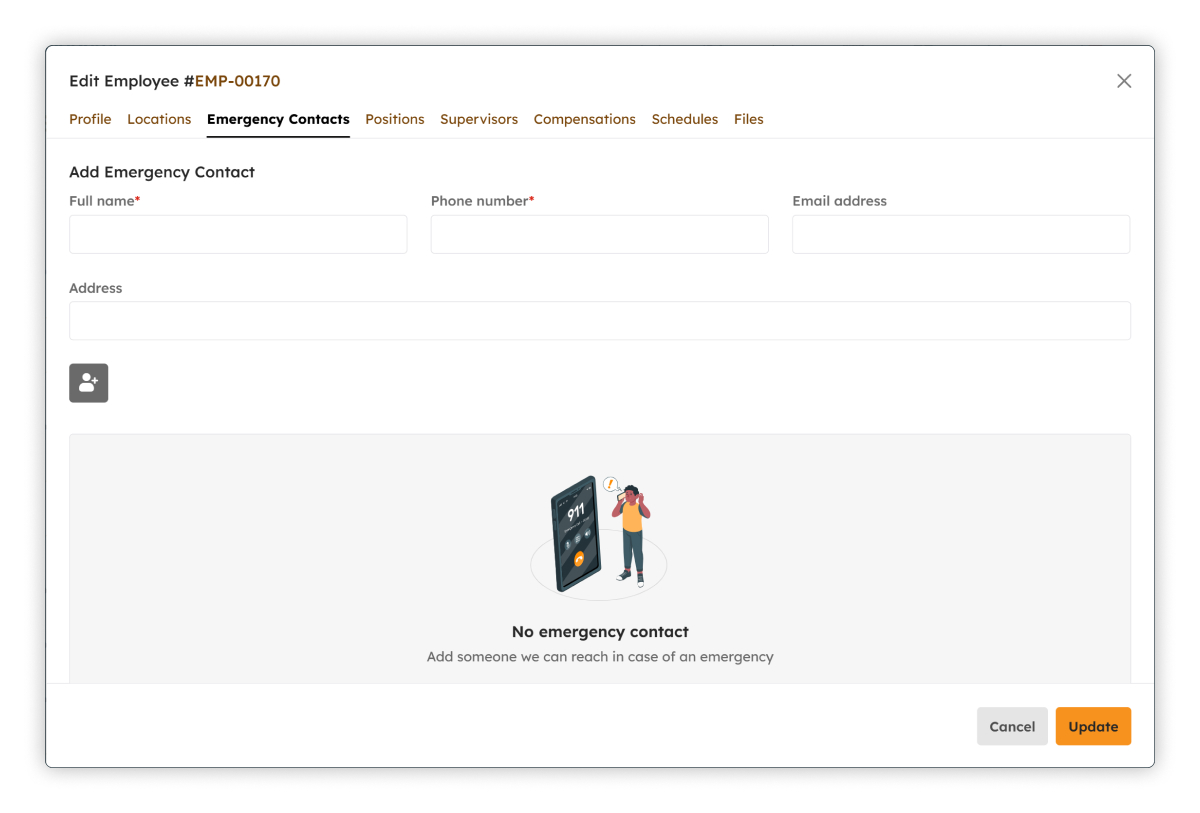
 The user can also click
  The user can also click
  The user can also click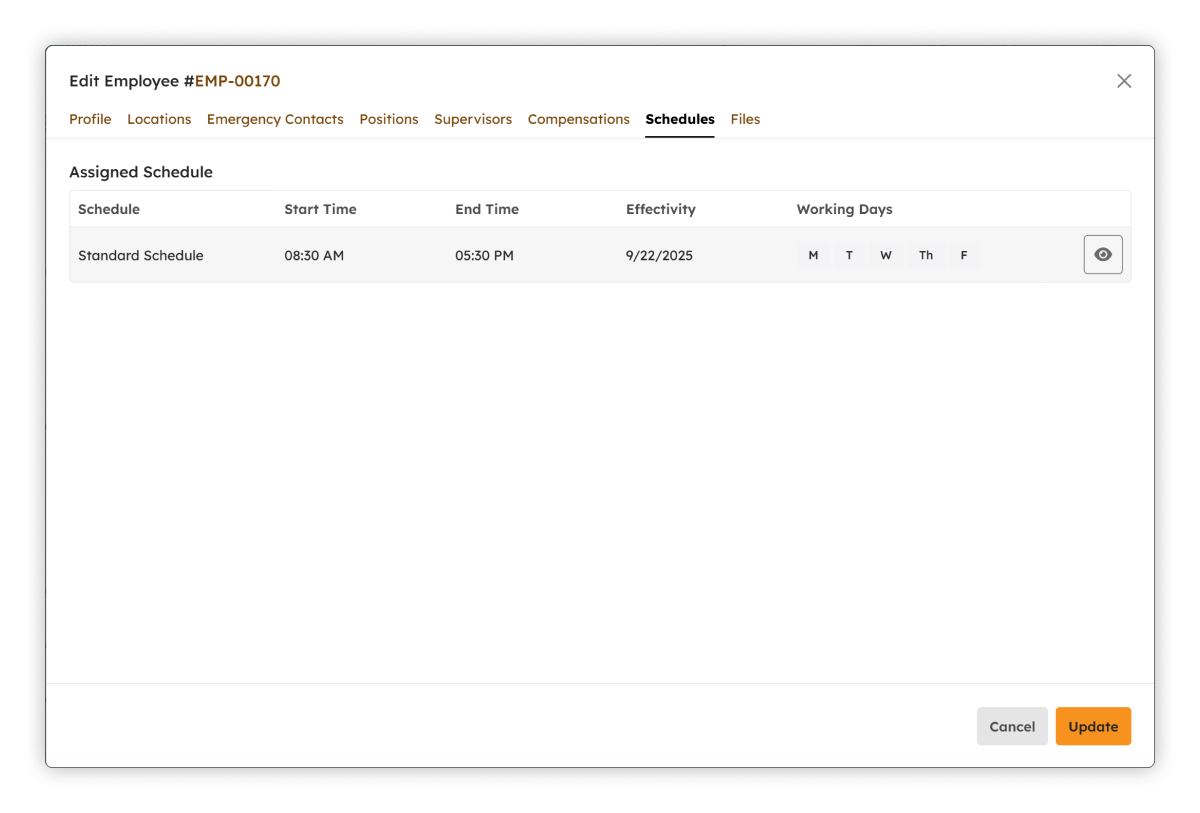
 The user may click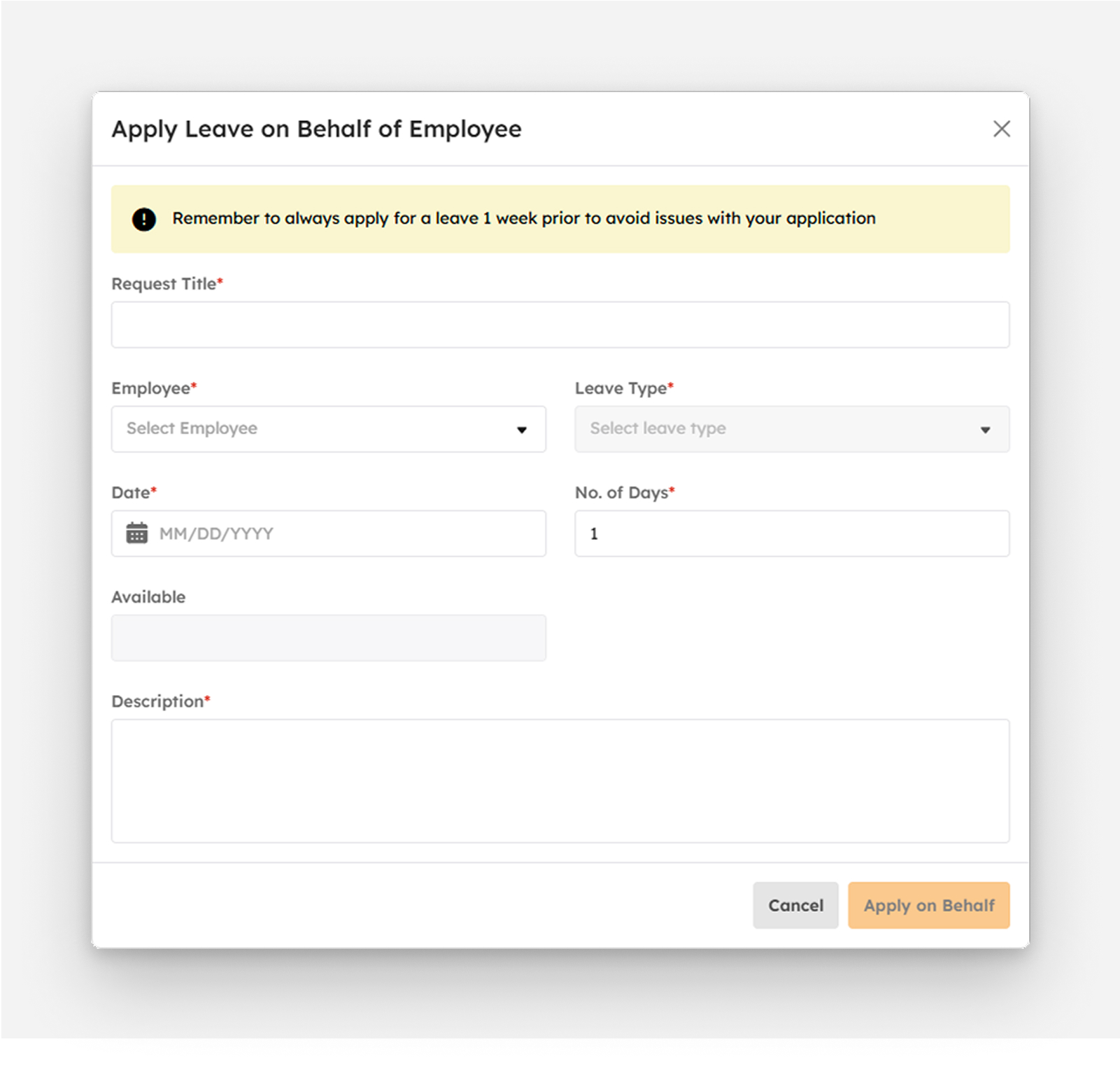
 Loan fees may be added if necessary.