Payroll
Who can use this feature
Anyone with Administrator and Payroll Manager role can access all the Payroll pages
Anyone with HR Manager and Employee role can only access the Payslips page
Introduction to Payroll Submodule
The Payroll Submodule provides tools for managing and processing employee payroll in one place. It includes features for calculating employee salaries and wages, managing deductions and taxes, and generating payslips.
The Payroll Submodule helps manage payroll-related tasks and process employee pay accurately and on time.
Definition of Terms
Defined in this section are the available pages under the Payroll submodule as follows:
- Payroll Generation. Used to generate payroll and payslips. It displays employee earnings, deductions, and net pay for the selected pay period.
- Payslips. Allows employees to view and download their payslips. It provides a breakdown of earnings, deductions, and net pay for a specific pay period.
- Benefits and Deductions. Used to manage payroll benefit and deduction items, including their amounts, formulas, frequencies, and visibility.
- Payroll Adjustments. Used to record additional payments, deductions, corrections, allowances, and other payroll-related adjustments.
- Batch Payroll Adjustments. Used to create and manage recurring payroll adjustments for one or more employees.
- 13th Month Pay. Used to generate and manage 13th month pay records for eligible employees.
Roles and Permissions
The table below shows the defined roles and permissions when accessing pages and features under Payroll Submodule.
| Functions | Administrator | HR Manager | Payroll Manager | Employee |
|---|---|---|---|---|
| Payroll Generation | ||||
| Generate | ||||
| Preview | ||||
| Download | ||||
| Edit | ||||
| Approve | ||||
| Payslips | ||||
| Preview | ||||
| Download | ||||
| Benefits and Deductions | ||||
| Create | ||||
| Preview | ||||
| Reorder | ||||
| Edit | ||||
| Activate/Deactivate | ||||
| Payroll Adjustment | ||||
| Create | ||||
| Edit | ||||
| Cancel | ||||
| Batch Payroll Adjustment | ||||
| Create | ||||
| Edit | ||||
| Cancel | ||||
| View | ||||
| 13th Month Pay | ||||
| Generate | ||||
| Preview | ||||
| Approve | ||||
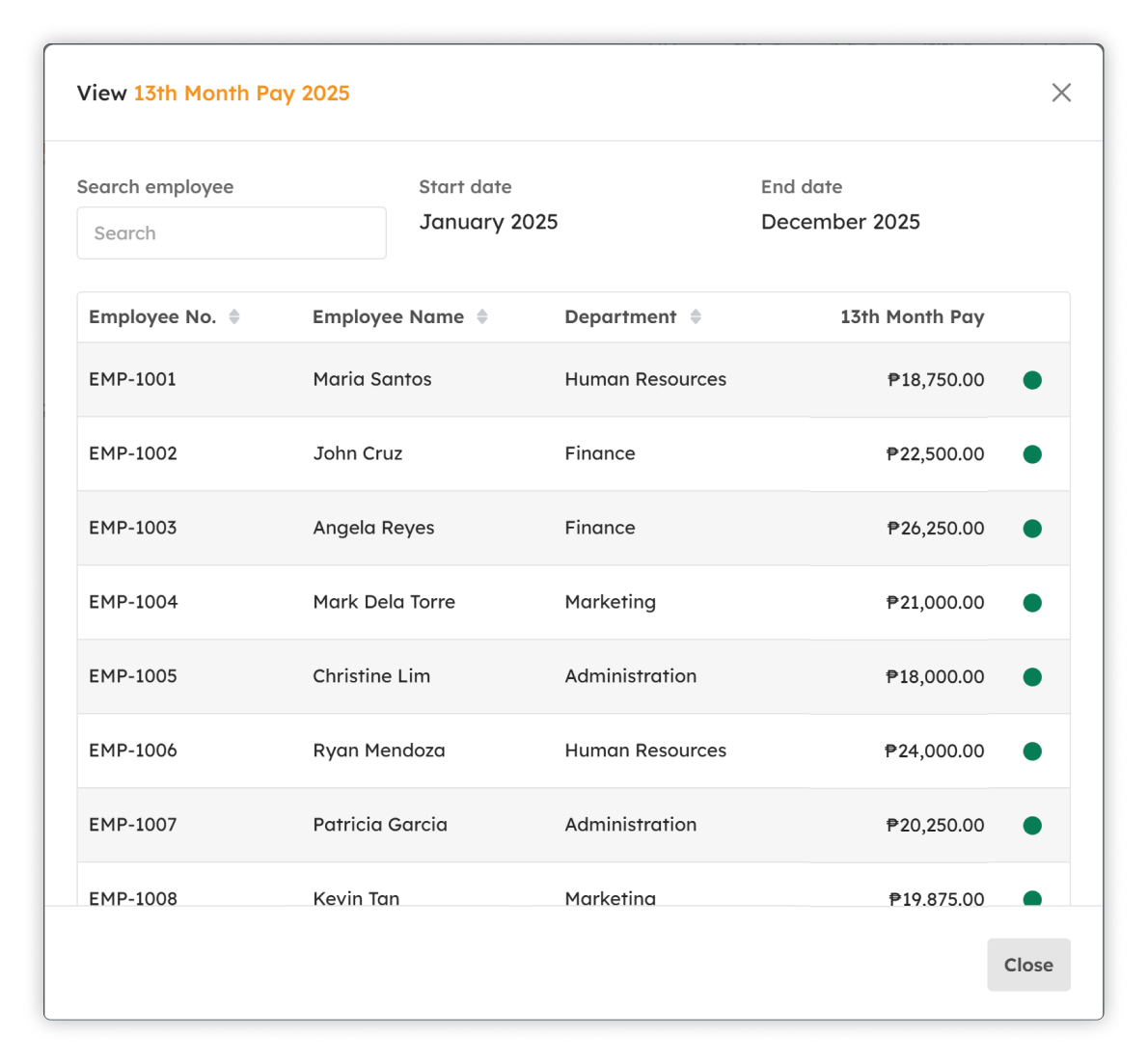
| View | ||||
| Delete | ||||
Roles and Permissions
Note that users have the flexibility to enhance access control and refine user privileges by effortlessly adding and configuring additional roles and permissions. This aligns system functionality with the organizational structure and security requirements, ensuring that users are assigned appropriate levels of access and responsibilities.
To do so, contact [email protected]
Payroll Formula Parameters
This section lists the default formula parameters available for payroll item calculations.
Note
Parameter names are case-sensitive. The exact capitalization shown in the table must be used. For example, MonthlySalary and monthlysalary are treated as different parameters. Using incorrect capitalization may result in an error.
Default Parameters
The table shows the default calculation for each parameter when no custom formula or implementation is set.
| # | Parameter Name | Description | How is it calculated? |
|---|---|---|---|
| 1 | MonthlySalary | Employee monthly salary. | Calculated from the Basic Salary component when the pay type is Monthly Salary; otherwise, 0. |
| 2 | DailyRate | Employee daily rate. | Monthly Salary: Basic Salary ÷ working days. Daily Rate: Daily Rate component. Project Based: assigned project activity rate. Otherwise, 0. |
| 3 | BasicPay | Employee basic pay for the pay period. | Calculated based on the employee's assigned pay type and configured work-hour thresholds. |
| 4 | TotalOvertimeHours | Total overtime hours for the pay period. | Calculated from Overtime entitlements. Returns 0 when required overtime entitlement conditions are not met. |
| 5 | TotalUndertimeMinutes | Total undertime minutes for the pay period. | Calculated from Undertime entitlements. Returns 0 when required undertime entitlement conditions are not met. |
| 6 | TotalAttendanceLog | Total approved attendance recorded during the pay period. | Counts approved records with time-in and time-out. 8+ hours = 1 day; 4–<8 hours = 0.5 day. Thresholds are configurable. |
| 7 | TotalAbsences | Total absences during the pay period. | Flexible Schedule: DTR entitlement amount. Other schedules: counts missing attendance on scheduled workdays without filed leave. |
| 8 | TotalAbsentHours | Total absent hours during the pay period. | Calculated from approved DTRs with the Absent entitlement using Absent (Hrs). |
| 9 | TotalSpecialOvertimeHours | Total special overtime hours during the pay period. | Calculated from Special OT entitlements; returns 0 without the required entitlement. |
| 10 | TotalLateMinutes | Total late minutes during the pay period. | Calculated from Late entitlements; returns 0 when required late entitlement conditions are not met. |
| 11 | TotalPaidLeaves | Total approved paid leaves during the pay period. | Total approved filed leaves with pay. |
| 12 | TotalUnpaidLeaves | Total approved unpaid leaves during the pay period. | Total approved filed leaves without pay. |
| 13 | EmployeePhilHealth | Employee PhilHealth contribution. | Uses the default PhilHealth contribution calculation; 0 for Daily Rate pay type. |
| 14 | EmployerPhilHealth | Employer PhilHealth contribution. | Uses the default PhilHealth contribution calculation; 0 for Daily Rate pay type. |
| 15 | EEPhilHealth | Employee PhilHealth contribution. | Uses the default PhilHealth contribution calculation. |
| 16 | ERPhilHealth | Employer PhilHealth contribution. | Uses the default PhilHealth contribution calculation. |
| 17 | EmployeeSSS | Employee SSS contribution. | Uses the default SSS contribution calculation; 0 for Daily Rate pay type. |
| 18 | EmployerSSS | Employer SSS contribution. | Uses the default SSS contribution calculation; 0 for Daily Rate pay type. |
| 19 | EESSS | Employee SSS contribution. | Uses the default SSS contribution calculation. |
| 20 | ERSSS | Employer SSS contribution. | Uses the default SSS contribution calculation. |
| 21 | EmployerSSSECC | Employer SSS ECC contribution. | Not yet implemented. |
| 22 | EmployeePAGIBIG | Employee PAG-IBIG contribution. | Uses the default PAG-IBIG contribution calculation; 0 for Daily Rate pay type. |
| 23 | EmployerPAGIBIG | Employer PAG-IBIG contribution. | Uses the default PAG-IBIG contribution calculation; 0 for Daily Rate pay type. |
| 24 | EEPAGIBIG | Employee PAG-IBIG contribution. | Uses the default PAG-IBIG contribution calculation. |
| 25 | ERPAGIBIG | Employer PAG-IBIG contribution. | Uses the default PAG-IBIG contribution calculation. |
| 26 | SSSLoan | Employee SSS loan payment. | Based on SSS loan payments within the pay period. |
| 27 | EmployeeLoan | Employee company loan payment. | Based on company loan payments within the pay period. |
| 28 | PAGIBIGLoan | Employee PAG-IBIG loan payment. | Based on PAG-IBIG loan payments within the pay period. |
| 29 | WithholdingTax | Employee withholding tax deduction. | Uses the default withholding tax calculation. |
| 30 | TotalNightDiffHours | Total night differential hours during the pay period. | Calculated from Night Differential entitlements; returns 0 without the required entitlement. |
| 31 | TotalPaidHolidayDailyRate | Total paid holidays for daily-rate employees. | Counts PaidHoliday entitlements in attendance logs for the covered holidays. |
| 32 | TotalRegularHolidays | Total regular holidays worked. | Counts attendance logs on regular holidays within the pay period. |
| 33 | TotalSpecWorkingHolidays | Total special working holidays worked. | Counts attendance logs on special working holidays within the pay period. |
| 34 | TotalSpecNonWorkingHolidays | Total special non-working holidays worked. | Counts attendance logs on special non-working holidays within the pay period. |
| 35 | TotalSchedWorkingDays | Total scheduled working days. | Counts working days based on the pay period start month/year and assigned schedule. Returns 0 for other employment statuses. |
| 36 | TotalDeductions | Total employee deductions. | Sum of all deductions. |
| 37 | TotalBenefits | Total employee benefits. | Sum of all benefits. |
| 38 | TotalRestDays | Total rest days during the pay period. | Counts rest days based on the assigned company schedule. Returns 0 for other employment statuses. |
| 39 | HourlyRate | Employee hourly rate. | Hourly Rate: Hourly Rate component. Daily Rate: Daily Rate ÷ 8. Monthly Salary: Basic Salary ÷ working days ÷ 8. Otherwise, 0. |
| 40 | Ecola | Emergency Cost of Living Allowance (ECOLA) value. | Default value is 8.63. |
| 41 | TotalSNWHOvertimeHours | Total overtime hours on special non-working holidays. | Calculated from overtime recorded during special non-working holidays. |
| 42 | TotalRestDayHours | Total hours worked on rest days. | Total hours worked on designated rest days during the pay period. |
| 43 | TotalRestDayOvertimeHours | Total overtime hours on rest days. | Calculated from approved DTRs with Overtime and RestDay entitlements. |
| 44 | TotalRegularHolidayOvertimeHours | Total overtime hours on regular holidays. | Calculated from overtime recorded during regular holidays. |
| 45 | TotalRestDayHolidayHours | Total hours worked on holidays that fall on rest days. | Total hours worked when a holiday falls on an employee's rest day. |
| 46 | TotalRestDayHolidayOvertimeHours | Total overtime hours on holidays that fall on rest days. | Total overtime hours worked when a holiday falls on an employee's rest day. |
| 47 | TotalSpecNonWorkingHolidayHours | Total hours worked on special non-working holidays. | Total attendance hours recorded during special non-working holidays. |
| 48 | TotalNightDiffOvertimeHours | Total overtime hours with night differential. | Calculated when Overtime and Night Differential entitlements apply together; otherwise, 0. |
| 49 | ThirteenthMonthPay | Employee 13th-month pay for the covered period. | (Basic salary + overtime + allowances − late/absence deductions) ÷ 12. Returns 0 without a 13th-month pay release date. |
| 50 | SSSCal | Employee SSS calamity loan payment. | Based on SSS loans filed with the purpose 'Calamity loans'. |
| 51 | SSSMpl | Employee SSS multi-purpose loan payment. | Based on SSS loans filed with the purpose 'Multi-Purpose Loans'. |
| 52 | PAGIBIGMpl | Employee PAG-IBIG multi-purpose loan payment. | Based on PAG-IBIG loans filed with the purpose 'Pag-IBIG Multi-Purpose Loans'. |
| 53 | TotalRegularHolidayNightDiffHours | Night differential hours on regular holidays. | Based on night differential hours worked on regular holidays. |
| 54 | TotalRegularHolidayNightDiffOvertimeHours | Night differential overtime hours on regular holidays. | Based on night differential overtime hours worked on regular holidays. |
| 55 | TotalRegularHolidayNonRestDayHours | Hours worked on regular holidays that are not rest days. | Sum of hours worked during regular holidays that fall on workdays. |
| 56 | TotalRestDayRegularHolidayHours | Hours worked on regular holidays that are also rest days. | Sum of hours worked during regular holidays that fall on rest days. |
| 57 | TotalRestDayRegularHolidayOvertimeHours | Overtime hours on regular holidays that are also rest days. | Total hours beyond scheduled work on regular holidays that fall on rest days. |
| 58 | TotalRestDayRegularHolidayNightDiffHours | Night differential hours on regular holidays that are also rest days. | Total night differential hours worked on regular holidays that fall on rest days. |
| 59 | TotalRestDayRegularHolidayNightDiffOvertimeHours | Night differential overtime hours on regular holidays that are also rest days. | Night differential portion of overtime on regular holidays that fall on rest days. |
| 60 | TotalNightDiffNonRestDayHours | Night differential hours on non-rest days. | Total night hours worked during regular workdays. |
| 61 | TotalNightDiffNonRestDayOvertimeHours | Night differential overtime hours on non-rest days. | Night differential portion of overtime on regular workdays. |
| 62 | TotalRestDayNightDiffHours | Night differential hours on rest days. | Total night hours worked on designated rest days. |
| 63 | TotalRestDayNightDiffOvertimeHours | Night differential overtime hours on rest days. | Night differential portion of overtime worked on rest days. |
| 64 | TotalSpecWorkingHolidayTardinessHours | Tardiness hours on special working holidays. | Late arrivals recorded during special working holidays. |
| 65 | TotalSpecWorkingHolidayNonRestDayHours | Hours worked on special working holidays that are not rest days. | Regular hours worked on special working holidays that are workdays. |
| 66 | TotalSpecWorkingHolidayNightDiffHours | Night differential hours on special working holidays. | Total night hours worked during special working holidays. |
| 67 | TotalSpecWorkingHolidayNightDiffOvertimeHours | Night differential overtime hours on special working holidays. | Night differential portion of overtime during special working holidays. |
| 68 | TotalRestDaySpecWorkingHolidayHours | Hours worked on special working holidays that are also rest days. | Hours worked on special working holidays that fall on rest days. |
| 69 | TotalRestDaySpecWorkingHolidayOvertimeHours | Overtime hours on special working holidays that are also rest days. | Hours beyond scheduled work on special working holidays that fall on rest days. |
| 70 | TotalRestDaySpecWorkingHolidayNightDiffHours | Night differential hours on special working holidays that are also rest days. | Night hours worked during special working holidays that fall on rest days. |
| 71 | TotalRestDaySpecWorkingHolidayNightDiffOvertimeHours | Night differential overtime hours on special working holidays that are also rest days. | Night differential portion of overtime on special working holidays that fall on rest days. |
| 72 | TotalRestDaySpecWorkingHolidayTardinessHours | Tardiness hours on special working holidays that are also rest days. | Late arrivals recorded on special working holidays that fall on rest days. |
| 73 | TotalOverbreakMinutes | Total overbreak minutes during the pay period. | Sum of overbreak minutes during the pay period. Returns 0 for Contractual employment or Project Based/Retainer Pay. |
| 74 | TotalOverbreak | Total overbreak deduction amount. | Overbreak minutes × hourly rate. Returns 0 for Contractual employment or Project Based/Retainer Pay. |
| 75 | TotalLateAmount | Total late deduction amount. | Project Based: activity rate × late minutes. Other pay types: applicable minute rate × late minutes, excluding Holiday/RestDay records. Returns 0 for Retainer Pay. |
| 76 | TotalRegularHolidayLateMinutes | Total late minutes on regular holidays. | Calculated when an approved DTR has Regular Holiday and Late entitlements; otherwise, 0. |
| 77 | TotalRegularHolidayUndertimeMinutes | Total undertime minutes on regular holidays. | Calculated when an approved DTR has Regular Holiday and Undertime entitlements; otherwise, 0. |
| 78 | TotalSpecWorkingHolidayLateMinutes | Total late minutes on special working holidays. | Calculated when an approved DTR has Special Working Holiday and Late entitlements; otherwise, 0. |
| 79 | TotalSpecWorkingHolidayOvertimeHours | Total overtime hours on special working holidays. | Calculated when an approved DTR has Special Working Holiday and Overtime entitlements; otherwise, 0. |
| 80 | TotalSpecWorkingHolidayUndertimeMinutes | Total undertime minutes on special working holidays. | Calculated when an approved DTR has Special Working Holiday and Undertime entitlements; otherwise, 0. |
| 81 | TotalSpecNonWorkingHolidayLateMinutes | Total late minutes on special non-working holidays. | Calculated when an approved DTR has Special Non-Working Holiday and Late entitlements; otherwise, 0. |
| 82 | TotalSpecNonWorkingHolidayOvertimeHours | Total overtime hours on special non-working holidays. | Calculated when an approved DTR has Special Non-Working Holiday and Overtime entitlements; otherwise, 0. |
| 83 | TotalSpecNonWorkingHolidayUndertimeMinutes | Total undertime minutes on special non-working holidays. | Calculated when an approved DTR has Special Non-Working Holiday and Undertime entitlements; otherwise, 0. |
| 84 | TotalRestDayLateMinutes | Total late minutes on rest days. | Calculated when an approved DTR has RestDay and Late entitlements; otherwise, 0. |
| 85 | TotalRestDayUndertimeMinutes | Total undertime minutes on rest days. | Calculated when an approved DTR has RestDay and Undertime entitlements; otherwise, 0. |
| 86 | TotalPaidLeavesExDailyRatePayType | Total approved paid leaves, excluding daily-rate employees. | Total approved paid leaves, excluding Daily Rate employees. |
| 87 | TotalPaidLeavesExHourlyRatePayType | Total approved paid leaves, excluding hourly-rate employees. | Total approved paid leaves, excluding Hourly Rate employees. |
| 88 | TotalPaidLeavesExMonthlySalaryPayType | Total approved paid leaves, excluding monthly-salary employees. | Total approved paid leaves, excluding Monthly Salary employees. |
| 89 | TotalPaidLeavesExProjectBasedPayType | Total approved paid leaves, excluding project-based employees. | Total approved paid leaves, excluding Project Based employees. |
| 90 | TotalPaidLeavesExRetainerPayType | Total approved paid leaves, excluding retainer-pay employees. | Total approved paid leaves, excluding Retainer Pay employees. |
| 91 | TotalAbsencesExHoliday | Total absences excluding holidays. | Counts working days with no leave and no holiday attendance. |
| 92 | TotalRestDaySpecNonWorkingHolidayHours | Hours worked on special non-working holidays that are also rest days. | Total work hours on special non-working holidays that fall on rest days. |
| 93 | TotalRestDaySpecNonWorkingHolidayOvertimeHours | Overtime hours on special non-working holidays that are also rest days. | Total hours beyond scheduled work on special non-working holidays that fall on rest days. |
| 94 | TotalRestDaySpecNonWorkingHolidayNightDiffOvertimeHours | Night differential overtime hours on special non-working holidays that are also rest days. | Night differential hours worked during overtime on special non-working holidays that fall on rest days. |
| 95 | TotalRestDaySpecNonWorkingHolidayNightDiffHours | Night differential hours on special non-working holidays that are also rest days. | Night differential hours worked on special non-working holidays that fall on rest days. |
| 96 | TotalRestDaySpecNonWorkingHolidayTardinessHours | Tardiness hours on special non-working holidays that are also rest days. | Late arrivals recorded on special non-working holidays that fall on rest days. |
| 97 | TotalSpecNonWorkingHolidayNightDiffHours | Night differential hours on special non-working holidays. | Based on night differential hours worked during special non-working holidays. |
Payroll Generation
Introduction to Payroll Generation
The Payroll Generation page is used to process employee payroll based on recorded employee and attendance data. It calculates employee earnings, deductions, taxes, and net pay for the selected payroll period.
To access the Payroll Generation page, navigate to Human Resources → Payroll → Payroll Generation, as shown in the image below.
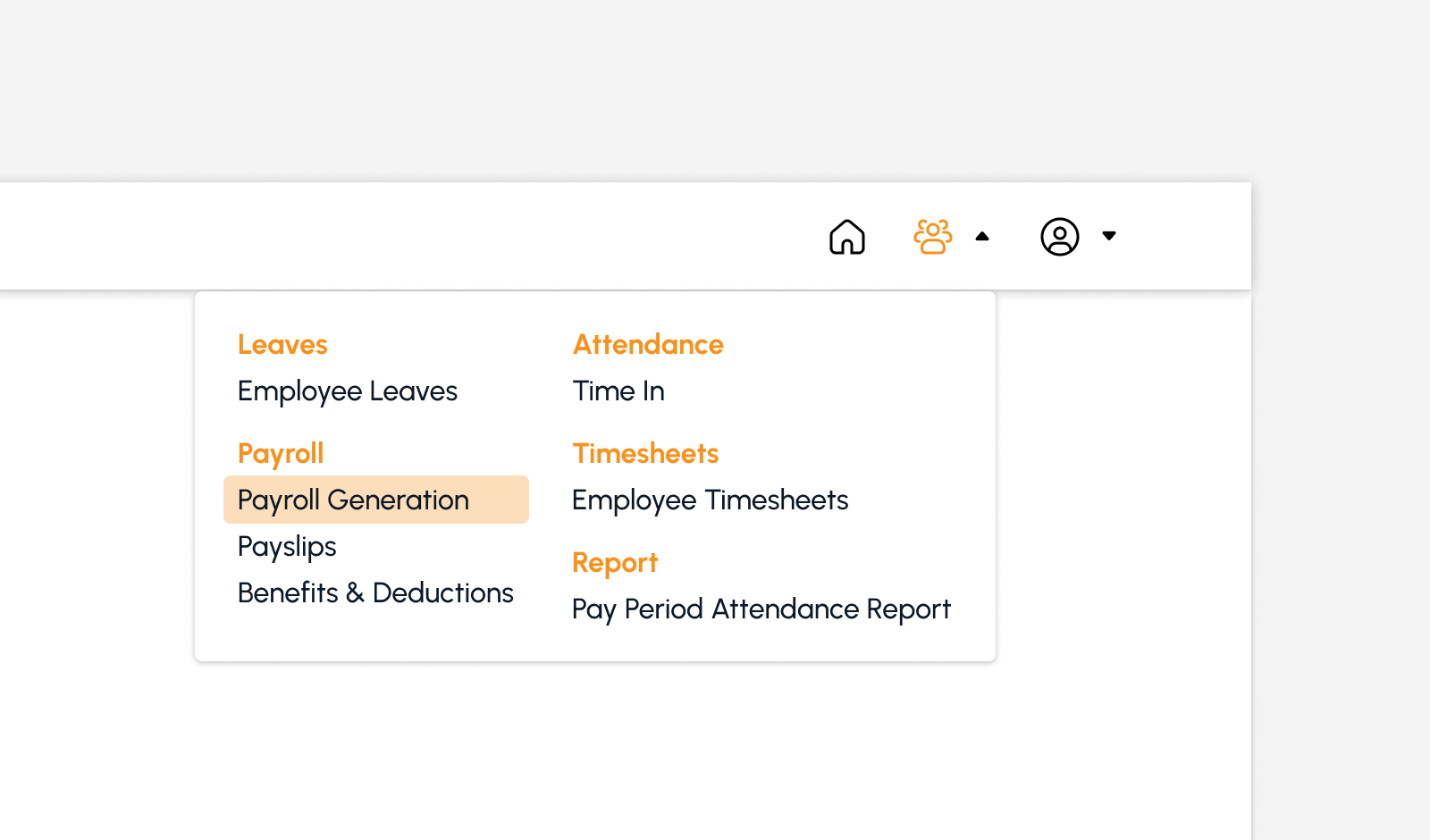
The system redirects to the Payroll page, where several payroll processing features are available.
Payroll Generation Features
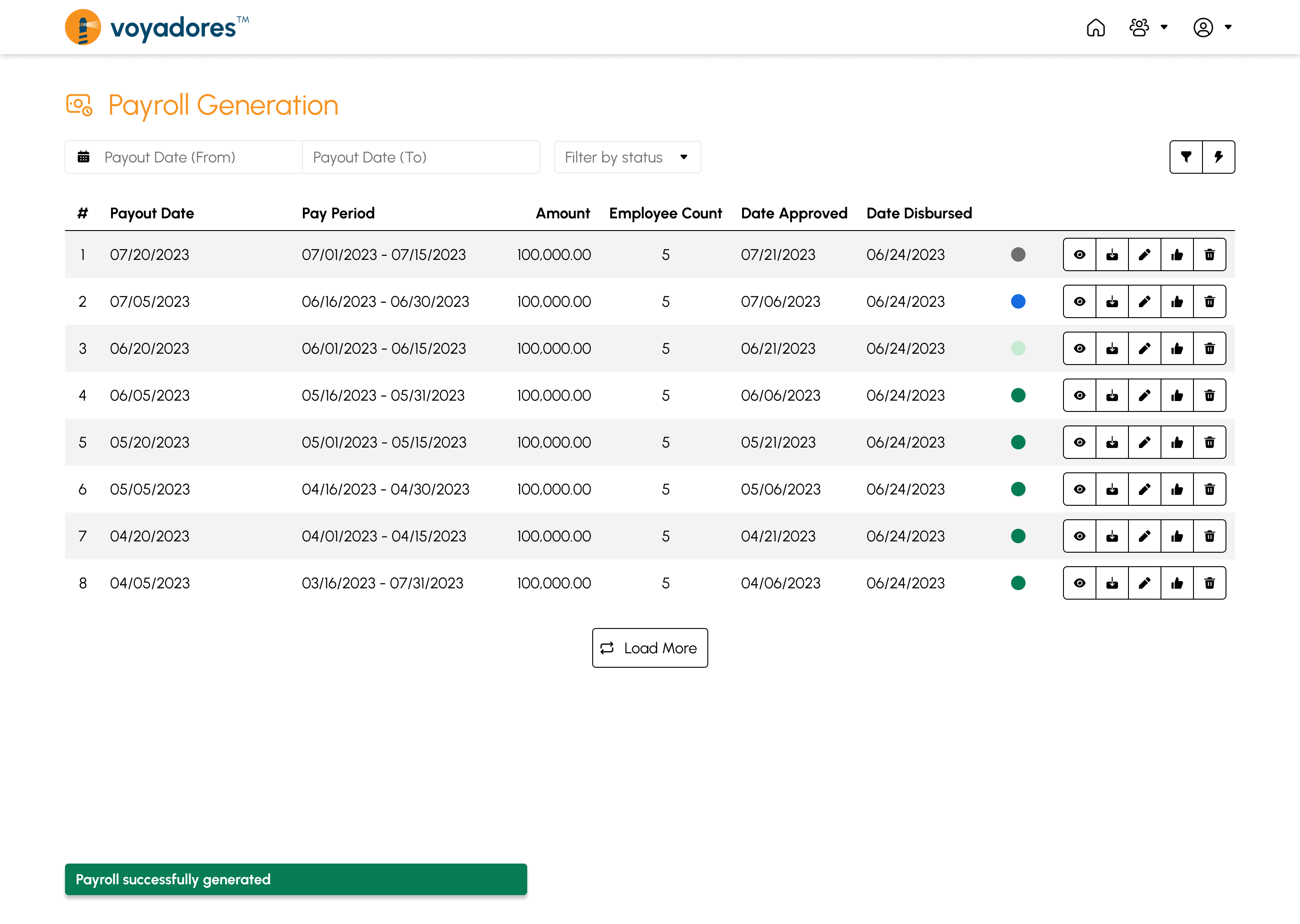
Payroll Generation Page Header Actions
- Set as Default Page
- Add to Quick Links
- Generate Payroll
- Preview Payroll
Payroll Generation Summary Table
The Payroll Generation Summary Table consists of the following columns:
- Title. Displays the title or payroll period associated with the generated payroll. It may indicate the covered date range or payroll name.
- Payout Date. Displays the scheduled date when the payroll is intended to be paid or distributed to employees.
- Pay Period. Displays the period covered by the payroll and serves as the basis for calculating employee salaries or wages.
- Amount. Displays the total payroll amount for the specified pay period.
- Payee Count. Indicates the number of employees or payees included in the payroll.
- Date Approved. Displays the date when the payroll was approved. A blank value or -- indicates that the payroll has not yet been approved.
- Disbursed. Displays the amount that has been disbursed and, when applicable, the date of disbursement. The indicator beside the amount shows the current payroll status.
- Status. Displayed here is the status indicator of the generated payroll.
-
Actions
- View Payroll
- Download Payroll
- Disburse Payroll
- Edit Payroll
- Approve Payroll
- Delete Payroll
- Preview Payslips PDF
Note
Some actions, such as Disburse Payroll, may only be available depending on the current payroll status.
Filter Generated Payroll by Payout Date
-
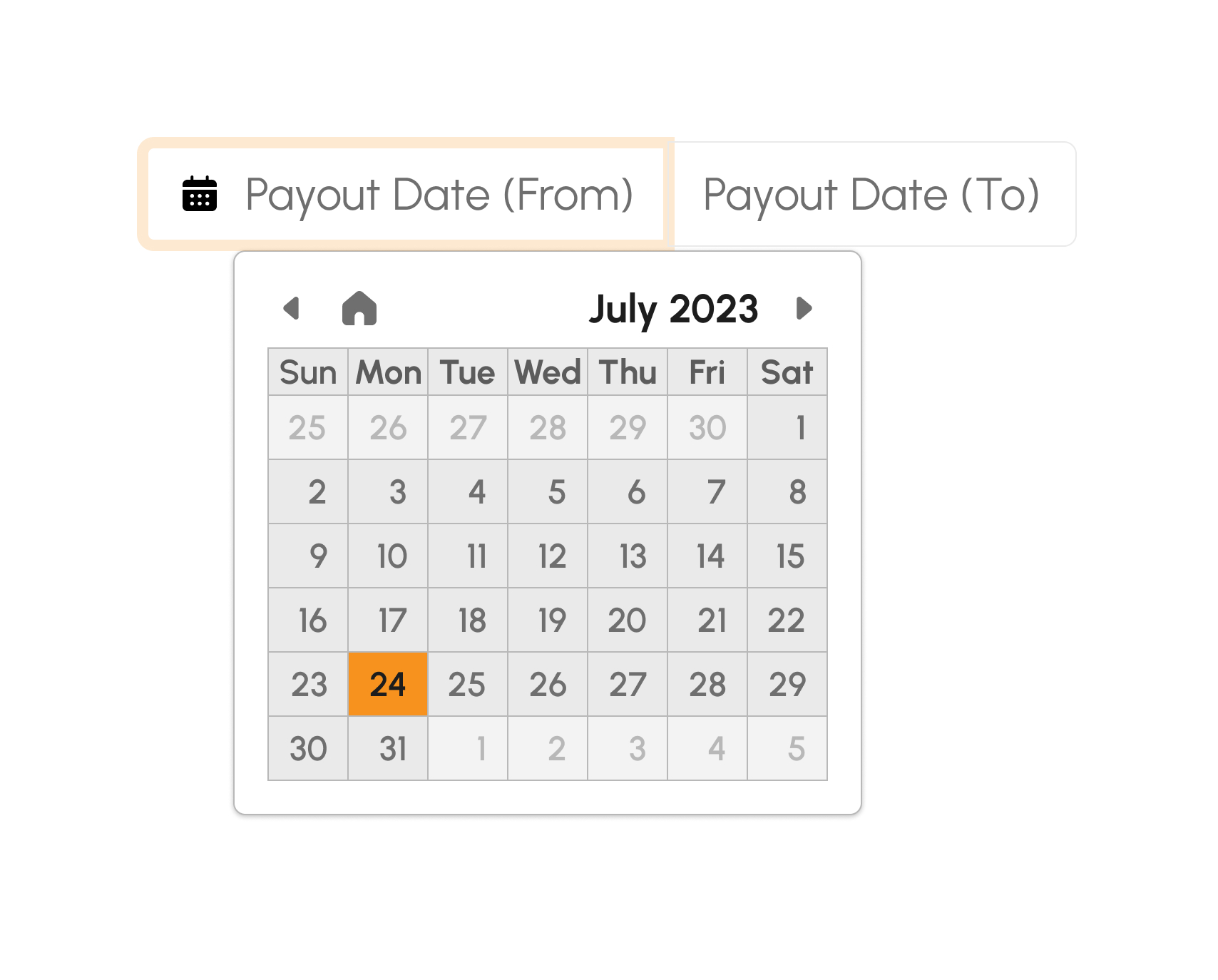
Click the date picker field to select Payout date range as shown below:
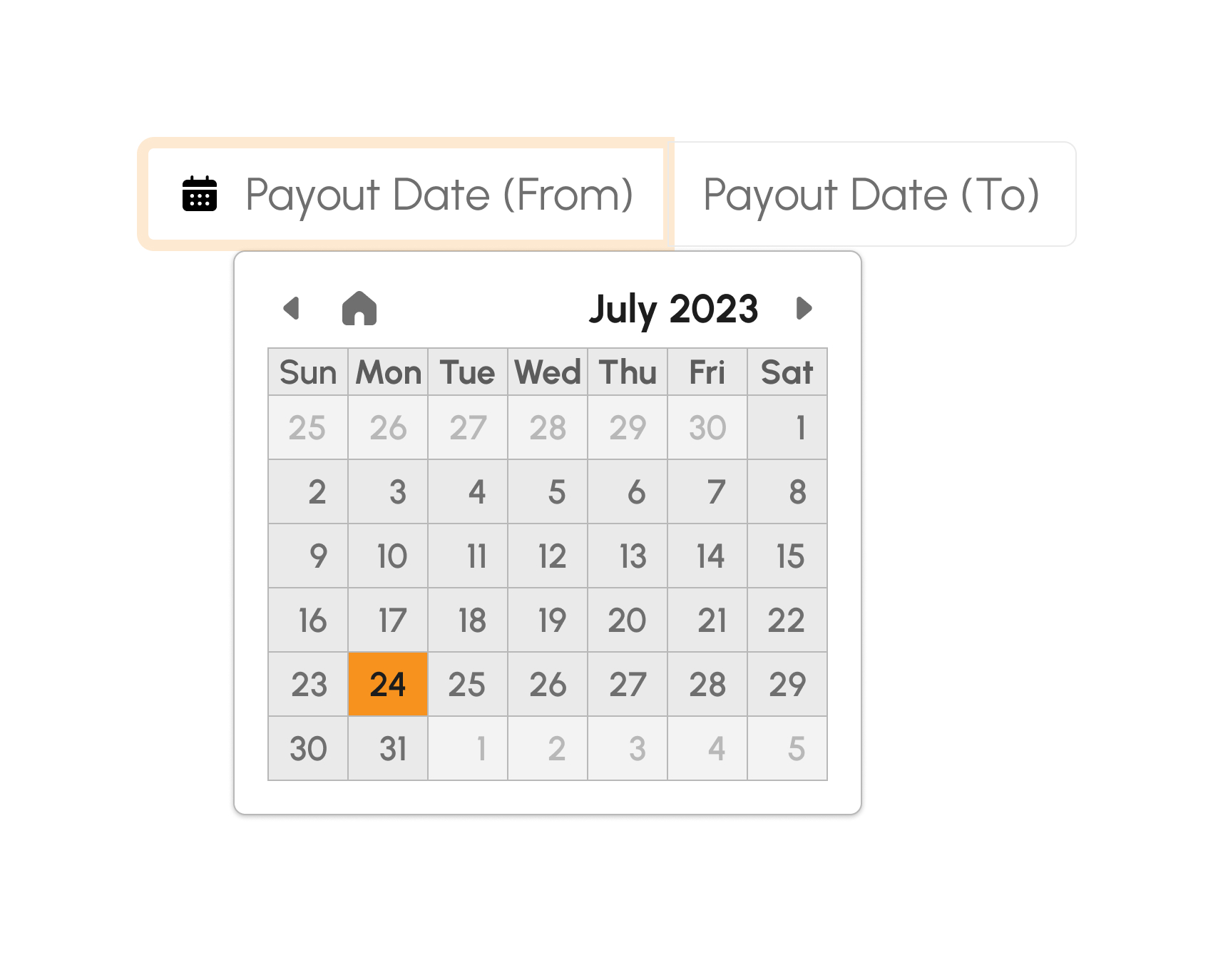
- Click the filter button to display Payroll with the selected Payout date range.
- Summary table will display the Payroll with the selected Payout date range.
Filter Generated Payroll by Status
The Status filter allows payroll records to be viewed according to their current status.
Click the Filter by Status drop down to select the desired Payroll status to display.
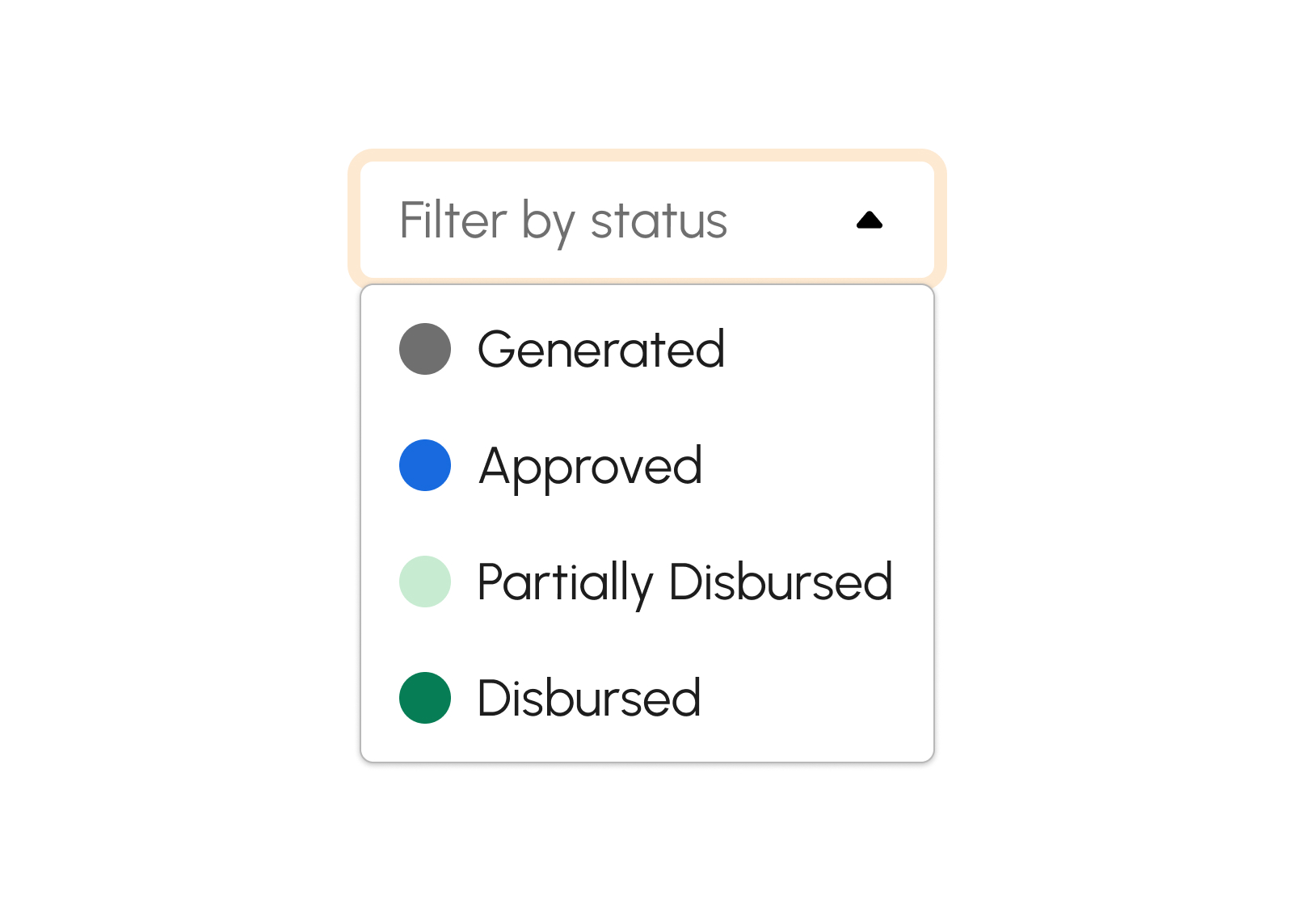
- Generated. Indicates that the payroll has been successfully generated.
- Approved. Indicates that the generated payroll has been approved.
- Partially Disbursed. Indicates that the payroll has been disbursed to some employees but not all.
- Disbursed. Indicates that the payroll has been fully disbursed.
- Failed. Indicates that payroll generation was unsuccessful.
Generate Payroll
-
Click the Generate Payroll button. The Generate Payroll modal appears.
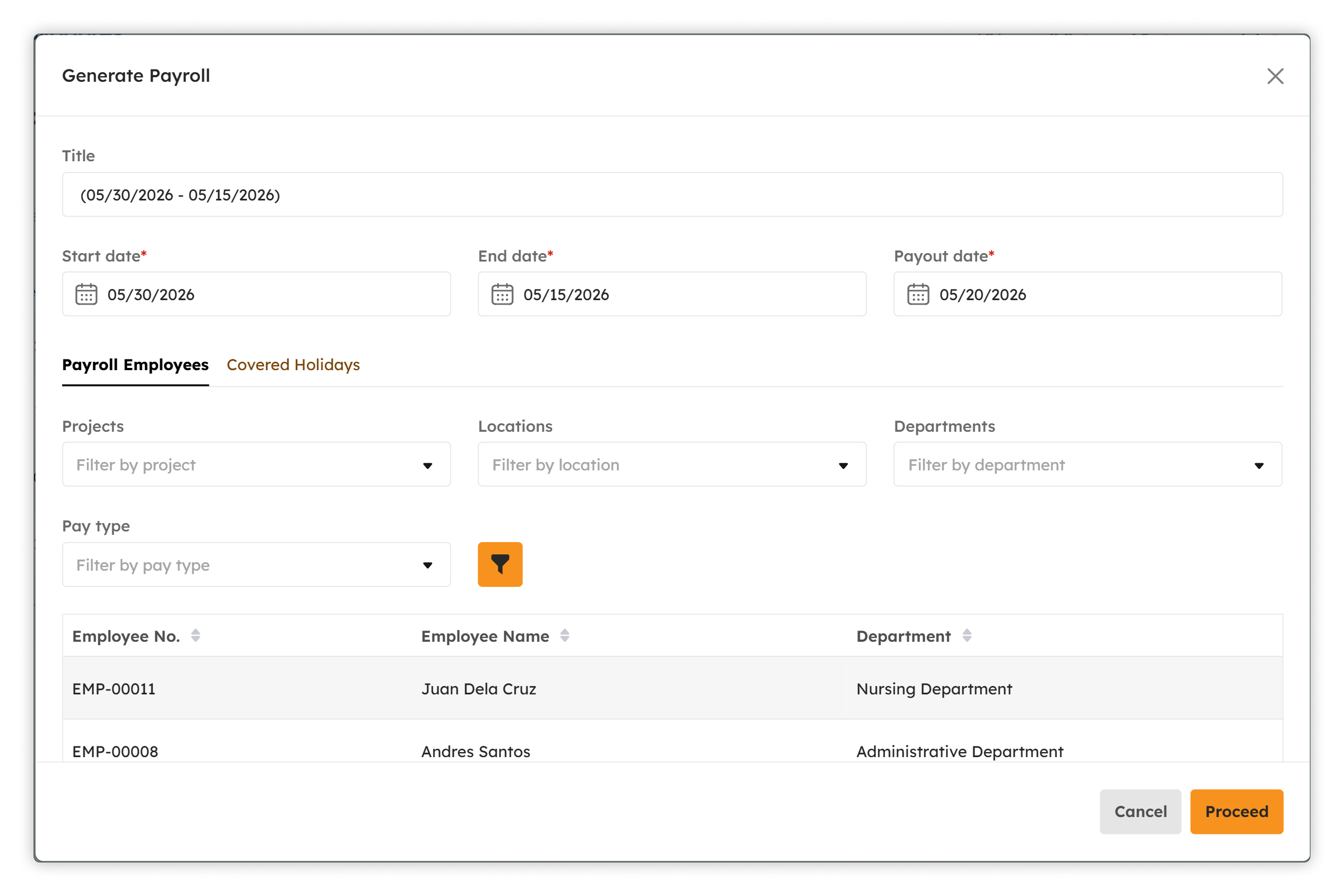
- Enter a Title, if desired. This field may be left blank because the system automatically generates the payroll title based on the selected Start Date and End Date.
-
Select the Start date, End date, and Payout Date.
- Start Date and End Date define the Pay Period covered by the payroll.
- Payout Date indicates the scheduled date when the payroll will be paid.
Note
Fields marked with an asterisk (*) are required.
-
On the Payroll Employees tab, select the applicable filters:
- Projects
- Locations
- Departments
- Pay Type
- Click to apply the selected employee criteria.
- Review the employees included in the payroll based on the selected pay period and filters.
-
Open the Covered Holidays tab to review holidays within the selected pay period.
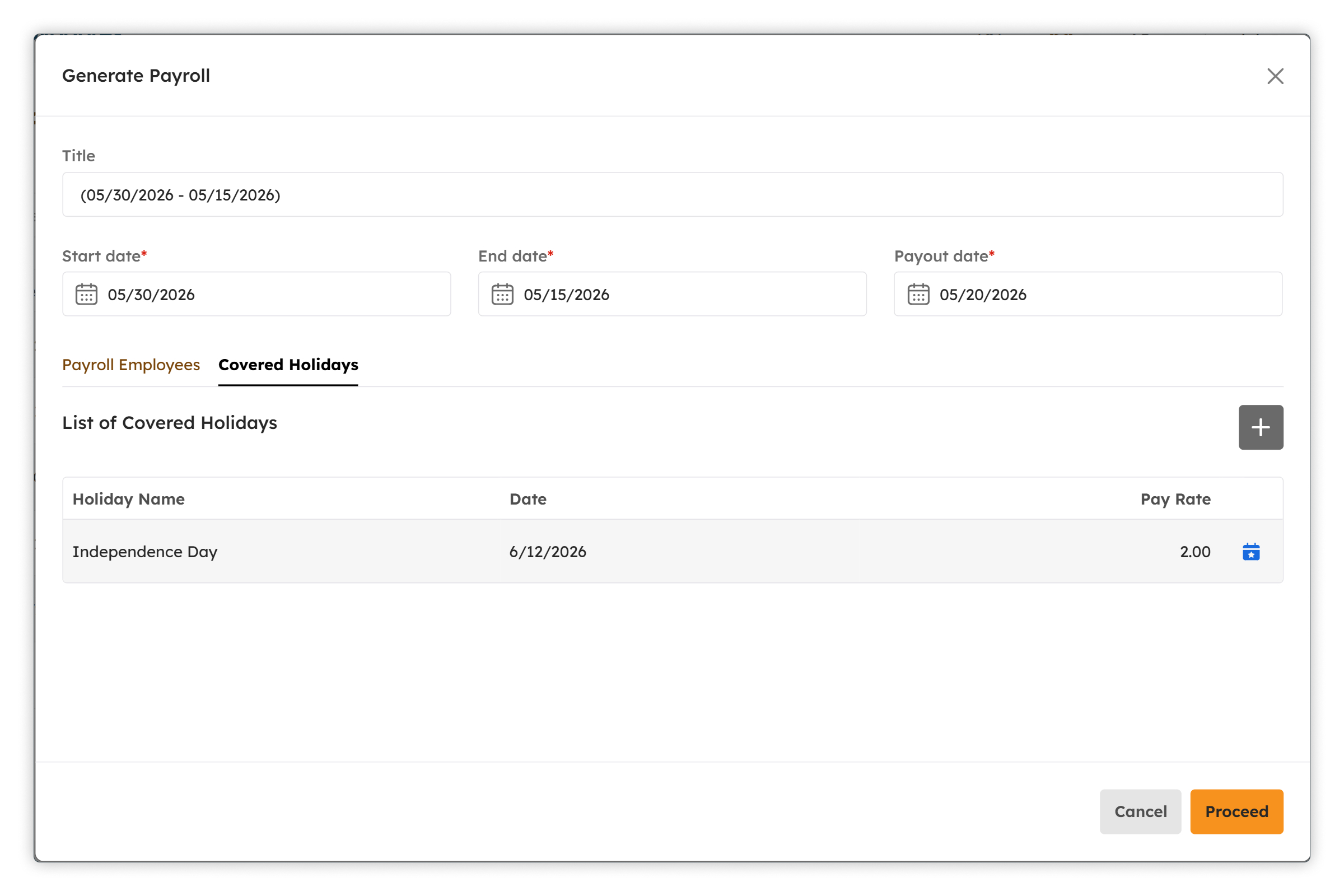
- Click Proceed to continue with payroll generation
- Review the payroll details in the confirmation step and confirm the generation.
-
Once successfully generated, the payroll record is added to the Payroll Generation list and successful notification will show:
Payroll successfully generated
Preview Generated Payroll
-
Click the button. The Preview Payroll modal displays the generated payroll details in a table.
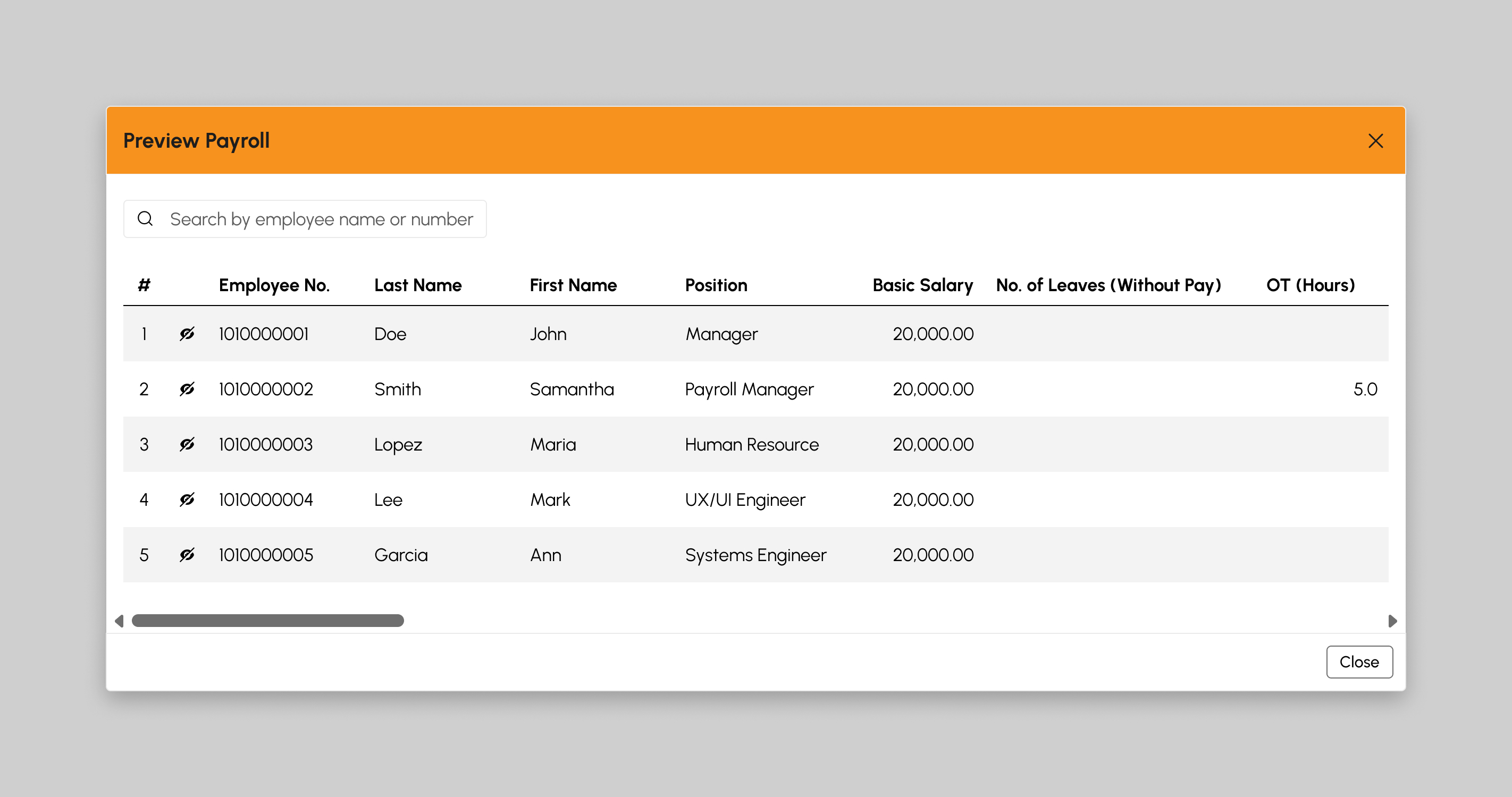
- Last Name
- First Name
- Employee Number
- Position
- Basic Salary
- Number of Leaves (Without Pay)
- OT Hours
- Allowance
- De Minimis Benefits
- Laptop Allowance
- Internet Allowance
- Rice Subsidy
- Clothing Allowance
- Transportation Allowance
- Laundry Allowance
- Overtime
- Night Differential
- 13th Month Pay
- Incentives
- Funeral Allowance
- Total Benefits
- PhilHealth
- SSS Contribution
- PAG-IBIG/HDMF Contribution
- Withholding Tax
- SSS Loan
- PAG-IBIG Loan
- Employee Loan
- Late/Absences
- Undertime
- Total Deductions
- Total Gross Pay
- Net Pay
Note
The columns displayed in the Preview Payroll table may vary depending on the payroll items configured in the Benefits and Deductions feature on the Payslips page. Only applicable payroll items are displayed in the generated payroll.
Download Generated Payroll in CSV
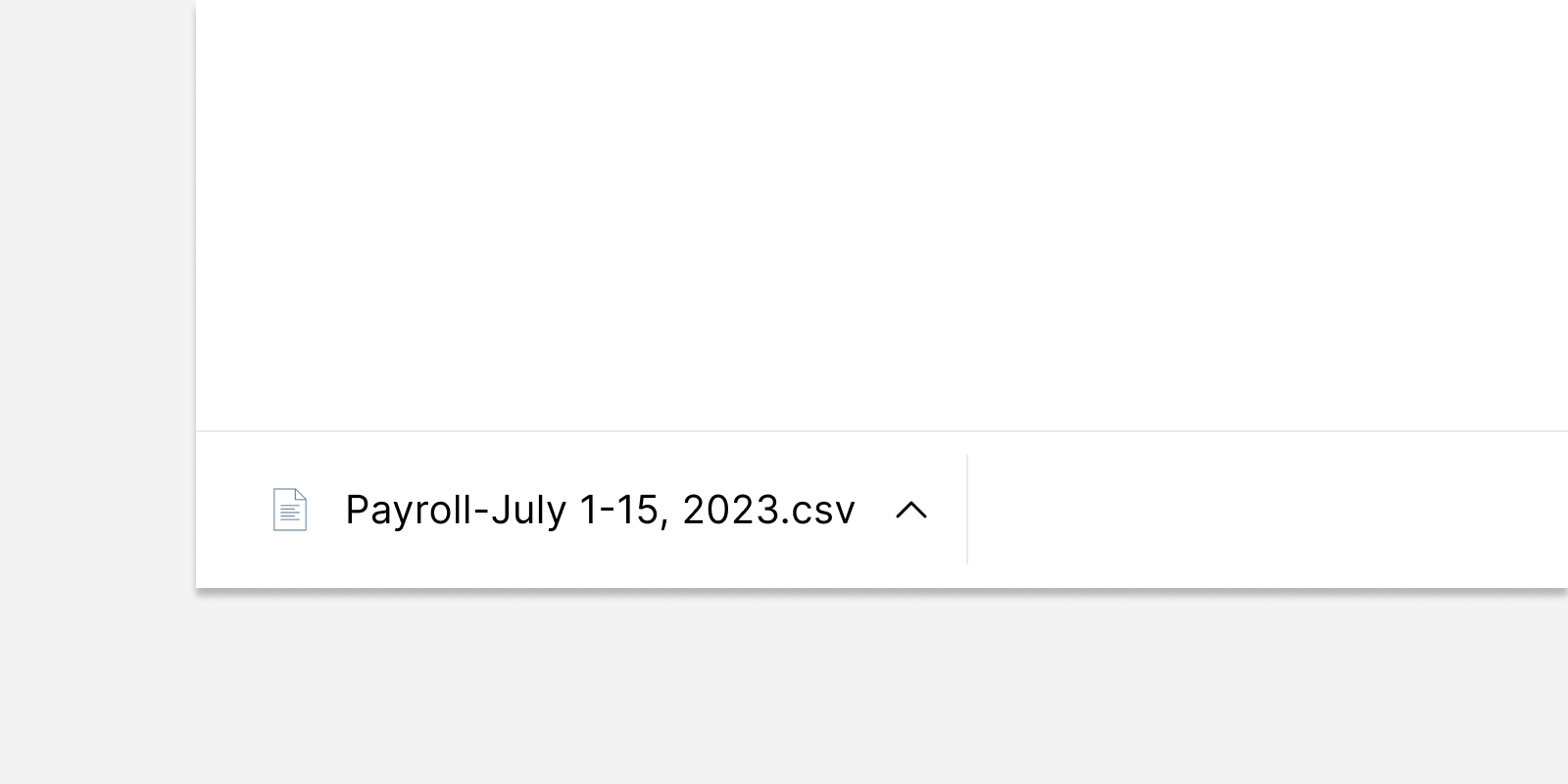
- Click the button to download the generated payroll in Excel CSV format.
Edit Generated Payroll
- Click the of the generated payroll to edit.
- Select the employee whose payroll details need to be modified.
-
Click the beside the selected employee.
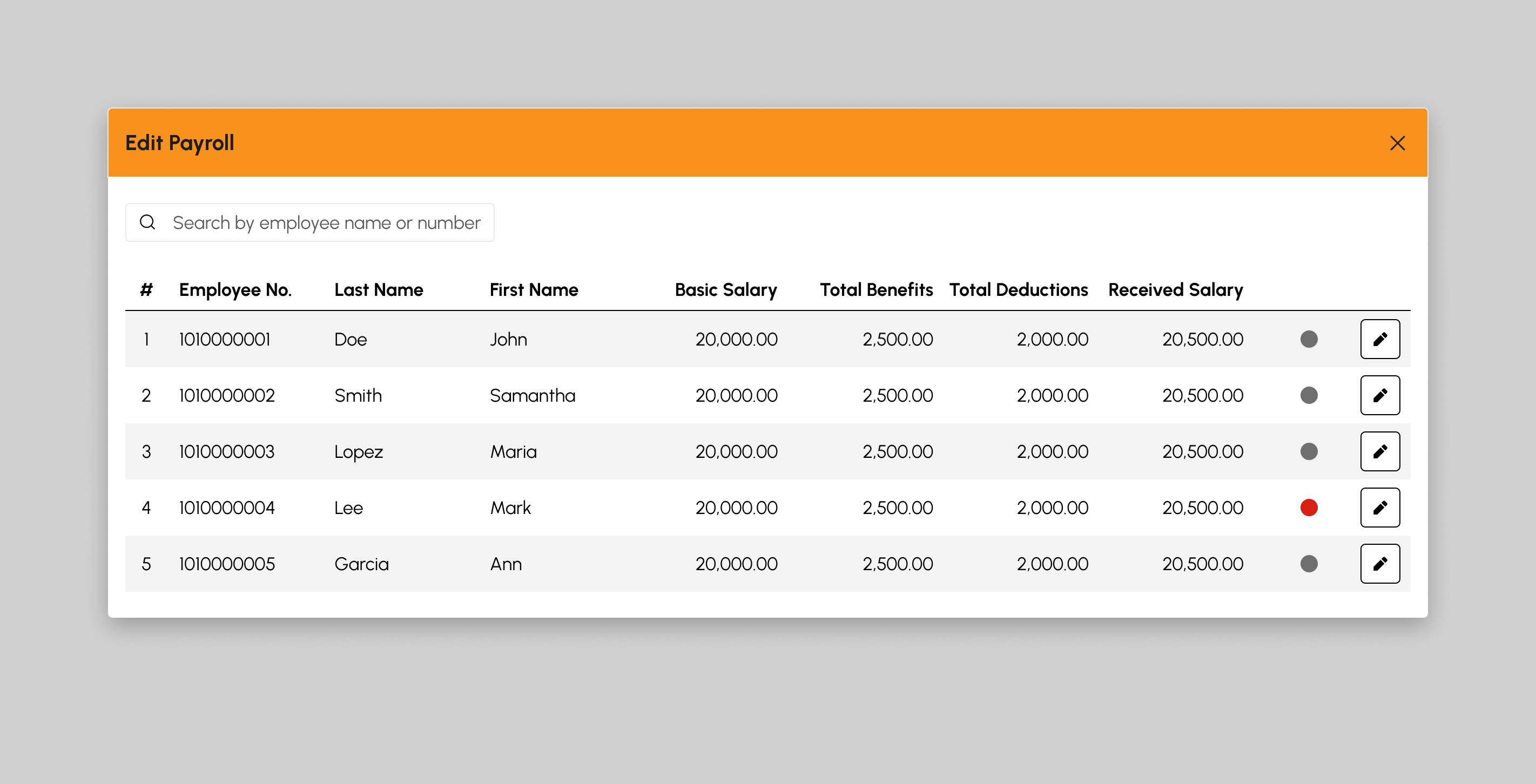
- The Edit Payroll Items section appears, allowing applicable payroll items to be modified.
Edit Payroll Items
-
In the Edit Payroll Items modal, locate the payroll item to be modified.
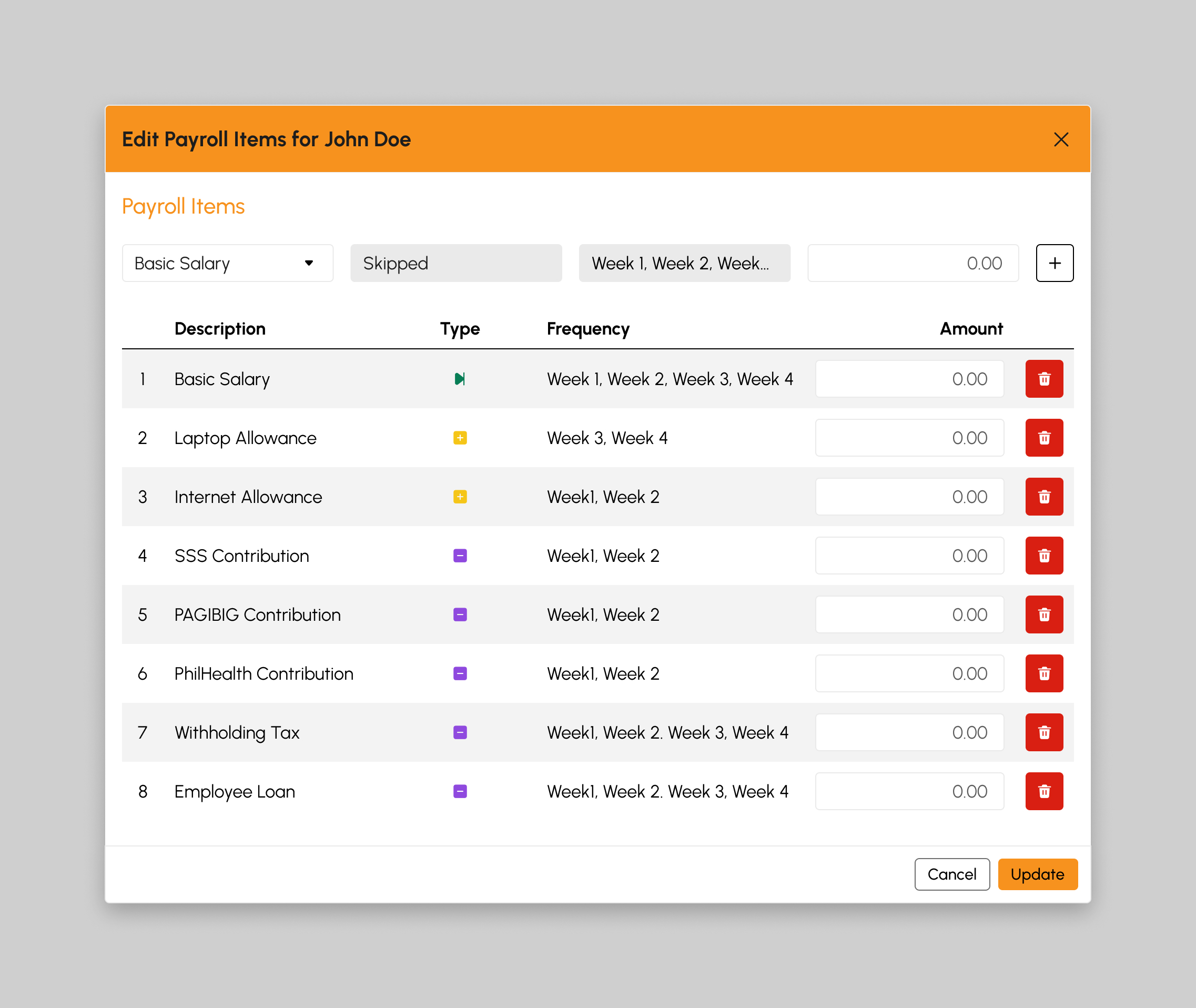
- Enter the desired amount in the corresponding Amount field.
-
To remove an existing payroll item, click the icon beside the item.
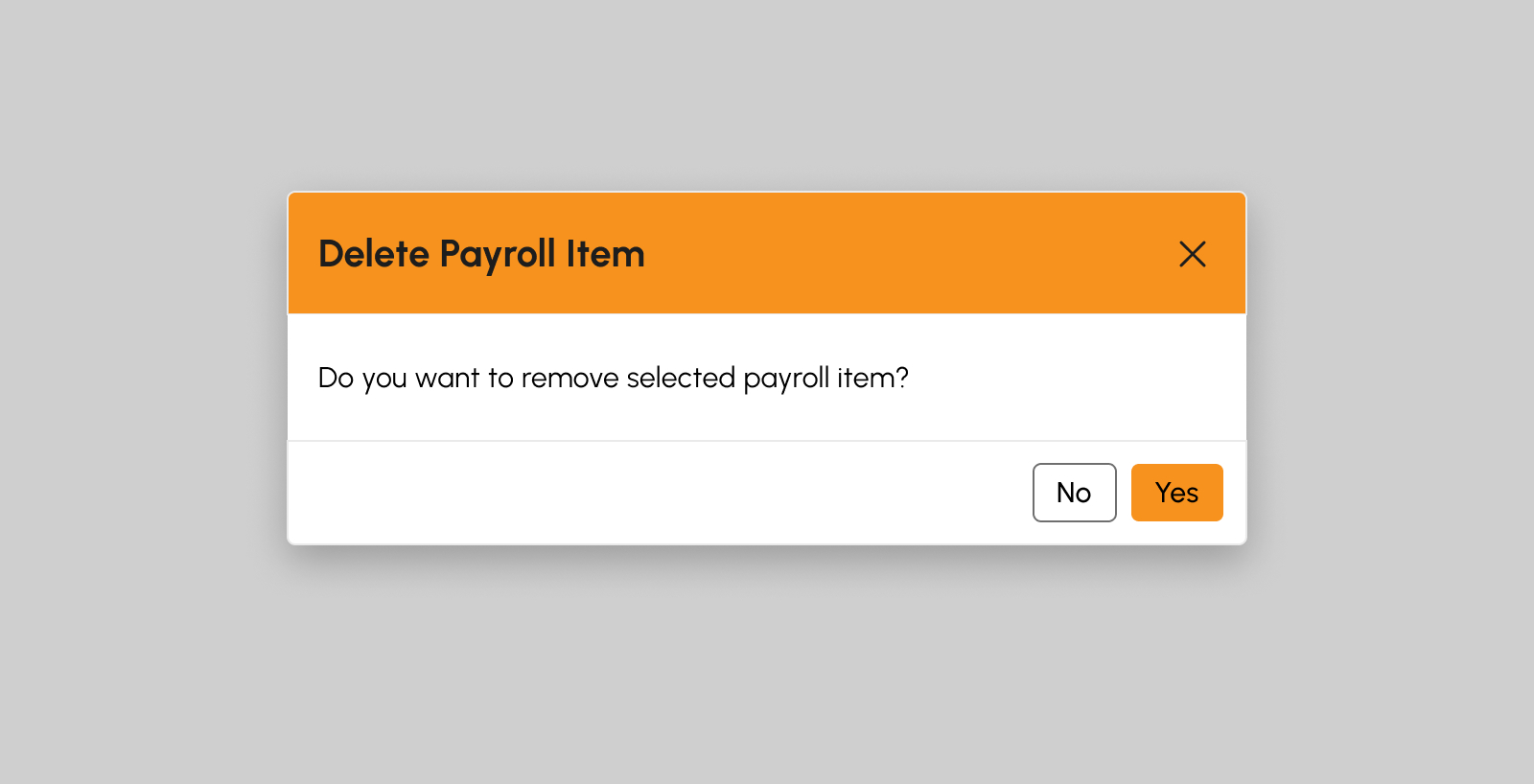 From the confirmation modal, click Delete button to successfully delete the Payroll Item, otherwise, click Cancel button.
- Click Update to save the changes.
-
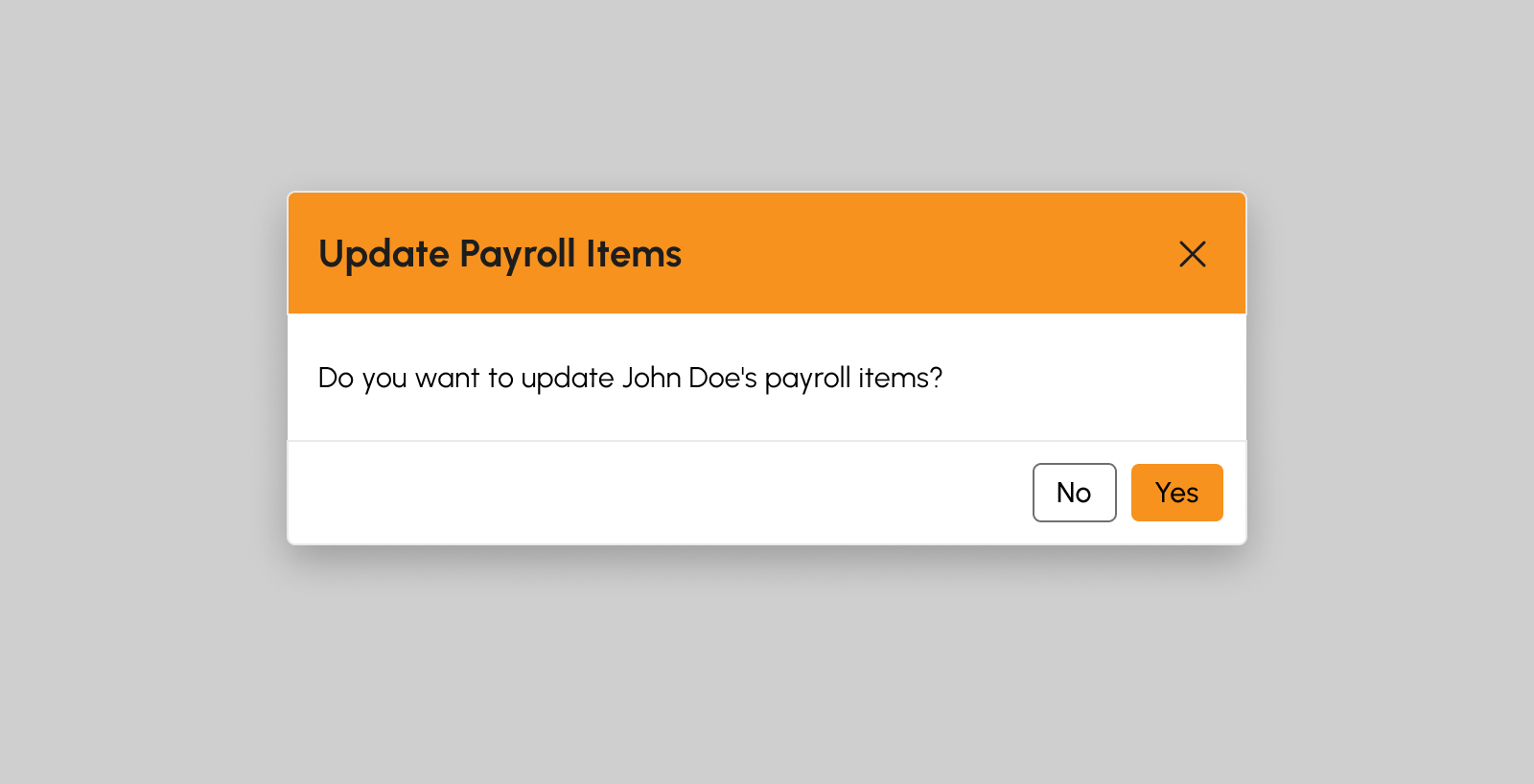
In the confirmation prompt, click Update to apply the changes or Cancel to discard them.
Approve a Generated Payroll
-
Click the of the generated payroll to approve.
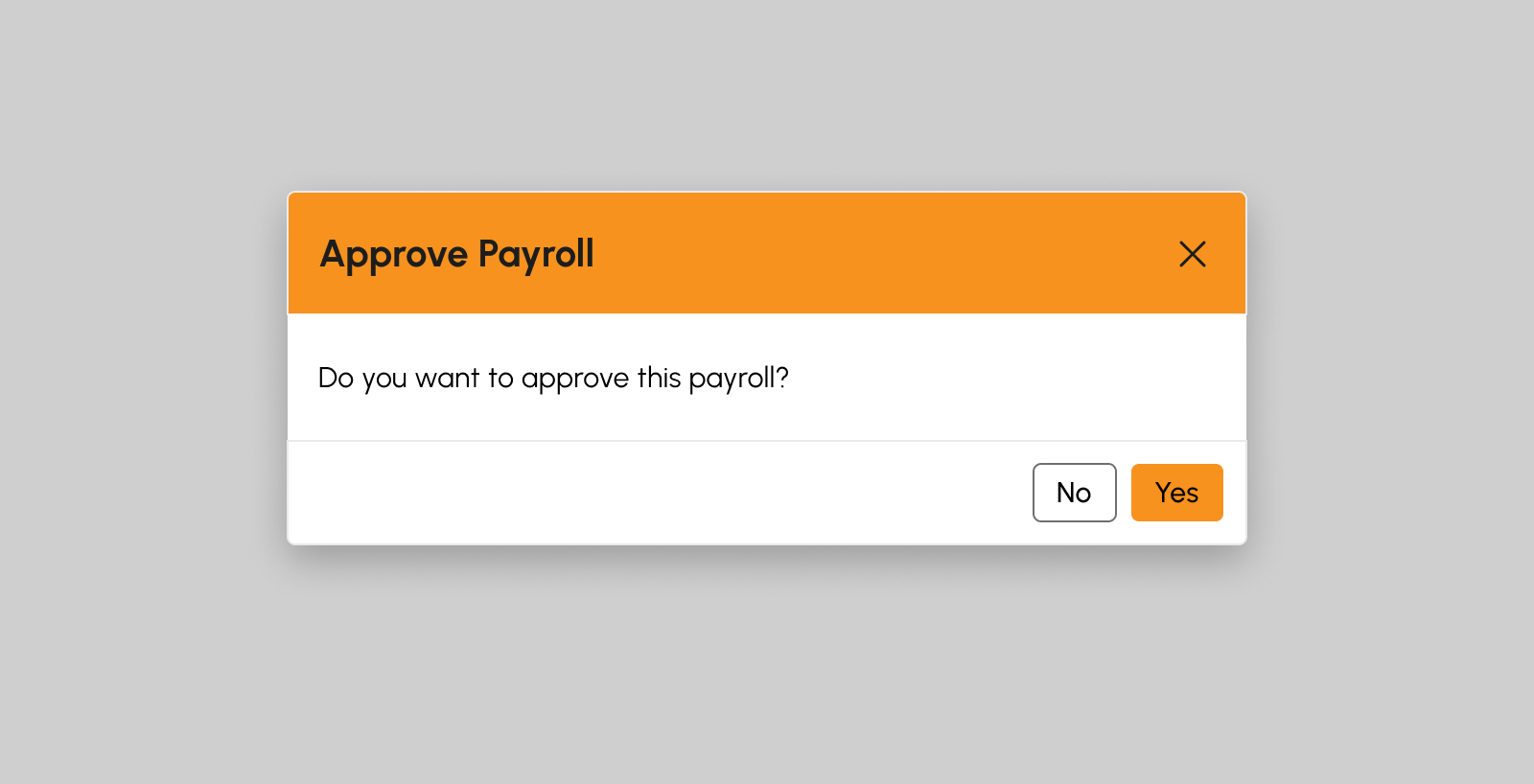
- Review the payroll details and employee records displayed in the modal.
- Click Close to exit the modal without approving the payroll.
- Click Approve to approve the generated payroll.
-
Once successfully approved, the payroll status is updated accordingly.
Note
The generated payroll can no longer be deleted nor edited once approved.
Delete a Generated Payroll
Note
A generated payroll can only be deleted when its status is Generated.
-
Click the Delete Payroll button. A confirmation modal will show after clicking the Delete button.
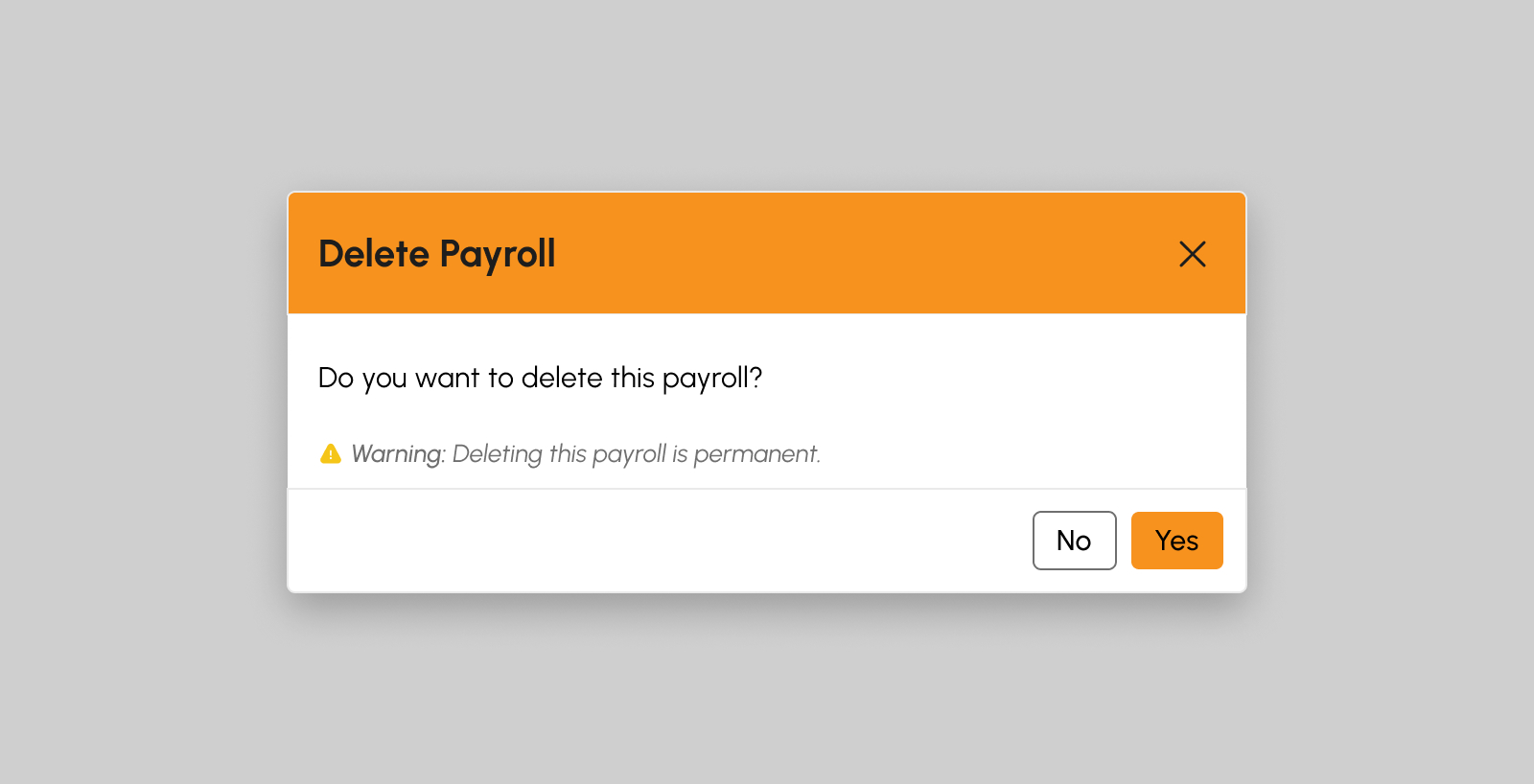
- In the confirmation prompt, click Delete to confirm or Cancel to discard the action.
Partially Disburse a Generated Payroll
-
Click the Disburse Payroll button. The Disburse Payroll modal appears.
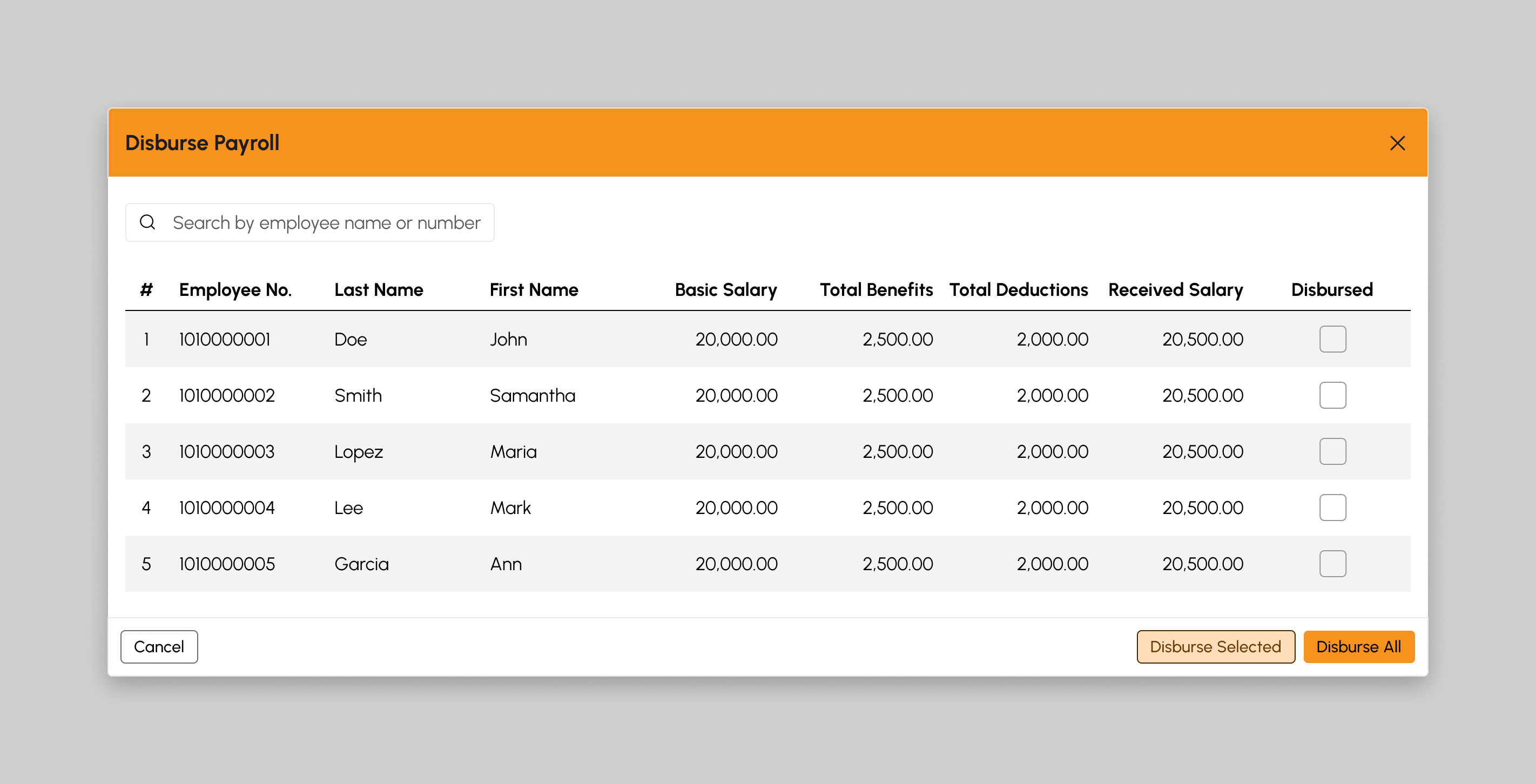
- Select the checkbox beside each employee payroll to be disbursed.
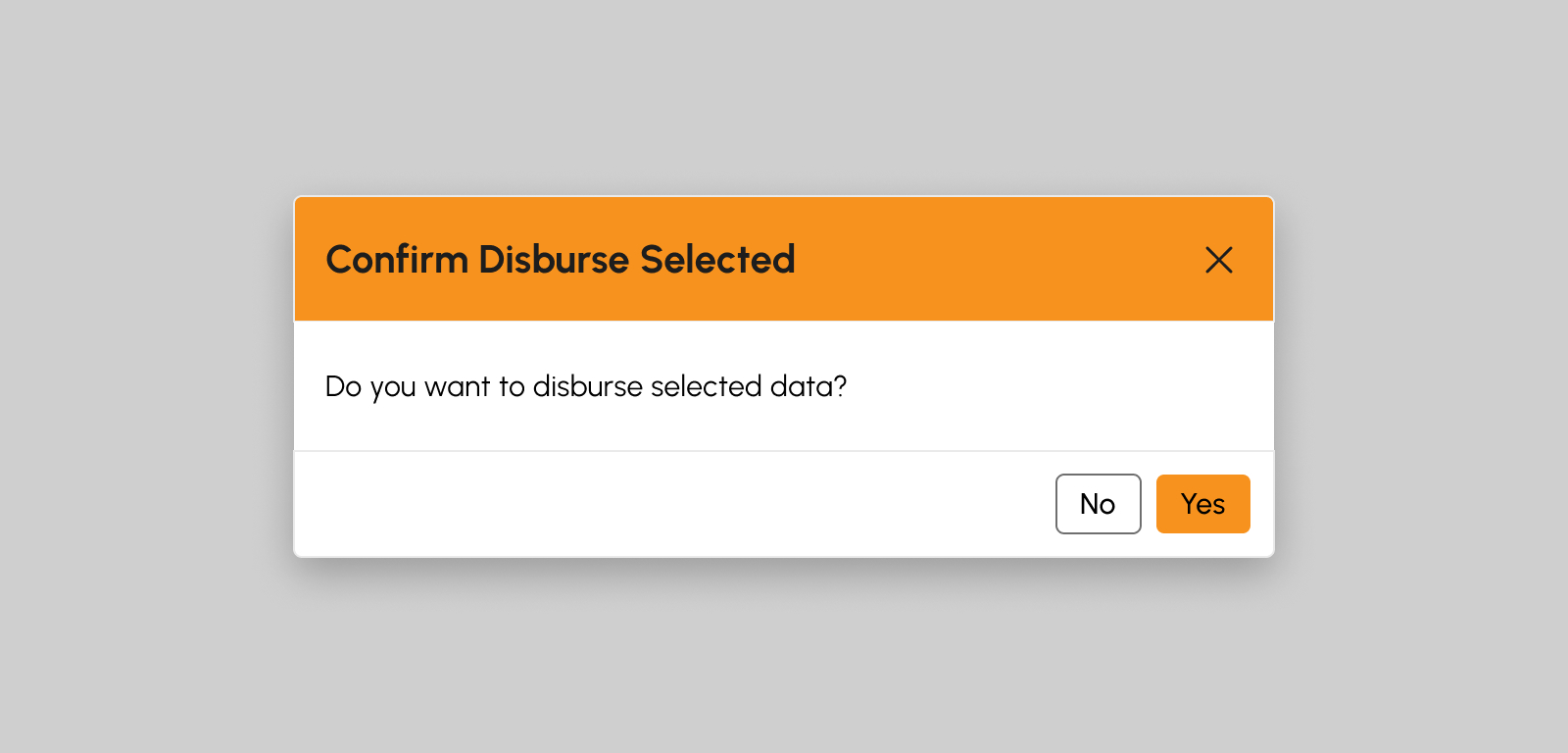
- Click Disburse Selected to partially disburse the payroll for the selected employees.
-
In the confirmation prompt, click Disburse to confirm or Cancel to discard the action.
Disburse a Generated Payroll
-
Click the Disburse Payroll button. The Disburse Payroll modal appears.
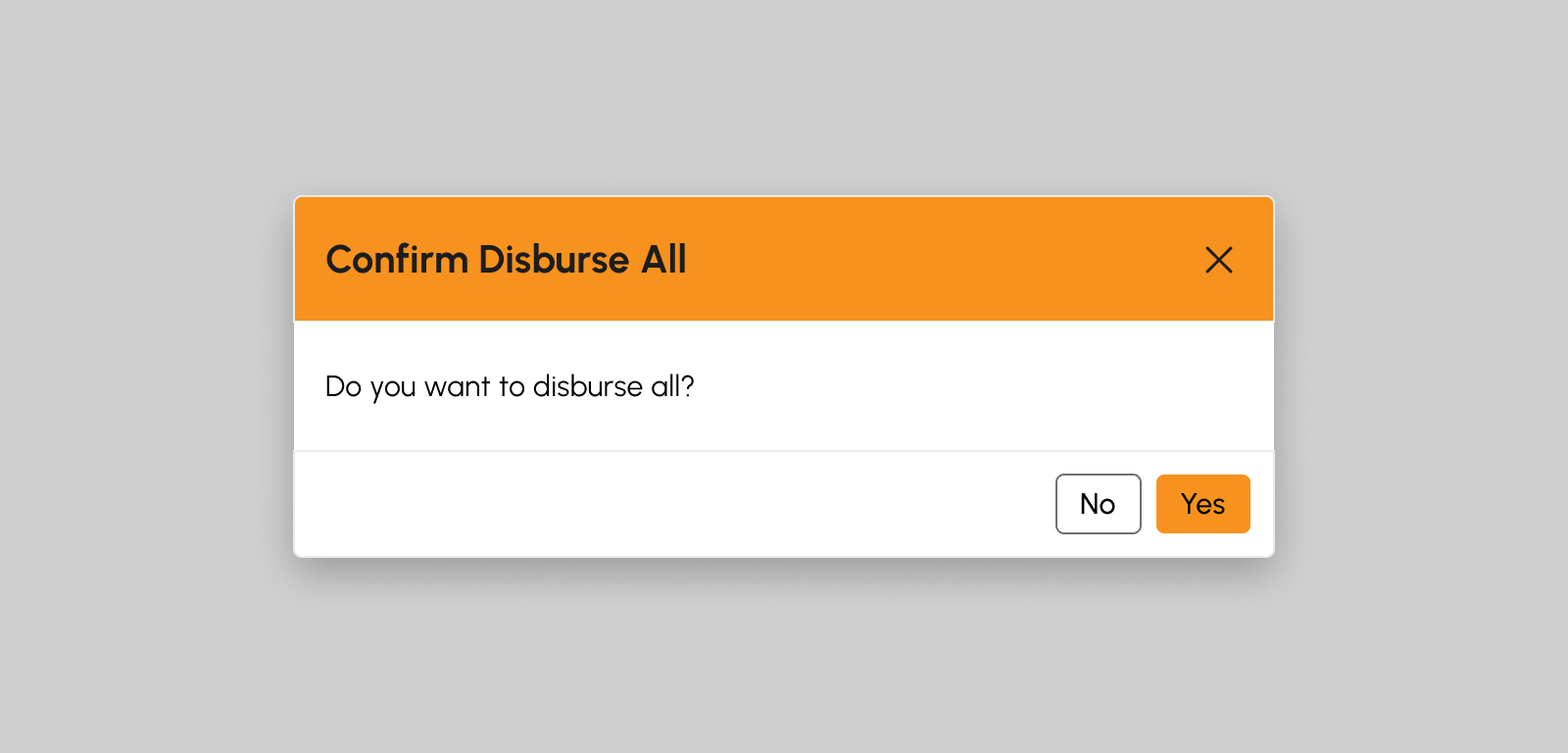
- Click Disburse All to disburse the generated payroll.
-
In the confirmation prompt, click Disburse All to confirm or Cancel to discard the action.
Payslips
Introduction to Payslips
The Payslips page allows employees to securely view and access their individual payslips. It provides a summary of earnings, deductions, and net pay for a specific pay period.
To access the Payslips page, navigate the menu as shown in the image below.
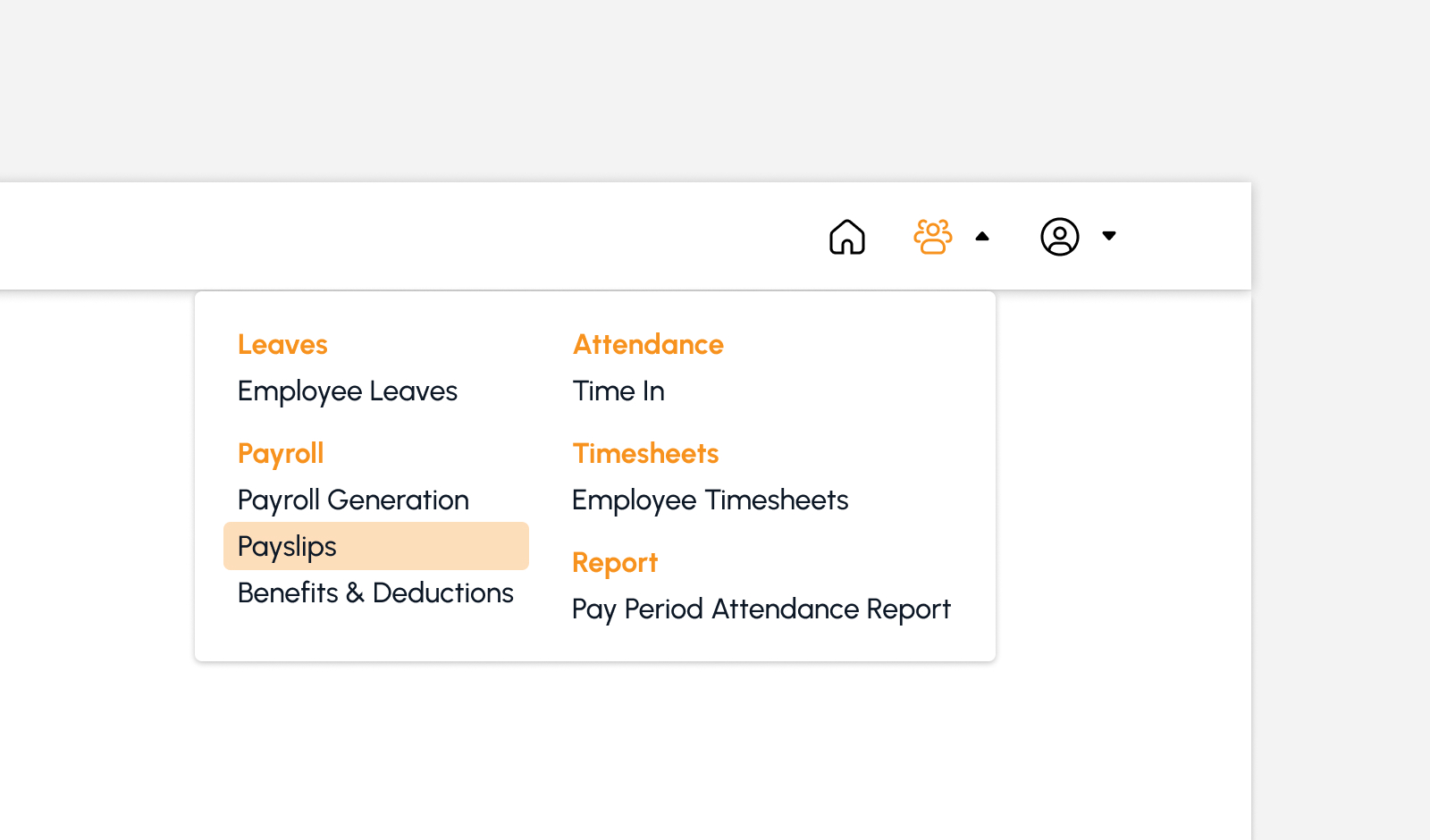
The system redirects to the Payslips page, where several features are available.
Payslips Features
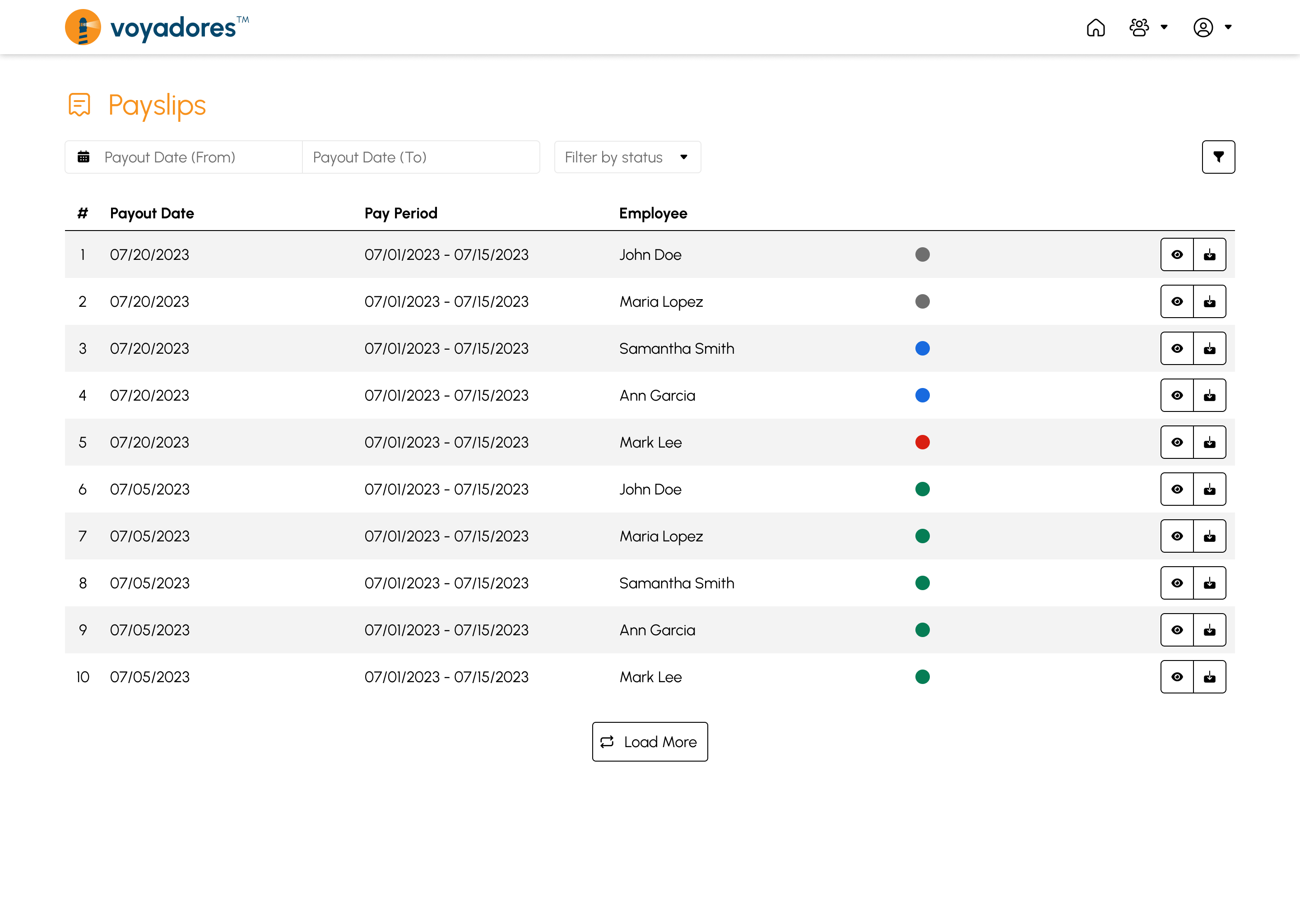
The snip below is the high-level view of Payslips page along with its built-in features.
Payslips Page Header Actions
- Set as Default Page
- Add to Quick Links
- Configure Benefits and Deduction
Payslips Summary Table (Admin View)
The summary table displays employee payslip records with the following columns:
- Payout Date. Displays the date when the employee's salary is scheduled to be paid.
- Pay Period. Displays the period covered by the payroll, including the start and end dates used to calculate the employee's salary.
- Employee. Displays the employee’s name.
- Status. Indicates the current status of the payslip.
-
Actions
- Preview Payslip
Payslips Summary Table (Employee View)
The Payslips summary table displays employee payslip records with the following columns:
- Payout Date. Displays the date when the salary was paid or scheduled to be paid.
- Pay Period. Displays the period covered by the payslip, including the start and end dates used to calculate the employee's salary.
- Employee. Displays the employee’s name.
-
Status. Indicates the status of the payslip.
Note
For employees, the status is always Disbursed.
-
Actions
- Preview Payslip
Note
Employees can only view payslips associated with their own name.
Filter Payslips by Payout Date
The page includes date filters that allow administrators to narrow down payslip records based on:
- Start Date. Specifies the beginning of the date range.
- End Date. Specifies the end of the date range.
Preview Payslip
Click the Preview button. This will open a modal to display the PDF view of the official Payslip.
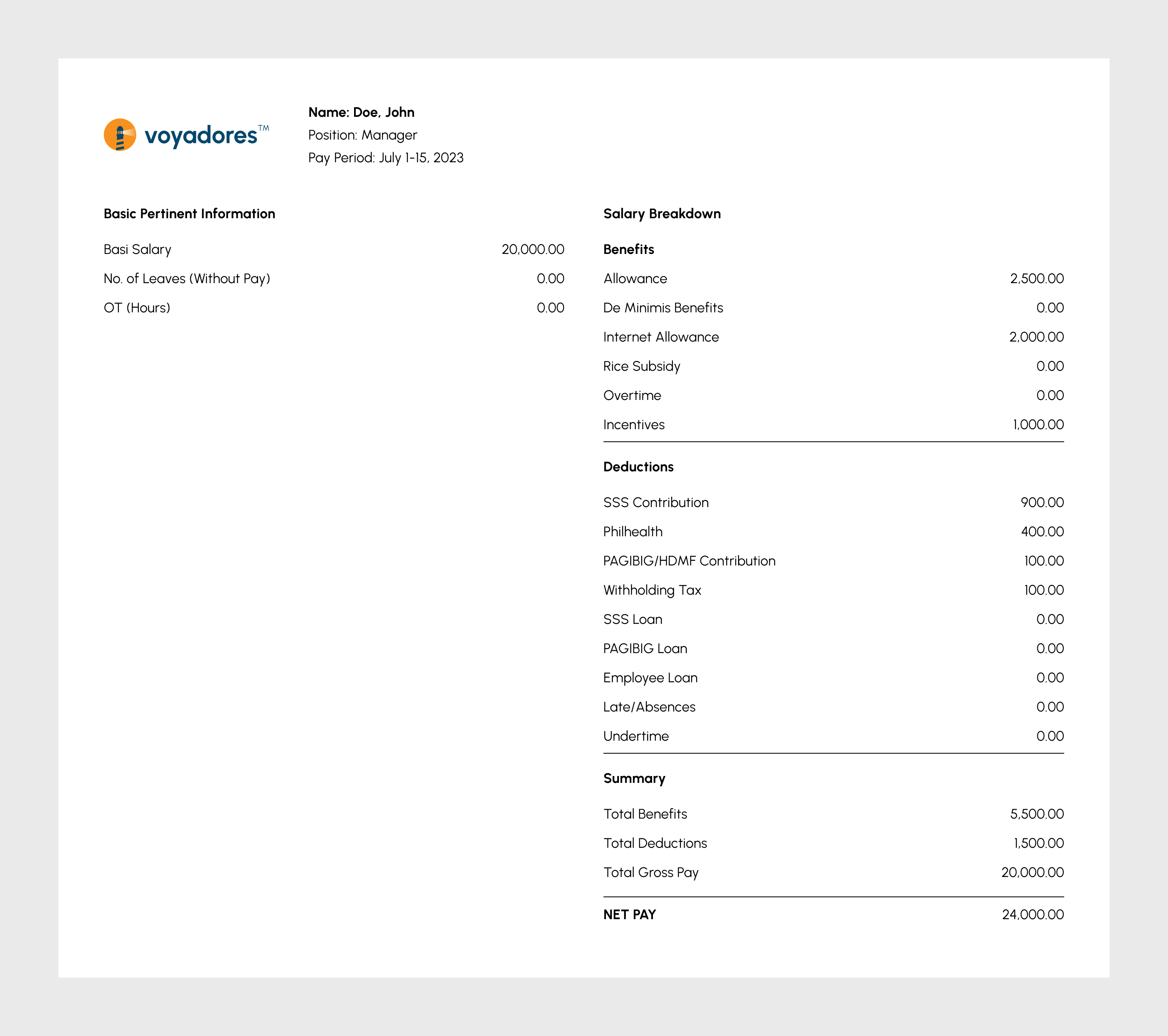
On this modal, the user may click to download a copy of the official Payslip on a local computer under the Downloads file directory.
Benefits and Deductions
Introduction to Benefits and Deductions
The Benefits and Deductions page is used to manage payroll items included in employee payroll. It allows payroll items to be created, edited, organized, and configured according to their amounts and frequencies.
For benefits and deductions with predefined rules and formulas, the system automatically calculates the applicable amounts during payroll processing. Manual formula configuration is not required for these items.
Benefits and Deductions Features
The Benefits and Deductions page provides a centralized view of payroll benefit and deduction items. Each record displays its default amount, applicable payroll frequency, type, status, visibility, and available actions.
To access the Benefits and Deductions page, click the Configure Benefits and Deduction on the Payslips page.
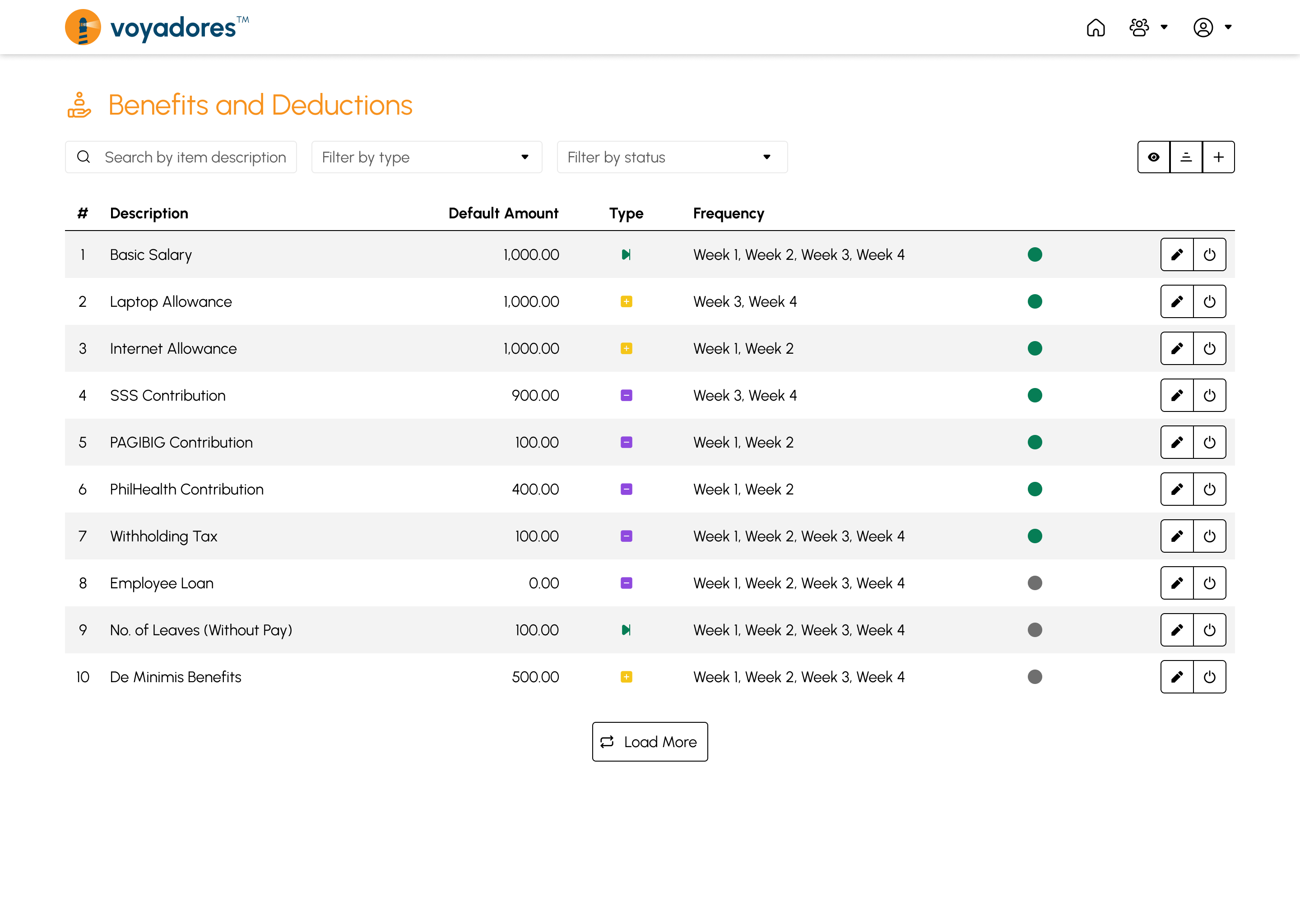
Benefits and Deductions Page Header Actions
- Set as Default Page
- Add to Quick Links
- Create Payroll Item
- Reorder Payroll Item
- Preview Sample Payslip PDF
Benefits and Deductions Summary Table
The Benefits and Deduction Summary Table consists of the following columns:
- Payroll Item. Displays the description or name of each benefit or deduction payroll item.
- Default Amount. Displays the default monetary amount or value assigned to the payroll item.
- Frequency. Indicates when the payroll item is applied during the monthly payroll cycle, such as Week 1, Week 2, Week 3, and/or Week 4.
- Type. Indicates the payroll treatment or classification of the item. Icons identify whether the item is configured as a benefit, deduction, or skipped item.
-
Visibility. Determines whether the payroll item is displayed based on its configured visibility setting:
- Always Show. The payroll item is always displayed.
- Show if not 0. The payroll item is displayed only when its value is not zero.
- Hidden. The payroll item is not displayed.
- Status. Indicates whether the payroll item is active or inactive.
-
Actions
- Edit Item
- Activate/Deactivate Item
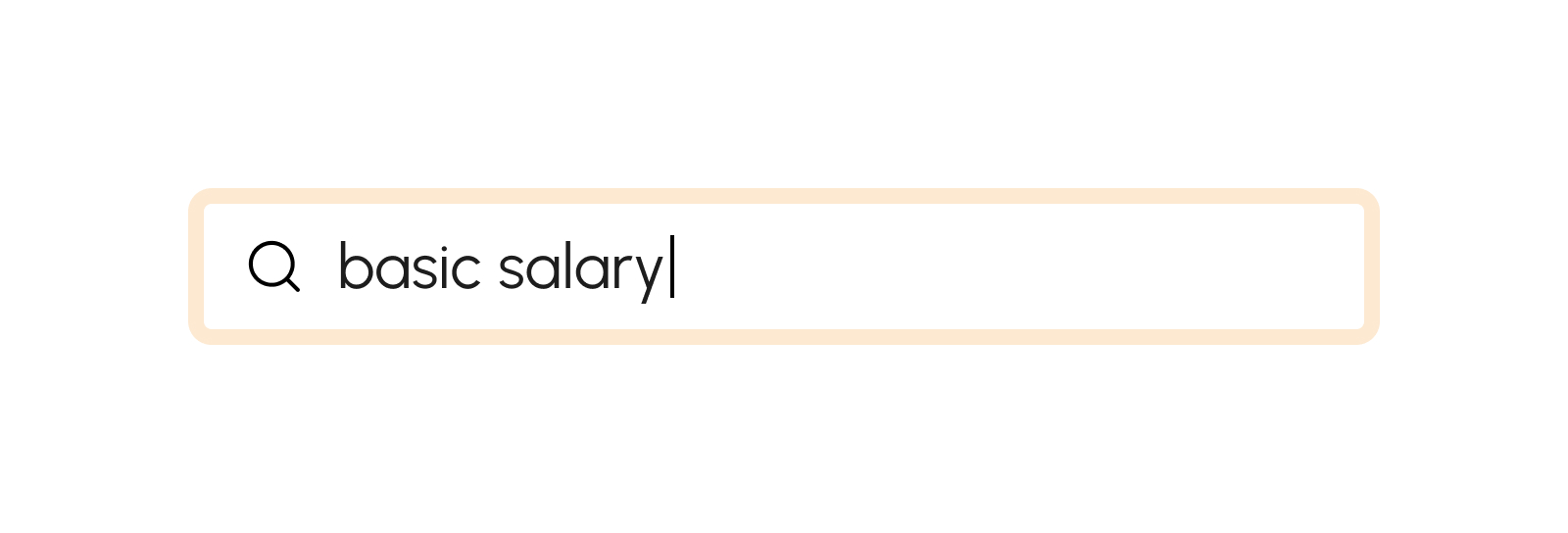
Search Payroll Item by Description
Allows specific payroll items to be located.
Filter Payroll Items by Type
Filters payroll items according to their configured type.
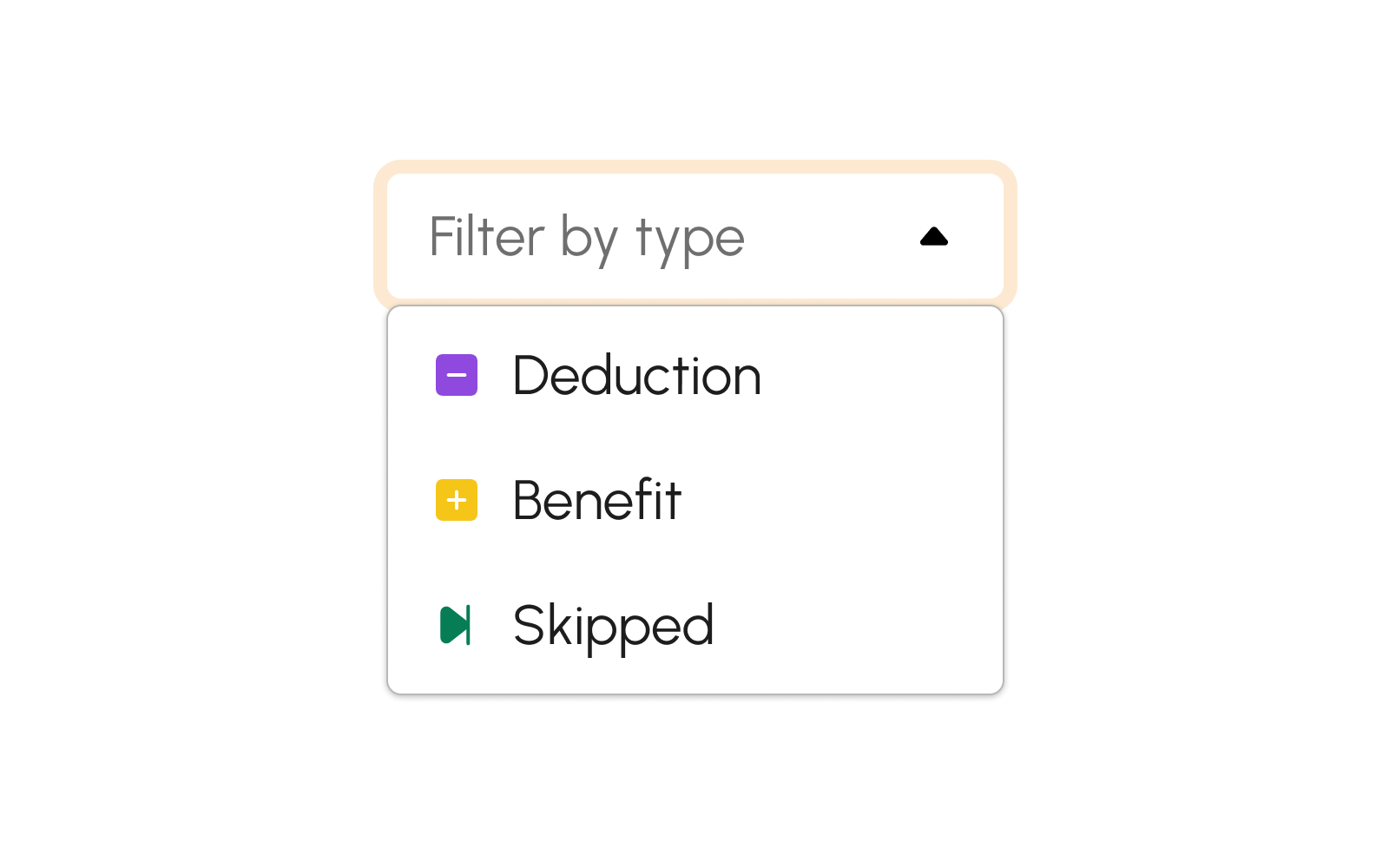
There are several types available to filter from the drop-down button as follows:
- Deduction. This type indicates that a payroll item is a deduction.
- Benefit. This type indicates that a payroll item is a benefit.
- Skipped. This type indicates that a payroll item is skipped.
Filter Payroll Items by Status
Filters the list based on active or inactive status.
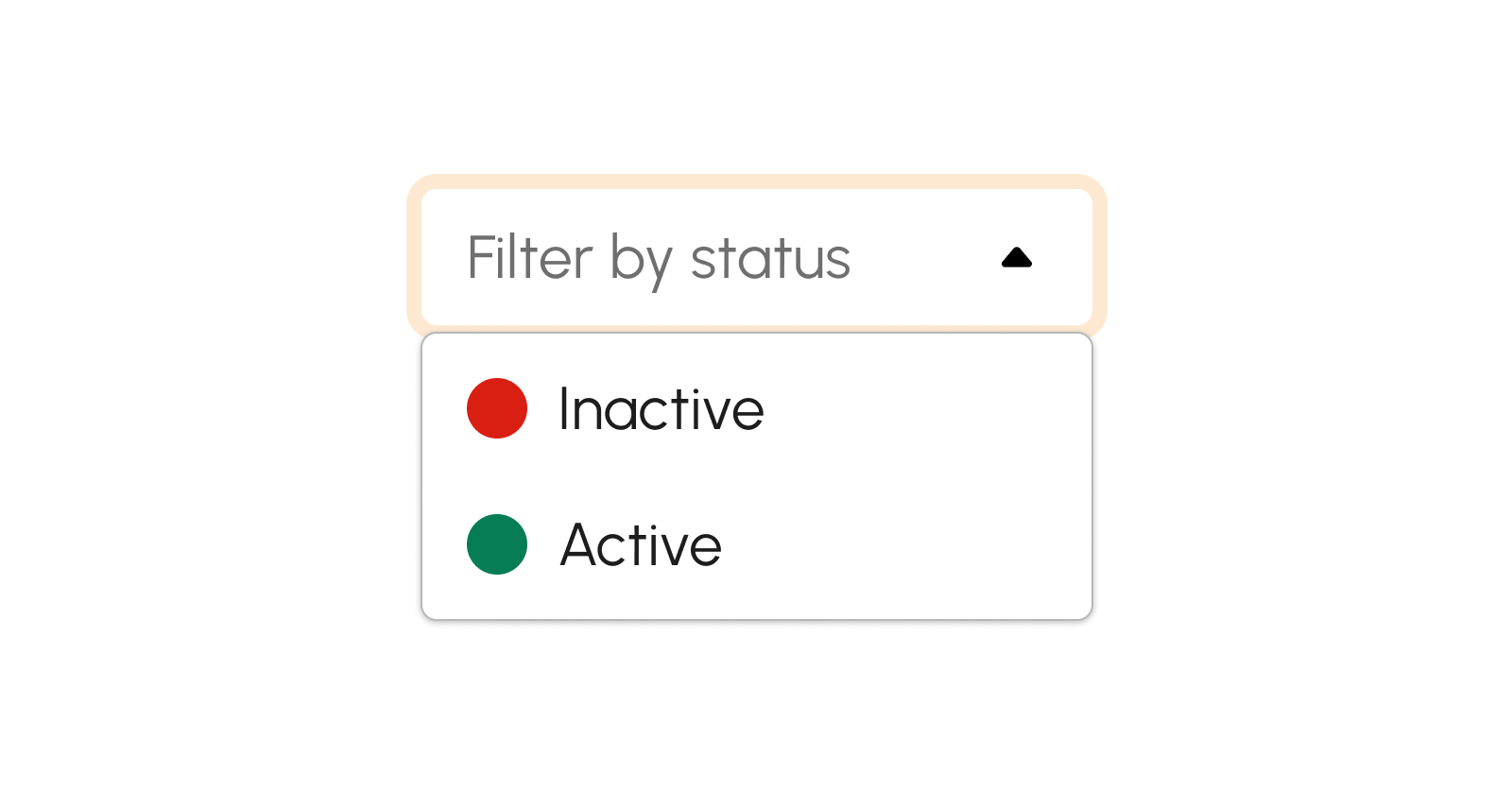
There are several statuses available to filter from the drop-down button as follows:
- Active. This status indicates an Active benefit or deduction item/s.
- Inactive. This status indicates an Inactive benefit or deduction item/s.
Create a Payroll Item
-
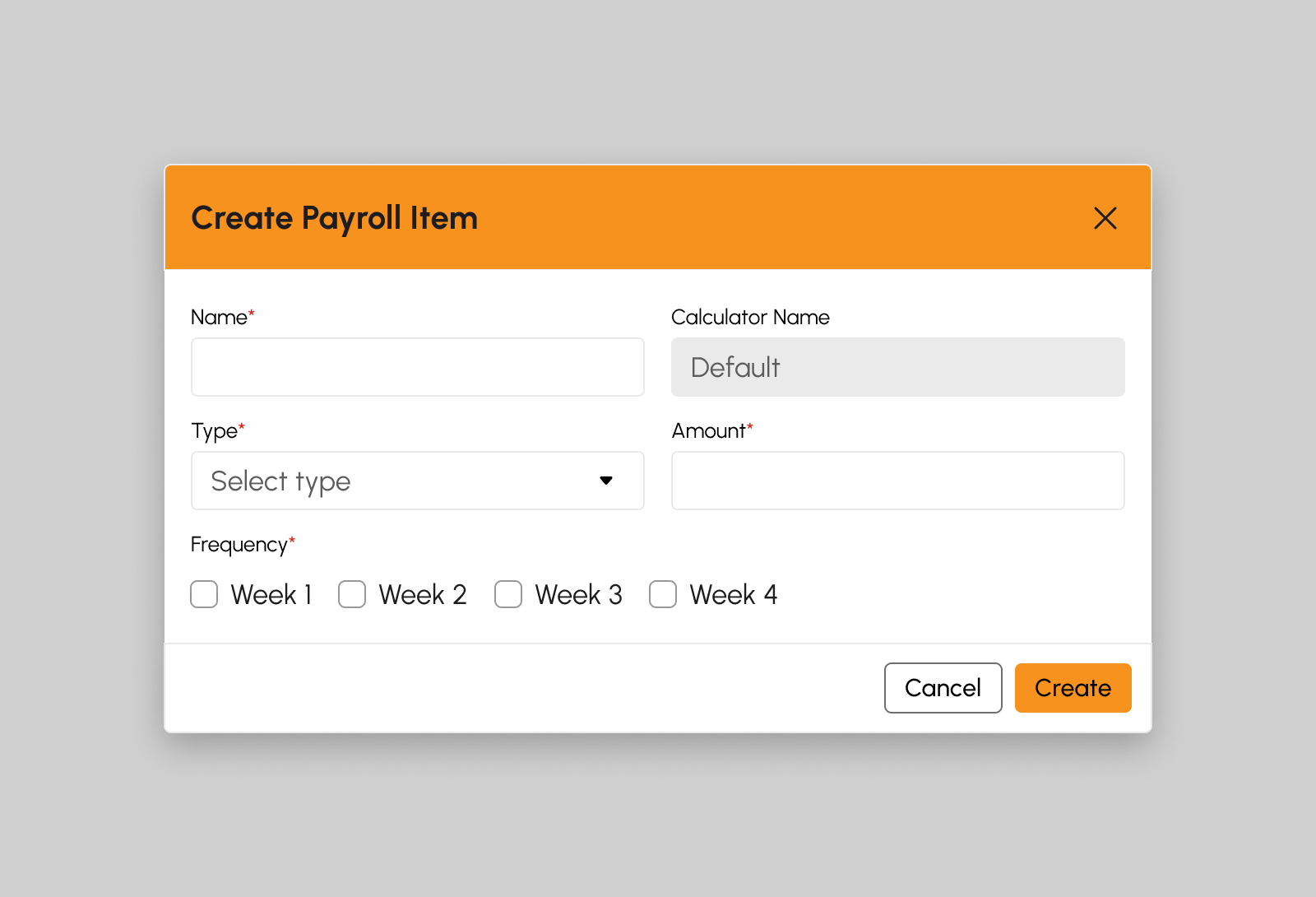
Click to open the Create Payroll Item modal.
-
Enter or select the following information:
- Name
- Type
- Visibility
- Uploadable
- Formula expression
- Frequency
Note
The Formula Expression field contains the calculation formula for the payroll item. Refer to the Payroll Formula Parameters section for the available parameters.
-
Click Save to create the payroll item or Cancel to close the modal without saving.
Note
Fields marked with an asterisk (*) are required and must not be left blank when Save is selected.
Edit a Payroll Item
-
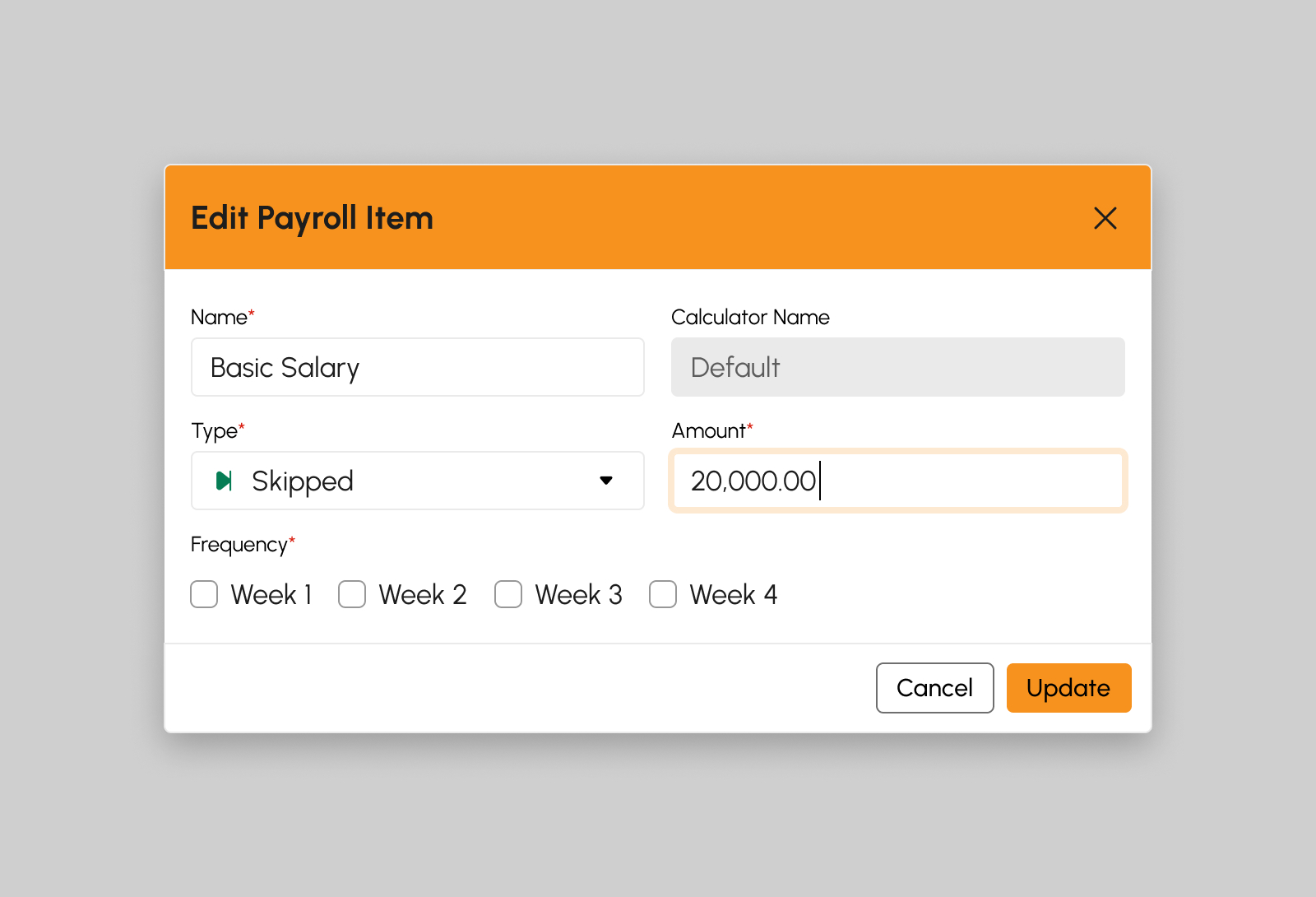
Click the button. The Edit Payroll Item modal appears.
-
Update the applicable fields:
- Name
- Type
- Visibility
- Uploadable
- Formula expression
- Frequency
Note
For Frequency, select or deselect the applicable weeks: Week 1, Week 2, Week 3, and/or Week 4.
-
Click Update to save the changes or Cancel to close the modal without saving.
Note
Fields marked with an asterisk (*) are required and must not be left blank when Update is selected.
Activate a Payroll Item
- Click for the payroll item to be activated. A confirmation modal appears.
-
Review the confirmation message.
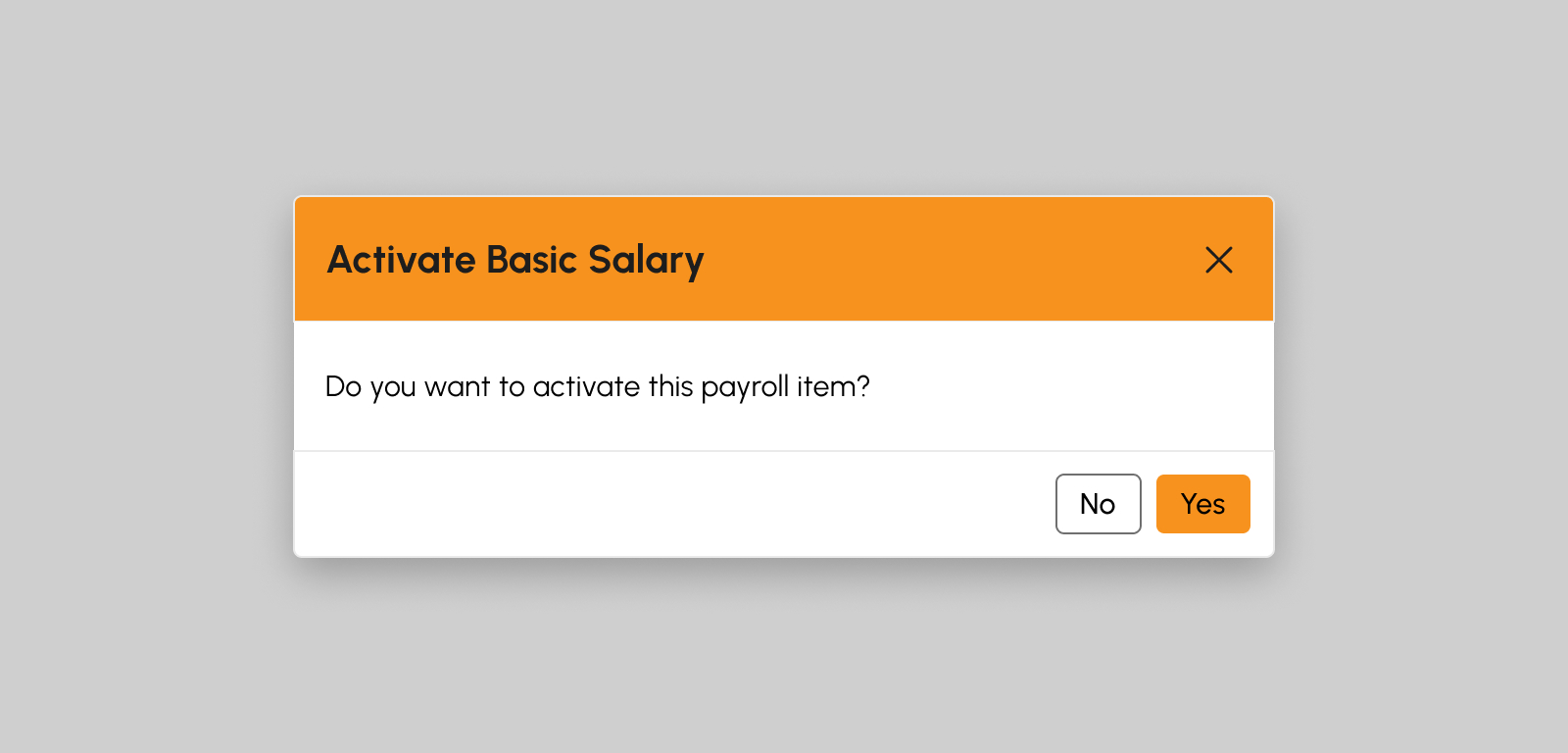
- Click Activate to activate the payroll item or Cancel to close the modal without making changes.
Deactivate a Payroll Item
- Click for the payroll item to be deactivated. A confirmation modal appears.
-
Review the confirmation message.
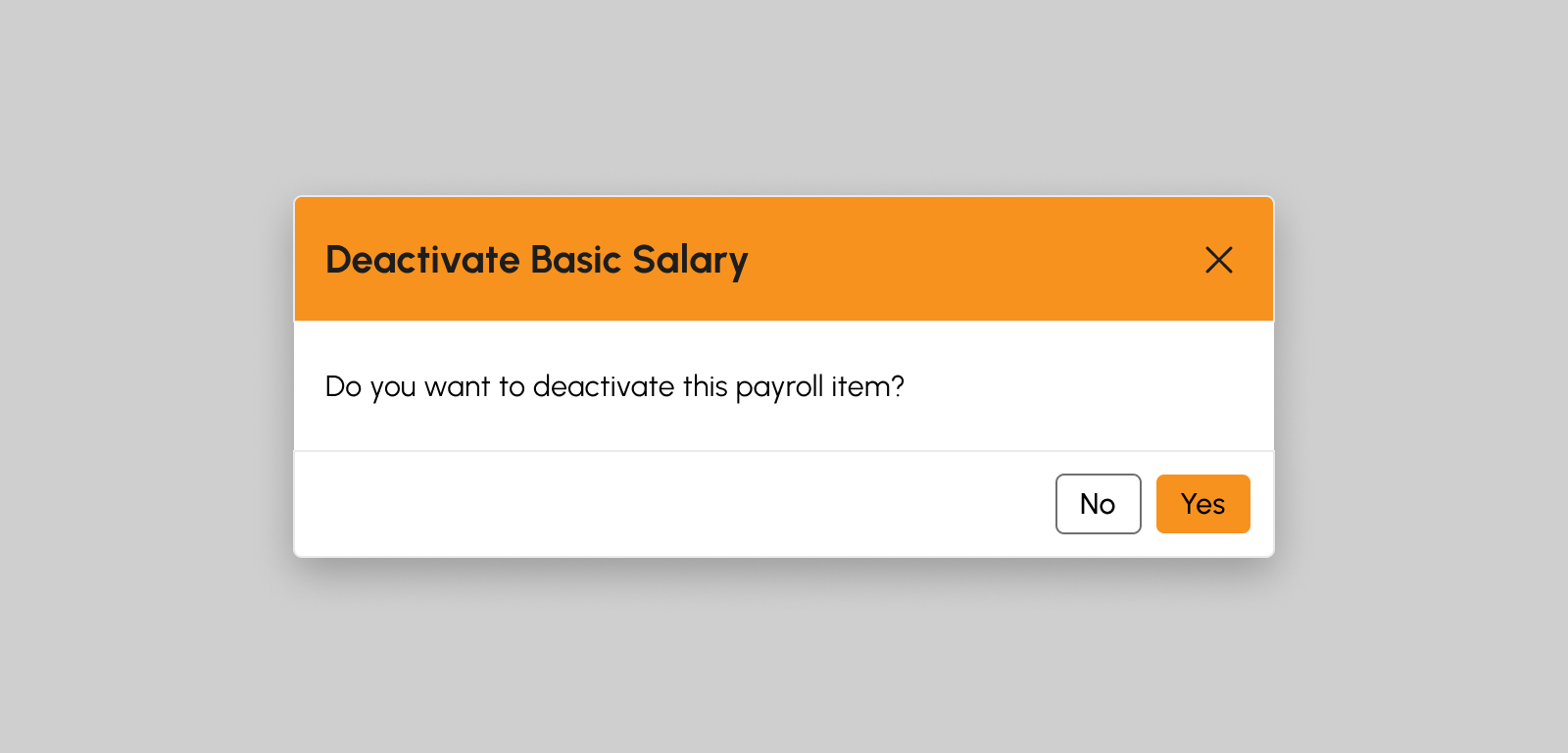
- Click Deactivate to deactivate the payroll item or Cancel to close the modal without making changes.
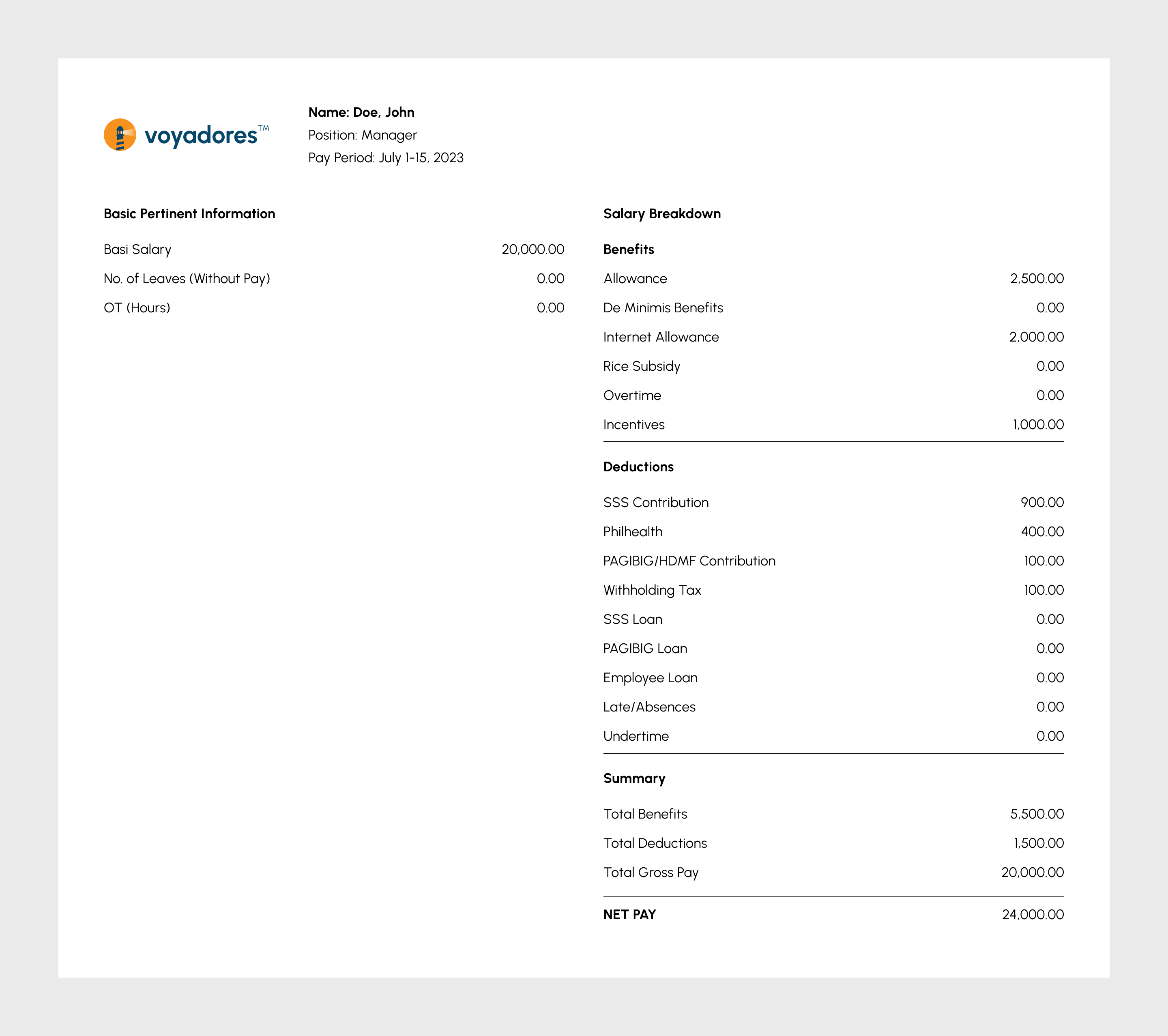
Preview Sample Payslip
- Click the Preview Sample Payslip button.
-
A modal opens and displays the sample payslip in PDF format.
Reorder Payroll Items
The Reorder feature allows payroll items to be arranged according to the preferred order.
-
Click the button to open the Reorder Payroll Items modal.
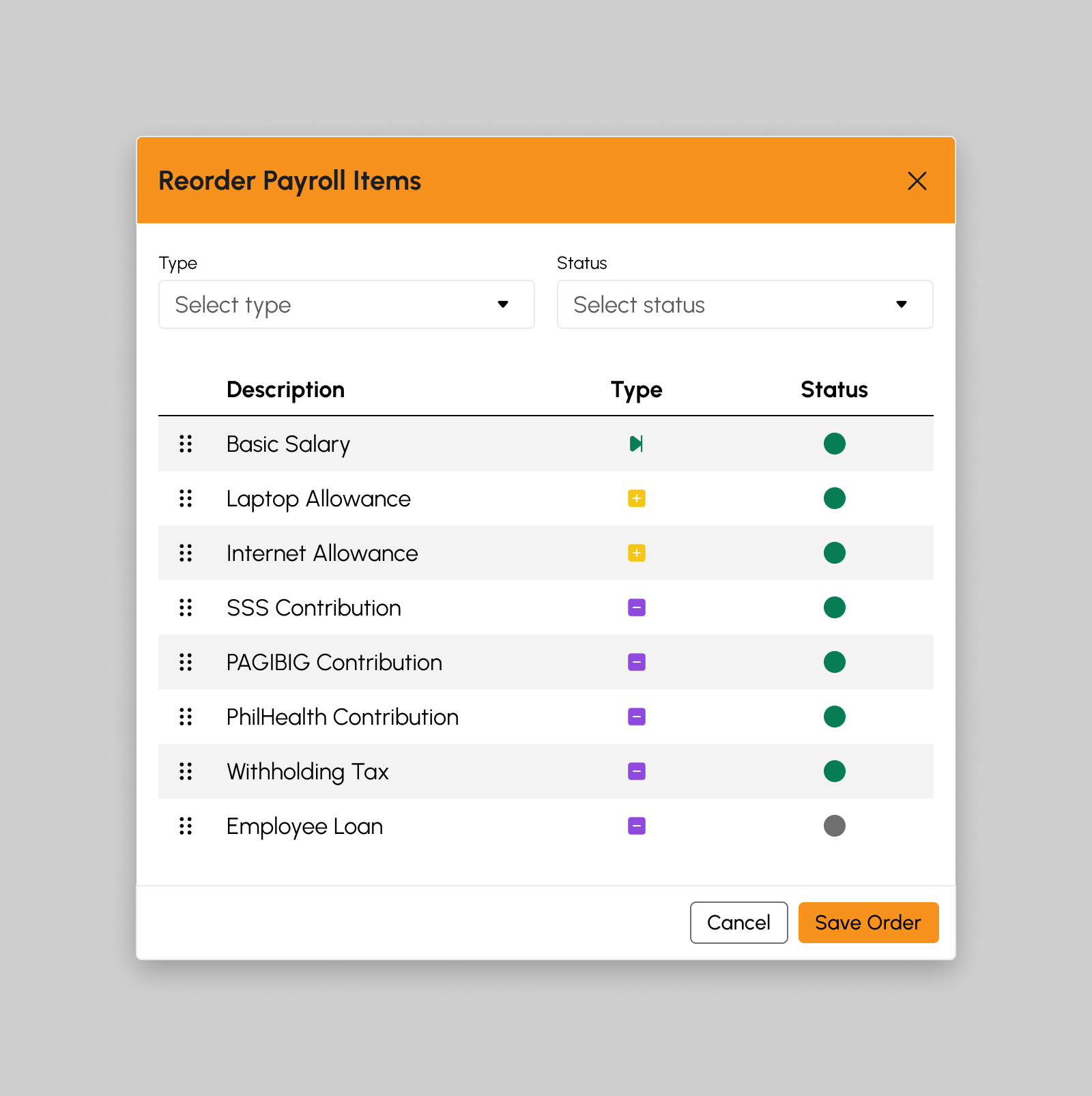
- In the Type field, select the payroll item type to be reordered.
- Drag and drop the payroll items into the desired order.
- Click Update Order to save the new order or Cancel to discard the changes.
Payroll Adjustments
Introduction to Payroll Adjustments
The Payroll Adjustments page is used to record changes or additional amounts that need to be applied to employee payroll.
Payroll adjustments are used when regular payroll calculations need to be increased or decreased because of a specific payment, deduction, correction, allowance, or other payroll-related transaction.
To access this page, navigate through the following menu path:
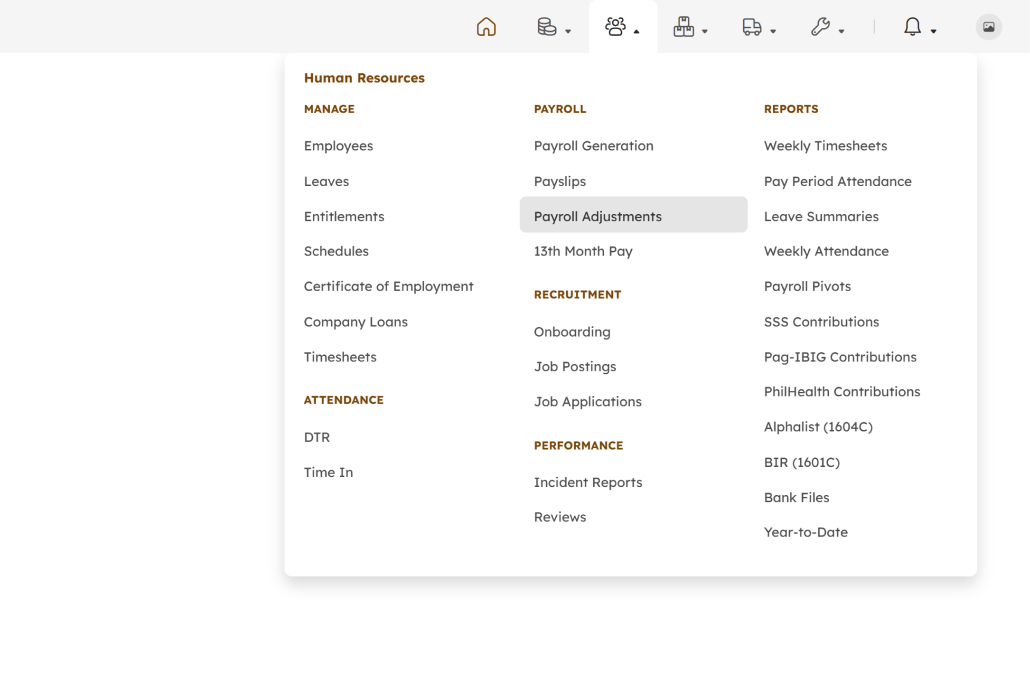
Payroll Adjustments Page Features
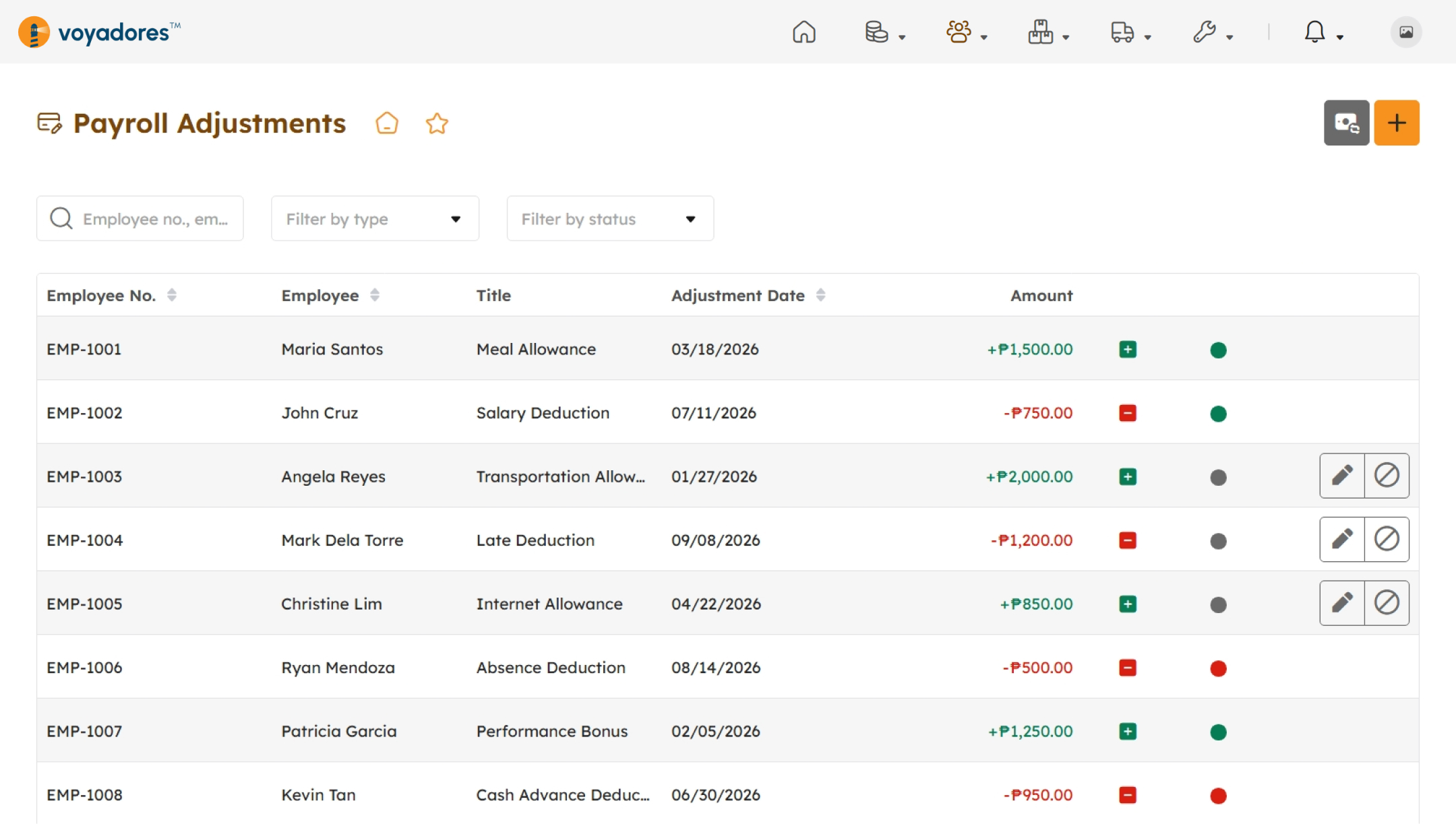
Payroll Adjustments Page Header Actions
- Set as Default Page
- Add to Quick Links
- Create Payroll Adjustment
- Manage Batch Payroll Adjustment
Payroll Adjustments Summary Table
The summary table displays the list of employees with the following columns:
- Employee No.
- Employee
- Title
- Adjustment Date
- Amount
- Type
- Status
-
Actions
- Edit Payroll Adjustments
- Cancel Payroll Adjustments
Understanding Positive and Negative Adjustments
The amount determines how the adjustment affects employee payroll.
- Positive Amount. Adds the specified amount to payroll.
- Negative Amount. Deducts the specified amount from payroll.
For example:
- +₱5,000.00 means ₱5,000.00 is added to payroll.
- -₱12,121.00 means ₱12,121.00 is deducted from payroll.
The amount and adjustment type should be reviewed carefully before payroll generation.
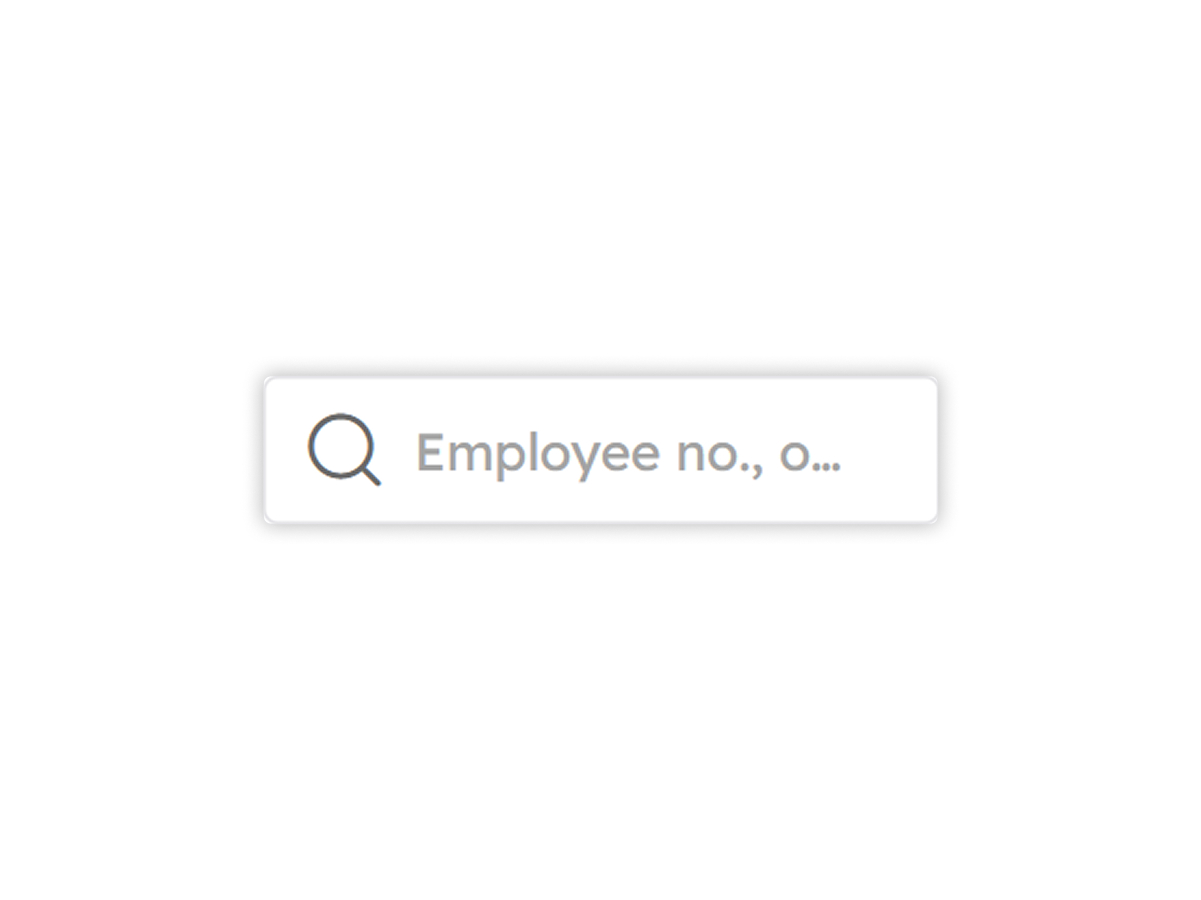
Search for a Payroll Adjustment
Enter the search term in the Employee No., Employee, or Title field. The list automatically filters based on the entered information.
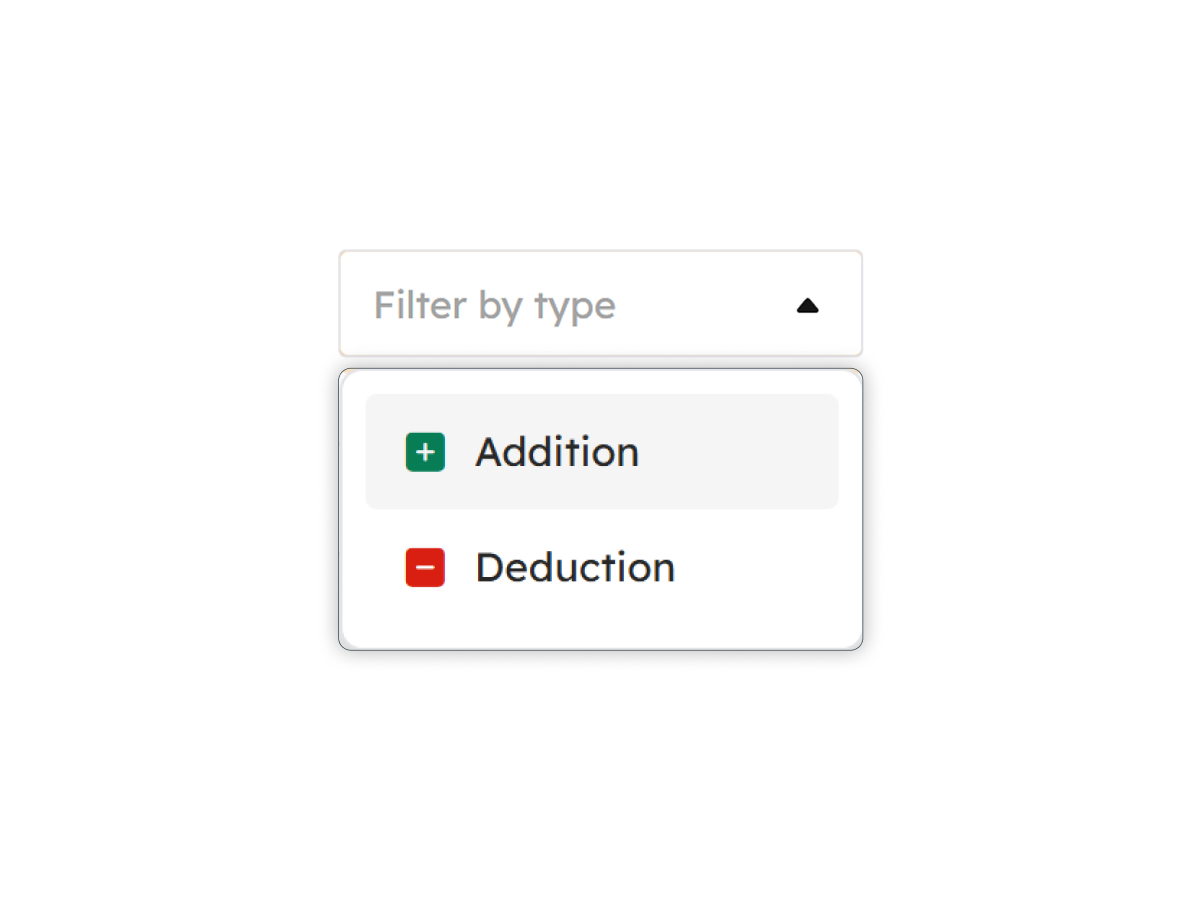
Filter Payroll Adjustment by Type
The adjustment list can be narrowed using the available filters.
Filter Payroll Adjustment by Status
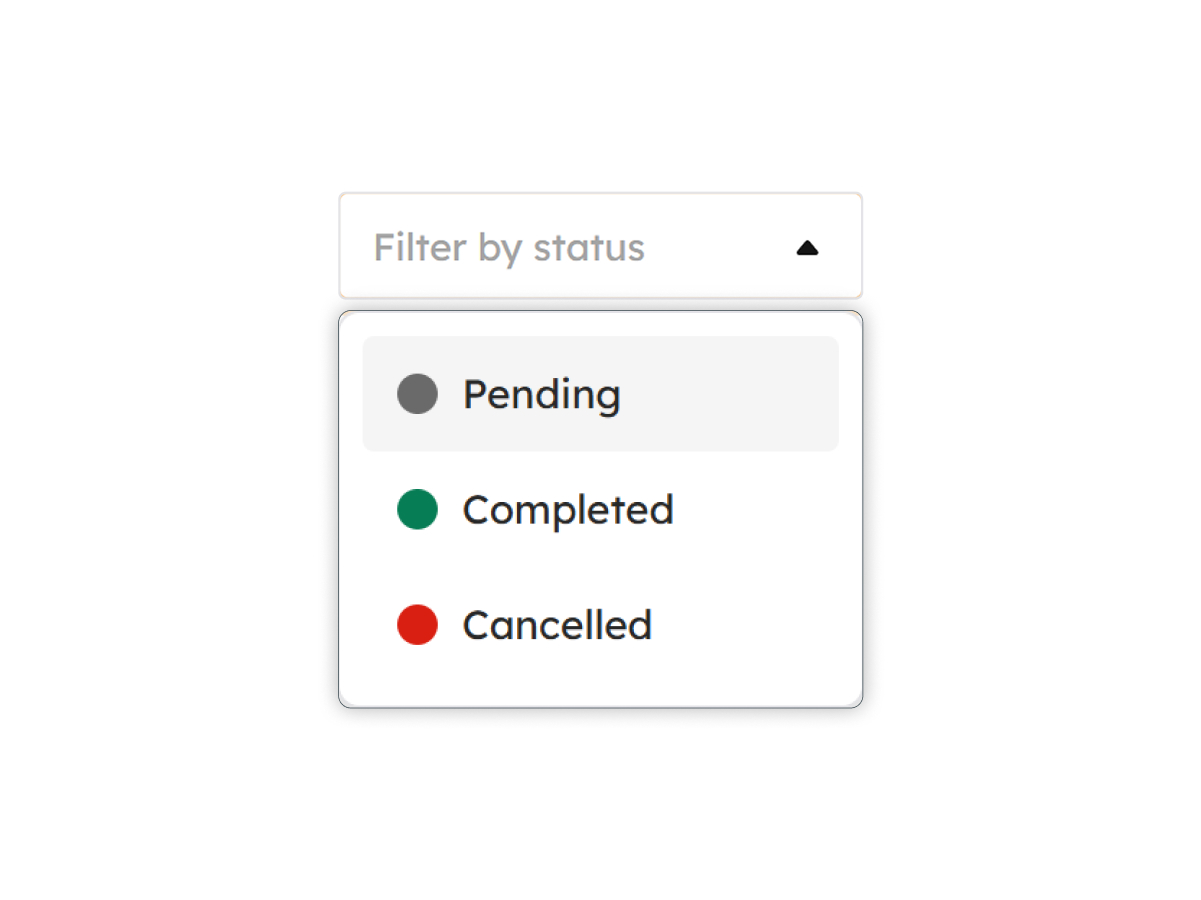
The Filter by Status option displays adjustments according to their current status.
Create Payroll Adjustment
-
Click the button in the upper-right corner of the Payroll Adjustments page.
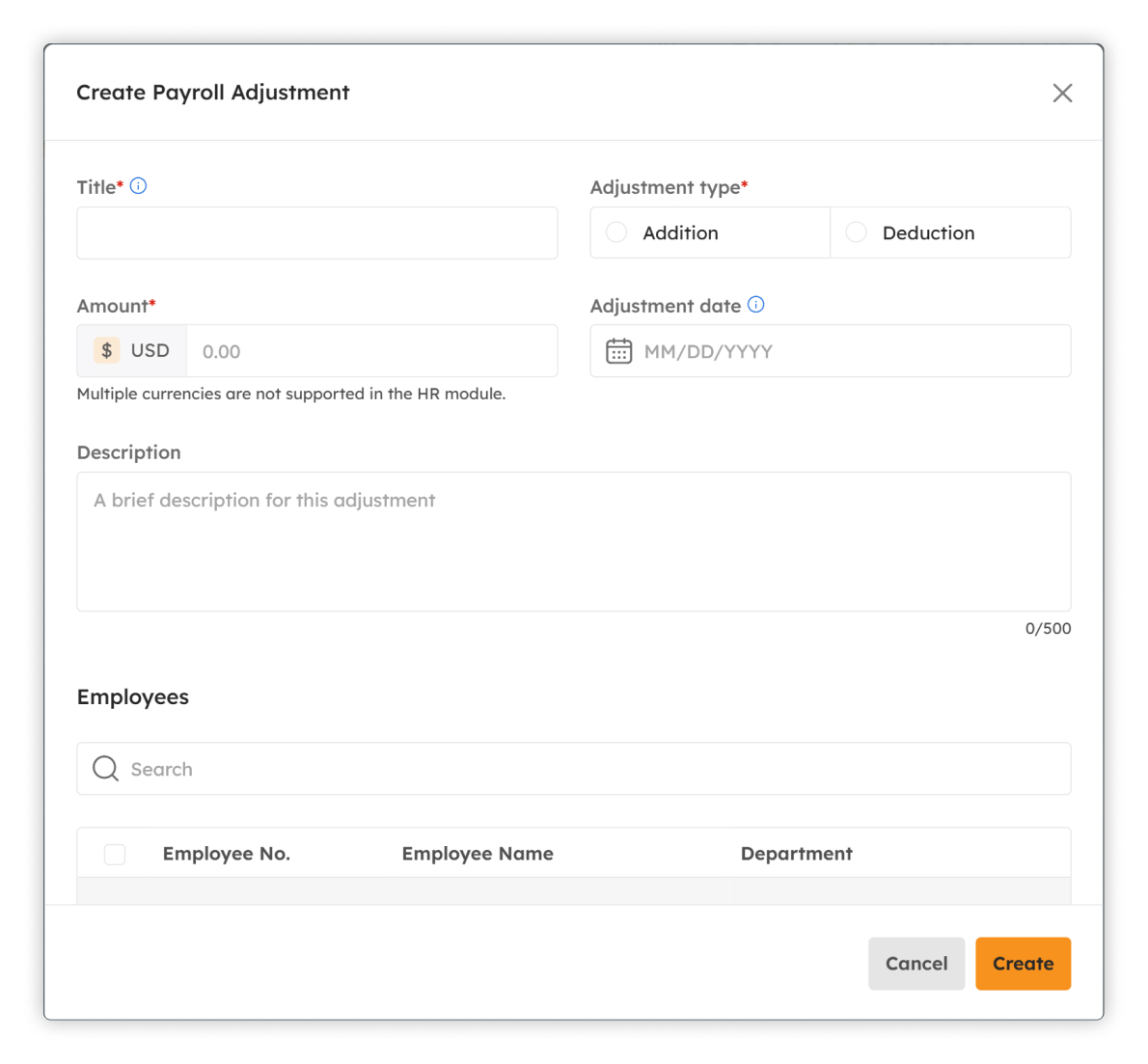
- Enter the Title of the adjustment.
- Select the Adjustment Type: Addition or Deduction.
- Enter the Amount.
- Enter or select the Adjustment Date.
- Enter a Description, if needed.
- Under the Employees section, select the employee(s) to whom the adjustment applies by checking the beside their name. To select all employees in the list, check the box in the table header.
- Review the adjustment details and selected employees.
- Click Create.
- The new payroll adjustment appears in the Payroll Adjustments list after successful creation.
Note
All necessary payroll adjustments should be created before generating payroll to ensure that they are properly included in the payroll calculation.
Review Adjustments Before Payroll Generation
Before generating payroll, the payroll administrator should review the adjustment list to ensure that all applicable adjustments have been entered.
The review should include:
- Checking that all employees with adjustments are included.
- Confirming the adjustment type.
- Confirming the adjustment date.
- Checking whether the amount should be positive or negative.
- Verifying the adjustment amount.
- Checking the adjustment status.
This review helps prevent incorrect or missing adjustments from being included in payroll.
Important Payroll Processing Reminder
The payroll generation process captures eligible adjustments already recorded in the system. If an employee has an adjustment for the payroll period, the adjustment should therefore be created and reviewed before starting payroll generation.
For example, if an employee is entitled to a ₱5,000.00 Medical Allowance for the current payroll period, the Medical Allowance adjustment should be entered first. Payroll can then be generated so that the adjustment is captured.
If an adjustment is entered only after payroll has already been generated, it may not be included in that payroll run and may require separate processing based on the system's payroll procedures.
For each payroll period, the recommended process is:
- Review employee adjustments.
- Create/Update adjustments.
- Verify adjustments.
- Generate payroll
Completing the adjustment process first ensures that the payroll generation process has the necessary information to calculate employee payroll correctly.
Edit Payroll Adjustment
- Locate the payroll adjustment to be modified in the Payroll Adjustments table.
- Click the in the corresponding row.
-
In the Edit Payroll Adjustment window, update any of the following fields as needed:
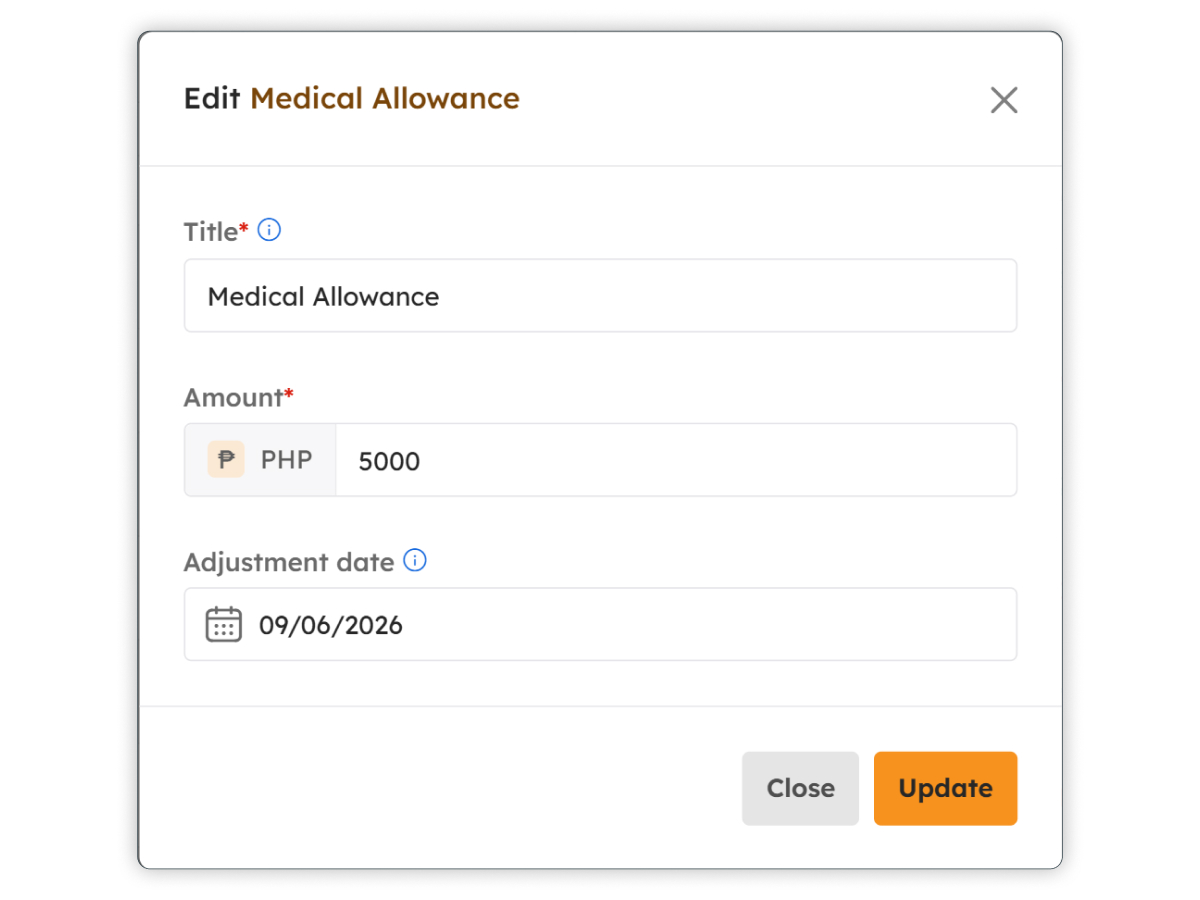
- Title. Enter or update the adjustment name.
- Amount. Enter the adjustment amount.
- Adjustment Date. Select the payroll date to apply the adjustment. Leave blank to apply it to the next payroll cycle.
- Enter or select the Adjustment Date.
- Enter a Description, if needed.
- Under the Employees section, select the employee(s) to whom the adjustment applies by checking the beside their name. To select all employees in the list, check the box in the table header.
- Review the adjustment details and selected employees.
- Click Update to save the changes.
Cancel Payroll Adjustment
- Locate the payroll adjustment to be cancelled in the Payroll Adjustments table.
- Click the in the corresponding row.
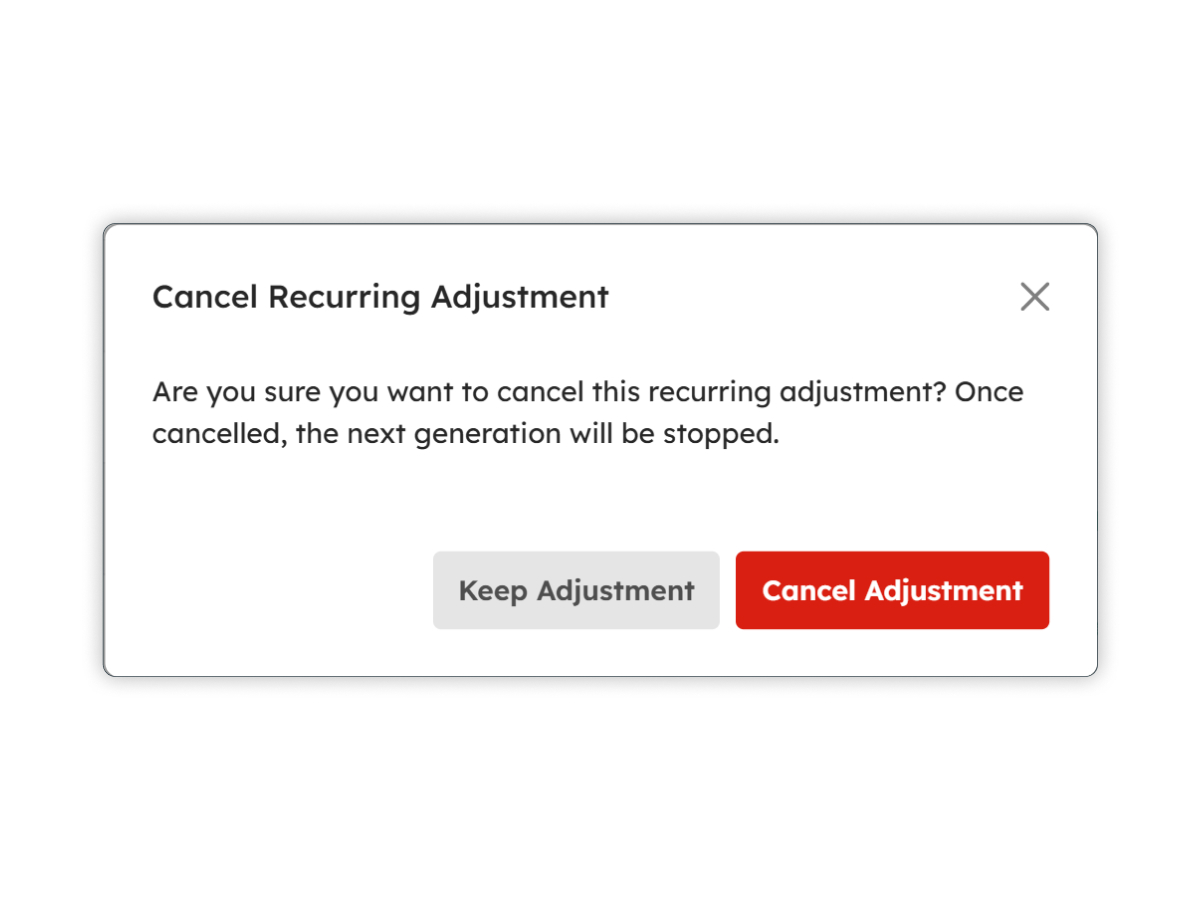
-
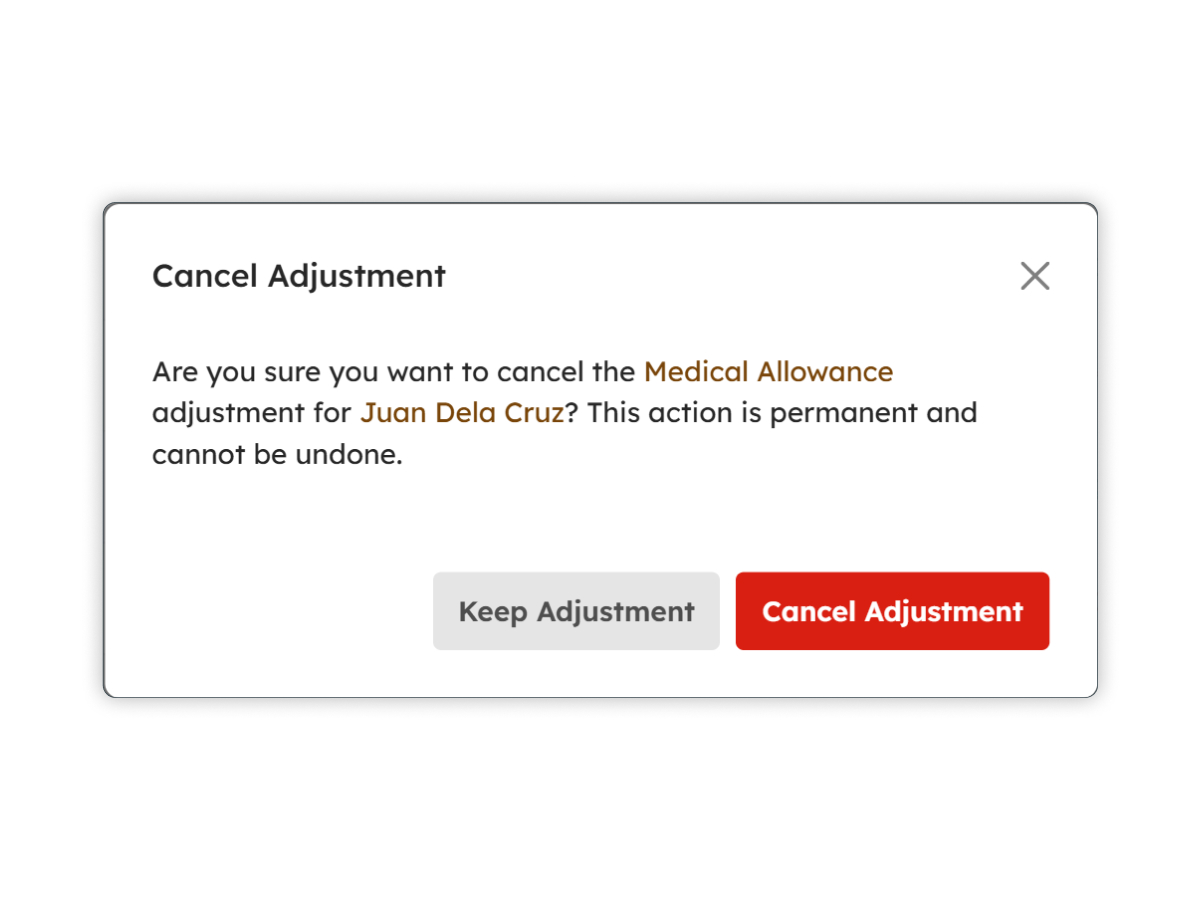
Review the confirmation message, which displays the adjustment title and assigned employee.
-
Select one of the following options:
- Cancel Adjustment to permanently cancel the adjustment.
- Keep Adjustment to return to the Payroll Adjustments page without making changes.
- Upon confirmation, the payroll adjustment is cancelled and removed from further payroll processing.
Batch Payroll Adjustment
The Batch Payroll Adjustments feature allows recurring payroll adjustments to be created and managed for one or more employees. It can be used for allowances, deductions, or other payroll items that need to be applied repeatedly over a specific period or recurring schedule.
The Manage Batch Payroll Adjustments window provides options to create new batch adjustments, search existing records, filter results, and view or manage batch details.
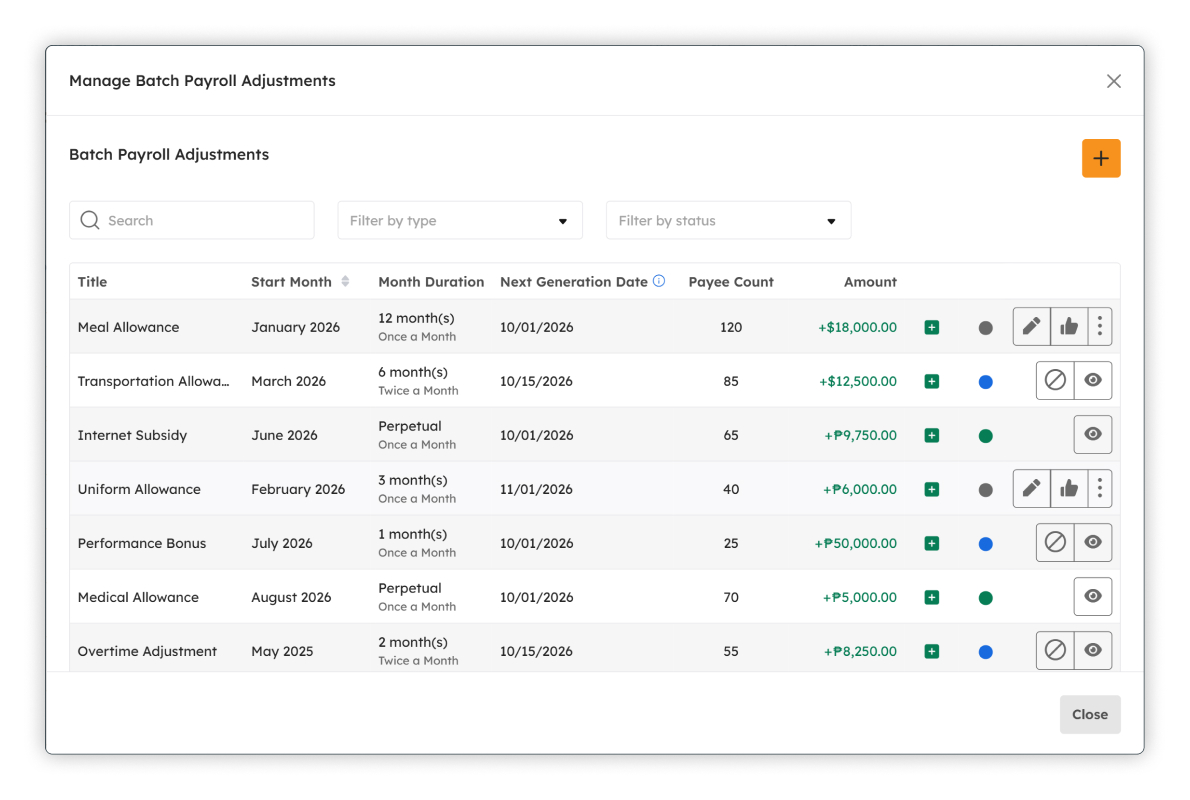
Batch Payroll Adjustment Table
- Title. Displays the name assigned to the batch payroll adjustment.
- Start Month. Displays the month when the batch payroll adjustment starts.
- Month Duration. Displays how long the adjustment runs, such as a specific number of months or Perpetual. The frequency is also displayed, such as Once a Month or Twice a Month.
- Next Generation Date. Displays the date when the next payroll adjustment will be generated.
- Payee Count. Displays the number of employees or payees included in the batch.
- Amount. Displays the adjustment amount associated with the batch.
- Status. Indicates the current status of the batch payroll adjustment.
-
Actions
- Edit Batch Payroll Adjustment
- Approve Batch Payroll Adjustment
- Cancel Batch Payroll Adjustment
- View Batch Payroll Adjustment
Create a Batch Payroll Adjustment
- Click Manage Batch Payroll Adjustments on the Payroll Adjustments page.
-
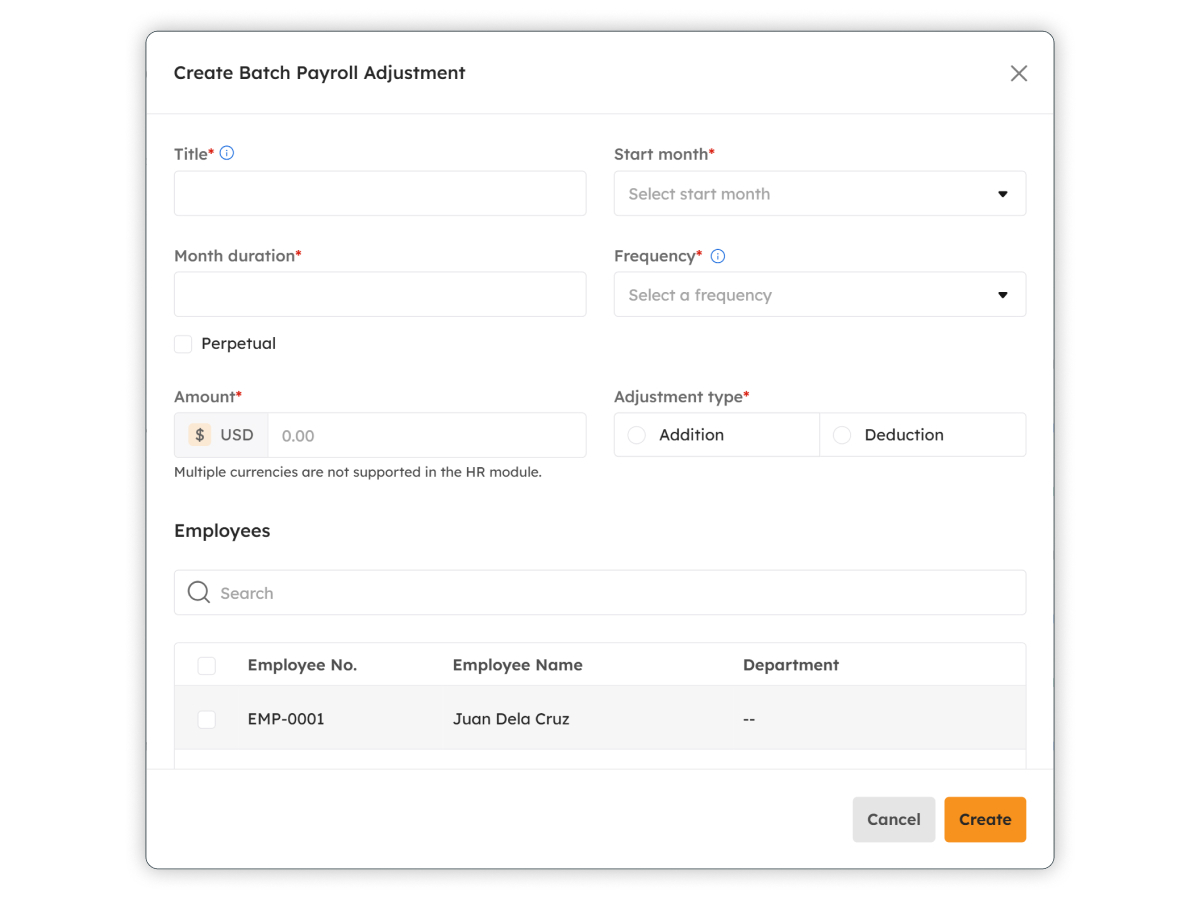
Click the button in the upper-right corner of the Manage Batch Payroll Adjustments modal.
-
Enter the required batch payroll adjustment information:
- Title. Identifies the adjustment.
- Start Month. Specifies when the adjustment begins.
- Month Duration. Specifies how long the adjustment applies.
- Perpetual. Allows the adjustment to continue indefinitely.
- Frequency. Specifies how often the adjustment is applied, such as monthly.
- Amount. Specifies the adjustment amount.
- Adjustment Type. Specifies whether the adjustment is an Addition or Deduction.
- Employees. Select the employees to whom the adjustment applies by clicking .
- Review the entered details and selected employees.
- Click Create to save the batch payroll adjustment.
The new batch payroll adjustment appears in the Batch Payroll Adjustments list after successful creation.
Edit a Batch Payroll Adjustment
Select the button to modify the batch payroll adjustment details.
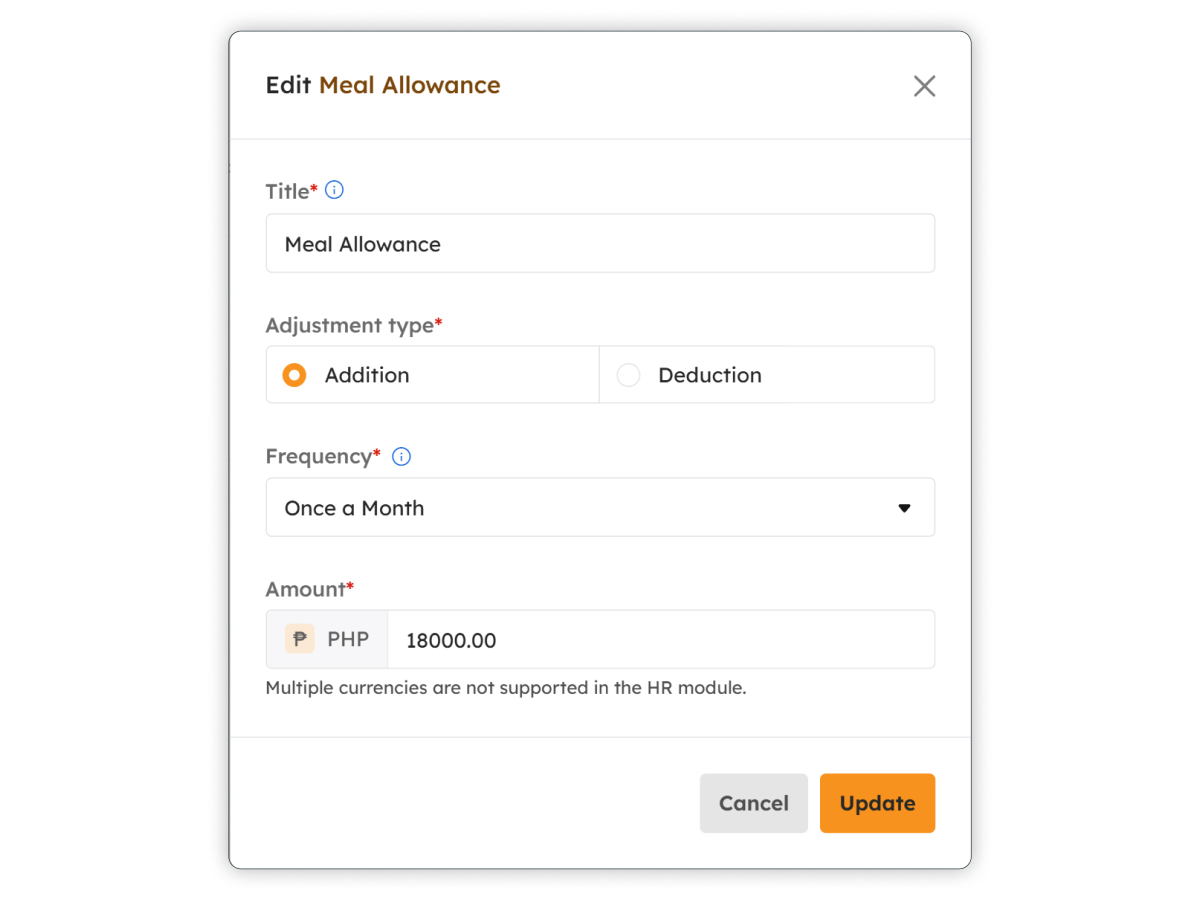
This option can be used to update information such as the adjustment schedule or amount, depending on the batch's current status.
Approve a Batch Payroll Adjustment
Select the button to approve the batch payroll adjustment and move it forward in the payroll process.
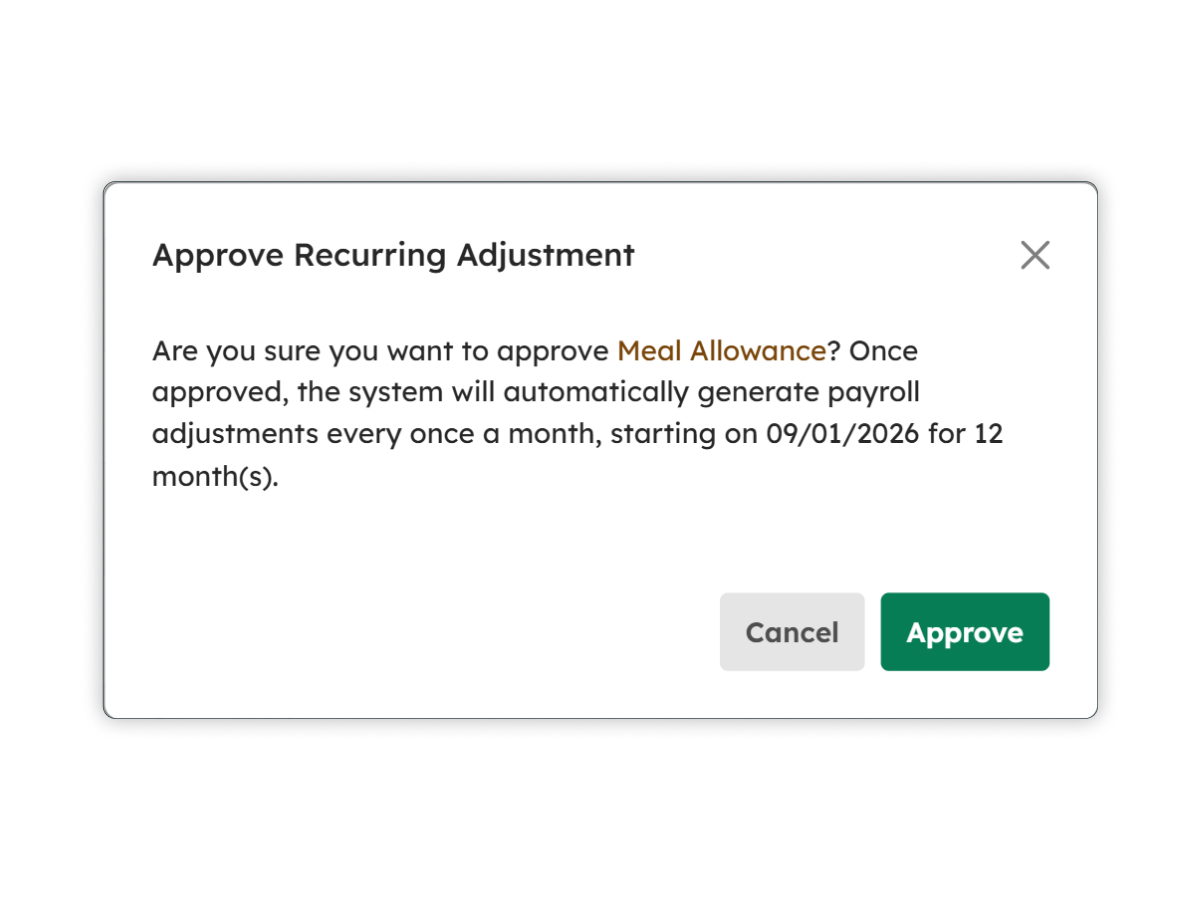
Cancel a Batch Payroll Adjustment
Select the button to cancel a batch that is no longer needed.
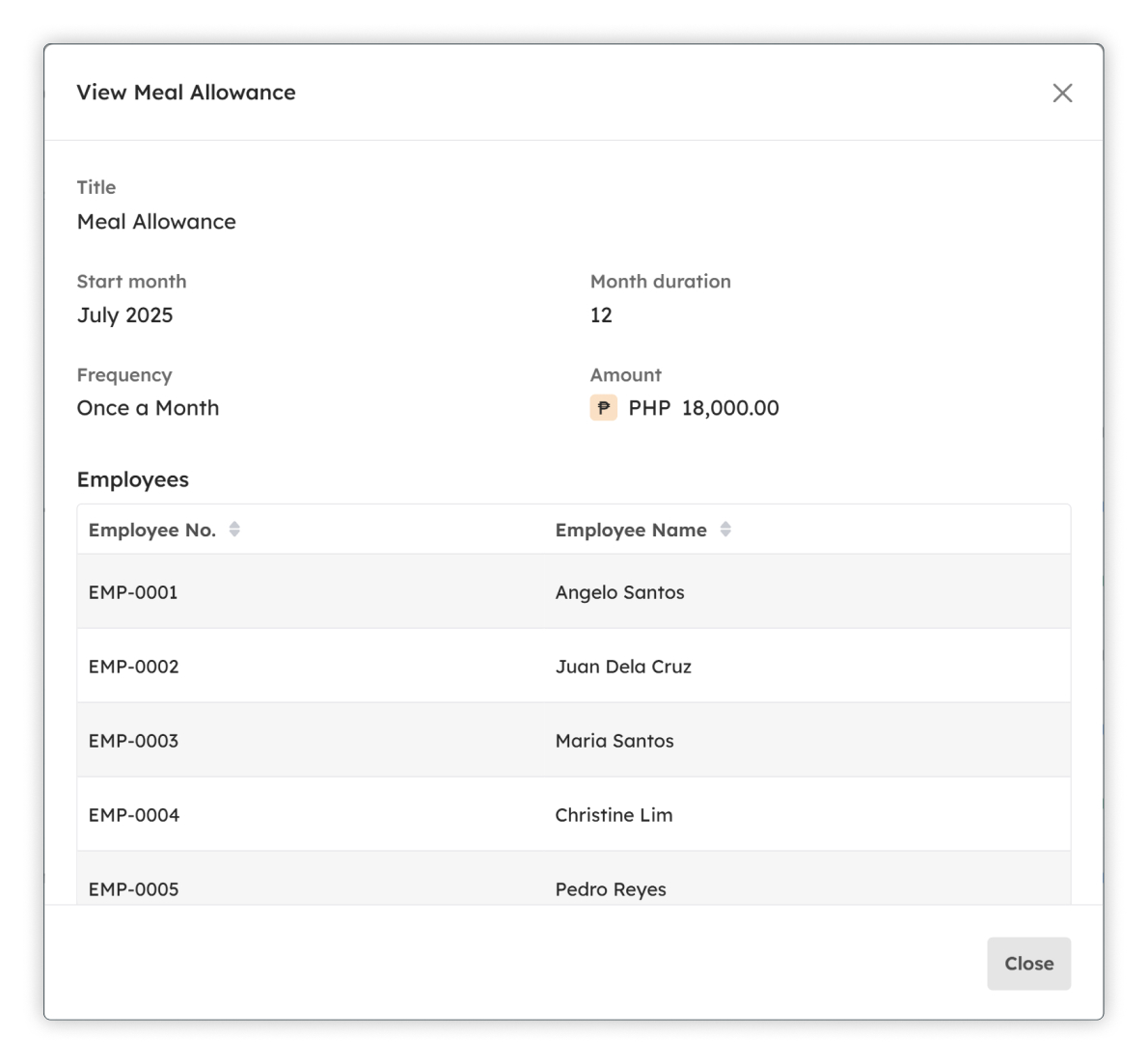
View a Batch Payroll Adjustment
Select the button to review an existing batch without making changes.
Note
Available actions depend on the batch status and assigned permissions. For example, a batch awaiting approval may display Approve, while a processed or cancelled batch may only allow its details to be viewed.
13th Month Pay
Introduction to 13th Month Pay Page
The 13th Month Pay page provides a centralized view of employee 13th month pay records. It allows authorized personnel to review payroll periods, release dates, total payment amounts, number of payees, approval dates, and payroll status.
This page helps ensure that 13th month pay records are properly monitored and reviewed before and after approval and release.
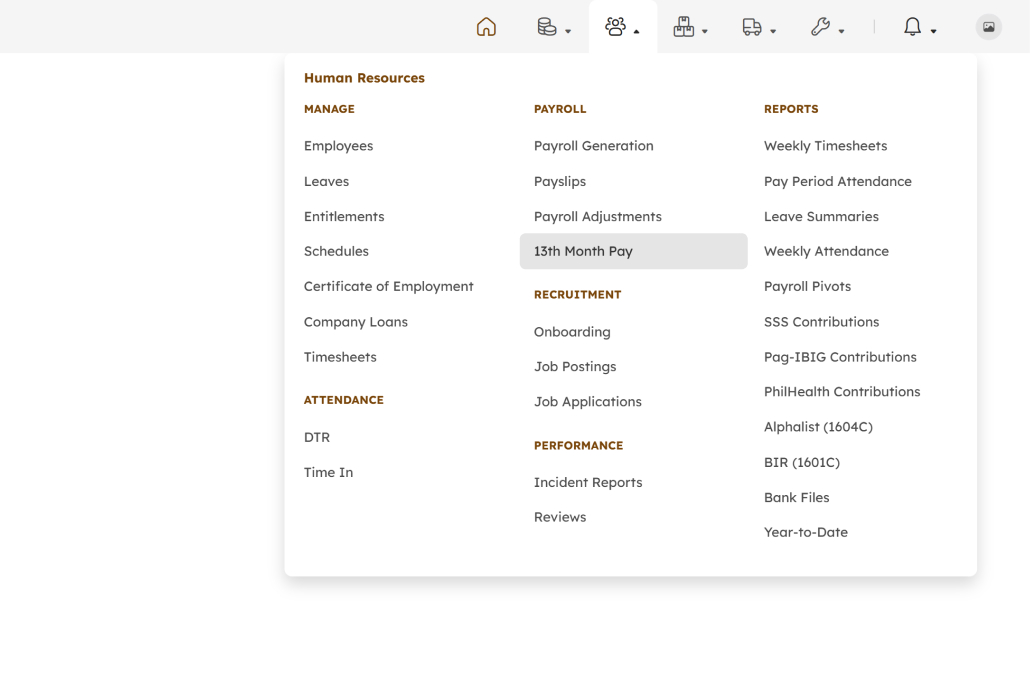
To access this page, navigate to the Human Resources Module by selecting '13th Month Pay' under the Payroll Submodule, as shown in the image below.
Note
Employees included in the payroll should have complete and accurate payroll records for the selected period.
13th Month Pay Page Features
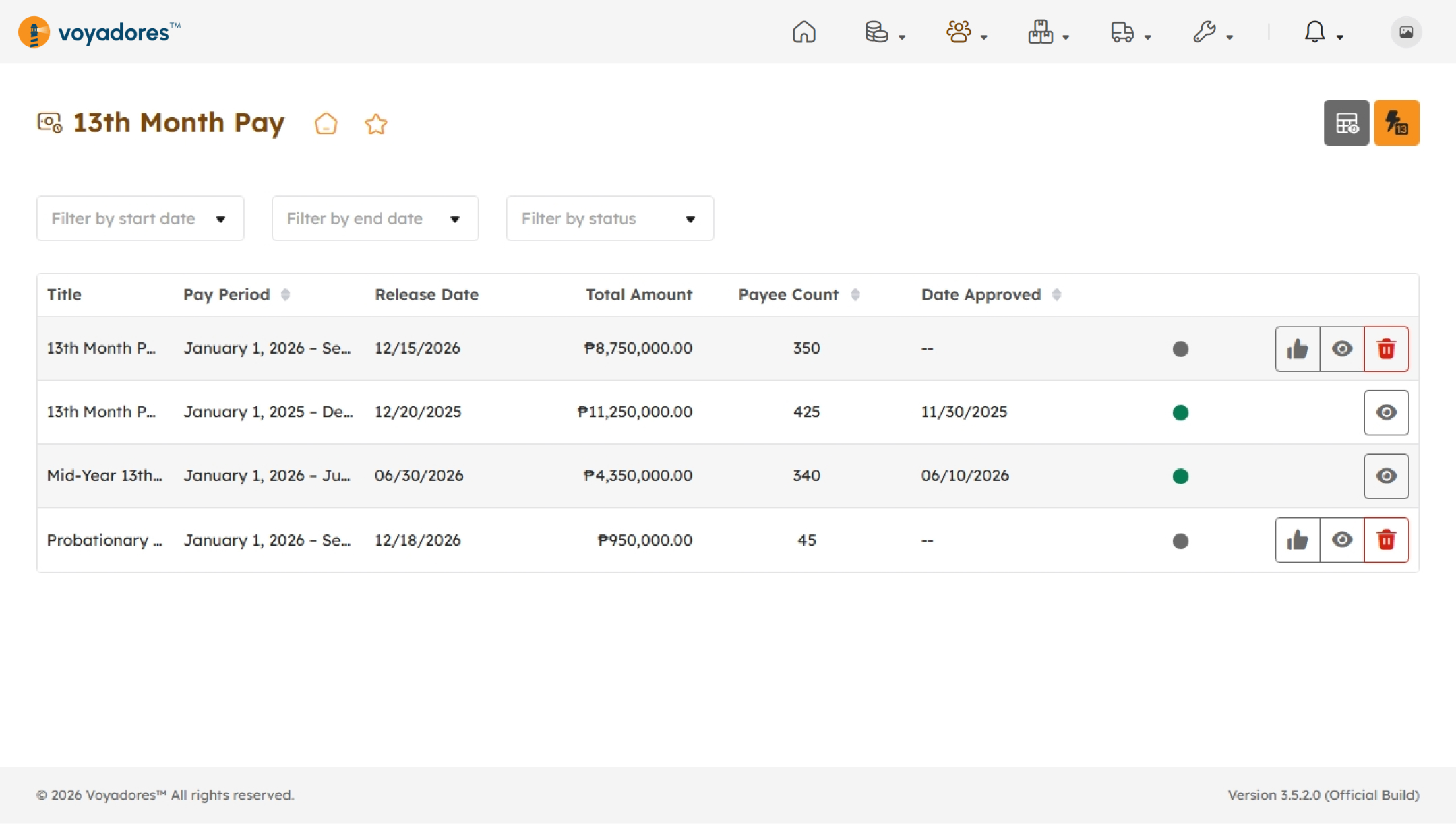
The snip below provides a high-level view of the 13th Month Pay page along with its built-in features.
13th Month Pay Page Header Actions
- Set as Default Page
- Add to Quick Links
- Generate 13th Month Pay
- Preview Employees
13th Month Summary Table
The summary table displays the following columns:
- Title
- Pay Period
- Release Date
- Total Amount
- Payee Count
- Date Approved
- Status
-
Actions
- Approve 13th Month Pay
- View 13th Month Pay
- Delete 13th Month Pay
Generate 13th Month Pay
- Click the Generate 13th Month Pay button.
- Enter a Title for the 13th month pay run.
-
Select the Pay Period Type:
- Annually. Used for employees covered by an annual 13th month pay period.
- Semi-Annually. Used for a six-month pay period.
- Quarterly. Used for a three-month pay period.
- Select the Start Date of the 13th month pay period.
- Select the End Date of the 13th month pay period.
- Review the employee list displayed in the table, including Employee No., Employee Name, and Department.
- Once the details are complete and the applicable employees are displayed, click Generate.
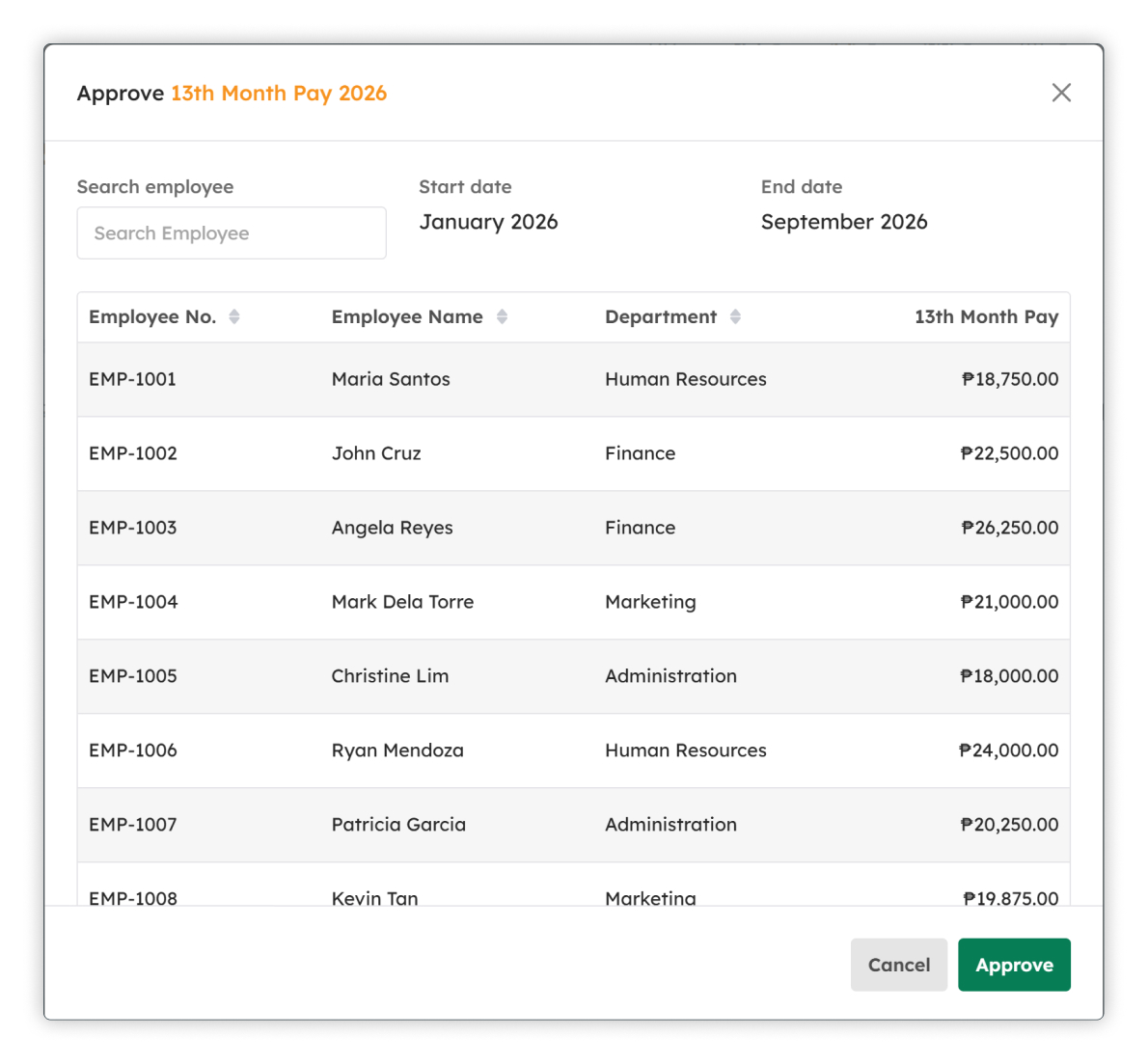
Approve a 13th Month Pay
Select the button to review the generated 13th month pay details and confirm approval. Once approved, the batch becomes available for the next stage of payroll processing.
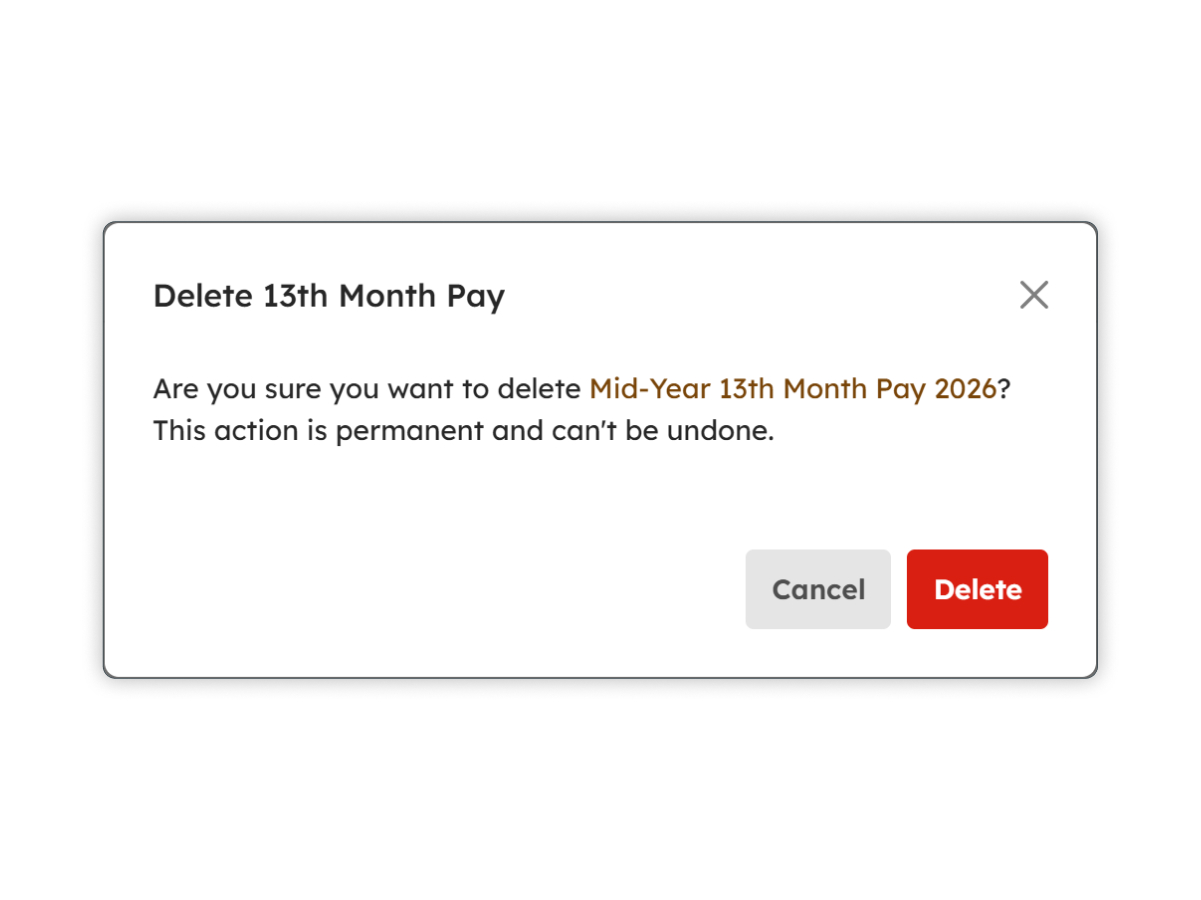
Delete a 13th Month Pay
Select the button to permanently remove the selected 13th month pay batch. Confirm the action in the confirmation window to proceed with the deletion.
View a 13th Month Pay
Select the button to open the selected 13th month pay batch and review its information, including the covered period, payees, and computed amounts. No changes can be made while viewing the batch.